Glue Finance Founder: ETH Has Entered a Phase of Non-Consensus, an Inflection Point Is Approaching

链捕手Опубліковано о 2026-06-26Востаннє оновлено о 2026-06-26

Анотація

Glue Finance founder argues that Ethereum's current price underperformance, despite high on-chain activity, stems from its incomplete state and lingering dependency on central stewards like the Ethereum Foundation. The core thesis is that the market is discounting ETH not for lack of use, but because the protocol remains a "machine under construction." Key unresolved issues include centralized L2 sequencers with limited escape hatches, state bloat, vulnerable public mempools, and the looming quantum computing threat. This perpetual "work-in-progress" status forces reliance on a small group of maintainers, undermining the network's promise of credible neutrality and immutability. The author, a self-described Ethereum maximalist, rejects two flawed paths: a "wartime mode" of centralizing for speed (surrendering Ethereum's unique value) or merely replacing the Foundation with another governing entity. The only solution is to complete and then "freeze" the protocol's neutral core through a focused "Manhattan Project" dubbed "Lean Ethereum." This project aims to bundle critical upgrades—consensus layer overhaul, massive scaling via ZK-proofs, quantum resistance, and statelessness—into a decisive push to finalize the base layer. Once the core rules are cryptographically solidified and beyond anyone's control (passing the "walk-away test"), Ethereum would shed its dependency discount and earn a "rigidity premium" for its credible neutrality and programmability, potentially surpassi...

Author:@LaLiLuLeL0x

Compiled by: Jiahuan, ChainCatcher

The debate about stewards is just a distraction. Ethereum truly wins when it no longer needs any stewards, when its core is frozen, beyond the reach of the EF, Ethlabs, or any future successors. This is its "Manhattan Project," and it's proceeding quite well.

It's mid-2026, and the numbers don't add up. Ethereum's settled value is at an all-time high, hosting the vast majority of stablecoins, tokenized funds, and DeFi. Yet ETH is trading around $1,750, down about 57% from its 2025 high and still below the peak set in 2021.

Five years on, with the technical transition complete, the asset price lags behind the past. Something is wrong. The comforting explanations about macroeconomics, the Fed, or capital rotation into Bitcoin don't touch the core issue.

The real explanation is more brutal, and it's the whole reason I'm writing this. Ethereum is a machine that runs but is unfinished. It's operational, it's decentralized, it's never down. But it's full of half-finished features, works in progress, promises rather than deliveries.

Especially post-Merge and with the rollup-centric roadmap, it feels less like a finished network and more like a long-term promise—credibly neutral and decentralized on paper, but each upgrade quietly adds a new pile of problems that need solving before that promise can be fully realized. And each pile eventually lands on the same small group of people to clean up.

An unfinished machine needs mechanics. So, while Ethereum is formally sovereign, controlled by no single entity, in practice, it's still indirectly dependent on the Ethereum Foundation's goodwill to keep building and steering.

The market isn't mispricing Ethereum's usage. The market is pricing this dependency. And the project to ultimately fix this has a name: Lean Ethereum, also known as Ethereum's Manhattan Project.

Let me break this down step-by-step because I know this will upset many. But I believe it nails the reality and the true challenges Ethereum faces right now, both in leadership and at the protocol level. Remember, I'm an Ethereum maximalist. I'm not here to spread FUD; I'm here to keep the conversation pointed in the right direction. I have my viewpoint. Please give me a chance to lay it out.

1. The State of the Machine

Take an honest look at where Ethereum stands today.

The L2 bet is half-lost where it matters most. The rollup-centric roadmap was a bet on scaling without sacrificing decentralization. Years later, every major L2 still runs a centralized sequencer—a single operator ordering transactions that can censor, extract value, or just go down, as Linea paused in 2024 and Base went offline in 2025.

Of the dozens of rollups, almost none have passed L2Beat's own Stage 1 maturity criteria, let alone Stage 2's full trustlessness.

We asked for this.

The only defensible justification for centralized sequencers has always been the escape hatch. Even if the operator censors you or goes completely offline, the rollup should allow you to force-include your own transaction from L1 and withdraw assets back to Ethereum without anyone's permission.

That guarantee is why centralized sequencers were tolerated in the first place: The keys to the chain were never yours, but the exit always was.

Yet, the exit lanes turned out to be conditional. In April 2026, after Kelp DAO's cross-chain bridge was drained of about $292 million, Arbitrum's security council—twelve elected members—invoked emergency powers, forcibly stepping in and moving 30,766 ETH (worth about $71 million) from the attacker's address into a governance-controlled wallet.

Freezing a thief's loot sounds like the system working, and perhaps it was. But look at what it proves. A small council can proactively seize and freeze funds on Arbitrum, meaning your assets there are subject to their discretion. A power that can stop a hacker can stop anyone, including under subpoena or government pressure.

The escape hatch can only save you if the people holding no privileged keys decide otherwise. The irony wrote itself: The moment the on-chain freeze took effect, a U.S. court pierced right through Arbitrum's supposed "decentralized" governance, ordering the DAO not to move the funds at all. So much for unstoppable.

The base layer itself carries open wounds that may never heal. State bloat keeps increasing the data each node must store. The mempool is worse.

Because pending transactions sit publicly, using the public mempool has become a frontrunning death spiral: The moment you broadcast a transaction, it's seen, sandwiched and tailgated before it confirms—a permanent tax where bots extract value from ordinary users just by seeing order flow first.

The fix, encrypted mempools, has been discussed and drafted for years, still not live. These aren't rare edge cases. They're core properties of anything that wants to call itself a neutral settlement layer, and they're still stamped "under construction."

Quantum computing is no longer science fiction without a date. Vitalik's 2026 cryptography roadmap names four parts of Ethereum potentially breakable by quantum computers, with a threat model that includes "harvest now, decrypt later"—an adversary records encrypted data today, then cracks it the day the hardware arrives.

It's a countdown, and the clock is ticking.

Against this backdrop, one faction wants Ethereum to respond by going into wartime mode. Become aggressive, court institutions on their terms, relax the decentralization standards that hold everything back, get faster, more centralized, to compete on throughput with Solana and pump the price.

It sounds like ambition. It's actually surrender.

Because if Ethereum trades away the neutrality that makes it unique, it doesn't beat Solana; it just becomes a slower Solana.

The best-case outcome for the wartime path is Ethereum falling to Solana's market cap, because that's what the market pays for a fast chain that gave up credible neutrality. You don't win a monetary premium by turning into something that never had one.

2. Why ETH Isn't at $10,000

So, here lies the answer to the question every ETH holder has been puzzling over.

The reason ETH isn't at five figures, or even holding old highs while the underlying network keeps growing, isn't lack of usage. Its usage is overwhelming. The reason is the machine is unfinished, and an unfinished machine isn't reliable; it can't stand alone.

Think about what a global settlement layer truly needs to promise. Not speed. Not features. It must promise the ground beneath you won't move, that if you settle a billion dollars on it today, the rules are the same tomorrow and no one can change them on a whim.

Ethereum can't make that promise yet because Ethereum is still under construction, and the act of construction is the act of change. Scaling isn't finished. L2 decentralization isn't finished. The consensus layer is a five-year-old design waiting to be replaced.

Quantum resistance is a roadmap, not a delivered fact. Every unclosed gap is a place where the protocol still needs to change, and every change must be decided by someone.

That someone is the Ethereum Foundation. It's not a conspiracy; it's because they're the ones who can finish this unfinished machine.

The market sees all of this clearly. The market doesn't pay a forever premium to a chain that still clearly needs its founders to finish and steer it. A settlement layer that depends on mechanics isn't a settlement layer at all. It's just a fancy machine with a maintenance contract. That's what $1,750 is pricing. Dependency.

I argued the bullish side in "The Ossification Premium": The market pays for eternity, and the chain that becomes the most immutable wins the monetary prize. This is the other side of the same coin. Ethereum hasn't earned that premium yet because it hasn't become immutable. It's not set in stone; what's not set needs stewarding, and what needs stewarding gets discounted.

3. Everyone Is Exhausted

The unfinished machine has a cost, a cost never priced in, only felt by those actually building here. Everyone building on Ethereum is exhausted, each layer with the same fatigue: The ground beneath them keeps shifting, and nothing lasting can be built on it.

Start with L2s. They can't fully decentralize because they're stuck waiting for the next standard, the next blob upgrade, the next interoperability layer, the next account abstraction model, and the next thing the base will change. So they keep the keys.

As of 2026, no major rollup reaches Stage 2 on L2Beat's criteria; Arbitrum and Optimism are stuck at Stage 1, meaning security councils holding upgrade keys remain a core trust point, a multisig that can rewrite bridges or shut down proofs.

Everyone says it's the price of the early phase. The early phase never ends because the base is unpredictable, and the centralization never leaves.

One layer up, Dapps have the same fatigue. They're forced to deploy on every L2 simultaneously—Arbitrum, Optimism, Base, ZK chains, etc.—maintaining a dozen deployment instances, fragmenting liquidity, and trusting cross-chain bridges that are attack surfaces themselves.

Because the foundational uncertainty, they keep their contracts upgradeable, with admin keys, proxies, and pause switches—the very escape hatches that cost contracts credible neutrality.

The original dream was to write immutable code that no one, not even the author, could change. The reality is that uncertainty forces every serious team to set an upgrade key, because publishing something truly frozen on a foundation that isn't is a bet most developers can't afford.

Client teams aren't faring better.

Browser vendors compete on performance and features, yet they spend all their time rewriting the deepest internals of the protocol just to digest the next hard fork, now twice a year, with a full consensus rewrite queued ahead. They're maintaining not a finished standard but something stuck in migration mode, rewriting the base over and over instead of building on it.

The Foundation sees the symptoms and wants to cure them with a schedule: a predictable, biannual fork cadence, marketed like iOS or Android releases, explicitly to reduce uncertainty for developers. It helps you plan but doesn't cure the sickness. Predictable churn is still churn.

And here's what should worry most: Those who came for the promise should worry more.

This endless, "under construction" state is quietly killing decentralization from top to bottom. You cannot build a credibly neutral, immutable, walk-away application on a foundation that is itself neither immutable nor walk-awayable.

The mutability at the base forces mutability up the stack: upgrade keys on rollups, admin keys on Dapps, migration mode for clients. The unfinished machine forces everyone building on it to have a mechanic too. And a mechanic is a skeleton key, the absolute opposite of what we all came here to build.

4. Two Wrong Escape Routes

There are two tempting ways out here, and both are traps.

The first is the wartime mode mentioned above. Centralizing to compete is to erase the only trait worth paying for. Dead end.

The second route is subtler and more tempting for those who care: Deciding the problem is the Foundation, and replacing it with a better institution, or going to war with Vitalik.

This is also wrong, completely misreading the situation. The Ethereum Foundation and Vitalik today are a gift. For a decade, they've steered Ethereum, remaining neutral when they didn't have to. I'm not writing this against them. I'm grateful they exist.

But some things gratitude can't solve. Dependency on good stewards isn't the same as not needing stewards. Even a perfect foundation is a single point of trust; it won't last forever, it's made of people, and people change.

The EF of 2035 won't be the EF of 2025. A foundation that stays neutral today can be captured, pressured, bought, or simply replaced by worse people tomorrow.

No one should want the credible neutrality of a global settlement layer to depend on the continued goodwill of the EF, Ethlabs, or whoever holds the reins next.

The whole point of cryptocurrency is not having to trust the people in power.

Ethereum needs about $30 million a year to keep its client teams and researchers running. Those researchers are underpaid relative to their market value, acknowledged by the ecosystem itself, making their teams easier acquisition targets.

New money is crowding into this vacuum. Ethlabs launched in June 2026, founded by five former EF researchers, backed by BitMine, SharpLink, and Joe Lubin, with a public mission to make Ethereum the settlement layer for the global economy. They may be perfectly well-intentioned and deliberately route funds through an independent steward to protect neutrality. But that's not the point.

The point is structural: When neutral stewards step back and capital fills the void, neutrality stops being anchored in an institution with no skin in the game and starts relying on players who inherently have one.

Sharper conflicts are already visible, like a live proposal to let a 51% staked-weight vote redistribute validator rewards, which critics call out as a governance capture machine because the people who would receive the money are the ones designing the system.

Replacing one steward with another doesn't solve anything. It just changes the name of the single point of trust.

5. The Walk-Away Test

There's a clean way to see through the whole issue, and it's the core test of the entire argument.

Ask one question. If the Ethereum Foundation and Vitalik collectively walked away tomorrow, could Ethereum keep running, unchanged and credibly neutral, forever?
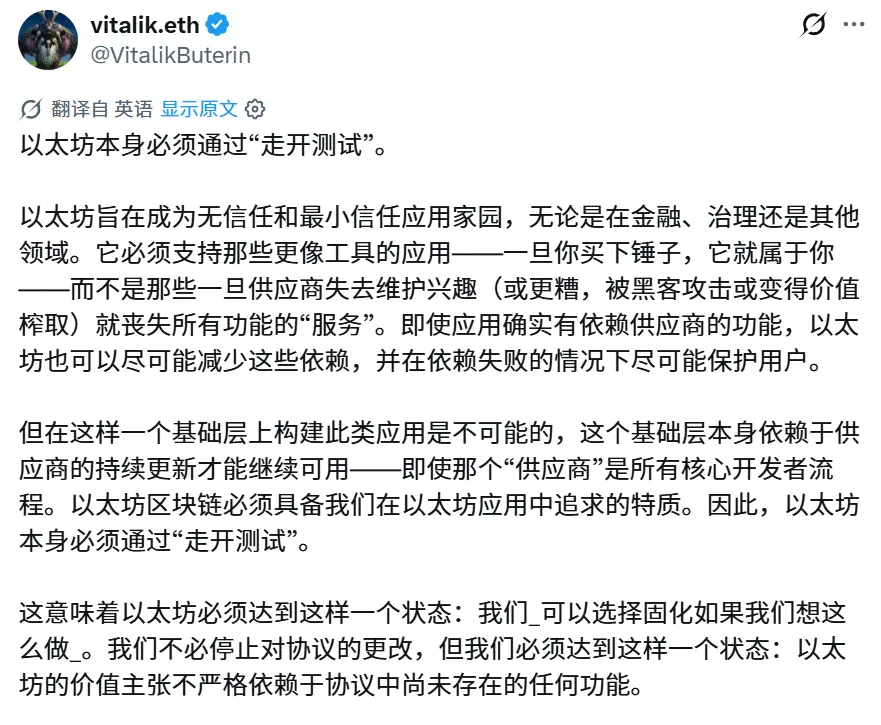
Be honest. The answer today is no. The machine is unfinished; it would stall if walked away from. And the neutrality it has is socially enforced, a promise kept by good people, not guaranteed by mechanics.

Vitalik himself defined credible neutrality as requiring transparent rules, equal application, open participation, and being hard to change. Ethereum achieves the first three but fails on the fourth.

Its rules are still easy to change, through a small off-chain process: an EIP proposal, a weekly All Core Devs call, rough consensus among ~150 core developers spread across ~11 organizations, and a few client teams. No enforced rules.

6. The Only Solution

The fix isn't a better foundation. It's finishing the machine, then freezing the parts that make it credibly neutral, putting the base layer into maintenance mode, so Ethereum finally passes the walk-away test on its own.

Once the neutral core is frozen, the dependency dissolves. Then, the Ethereum Foundation can do the healthiest thing a steward can do: become optional.

It can partner with a thousand new entities, shrink to a research lab, hand work off to a dozen competing teams, or even die off, and none of it threatens the blockchain because the part that defines Ethereum's neutrality can no longer be changed by anyone, whether captured or well-intentioned. You can't manipulate what can't be moved. You can't capture what's finished.

This is what makes the order non-negotiable, because the goal here isn't anti-capitalism; it's the opposite.

Private capital flooding into Ethereum research, entities like Ethlabs delivering tangible value instead of grant-chasing busywork, is one of the healthiest things that could happen to this ecosystem, and I hope for more of it.

But you can't put capitalism into an environment with no rule of law, where nothing stops you from hurting others, stealing, or tearing up contracts. A free market without an underlying rule of law doesn't create prosperity; it unleashes human nature's worst aspects, bound to money.

Capitalism on top of rule of law is a gift; apart from it, it's a predator.

Same for the protocol. First, freeze the parts that make Ethereum safe and credibly neutral, carve the fundamental rules into stone, then open the doors to private capital and let a hundred well-funded teams compete to build everything on top.

If you reverse the order, inviting capital in before the neutral core is frozen, you just get a Solana competitor with one-sixth of ETH's market cap today.

As an ETH maximalist, I don't enjoy writing what comes next, but it's the core truth of everything. Ethereum's endgame is its own Bitcoinization. Becoming as immutable as Bitcoin, earning the eternity premium the market actually pays for, and doing the one thing Bitcoin never could: cross the finish line with full programmability.

Bitcoin's freeze was accidental and neglectful, ending up as a rock that does nothing.

Ethereum has the chance to freeze (only certain parts) actively, intentionally, and end up the trusted neutral settlement layer for the entire tokenized economy. Same eternity. Much larger prize. That's the entire bullish case, and it demands ossification before wartime mode.

7. The Manhattan Project

Lean Ethereum is the path to finishing and freezing this machine, which is why I keep invoking the grandest historical metaphor. A Manhattan Project is when a field bundles its hardest problems into a single, concentrated, deadline-driven, existential push. That's the situation now.

It bundles the protocol's four hardest problems into one definitive plan, aiming for a single bundled hard fork rather than a decade of trickles.

Ossification. The consensus layer is being rebuilt from scratch as Lean Consensus, work formerly called Beam Chain, with 3-slot finality, ~12-second finality, and 4-second block times. Justin Drake calls the strategy ossification accelerationism: Pack every hard change into one jump to get the layer into maintenance mode as fast as possible. Build it once, then freeze it.

Scaling. The goal is L1-level trillion-gas-per-second, ~10,000 TPS at the base layer, millions at L2, through ZK verification and Blob- and PeerDAS-based data availability, not scaling blocks on centralized hardware. The pace is 3x, then 10x, then 100x.

Quantum Resistance. Validators' BLS signatures are replaced by leanXMSS, a hash-based, quantum-safe scheme, with a STARK aggregation engine compressing results ~250x. User accounts get signature agility via account abstraction, so wallets can opt into post-quantum protection without waiting for the whole chain. Target readiness ~2029.

ZK. Make the whole chain provable, letting anyone verify consensus with a succinct proof on cheap hardware, while the execution layer gets rebuilt around ZK-friendly VMs. Hash-based signatures also friendly to SNARKs are the key hinge merging quantum resistance and provability.

And, crucially, this plan closes the two specific wounds mentioned at the article's start.

Statelessness. State bloat is the first wound, where the full state copy each node must carry keeps growing, slowly pricing out home validators. Statelessness cuts it: Validators no longer store the whole state, instead verifying each block via compact proofs, turning the node-running burden back from a storage cost to cheap computation, keeping the validator set broad and decentralized.

Native Rollups. The L2 mess is the other wound, and the EXECUTE precompile in EIP-8079 is the fix. Native rollups no longer run their own proofs, governance, security councils; they hand their blocks back to Ethereum for direct validation, inheriting L1 security, upgrades, and quantum resistance for free.

No multisigs to hack, no upgrade keys to hold. The centralization trap rollups were forced into disappears: You're not reimplementing Ethereum; you're part of it, ossifying the day Ethereum ossifies.

Synchronous Compossability. Even better, it recovers what fragmentation stole. With shared execution and Ethereum-level ordering, rollups become atomically composable: A transaction can hit a few rollups and L1 in the same block, all succeed or all fail, like smart contracts on a single chain.

No cross-chain bridges, no routing, no doubt about what chain you're on. Liquidity pools into one whole, and Ethereum feels like the same computer no matter how many rollups run on top. It needs real-time proofs, still racing to production, but that's the finish line.

The work is already underway. The Fusaka upgrade is live, carrying PeerDAS and the first substantive steps of the scaling plan. Post-quantum efforts have a public home at pq.ethereum.org, with its alternative signature scheme designated. New client teams have formed around Lean Consensus.

The hard, definitive parts—the consensus rewrite, quantum migration, and final freeze—lie ahead, with the next forks, Glamsterdam and Hegotá, scheduled for 2026, targeting full readiness by the decade's end. That part is still on the clock.

The original Manhattan Project didn't just end the bloodiest war in history; it reshaped the global order around the nation that got there first.

Lean Ethereum aims for finality of the same magnitude. Not to win a blockchain race, but to end it. The day Ethereum freezes its neutral core, passes the walk-away test, and can no longer be steered by anyone, the race for the world's base layer is over.

Bitcoin has shown us what the market pays for an ossified rock that does nothing—over a trillion dollars for eternity alone.

The world has never priced an ossified rock that's also the global economy's settlement layer because it has never existed.

Lean Ethereum is the plan to build that thing. Finish it, and Ethereum doesn't just flip Bitcoin; it hits a number no model yet projects, and leaves Bitcoin behind for good because it finally has the one thing Bitcoin has—eternity—plus the one thing Bitcoin gave up—programmability.

That's why it can't be a decade of gentle incrementalism. It's a race between two clocks.

The first is the ossification clock: How fast Lean Ethereum finishes the machine and freezes the neutral core. The second is the capture clock: How fast the funding vacuum, the corporate stewards filling empty EF chairs, the wartime centralization push, and the quantum deadline harden into actual problems. Every year Ethereum stays unfinished is another year of window for capture, pressure, or just continued dependency on whoever happens to be holding the wheel.

8. Two Endings

So, past doomsaying and blind cheering, here's Ethereum's actual situation.

Finish the Manhattan Project, freeze the base, pass the walk-away test, and Ethereum becomes the world's first ossified, quantum-resistant, credibly neutral global economic settlement layer—a settlement layer that doesn't need a foundation, founders, or permission to stay neutral.

At that moment, the dependency discount crushing the price inverts into the eternity premium, a revaluation with no peer and no ceiling.

Stall, or let the wartime faction trade neutrality for speed, and Ethereum becomes, at best, a slower Solana; at worst, an untrustworthy, manipulated, forever-mutable chain, something captured and steered by its paymasters, with the premium it chased forever evaporated.

I'm long because I believe it can. But anyone telling you the outcome is guaranteed has skipped the hardest chapter. Finish the machine, freeze it, walk away from any need for stewards at all. That's the whole game now.


Трендові криптовалюти

Пов'язані питання

QAccording to the article, why hasn't ETH's price reached or sustained higher levels despite high usage and settlement volume?

AThe article argues that the market is not mispricing Ethereum's usage. Instead, it is pricing in its 'dependency' on the Ethereum Foundation and its incomplete, evolving nature. ETH's price is discounted because Ethereum is an 'unfinished machine' that still requires stewards for development and guidance, preventing it from achieving the 'immutability premium' that comes with a truly reliable, neutral, and final settlement layer.

QWhat is the 'Manhattan Plan' (Lean Ethereum) as described in the article, and what are its four core objectives?

AThe 'Manhattan Plan,' or Lean Ethereum, is a decisive, bundled initiative to complete and 'freeze' Ethereum's neutral core. Its four core objectives are: 1. **Rigidification**: Rebuilding the consensus layer (Beam Chain) for speed and then entering maintenance mode. 2. **Scale**: Achieving massive throughput (e.g., 1 trillion gas per second) via ZK proofs and advanced data availability. 3. **Post-Quantum Security**: Replacing BLS signatures with quantum-safe alternatives like leanXMSS. 4. **ZK**: Making the entire chain provable with ZK-friendly VMs, which also enables key features like statelessness and native rollups.

QWhat is the 'handoff test' mentioned in the article, and what is the author's conclusion about Ethereum's current state regarding it?

AThe 'handoff test' asks: If the Ethereum Foundation and Vitalik Buterin collectively stepped away tomorrow, could Ethereum continue running, unchanged and reliably neutral, forever? The author concludes the honest answer today is 'no.' The machine is unfinished and would stall without its stewards. Its current neutrality is upheld by social consensus and the goodwill of its maintainers, not by mechanisms that are frozen and beyond anyone's reach.

QThe article discusses two 'wrong escape routes' for Ethereum. What are they, and why does the author consider them traps?

AThe two wrong escape routes are: 1. **War Mode**: Sacrificing decentralization and reliable neutrality for speed to compete with chains like Solana. The author argues this is surrender, turning Ethereum into a 'slower Solana' and forfeiting its unique monetary premium. 2. **Replacing the Stewards**: Focusing criticism on the EF or Vitalik and trying to replace them with another entity. The author believes this misreads the problem, as it merely changes the name of the single point of trust/dependency rather than eliminating the need for a steward altogether.

QWhat is the author's ultimate vision for Ethereum's endgame, and how does it relate to Bitcoin?

AThe author's vision is for Ethereum to 'Bitcoinize itself'—to become as immutable as Bitcoin, thereby winning the 'eternity premium' the market pays. However, Ethereum's opportunity is to achieve this 'rigidity' *actively and selectively* while retaining full programmability. The endgame is for Ethereum to become 'the world’s first rigid, post-quantum, credibly neutral settlement layer for the global economy'—possessing Bitcoin's key property (immutability) without abandoning its own (programmability), which would allow it to surpass Bitcoin in value and utility.

Пов'язані матеріали

Airwallex's Pivot: From Dismissing Stablecoins a Year Ago to Making High-Profile Investments Today

Airwallex, a major cross-border payments fintech, has made a notable strategic shift by leading a seed round investment in Metal, a tokenized financial settlement network. This move is significant given that Airwallex founder Jack Zhang was a prominent critic of stablecoins just a year prior, arguing they failed to reduce costs for mainstream currency corridors and lacked clear utility. The investment targets Metal, a Layer-1 blockchain designed for the tokenization and settlement of assets like stocks, bonds, and stablecoins, aiming for the institutional market. Metal's team includes veterans from Ren Protocol and Meta's Diem project. For Airwallex, this partnership integrates tokenized finance into its global payments network, providing a new settlement layer. Despite his company's investment, Zhang maintains a distinction, stating his skepticism toward "cryptocurrencies" remains, while classifying regulated, asset-backed stablecoins as a separate category. This stance reflects a broader trend of traditional finance (TradFi) cautiously engaging with crypto infrastructure. Companies like Stripe, Mastercard, and major banks are similarly exploring stablecoin payments and tokenization networks, recognizing their potential in emerging markets and 24/7 settlement. The article concludes that Airwallex's investment is less a change of belief and more a strategic necessity to secure a position in the evolving landscape of digital asset settlement, where stablecoins are becoming a key interface for global finance.

marsbit5 хв тому

Airwallex's Pivot: From Dismissing Stablecoins a Year Ago to Making High-Profile Investments Today

marsbit5 хв тому

Spicy Review|Is the "Most Emotionally Valuable" Post Here? Could STRC Be the Next LUNA?

Here is an English summary of the article (under 1500 characters): This article from the spicy commentary series "LaPing" covers three key stories in the crypto world for the week. First, during a sharp market downturn in June where BTC fell over 20%, a Reddit post on r/Cryptocurrency rallying against "Fear, Uncertainty, and Doubt (FUD)" went viral. The comment section became a hub for retail traders to share memes and encouragement, with many advocating holding (HODLing) through the volatility, embodying the "be fearful when others are greedy" mantra. Second, it examines the situation with STRG (Strategy's perpetual preferred stock), which has "de-pegged," trading around $76 vs. its $100 face value, a ~25% discount. The concern is whether Michael Saylor's company, MicroStrategy, can sustain the $1.2 billion annual dividend payment, given its ~$1.4 billion cash reserve. While analysts note STRG is fundamentally different from the catastrophic LUNA collapse—as Saylor isn't obligated to pay the dividend—risks remain. If MicroStrategy's (MSTR) common stock investors feel their capital is being prioritized for STRG dividends, it could hurt MSTR demand. Third, the article analyzes the online persona of "Chuan Mu," a trader famous for turning $500 into $1 million during the 2023 ORDI inscription boom and again with short positions in 2025. An analysis of his 1,828 tweets reveals his success stems from a top-down analytical framework, asking systemic questions like "Where will the bottleneck be in the AI supply chain?" rather than chasing individual pumps. His investments migrated from crypto-linked stocks to AI infrastructure plays like SK Hynix and Samsung. However, the piece also notes criticism that he has occasionally "pumped" assets and sold positions without notifying followers, creating a contradictory public image. The weekly recap highlights themes of community sentiment during bear markets, financial instrument risks, and the complex realities of following influential online traders.

Foresight News39 хв тому

Spicy Review|Is the "Most Emotionally Valuable" Post Here? Could STRC Be the Next LUNA?

Foresight News39 хв тому

Торгівля

Спот

Популярні статті

Що таке ETH 2.0

ETH 2.0: Нова ера для Ethereum Вступ ETH 2.0, широко відомий як Ethereum 2.0, є величезним оновленням для блокчейну Ethereum. Ця трансформація не є лише косметичною зміною; вона має на меті фундаментально покращити масштабованість, безпеку та сталий розвиток мережі. З переходом від енергомісткого механізму консенсусу Proof of Work (PoW) до більш ефективного Proof of Stake (PoS), ETH 2.0 обіцяє трансформаційний підхід до екосистеми блокчейнів. Що таке ETH 2.0? ETH 2.0 — це збірка особливих, взаємопов’язаних оновлень, спрямованих на оптимізацію можливостей та продуктивності Ethereum. Це перетворення розроблене для вирішення критичних викликів, з якими стикалося існуюче механізм Ethereum, зокрема щодо швидкості транзакцій та заторів у мережі. Мета ETH 2.0 Основні цілі ETH 2.0 зосереджені на покращенні трьох ключових аспектів: Масштабованість: Мета — значно підвищити кількість транзакцій, які мережа може обробити за секунду; ETH 2.0 прагне вийти за межі поточного обмеження приблизно в 15 транзакцій на секунду, потенційно досягнувши тисяч. Безпека: Підвищені заходи безпеки є невід’ємною частиною ETH 2.0, зокрема через покращену стійкість до кібератак і збереження децентралізованої етики Ethereum. Сталий розвиток: Новий механізм PoS розроблений не тільки для підвищення ефективності, але й для різкого зменшення споживання енергії, що узгоджує операційну структуру Ethereum з екологічними міркуваннями. Хто є творцем ETH 2.0? Створення ETH 2.0 можна віднести до Ethereum Foundation. Ця неприбуткова організація, яка відіграє важливу роль у підтримці розвитку Ethereum, очолюється відомим співавтором Віталіком Бутеріним. Його бачення більш масштабованого та стійкого Ethereum стало рушійною силою цього оновлення, залучаючи внески зі всього світу від розробників і ентузіастів, які прагнуть покращити протокол. Хто є інвесторами ETH 2.0? Хоча подробиці про інвесторів ETH 2.0 не були оприлюднені, відомо, що Ethereum Foundation отримує підтримку від різних організацій та осіб у сфері блокчейну та технологій. Ці партнери включають венчурні капітальні компанії, технологічні компанії та філантропічні організації, які мають спільний інтерес у підтримці розвитку децентралізованих технологій та інфраструктури блокчейну. Як працює ETH 2.0? ETH 2.0 відзначається введенням низки ключових функцій, які відрізняють його від попередника. Proof of Stake (PoS) Перехід до механізму консенсусу PoS є одним із знакових змін ETH 2.0. На відміну від PoW, який покладається на енергомісткий видобуток для перевірки транзакцій, PoS дозволяє користувачам підтверджувати транзакції та створювати нові блоки відповідно до кількості ETH, яку вони ставлять у мережі. Це призводить до підвищення енергоефективності, зменшуючи споживання приблизно на 99,95%, завдяки чому Ethereum 2.0 стає значно більш екологічною альтернативою. Шардові ланцюги Шардові ланцюги є ще одним ключовим нововведенням ETH 2.0. Ці менші ланцюги працюють паралельно з основним ланцюгом Ethereum, що дозволяє обробляти кілька транзакцій одночасно. Це підходи покращує загальну ємність мережі, усуваючи проблеми масштабованості, які переслідували Ethereum. Beacon Chain У центрі ETH 2.0 знаходиться Beacon Chain, яка координує мережу і управляє протоколом PoS. Вона виконує роль організатора: контролює валідаторів, забезпечує з’єднання шард з мережею і моніторить загальний стан екосистеми блокчейнів. Хронологія ETH 2.0 Шлях ETH 2.0 характеризується кількома ключовими етапами, які відображають еволюцію цього значного оновлення: Грудень 2020: Запуск Beacon Chain ознаменував введення PoS, проклавши шлях до міграції на ETH 2.0. Вересень 2022: Завершення "Злиття" є знаковим моментом, коли мережа Ethereum успішно перейшла з PoW на PoS, відкриваючи нову еру для Ethereum. 2023: Очікуване розгортання шардових ланцюгів має на меті подальше покращення масштабованості мережі Ethereum, закріплюючи ETH 2.0 як надійну платформу для децентралізованих додатків і послуг. Ключові особливості та переваги Покращена масштабованість Однією з найзначніших переваг ETH 2.0 є його покращена масштабованість. Поєднання PoS та шардових ланцюгів дозволяє мережі розширити свою ємність, що дозволяє їй обробляти набагато більший обсяг транзакцій в порівнянні з класичною системою. Енергоефективність Запровадження PoS є величезним кроком до енергоефективності в технології блокчейн. Значно зменшуючи споживання енергії, ETH 2.0 не тільки знижує операційні витрати, але також ближче узгоджується з глобальними цілями сталого розвитку. Підвищена безпека Оновлені механізми ETH 2.0 сприяють підвищенню безпеки по всій мережі. Впровадження PoS, поряд з інноваційними контрольними заходами, встановленими через шардові ланцюги та Beacon Chain, забезпечує вищий рівень захисту від потенційних загроз. Зниження витрат для користувачів З покращенням масштабованості вплив на витрати на транзакції також стане очевидним. Збільшена ємність і зменшені затори, як очікується, призведуть до зниження зборів для користувачів, що зробить Ethereum більш доступним для повсякденних транзакцій. Висновок ETH 2.0 є значною еволюцією в екосистемі блокчейну Ethereum. Оскільки він вирішує важливі питання, такі як масштабованість, споживання енергії, ефективність транзакцій і загальна безпека, важливість цього оновлення не можна недооцінювати. Перехід до Proof of Stake, введення шардових ланцюгів і фундаментальна робота Beacon Chain свідчать про майбутнє, в якому Ethereum може задовольнити зростаючі вимоги децентралізованого ринку. В індустрії, що рухається вперед завдяки інноваціям та прогресу, ETH 2.0 є підтвердженням можливостей технології блокчейн у прокладенні шляху до більш сталого та ефективного цифрового економіки.

180 переглядів усьогоОпубліковано 2024.04.04Оновлено 2024.12.03

Що таке ETH 2.0

Що таке ETH 3.0

ETH3.0 та $eth 3.0: Глибоке дослідження майбутнього Ethereum Вступ У швидко змінюваному світі криптовалют та технології блокчейн, ETH3.0, часто позначуваний як $eth 3.0, став темою значного інтересу та спекуляцій. Цей термін охоплює два основні концепти, які потребують уточнення: Ethereum 3.0: Це потенційне майбутнє оновлення, яке має на меті покращення можливостей існуючого блокчейну Ethereum, зокрема, фокусуючись на поліпшенні масштабованості та продуктивності. ETH3.0 Мем Токен: Цей окремий криптовалютний проект прагне використовувати блокчейн Ethereum для створення екосистеми, орієнтованої на меми, сприяючи залученню до криптовалютної громади. Розуміння цих аспектів ETH3.0 є важливим не лише для криптоентузіастів, але й для тих, хто спостерігає за широкими технологічними тенденціями у цифровому просторі. Що таке ETH3.0? Ethereum 3.0 Ethereum 3.0 пропонується як оновлення вже існуючої мережі Ethereum, яка стала основою багатьох децентралізованих додатків (dApps) та смарт-контрактів з моменту свого виникнення. Передбачувані удосконалення зосереджені в основному на масштабованості — інтегруючи передові технології, такі як шардінг та нульові знання (zk-докази). Ці технологічні нововведення націлені на забезпечення безпрецедентної кількості транзакцій на секунду (TPS), потенційно досягаючи мільйонів, тим самим вирішуючи одну з найзначніших обмежень, з якими стикається сучасна технологія блокчейн. Покращення є не лише технічним, а й стратегічним; воно спрямоване на підготовку мережі Ethereum до широкого прийняття та корисності в майбутньому, позначеному збільшеним попитом на децентралізовані рішення. ETH3.0 Мем Токен На відміну від Ethereum 3.0, ETH3.0 Мем Токен пропонує легшу та грайливішу домену, поєднуючи культуру інтернет-мемів із динамікою криптовалют. Цей проект дозволяє користувачам купувати, продавати та обмінювати меми на блокчейні Ethereum, надаючи платформу, яка сприяє залученню громади через креативність та спільні інтереси. ETH3.0 Мем Токен має на меті продемонструвати, як технологія блокчейн може перетинатися з цифровою культурою, створюючи випадки використання, які є водночас розважальними та фінансово життєздатними. Хто є творцем ETH3.0? Ethereum 3.0 Ініціатива щодо Ethereum 3.0 переважно підтримується консорціумом розробників та дослідників у межах громади Ethereum, зокрема, до складу якого входить Джастін Дрейк. Відомий своїми думками та внеском у розвиток Ethereum, Дрейк є помітною особистістю в обговореннях щодо переходу Ethereum на новий рівень консенсусу, який називається «Beam Chain». Цей колабораційний підхід до розробки свідчить про те, що Ethereum 3.0 не є продуктом єдиного творця, а скоріше втіленням колективної винахідливості, спрямованої на просування технології блокчейн. ETH3.0 Мем Токен Деталі про творця ETH3.0 Мем Токена наразі не відстежуються. Природа мем-токенів часто призводить до більш децентралізованої та громартової структури, що може пояснити відсутність специфічної атрибуції. Це узгоджується з етикою ширшої крипто-спільноти, де інновації часто виникають з колективних, а не індивідуальних зусиль. Хто є інвесторами ETH3.0? Ethereum 3.0 Підтримка Ethereum 3.0 переважно надходить від Фонду Ethereum поряд з ентузіастичною спільнотою розробників та інвесторів. Це базове співробітництво надає значний градус легітимності та підвищує ймовірність успішної реалізації, оскільки воно використовує довіру та авторитет, накопичені за роки роботи мережі. У швидко змінюваному кліматі криптовалют підтримка громади займає важливу роль у розвитку та прийнятті, позиціонуючи Ethereum 3.0 як серйозного конкурента для майбутніх блокчейн-інновацій. ETH3.0 Мем Токен Хоча наразі доступні джерела не надають явної інформації щодо інвестиційних фондів або організацій, що підтримують ETH3.0 Мем Токен, це свідчить про типову модель фінансування для мем-токенів, яка часто спирається на підтримку знизу та залучення громади. Інвестори в такі проекти зазвичай складаються з осіб, які мотивовані потенціалом інновацій, що керуються спільнотою, та духом співпраці, притаманним крипто-спільноті. Як працює ETH3.0? Ethereum 3.0 Відмінні риси Ethereum 3.0 полягають у його запропонованій реалізації технології шардінгу та zk-proof. Шардінг — це метод розподілу блокчейну на менші, керовані частини чи «шарди», які можуть обробляти транзакції одночасно, а не послідовно. Це децентралізоване оброблення допомагає запобігти заторам та забезпечити оперативність мережі навіть під великим навантаженням. Технологія нульових доказів (zk-proof) надає ще один рівень складності, дозволяючи валідацію транзакцій без розкриття підпорядкованих даних. Цей аспект не лише підвищує конфіденційність, а й збільшує загальну ефективність мережі. Також обговорюється включення нульової Ефірної віртуальної машини (zkEVM) в це оновлення, що ще більше підвищить можливості та корисність мережі. ETH3.0 Мем Токен ETH3.0 Мем Токен виділяється завдяки використанню популярності культури мемів. Він створює ринок, на якому користувачі можуть брати участь у торгівлі мемами не лише для розваги, але й для потенційного економічного вигоди. Інтегруючи функції, такі як стейкінг, забезпечення ліквідності та механізми управління, проект сприяє створенню середовища, яке заохочує взаємодію та участь громади. Пропонуючи унікальне поєднання розваг та економічних можливостей, ETH3.0 Мем Токен прагне залучити різну аудиторію, яка охоплює від криптоентузіастів до casual-консумерів мемів. Хронологія ETH3.0 Ethereum 3.0 11 листопада 2024: Джастін Дрейк натякає на майбутнє оновлення ETH 3.0, яке зосереджене на поліпшеннях масштабованості. Це оголошення означає початок формальних обговорень щодо майбутньої архітектури Ethereum. 12 листопада 2024: Очікується, що запропоновану пропозицію для Ethereum 3.0 буде представлено на Devcon у Бангкоку, що готує ґрунт для більш широкого зворотного зв'язку від громади та потенційних наступних кроків у розвитку. ETH3.0 Мем Токен 21 березня 2024: ETH3.0 Мем Токен офіційно потрапляє у список на CoinMarketCap, що означає його дебют у публічному крипто-просторі та підвищує видимість для його меморієнтованої екосистеми. Ключові моменти На завершення, Ethereum 3.0 представляє значну еволюцію в межах мережі Ethereum, зосереджуючись на подоланні обмежень щодо масштабованості та продуктивності через передові технології. Його запропоновані оновлення відображають проактивний підхід до майбутніх вимог і корисності. Натомість ETH3.0 Мем Токен втілює суть культури, керованої громадою, у сфері криптовалют, використовуючи культуру мемів для створення привабливих платформ, які заохочують творчість і участь користувачів. Розуміння окремих цілей і функцій ETH3.0 та $eth 3.0 є надзвичайно важливим для кожного, хто цікавиться поточними подіями в крипто-просторі. З обома ініціативами, які прокладають унікальні шляхи, вони разом підкреслюють динамічну та багатогранну природу інновацій у блокчейн-технологіях.

168 переглядів усьогоОпубліковано 2024.04.04Оновлено 2024.12.03

Що таке ETH 3.0

Як купити ETH

Ласкаво просимо до HTX.com! Ми зробили покупку Ethereum (ETH) простою та зручною. Дотримуйтесь нашої покрокової інструкції, щоб розпочати свою криптовалютну подорож.Крок 1: Створіть обліковий запис на HTXВикористовуйте свою електронну пошту або номер телефону, щоб зареєструвати обліковий запис на HTX безплатно. Пройдіть безпроблемну реєстрацію й отримайте доступ до всіх функцій.ЗареєструватисьКрок 2: Перейдіть до розділу Купити крипту і виберіть спосіб оплатиКредитна/дебетова картка: використовуйте вашу картку Visa або Mastercard, щоб миттєво купити Ethereum (ETH).Баланс: використовуйте кошти з балансу вашого рахунку HTX для безперешкодної торгівлі.Треті особи: ми додали популярні способи оплати, такі як Google Pay та Apple Pay, щоб підвищити зручність.P2P: Торгуйте безпосередньо з іншими користувачами на HTX.Позабіржова торгівля (OTC): ми пропонуємо індивідуальні послуги та конкурентні обмінні курси для трейдерів.Крок 3: Зберігайте свої Ethereum (ETH)Після придбання Ethereum (ETH) збережіть його у своєму обліковому записі на HTX. Крім того, ви можете відправити його в інше місце за допомогою блокчейн-переказу або використовувати його для торгівлі іншими криптовалютами.Крок 4: Торгівля Ethereum (ETH)Легко торгуйте Ethereum (ETH) на спотовому ринку HTX. Просто увійдіть до свого облікового запису, виберіть торгову пару, укладайте угоди та спостерігайте за ними в режимі реального часу. Ми пропонуємо зручний досвід як для початківців, так і для досвідчених трейдерів.

3.2k переглядів усьогоОпубліковано 2024.12.10Оновлено 2026.06.02

Як купити ETH

Обговорення

Ласкаво просимо до спільноти HTX. Тут ви можете бути в курсі останніх подій розвитку платформи та отримати доступ до професійної ринкової інформації. Нижче представлені думки користувачів щодо ціни ETH (ETH).

活动图片