Recent severe volatility has emerged in the South Korean market, with the South Korean KOSPI index experiencing a maximum drawdown of 32% since its high of 9385.6 points on June 19.
As the most concentrated 'storm center' in this round of the global AI thematic market, the adjustment in the South Korean market has become a key trigger for this wave of global technology stock volatility, leading to widespread corrections in global tech stocks.
In terms of sequence, this round of decline originated from fundamental expectation disruptions and short-term capital rotation,but the core variable that truly magnified the decline is the highly concentrated leverage capital structure in the South Korean market.
Notably,from the current perspective, the fundamentals of the South Korean market have not fundamentally changed, and the passive unwinding process driven by leverage has entered its final stage.
Leveraged ETF Unwinding Progress at 75%
The core trigger for this market volatility is the massive expansion and concentrated unwinding of leveraged ETFs.
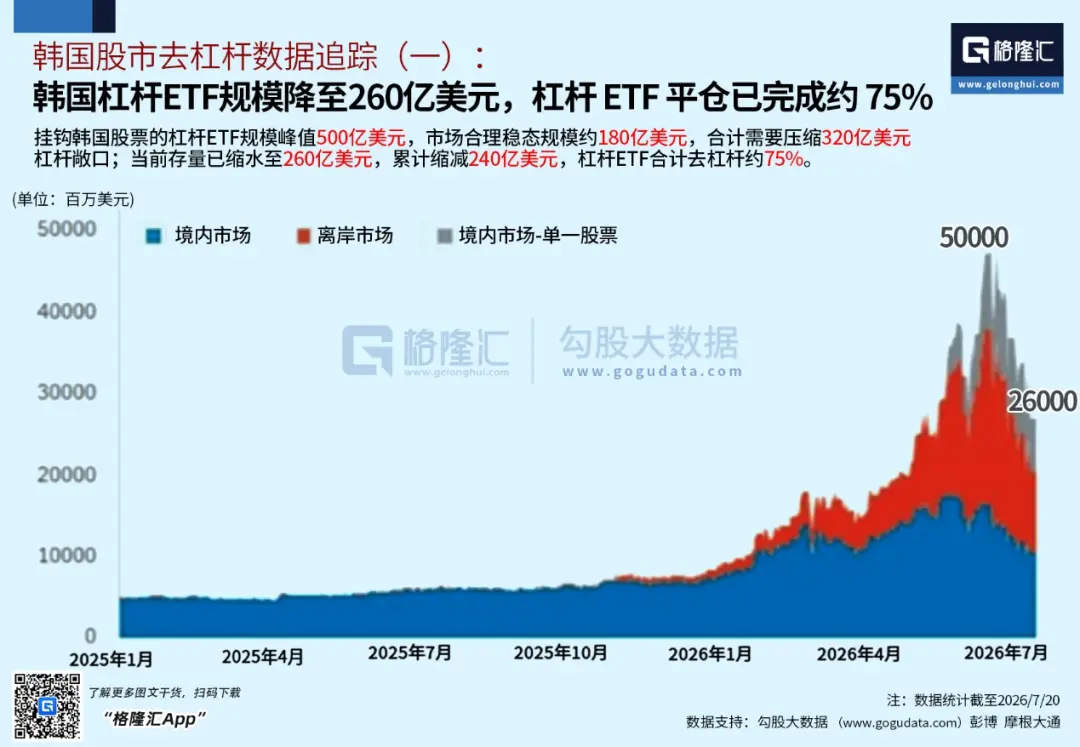
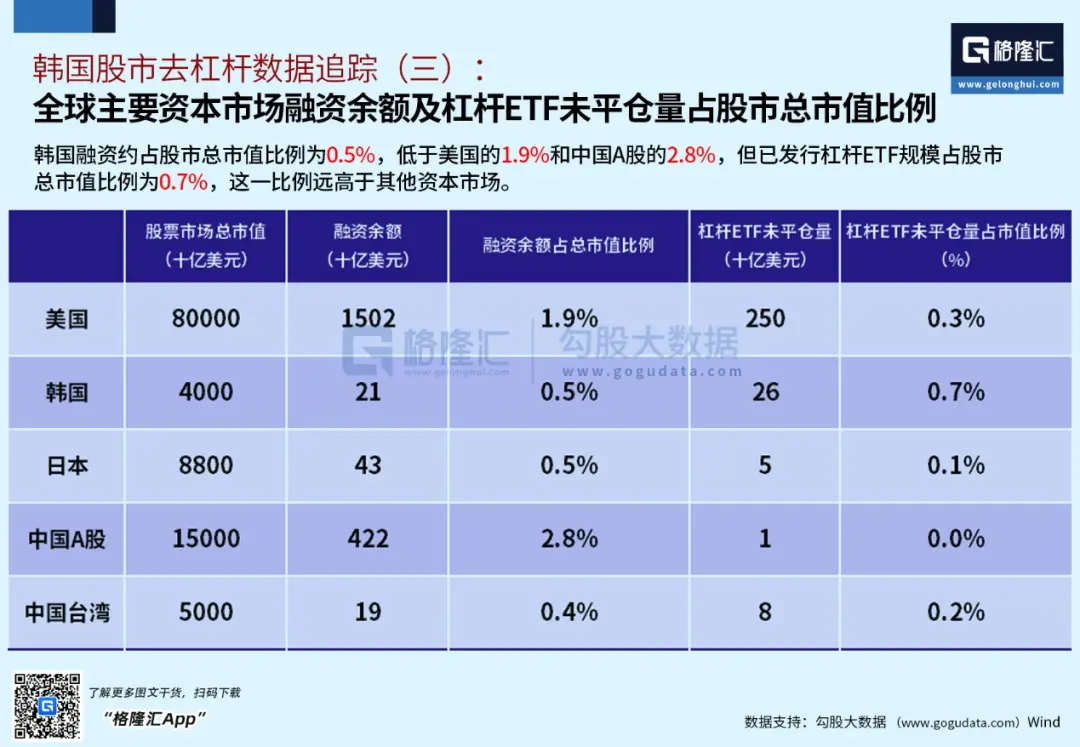
During the earlier phase of rapid stock market gains, the scale of leveraged ETFs once approached $50 billion, with their share of the total South Korean stock market capitalization being about four times that of the US market, significantly amplifying the market's inherent volatility.
This high-leverage structure meant price movements were no longer driven purely by fundamentals but were dominated more by position structures.
High volatility, on one hand, deterred the entry of volatility-sensitive long-term capital, and on the other, significantly increased the operational difficulty for asset managers and brokerages under risk control constraints.
Entering June-July, with the global AI hardware sector temporarily weakening, coupled with the leveraged ETFs' 'daily rebalancing' mechanism—characterized by passively adding positions on gains and concentrated selling on losses—any correction in leading stocks easily triggered a negative feedback loop: 'stock price decline → margin calls → forced liquidation → further stock price decline'.
In late June, several leveraged ETFs experienced single-day declines exceeding 25%, driving the market to trigger circuit breakers, with the volatility index VKOSPI once soaring to five times the level of the US stock market's VIX index, and market liquidity temporarily approached a standstill.
According to institutional estimates, the scale of leveraged ETFs has rapidly contracted from a peak of about $50 billion to $26 billion, a cumulative reduction of approximately $24 billion.Based on a reasonable existing stock estimate of about $18 billion, the current unwinding progress has reached about 75%, with about 25% remaining adjustment space, showing significant convergence.
Simultaneously, regulators have begun constraining leverage expansion at the institutional level.
Regulators will implement strict new rules starting in August:From August 5th, suspending all new single-stock leveraged ETF issuances, raising the minimum transaction cash threshold from 10 million KRW to 30 million KRW; from August 19th, only cash can be used as initial margin; starting November, the minimum trading unit for single-stock leveraged ETFs will be increased from 1 share to 20 shares.
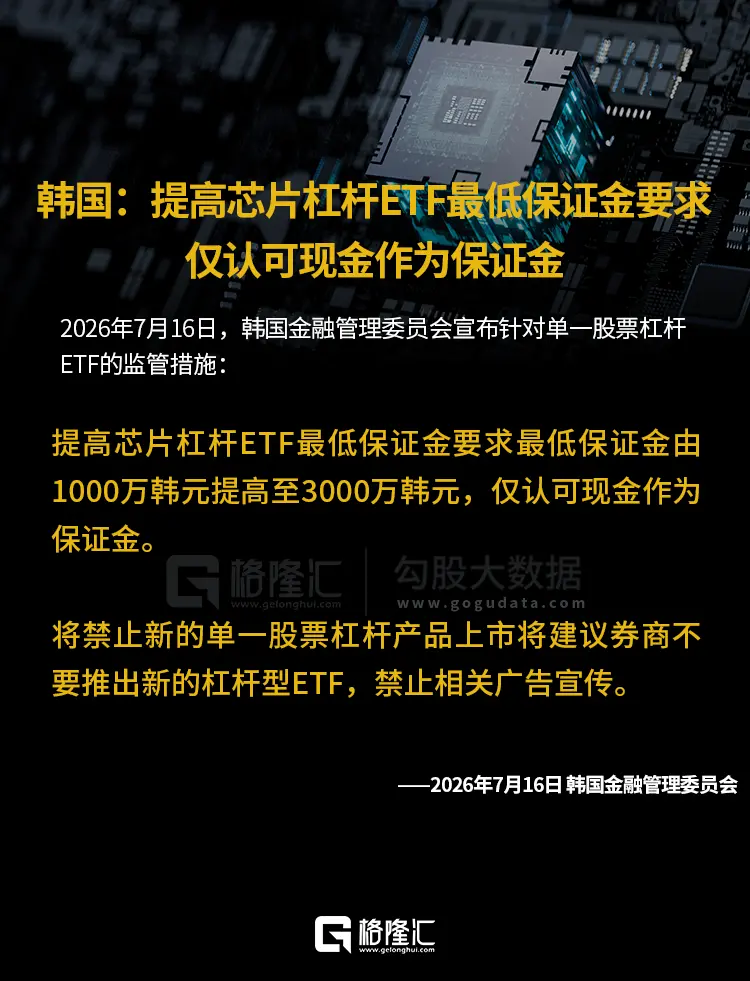
As these policies are gradually implemented, channels for new high-leverage capital entry are effectively blocked, and the scale of leveraged ETFs is expected to contract further, reducing the mechanistic risk of amplified volatility from the source.
Hedge Fund De-leveraging Exceeds 50%
In addition to leveraged ETFs, the high-leverage allocations of hedge funds were also a significant amplifier of this volatility wave.
Since April this year, global equity and macro hedge funds significantly increased allocations to the South Korean market, using Total Return Swaps (TRS) provided by brokerages to amplify stock exposure. During the uptrend, this structure significantly boosted market elasticity; but during corrections, it simultaneously amplified de-leveraging pressure.
With the index's decline and the memory chip sector underperforming the broader market, the strain on swap limits has noticeably eased.
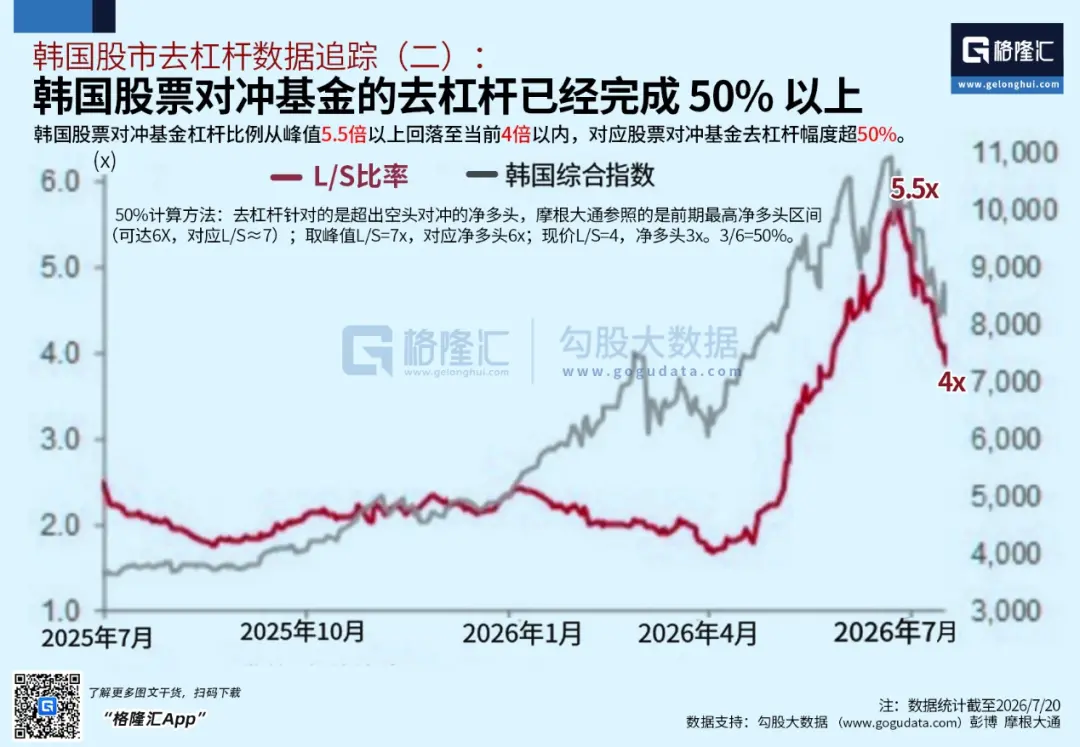
Institutional estimates show thatthe long-short ratio has fallen from a peak of about 5.5 times to below 4 times; using the extreme period's roughly 7 times long-short ratio and corresponding 6 times net long position as a reference, the current net long position of about 3 times implies leverage has declined by over 50%.
Meanwhile, as stock price declines led to reductions in MSCI index weights, the forced selling pressure from passive index funds has largely been released, significantly alleviating liquidity run risks on the institutional side.
Overall, the 'passive de-leveraging' process at the hedge fund level has completed its most intense phase.
Korean Retail Margin Financing Is Not the Major Risk Source
Compared to leveraged ETFs and hedge funds, South Korean retail margin financing contributes relatively limitedly to systemic risk.
Currently, the balance of South Korean retail margin financing has declined from over $25 billion to about $21 billion, accounting for about 0.5% of the total South Korean stock market capitalization. This level is not only lower than the US market's approximately 1.9%, but also significantly lower than the A-share market's margin financing ratio of about 2.8%.
Structurally, retail margin financing is more concentrated in the KOSDAQ market, which has a higher proportion of small and mid-cap stocks, and has a relatively limited direct impact on the core KOSPI-weighted stocks.
More crucially, ordinary margin accounts do not have a similar 'mechanical rebalancing' mechanism like leveraged ETFs.During stock price declines, investors are not forced to quickly reduce positions, making it difficult to form a chain reaction of panic selling.
Additionally, South Korean household assets still include cash, overseas assets, and previously accumulated stock gains, providing a certain buffer space.
Therefore, from a transmission mechanism perspective, retail margin financing is unlikely to become the core variable triggering systemic risk, nor does it have a realistic basis for large-scale, cascading liquidations.
Overall, the de-leveraging process in the South Korean market can be clearly summarized as follows: leveraged ETFs have unwound about 75%, hedge fund de-leveraging exceeds 50%, retail margin financing risks are controllable, and foreign passive selling pressure has been largely released.
Compared to the initial stage of the decline, the high-leverage structures most likely to trigger 'chain reaction selling' have largely completed their unwinding. The market is gradually transitioning from a 'liquidity-driven decline' to 'fundamentals-driven pricing'.
Against this backdrop, as long as fundamentals do not show a trend reversal, this round of adjustment is closer to a concentrated unwinding of crowded trades, rather than the end of the AI thematic market.
Conclusion
Looking further ahead, we must hold a firm conviction:The AI megatrend is irreversible, the silicon-based revolution is irreversible.
Almost all technological revolutions in history have followed a similar path: first, a compelling narrative is established, and capital rapidly flows in; subsequently, due to excessive crowding and leverage amplification, severe volatility is triggered; finally, true reshuffling of holdings is completed during the unwinding process. Each decline, superficially a price retracement, is essentially an optimization of structure.
This time is no exception.
The reason the South Korean market became the storm center is not because it is more fragile; on the contrary, it's precisely because it stands at the most crucial position in the AI industrial chain—memory chips. Capital first rushes to the most certain place, and it's easiest for crowding to form there. When leverage is superimposed on a trend, volatility is no longer a risk but an inevitability.
But now, the most dangerous stage is passing.
What we truly need to consider now is never short-term price movements, but: is this race still on?
If the answer is yes, then volatility is a cost, not a risk.
The megatrend of AI has not changed in any way due to this round of adjustment. Computing power demand is still growing exponentially, large language models are still accelerating iteration, and data centers, optical communication, and advanced packaging—every link is expanding. This is not an industrial path that can be easily disproven; it's a productivity revolution unfolding before us.
One could even say—it has no way back.
Our generation, in fact, does not lack hard work; what we lack is the 'entry point' for generational dividends. Many people looking back at their parents' generation often have complex feelings: during the reform and opening-up era, it seemed opportunities were everywhere—those who went into manufacturing, went into business, engaged in trade—many who seized one opportunity changed their entire lives.
You might also have asked: why could they, but why can't we?
But the issue is that the form of opportunities differs for each generation.
Today's opportunities are no longer about opening factories or doing trade, but about standing on top of the technological wave and participating in industrial upgrading through capital. AI is not just an opportunity for a single company; it's the entire era's dividend distribution mechanism being restructured.
Semiconductors, large language models, computing power networks, optical modules—these fields, which sound complex and have high entry barriers, indeed are not areas ordinary people can participate in by 'jumping in personally.' But the capital market precisely provides a path—you don't need to become an engineer or an entrepreneur; you only need to understand the trend and participate in it.
What's truly important is not whether you can precisely select every single investment target, but whether you are positioned in the right direction.
With the right direction, volatility is just part of the process; with the wrong direction, no amount of effort is anything but waste.

So, returning to the core question—
If AI is ultimately proven wrong, then our generation may indeed have lost its most important opportunity; but if it is right, then every adjustment now is an opportunity for later-comers to get back on board.
The market won't stop because you hesitate, nor will the era slow down because you are uncertain.
The only thing you need to decide is whether to get on board.






