Global Crypto Reporting Expands As 48 Countries Prep For CARF 2027

bitcoinistОпубліковано о 2026-01-02Востаннє оновлено о 2026-01-02

Анотація

A coordinated effort among 48 jurisdictions to implement the Crypto-Asset Reporting Framework (CARF) has begun, with standardized crypto transaction and user data collection starting January 1, 2026. The first automatic cross-border exchanges between tax authorities are expected in 2027. Service providers, including exchanges, brokers, and crypto ATMs, must collect account details, transaction histories, and users’ tax residency information. This framework aims to enhance tax transparency and enforcement of existing rules, not create new taxes. While larger platforms are adapting systems, smaller ones face operational burdens, and privacy concerns have been raised regarding data storage and access. An additional 27 jurisdictions plan to begin collection in 2027, with exchanges following in 2028. For users, this means more detailed onboarding processes and clearer record-keeping requirements from providers.

A coordinated effort to gather crypto tax records has begun in a group of jurisdictions preparing to take part in the Crypto-Asset Reporting Framework (CARF).

According to official monitoring from the Organization for Economic Co-operation and Development (OECD), 48 jurisdictions committed to start collecting standardized crypto transaction and user data from January 1, 2026, with the first automatic cross-border exchanges expected to take place in 2027.

Countries Begin Collecting Data

Based on reports, service providers such as major exchanges, some broker platforms, crypto ATMs and certain custody services will be obliged to record account details, transaction histories and users’ tax residency information for reporting to domestic tax authorities.

That information will be formatted so it can be shared automatically with partner tax offices once the exchange phase starts. The OECD monitoring update lays out the kinds of fields that must be gathered and stored for future reporting.
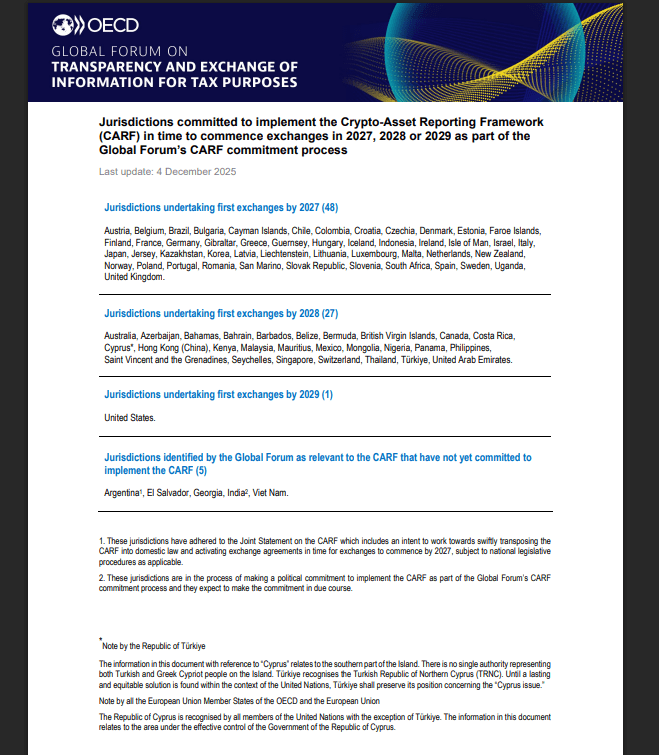
Source: OECD

What Exchanges Must Report

According to news outlets tracking the rollout, exchanges are already adjusting onboarding forms and internal compliance systems to verify customers’ tax residency and capture wallet-level activity.

Some jurisdictions, led by the United Kingdom, have moved faster to require platforms to keep detailed purchase and sale records for users in scope. Tax authorities will then receive yearly reports covering balances, transfers and gains for listed accounts.

Operational Strain And Privacy Questions

The new rules create practical burdens. Smaller platforms will need to upgrade systems or hire compliance staff to track the new data points.

Based on reports, privacy advocates and parts of the crypto industry are warning that the depth of data collection could raise concerns about how long sensitive transaction records are held and who can access them.

Some legal teams are already studying how domestic data-privacy laws interact with automatic information exchange.

Total crypto market cap currently at $2.99 trillion. Chart: TradingView

Middle Nations Join The Second Wave

A further group of jurisdictions has said it will begin domestic collection later. Reports note that an additional 27 jurisdictions have timelines that target January 1, 2027 for starting to collect, with exchanges of information to follow in 2028 for that batch.

At least one analysis of national updates also indicates that a handful of countries are planning to stagger implementation because of local legislative calendars.

How This Will Play Out For Users

For ordinary crypto users, the immediate change will be more questions during account setup and clearer record-keeping demands from providers.

Based on official guidance, CARF itself does not create new taxes; rather, it gives tax offices the data they need to enforce existing rules. For some investors, that means past reporting gaps will be easier for authorities to spot.

Reports have disclosed that implementation will vary by country. Some tax administrations are ready to receive standardized files in 2027, while others are still finishing domestic law changes.

Observers say the rollout marks a major step toward treating crypto transactions like other financial accounts when it comes to cross-border tax transparency.

Featured image from Unsplash, chart from TradingView

Пов'язані питання

QWhat is the Crypto-Asset Reporting Framework (CARF) and when will the first automatic cross-border exchanges begin?

AThe Crypto-Asset Reporting Framework (CARF) is a coordinated effort to gather standardized crypto tax records. According to the OECD, the first automatic cross-border exchanges of this data are expected to take place in 2027.

QHow many jurisdictions have committed to start collecting standardized crypto transaction data from January 1, 2026?

A48 jurisdictions have committed to start collecting standardized crypto transaction and user data from January 1, 2026.

QWhat specific information will crypto service providers be obliged to record and report under CARF?

AService providers such as exchanges, broker platforms, crypto ATMs, and custody services will be obliged to record account details, transaction histories, and users' tax residency information for reporting to domestic tax authorities.

QWhat are two major concerns or challenges raised by the implementation of CARF?

ATwo major concerns are the practical burden and operational strain on smaller platforms, which will need to upgrade systems or hire compliance staff, and the privacy concerns regarding how long sensitive transaction records are held and who can access them.

QHow will the CARF implementation affect ordinary crypto users according to the article?

AFor ordinary crypto users, the immediate change will be more questions during account setup and clearer record-keeping demands from their service providers. CARF does not create new taxes but gives tax offices the data to enforce existing rules, making it easier for authorities to spot past reporting gaps.

Пов'язані матеріали

In Jinjiang, Fujian, a Storage Super Unicorn Lies Quiet

In Fujian's Jinjiang, a city known for sportswear, lies a quiet semiconductor giant: Fujian Jinhua Integrated Circuit Co. (JHICC). Once a promising domestic DRAM manufacturer alongside Yangtze Memory and ChangXin Memory Technologies (CXMT), its journey was derailed in 2018 when the U.S. placed it on an Entity List and filed criminal charges for alleged trade secret theft. This halted production for years. A turning point came in February 2024 when a U.S. federal court found JHICC not guilty. However, it had lost crucial time. While CXMT soared to become a top-valued A-share company in 2024, JHICC, with an estimated valuation of 80 billion RMB, was just restarting. Its current output is primarily customized DDR4 chips, not the advanced DDR5/HBM demanded for AI, but it still benefits from the broader memory chip upcycle. JHICC's story is tied to Chen Zhengkun, a veteran engineer who left Micron to lead the venture. Founded in 2016 with state-backed funding, JHICC partnered with Taiwan's UMC to develop DRAM technology. Rapid progress was cut short by the U.S. actions, which Micron initiated, partly due to its heavy reliance on the Chinese market. Post-sanctions, Chen's team worked to rebuild the production line with reduced reliance on U.S. technology. According to its records, JHICC achieved small-scale production and revenue growth under immense pressure. It now focuses on the stable "niche" DRAM market (e.g., TVs, routers) with a monthly capacity of ~40,000 wafers, aiming for 60,000 by 2026. It holds over 1,000 patents but remains on the Entity List. For Jinjiang, investing in JHICC was a bold industrial leap. The local government provided unwavering financial and logistical support during the crisis, helping the company survive. JHICC has become the anchor for a growing local semiconductor cluster. Though its scale lags behind domestic peers, JHICC's persistence symbolizes a hard-won foothold in a global market long dominated by Samsung, SK Hynix, and Micron. Having missed one boom, it seeks a place in the new AI-driven memory supercycle.

marsbit6 хв тому

In Jinjiang, Fujian, a Storage Super Unicorn Lies Quiet

marsbit6 хв тому

Must-Watch Events Next Week|CLARITY Act Could Face Senate Vote; SpaceX, Circle to Report Earnings (8.3-8.9)

**Summary: Key Events and Developments to Watch (August 3-9)** The upcoming week is marked by significant financial disclosures, key legislative deadlines, and notable product updates. **Major Financial Events:** Several companies are scheduled to release their Q2 2026 earnings. American Bitcoin (ABTC) will report on August 3, followed by SpaceX and Hut 8 Mining Corp. on August 4, and Circle on August 5. Notably, a significant portion of SpaceX shares (up to 12% of total shares) will be unlocked on August 6 following their earnings release. **Key Legislative Deadline:** The U.S. Senate faces an August 7 deadline to secure 60 votes for the CLARITY Act, a bipartisan bill aiming to establish a federal regulatory framework for cryptocurrencies. The Senate may hold a full vote on the bill during the week. **Economic Data:** The U.S. July Non-Farm Payrolls report will be released on August 7, providing crucial labor market data. **Technology & Product Updates:** * **Shutdowns:** DeFi portfolio tracker Zapper and wallet app Ctrl Wallet will cease operations on August 3. * **Upgrades:** LayerZero will deprecate its v1 relayers on August 3. XRP Ledger's new version 3.3.0, featuring five new functions, is expected next week. * **AI:** Elon Musk announced that the advanced Grok 4.6 AI model is set for release around August 7. * **Bitcoin:** The BIP-110 forced signaling for a potential Bitcoin network change is scheduled to begin around August 8. **Other Notable Events:** Chinese robotics firm Unitree Tech has set its preliminary price inquiry for its IPO for August 5. South Korean exchange Upbit will delist AQT and AERGO tokens on August 3.

marsbit2 год тому

Must-Watch Events Next Week|CLARITY Act Could Face Senate Vote; SpaceX, Circle to Report Earnings (8.3-8.9)

marsbit2 год тому

Торгівля

Спот
活动图片





