Geopolitical Tensions Push Bitcoin Lower, Driving Market Sentiment Into Extreme Fear

bitcoinistОпубліковано о 2026-02-19Востаннє оновлено о 2026-02-19

Анотація

Escalating geopolitical tensions and a broader risk-off sentiment in traditional markets are driving Bitcoin's price decline, with BTC falling below $70,000. The cryptocurrency is mirroring the weakness in equity futures, with Nasdaq 100 and S&P 500 contracts also dropping. This has led to a fourth consecutive week of outflows from US-listed Bitcoin ETFs, totaling over $360 million last week, pushing the market sentiment into "extreme fear" with a reading of 10 on the CryptoQuant index. Analysts warn that if the current bearish trend continues, Bitcoin could test key support at $60,000, with further macro shocks potentially pushing it toward $50,000. On-chain analysis reveals that short-term holders are currently under significant stress and capitulating, while long-term holders have not yet undergone a true capitulation phase, a typical precursor to a new market uptrend.

The waning cryptocurrency market momentum, coupled with ongoing geopolitical tensions, continues to hamper Bitcoin’s price trajectory, pushing it downward. With BTC’s price and sentiment dropping significantly, the market appears to have entered a phase of heightened uncertainty and caution as investors look for alternative assets to hedge against geopolitical risks.

Bitcoin Weakness Reflects Broader Risk-Off Move

Bitcoin remains on a downward trajectory as its price trades below the $70,000 mark, bolstered by the geopolitical tensions around the world. Following the unfavorable conditions of Bitcoin and the sector, the market is now positioned at a critical moment, where the bearish action could either flip or continue.

Walter Bloomberg shared that Bitcoin is sliding as geopolitical risks spur risk-off trade after examining the cryptocurrency’s price against Nasdaq Futures. Such synchronous decrease indicates that market behavior across asset classes is once again being driven by macro variables like changing interest-rate expectations and a generalized feeling of risk aversion.

The report shows that Bitcoin fell by 1.7% to about $67,000 ahead of the United States Open, tracking weaker equity futures. Meanwhile, Nasdaq 100 Futures experienced a drop of 0.9% and S&P 500 contracts fell by 0.6%.
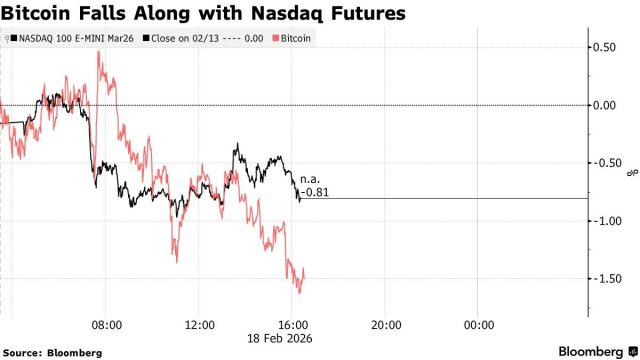
BTC and Nasdaq in the same downward trajectory | Source: Chart from Walter Bloomberg on X

This development has impacted investors’ sentiment and focus. Currently, investors are becoming more cautious due to growing tensions over Iran, renewed discussions about AI’s broader economic effects, and uncertainty about a potential Fed rate cut following recent inflation data.

In the midst of the geopolitical tension, flows, especially from Exchange-Traded Funds (ETFs), have stayed negative. US-listed Bitcoin ETFs recorded a fourth consecutive week of outflows, with over $360 million withdrawn just last week. These outflows point to weakening sentiment as indicated by CryptoQuant’s Fear and Greed Index, which is positioned at 10, classified as extreme fear.

While the market has shifted into extreme fear levels, analysts believe that BTC might extend its ongoing consolidation phase, with $60,000 considered as the main support. However, further macro shocks are expected to push BTC’s price back toward the $50,000 threshold.

Which BTC Investors Are Under Stress

During increased bearish phases, investors’ action and activity are crucial to gauging the current market state and its next possible direction. In a recent analysis, Anil, an on-chain researcher and investor, has outlined a key divergence between Bitcoin short-term holders and long-term holders.

With the market’s current state, BTC short-term holders are going through a stress period driven by capitulation. Meanwhile, long-term Bitcoin holders have yet to undergo a true stress or capitulation process.

It is worth noting that long-term holders eventually go through a phase of capitulation in every cycle, and then a fresh uptrend starts after a period of accumulation. However, it is hard to determine whether the group will capitulate again this time. Should this occur, Anil noted that the area below 1 on the LTH Unrealized Profit/Loss Ratio chart would be the decisive point for the market.

BTC trading at $68,134 on the 1D chart | Source: BTCUSDT on Tradingview.com

Пов'язані питання

QWhat is the main reason for Bitcoin's recent price decline according to the article?

AThe main reason for Bitcoin's recent price decline is ongoing geopolitical tensions, which are spurring a risk-off trade among investors.

QWhat is the current reading of CryptoQuant's Fear and Greed Index, and what does it signify?

AThe current reading of CryptoQuant's Fear and Greed Index is 10, which is classified as 'extreme fear,' signifying very weak market sentiment.

QHow did US-listed Bitcoin ETFs perform last week in terms of investor flows?

AUS-listed Bitcoin ETFs recorded a fourth consecutive week of outflows, with over $360 million withdrawn just last week.

QAccording to the on-chain analysis, which group of Bitcoin investors is currently under stress and experiencing capitulation?

AAccording to the on-chain analysis, short-term Bitcoin holders are currently under stress and experiencing capitulation.

QWhat are the two key support levels mentioned for Bitcoin's price if the bearish trend continues?

AThe two key support levels mentioned are $60,000 as the main support and the $50,000 threshold if further macro shocks occur.

Пов'язані матеріали

Within Strategy's Framework, STRC's Dividend Yield Remains at 12% as Share Price Stays Below Par Value

Michael Saylor, Executive Chairman of Strategy (MSTR), confirmed that the dividend rate for its STRC perpetual preferred shares will remain at 12.00% through August 2026. The rate has increased from 9% at its July 2025 launch to the current high via a "ratchet" mechanism, which permanently raises the rate by 0.5% whenever the share price falls below $95. This mechanism is intended to push the price back toward its $100 par value and support Strategy's "at-the-market" (ATM) program for issuing new shares to fund Bitcoin purchases. However, the mechanism has not worked as intended. STRC shares closed at $89.46 on July 31, remaining about 10-11% below par value despite the record-high dividend. Competition from rival Strive's higher-yielding SATA securities has pressured demand. The persistent discount has forced Strategy to suspend new STRC issuances via its ATM program, limiting this funding channel for Bitcoin acquisitions. STRC's struggles reflect Bitcoin's own volatility, as the preferred shares historically move in tandem. Analysts have warned the ratchet structure carries long-term, one-way risk. A law firm is investigating Strategy's ability to maintain dividend payments if Bitcoin's price stays low. Retail investors own roughly 83% of outstanding STRC shares, a group seen as prone to panic selling during downturns. In response, Strategy has established financial reserves, including a liquidity cushion covering about 26 months of dividend/interest obligations, and a $2 billion share buyback program alongside a Bitcoin monetization framework, though the company emphasized it is not obligated to sell any Bitcoin.

cryptonews.ru6 хв тому

Within Strategy's Framework, STRC's Dividend Yield Remains at 12% as Share Price Stays Below Par Value

cryptonews.ru6 хв тому

Analyst: Bitcoin's Price Will Drop to $60k in August, Then Rebound to $70k

Financial analyst Andrey Poroshin has provided a new forecast for Bitcoin's price dynamics in August. Poroshin, an analyst at the Bitbanker exchange, expects the cryptocurrency market to experience a downturn this month, with prices retesting the $60,000 level due to a lack of supportive macroeconomic catalysts. He noted that the recent US Federal Reserve decision to hold interest rates did not significantly impact the market, while inflation remains above the 2% target. Poroshin stated that Bitcoin is ending July under pressure from moderate volatility and a lack of new macroeconomic stimuli, leading to continued market caution. According to his base scenario, Bitcoin will drop to a range of $60,000 to $62,000 before recovering to $70,000. He pointed out that even $70,000 remains below the cost of mining in the US, which has prompted some miners to shift towards AI data center operations. Poroshin cited the winding down of BitMEX's operations as a potential catalyst for a price rebound, suggesting the exit of weaker players often coincides with market reversals and reduced short-term selling pressure. He believes Bitcoin is currently less susceptible to geopolitical shocks, such as the Iran-US conflict, and does not expect significant market changes in August related to the pending CLARITY Act. Looking ahead, Poroshin forecasts that September will bring more active price fluctuations driven by potential Fed rate decisions and possible discussions or approval of the CLARITY Act.

cryptonews.ru7 хв тому

Analyst: Bitcoin's Price Will Drop to $60k in August, Then Rebound to $70k

cryptonews.ru7 хв тому

Торгівля

Спот
活动图片





