Gemini nabs US license to offer prediction markets

cointelegraphОпубліковано о 2025-12-11Востаннє оновлено о 2025-12-11

Анотація

Crypto exchange Gemini, founded by the Winklevoss twins, has received a designated contract market license from the CFTC, allowing it to offer prediction markets in the US. Through its affiliate Gemini Titan, the company plans to let users trade event contracts and expand into crypto derivatives like futures and options. The announcement caused Gemini's stock to surge 13.7% in after-hours trading. The license marks the end of a five-year application process and could significantly boost the company, which has seen its stock decline since its public debut. President Cameron Winklevoss stated that prediction markets could potentially rival or exceed traditional capital markets in size.

Crypto exchange Gemini, founded by billionaire twins Tyler and Cameron Winklevoss, has scored a license from the Commodity Futures Trading Commission to offer prediction markets in the US.

Gemini said on Wednesday that its affiliate, Gemini Titan, received a designated contract market license from the CFTC and “plans to enter into the prediction markets space.”

The company said that “starting shortly,” its US users would be able to trade event contracts on its web platform and could expand its US derivatives offerings to include crypto futures, options, and perpetual contracts.

Gemini joins a number of crypto companies that have begun to offer prediction markets, allowing users to bet on the outcomes of a range of events, including sports and geopolitics.

Shares in Gemini (GEMI) shot up 13.7% in after-hours trading on Wednesday to $12.92 after ending the day’s trading session down 0.7%.
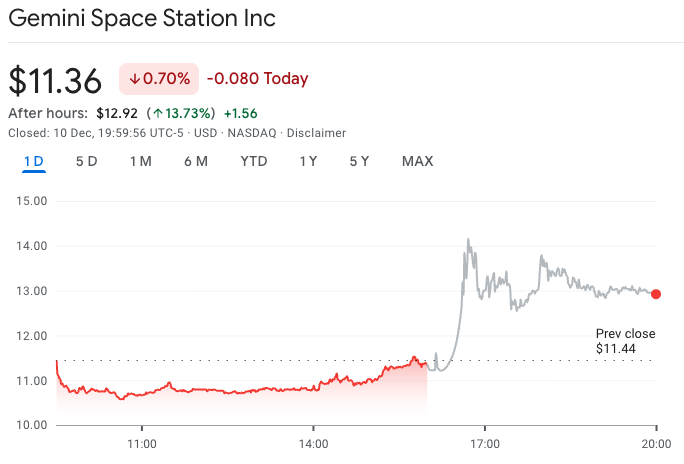
Shares in Gemini jumped on the company’s announcement that it will offer prediction markets. Source: Google Finance

The license could be a major boost for Gemini, whose stock is down 64.5% since its public debut on Sept. 12 as the crypto market has struggled to sustain a rally.

Related: ‘Elite’ traders hunt dopamine-seeking retail on prediction markets: 10x Research

“Prediction markets have the potential to be as big or bigger than traditional capital markets,” said Gemini’s president, Cameron Winklevoss.

Gemini CEO Tyler Winklevoss said it first applied for the license in March 2020, and the approval “marks the culmination of a 5-year licensing process and the beginning of a new chapter for Gemini.”

Magazine: Can Robinhood or Kraken’s tokenized stocks ever be truly decentralized?

Пов'язані питання

QWhat license did Gemini receive and from which US regulatory body?

AGemini received a designated contract market license from the Commodity Futures Trading Commission (CFTC).

QWhich Gemini affiliate was specifically granted the license to operate prediction markets?

AGemini Titan, an affiliate of the crypto exchange Gemini, was granted the license.

QHow did the announcement of the license affect Gemini's stock price in after-hours trading?

AGemini's stock (GEMI) shot up 13.7% in after-hours trading to $12.92.

QAccording to Cameron Winklevoss, how big does he believe prediction markets can become?

ACameron Winklevoss stated that prediction markets 'have the potential to be as big or bigger than traditional capital markets.'

QWhen did Gemini first apply for this license, according to CEO Tyler Winklevoss?

ACEO Tyler Winklevoss said the company first applied for the license in March 2020.

Пов'язані матеріали

Bitcoin Withdrawals Continue: 8 Years of Storage in a Coldcard Cold Wallet Ended in Zero

Coldcard Hardware Wallet Hacked: Losses Mount Due to Vulnerable Seed Generation A critical vulnerability in Coldcard hardware wallets has led to a continued wave of fund thefts. According to Galaxy Research, the total stolen has reached 1,367.05 BTC (approx. $88.6 million) from 4,585 addresses, a significant increase from the initial 594.5 BTC reported on July 30, 2026. Most of the stolen funds remain on the attackers' addresses. The issue is not with the current firmware, which Coinkite has updated, but with seed phrases generated on vulnerable devices between March 2021 and the release of fixed firmware versions. Due to a programmer error, devices switched from using a hardware random number generator to the software-based Yasmarang generator, which was initialized with publicly accessible data like the chip's serial number. This made the seed phrases predictable through offline brute-force attacks, meaning wallets remain at risk until funds are moved to a new wallet generated with the patched firmware. Affected devices include Mk2/Mk3 with firmware 4.0.1–4.1.9 (and up to 5.0.3), Mk4/Mk5 up to version 5.6.0, and Q models up to 1.5.0Q. The only exceptions are seeds created with a high-entropy method like at least 50 independent dice rolls or a strong unique BIP-39 passphrase. All other owners must generate a new seed on the fixed firmware and transfer their assets. A case highlighting the human impact involves a 39-year-old long-term investor who lost 2 BTC (approx. $130,000) in minutes. He had accumulated the Bitcoin over eight years through physical labor, viewing it as a financial lifeline and a retirement plan in a country suffering from hyperinflation. His story underscores that even conservative "buy and hold in cold storage" strategies can be compromised by such underlying technical flaws. From a technical perspective, this incident echoes historical failures where weak random number generators undermined cryptographic security, challenging the assumption that offline storage is automatically foolproof.

cryptonews.ru32 хв тому

Bitcoin Withdrawals Continue: 8 Years of Storage in a Coldcard Cold Wallet Ended in Zero

cryptonews.ru32 хв тому

Торгівля

Спот
活动图片





