Gemini Leaves For USA Market Dominance As MAXI Emerges As A Top Contender

bitcoinistОпубліковано о 2026-02-05Востаннє оновлено о 2026-02-05

Анотація

Gemini exchange is strategically withdrawing from secondary markets like Canada, the Netherlands, and France to focus on dominating the U.S. market and capturing institutional capital. This shift creates a divergence: regulated platforms target safety and compliance, while retail traders seek high-risk, high-reward opportunities on-chain. Maxi Doge ($MAXI) emerges as a meme token catering to this demand, offering gamified trading, leverage-like features, and staking rewards. Its presale has raised over $4.5M, reflecting strong retail interest as on-chain volumes grow. The project represents a cultural shift toward aggressive, community-driven trading amid increasing central exchange regulation.

The crypto regulatory map is changing fast. Gemini, the Winklevoss-led exchange, is accelerating its withdrawal from secondary jurisdictions to double down on the United States of America.

After leaving the Netherlands and France, they’ve just told Canadian users to close accounts by year-end. Is this a retreat? Hardly. It’s a cold calculation.

By cutting loose fragmented markets, Gemini is clearing the runway to become the primary gateway for the massive wave of U.S. institutional capital heading our way. The market is effectively splitting in two.

On one side, you have regulated giants like Gemini chasing safety and ‘slow’ institutional money. On the other? An insatiable retail hunger for high-variance plays. While institutions stick to the ‘boring’ infrastructure, retail liquidity is flowing aggressively on-chain, hunting for outsized returns.

As exchanges get ‘suit-ified,’ a vacuum for risk-on assets is opening up. New meme tokens are filling the gap, offering the volatility regulated giants can’t touch.

That explains why on-chain volumes are hitting fresh highs even as exchanges shrink their global footprints. It’s in this divergence that Maxi Doge ($MAXI) has surfaced, not just as a token, but as a vehicle for the aggressive trading culture traditional exchanges are regulating out of existence.

Institutional Safety Versus The Retail Hunger For Alpha

The narrative is defined by a tension between compliance and degeneracy. Gemini exiting Canada to focus on U.S. dominance might be great for Bitcoin’s long-term legitimacy, but frankly, it leaves a void for traders craving the raw energy of early crypto.

The ‘Leverage King’ culture of Maxi Doge targets that exact crowd, traders who see volatility as a feature, not a bug.

Maxi Doge isn’t just another static meme coin relying on a cute dog picture. It gamifies the experience, baking a 1000x leverage mentality right into the project. With planned features like Holder-Only Trading Competitions and a Maxi Fund treasury, community activity actually influences liquidity. It doesn’t avoid the mascot play altogether, though, instead leaning into a fitting, ‘gym-bro’ canine stack with muscles and chugging energy drinks.
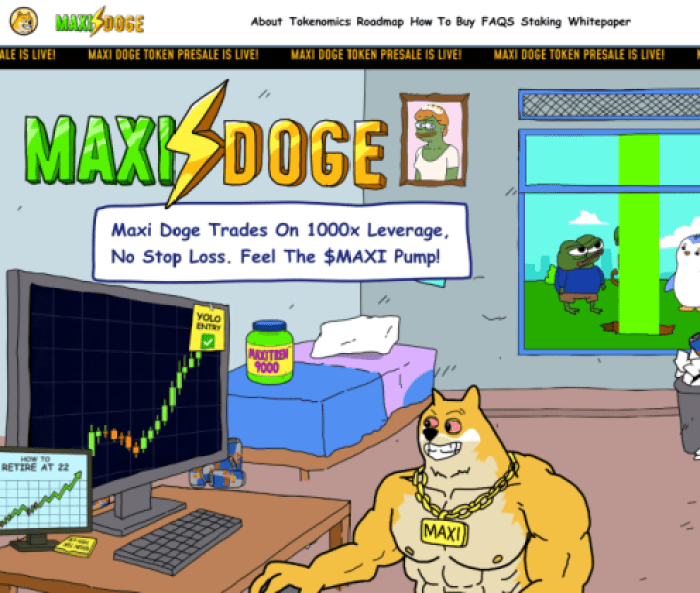
It’s a feedback loop that mirrors a broader trend: utility-adjacent memes are simply outperforming pure speculative assets right now.

Smart money seems to be watching this setup. On-chain data from Etherscan highlights whale wallets scooping up purchases as high as $314K. It suggests high-net-worth players are hedging the institutional bets with high-upside meme plays.

That barbell strategy holding Bitcoin while hunting alpha is quickly becoming the standard for sophisticated portfolios.

BUY $MAXI ON ITS OFFICIAL PRESALE PAGE

Presale Metrics Signal A Shift In Risk Appetite

While Gemini sanitizes its platform for ETF issuers and pension funds, the speculative capital driving viral cycles is moving on-chain. The Maxi Doge presale proves the point. $MAXI has already raised over $4.5M. That figure signals massive demand, arguably because retail excitement on centralized exchanges is cooling off.

At the current price of $0.0002802, the token is sitting in a spot to capture entry-level liquidity before potential listing premiums hit. But there’s more to it than just price action. The project offers a dynamic APY staking model (rewards planned to be paid daily from a 5% pool). It encourages holding, ‘never skipping leg day,’ while the treasury builds out partnerships.

The contrast couldn’t be starker. Gemini offers safety and modest yields (wealth preservation). Maxi Doge offers a high-risk, high-reward arena (wealth creation).

For the retail trader priced out of owning a whole Bitcoin, the ‘lift, trade, repeat’ ethos of $MAXI just hits harder than regulatory compliance. The data backs it up, too: as centralized friction grows, decentralized volume explodes.

EXPLORE $MAXI ON ITS OFFICIAL PRESALE PAGE

This article is for informational purposes only and does not constitute financial advice. Cryptocurrency investments, especially in presale and meme tokens, carry high risks, including the potential loss of principal. Always conduct independent research.

Пов'язані питання

QWhy is Gemini withdrawing from secondary markets like Canada, the Netherlands, and France?

AGemini is withdrawing from these secondary jurisdictions to focus its resources and double down on the United States market, aiming to become the primary gateway for the massive wave of U.S. institutional capital entering the crypto space.

QWhat is the core difference between the strategy of regulated giants like Gemini and the on-chain retail activity described in the article?

ARegulated giants like Gemini are chasing safety and 'slow' institutional money, focusing on compliance and wealth preservation. In contrast, retail liquidity is flowing on-chain, aggressively hunting for high-variance, high-return assets that offer outsized gains, which regulated exchanges often cannot provide.

QWhat is the unique value proposition of Maxi Doge ($MAXI) according to the article?

AMaxi Doge ($MAXI) is not just a meme token; it gamifies the trading experience by baking a 1000x leverage mentality into the project. It offers features like Holder-Only Trading Competitions and a treasury fund, creating a feedback loop where community activity influences liquidity, targeting traders who see volatility as a feature.

QWhat does the article suggest about the current trend of 'smart money' or high-net-worth players in crypto?

AThe article suggests that smart money is employing a 'barbell strategy': they are hedging their institutional bets (like holding Bitcoin) with high-upside meme plays (like $MAXI), as indicated by whale wallets making large purchases to capture alpha while maintaining a base of safer assets.

QWhat does the success of the Maxi Doge presale (raising over $4.5M) indicate about the current market?

AThe successful presale indicates a massive demand and a shift in risk appetite, showing that speculative capital is moving on-chain as retail excitement on centralized exchanges cools off, and traders are seeking high-risk, high-reward opportunities in decentralized environments.

Пов'язані матеріали

Breaking: OpenAI Undergoes Major Reorganization, President Brockman Assumes Command

OpenAI has announced a major internal reorganization just months before its anticipated IPO. The company is merging its three flagship product lines—ChatGPT, Codex, and the API platform—into a single, unified product organization. The most significant leadership change involves co-founder and President Greg Brockman moving from a background technical role to take full, permanent control over all product strategy. This follows the indefinite medical leave of AGI Deployment CEO Fidji Simo. Additionally, ChatGPT's longtime lead, Nick Turley, has been reassigned to enterprise products, with former Instagram executive Ashley Alexander taking over consumer offerings. The consolidation, internally framed as a strategic move towards an "Agentic Future," aims to break down internal silos and create a cohesive "Super App." This planned desktop application would integrate ChatGPT's conversational abilities, Codex's coding power, and a rumored internal web browser named "Atlas" to autonomously perform complex user tasks. The reorganization occurs amid significant internal and external pressures. OpenAI has recently seen a wave of high-profile departures, including Sora co-lead Bill Peebles and other senior technical leaders, leading to concerns about a thinning executive bench. Externally, rival Anthropic recently secured funding at a staggering $900 billion valuation, surpassing OpenAI's own. Google's upcoming I/O developer conference also poses a competitive threat. Analysts suggest the dramatic restructure is a pre-IPO move to present a clearer, more focused narrative to Wall Street—streamlining operations and demonstrating decisive leadership under Brockman to counter internal turbulence and intense market competition.

marsbit3 год тому

Breaking: OpenAI Undergoes Major Reorganization, President Brockman Assumes Command

marsbit3 год тому

Two Survival Structures of Market Makers and Arbitrageurs

Market makers and arbitrageurs represent two distinct survival structures in high-frequency trading. Market makers primarily use limit orders (makers) to profit from the bid-ask spread, enjoying high capital efficiency (nominally 100%) but bearing inventory risk. This "inventory risk" arises from passive, fragmented, and discontinuous order fills in the limit order book (LOB). This risk, while a potential cost, can also contribute to excess profit if managed within control boundaries, allowing for mean reversion. Market makers essentially sell "time" (uncertainty over execution timing) to the market for price control and low fees. In contrast, cross-exchange arbitrageurs typically use market orders (takers) to exploit price differences or funding rates, resulting in lower nominal capital efficiency (requiring capital on both exchanges) and higher transaction costs. Their risk exposure stems from asymmetries in exchange rules (e.g., minimum order sizes), execution latency, and infrastructure risks (e.g., ADL, oracle drift). These exposures are active, exogenous gaps that primarily erode profits rather than contribute to them. Arbitrageurs essentially sell "space" (capital sunk across venues) for localized, immediate certainty. Both strategies engage in a trade-off between execution friction and residual risk. Optimal systems allow for temporary, controlled risk exposure rather than enforcing zero exposure at all costs. Their evolution converges towards hybrid models: arbitrageurs may use maker orders to reduce costs, while market makers may use taker orders or hedges for risk management. Ultimately, both use different forms of risk exposure—market makers exposing inventory, arbitrageurs immobilizing capital—to extract marginal, hard-won certainty from the market.

链捕手3 год тому

Two Survival Structures of Market Makers and Arbitrageurs

链捕手3 год тому

Who Will Define the Rules of the AI Era? Anthropic Discusses the 2028 US-China AI Landscape

This article, based on Anthropic's analysis, outlines the intensifying systemic competition between the U.S./allies and China for AI leadership by 2028. It argues that access to advanced computing power ("compute") is the critical bottleneck, where the U.S. currently holds a significant advantage through chip export controls and allied innovation. However, China's AI labs remain competitive by exploiting policy loopholes—via chip smuggling, overseas data center access, and "model distillation" attacks to copy U.S. model capabilities—keeping them close to the frontier. The piece presents two contrasting scenarios for 2028. In the first, decisive U.S. action to tighten compute controls and curb distillation locks in a 12-24 month AI capability lead, cementing democratic influence over global AI norms, security, and economic infrastructure. In the second, policy inaction allows China to achieve near-parity through continued access to U.S. technology, enabling Beijing to promote its AI stack globally and integrate advanced AI into its military and governance systems, altering the strategic balance. Anthropic contends that maintaining a decisive U.S. lead is essential for shaping safe AI development and governance. The core recommendation is for U.S. policymakers to urgently close compute and model access loopholes while promoting global adoption of the U.S. AI technology stack to secure a lasting strategic advantage.

marsbit5 год тому

Who Will Define the Rules of the AI Era? Anthropic Discusses the 2028 US-China AI Landscape

marsbit5 год тому

Торгівля

Спот
Ф'ючерси
活动图片