Gemini Leaves For USA Market Dominance As MAXI Emerges As A Top Contender

bitcoinistОпубліковано о 2026-02-05Востаннє оновлено о 2026-02-05

Анотація

Gemini exchange is strategically withdrawing from secondary markets like Canada, the Netherlands, and France to focus on dominating the U.S. market and capturing institutional capital. This shift creates a divergence: regulated platforms target safety and compliance, while retail traders seek high-risk, high-reward opportunities on-chain. Maxi Doge ($MAXI) emerges as a meme token catering to this demand, offering gamified trading, leverage-like features, and staking rewards. Its presale has raised over $4.5M, reflecting strong retail interest as on-chain volumes grow. The project represents a cultural shift toward aggressive, community-driven trading amid increasing central exchange regulation.

The crypto regulatory map is changing fast. Gemini, the Winklevoss-led exchange, is accelerating its withdrawal from secondary jurisdictions to double down on the United States of America.

After leaving the Netherlands and France, they’ve just told Canadian users to close accounts by year-end. Is this a retreat? Hardly. It’s a cold calculation.

By cutting loose fragmented markets, Gemini is clearing the runway to become the primary gateway for the massive wave of U.S. institutional capital heading our way. The market is effectively splitting in two.

On one side, you have regulated giants like Gemini chasing safety and ‘slow’ institutional money. On the other? An insatiable retail hunger for high-variance plays. While institutions stick to the ‘boring’ infrastructure, retail liquidity is flowing aggressively on-chain, hunting for outsized returns.

As exchanges get ‘suit-ified,’ a vacuum for risk-on assets is opening up. New meme tokens are filling the gap, offering the volatility regulated giants can’t touch.

That explains why on-chain volumes are hitting fresh highs even as exchanges shrink their global footprints. It’s in this divergence that Maxi Doge ($MAXI) has surfaced, not just as a token, but as a vehicle for the aggressive trading culture traditional exchanges are regulating out of existence.

Institutional Safety Versus The Retail Hunger For Alpha

The narrative is defined by a tension between compliance and degeneracy. Gemini exiting Canada to focus on U.S. dominance might be great for Bitcoin’s long-term legitimacy, but frankly, it leaves a void for traders craving the raw energy of early crypto.

The ‘Leverage King’ culture of Maxi Doge targets that exact crowd, traders who see volatility as a feature, not a bug.

Maxi Doge isn’t just another static meme coin relying on a cute dog picture. It gamifies the experience, baking a 1000x leverage mentality right into the project. With planned features like Holder-Only Trading Competitions and a Maxi Fund treasury, community activity actually influences liquidity. It doesn’t avoid the mascot play altogether, though, instead leaning into a fitting, ‘gym-bro’ canine stack with muscles and chugging energy drinks.
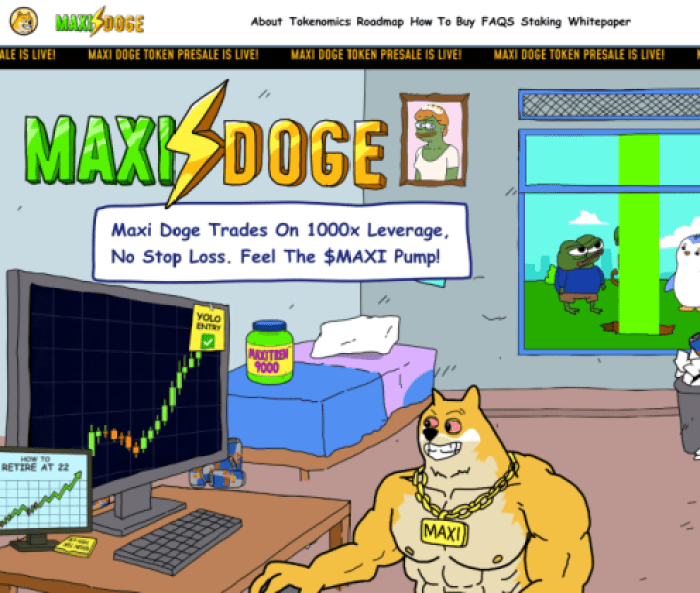
It’s a feedback loop that mirrors a broader trend: utility-adjacent memes are simply outperforming pure speculative assets right now.

Smart money seems to be watching this setup. On-chain data from Etherscan highlights whale wallets scooping up purchases as high as $314K. It suggests high-net-worth players are hedging the institutional bets with high-upside meme plays.

That barbell strategy holding Bitcoin while hunting alpha is quickly becoming the standard for sophisticated portfolios.

BUY $MAXI ON ITS OFFICIAL PRESALE PAGE

Presale Metrics Signal A Shift In Risk Appetite

While Gemini sanitizes its platform for ETF issuers and pension funds, the speculative capital driving viral cycles is moving on-chain. The Maxi Doge presale proves the point. $MAXI has already raised over $4.5M. That figure signals massive demand, arguably because retail excitement on centralized exchanges is cooling off.

At the current price of $0.0002802, the token is sitting in a spot to capture entry-level liquidity before potential listing premiums hit. But there’s more to it than just price action. The project offers a dynamic APY staking model (rewards planned to be paid daily from a 5% pool). It encourages holding, ‘never skipping leg day,’ while the treasury builds out partnerships.

The contrast couldn’t be starker. Gemini offers safety and modest yields (wealth preservation). Maxi Doge offers a high-risk, high-reward arena (wealth creation).

For the retail trader priced out of owning a whole Bitcoin, the ‘lift, trade, repeat’ ethos of $MAXI just hits harder than regulatory compliance. The data backs it up, too: as centralized friction grows, decentralized volume explodes.

EXPLORE $MAXI ON ITS OFFICIAL PRESALE PAGE

This article is for informational purposes only and does not constitute financial advice. Cryptocurrency investments, especially in presale and meme tokens, carry high risks, including the potential loss of principal. Always conduct independent research.


Пов'язані питання

QWhy is Gemini withdrawing from secondary markets like Canada, the Netherlands, and France?

AGemini is withdrawing from these secondary jurisdictions to focus its resources and double down on the United States market, aiming to become the primary gateway for the massive wave of U.S. institutional capital entering the crypto space.

QWhat is the core difference between the strategy of regulated giants like Gemini and the on-chain retail activity described in the article?

ARegulated giants like Gemini are chasing safety and 'slow' institutional money, focusing on compliance and wealth preservation. In contrast, retail liquidity is flowing on-chain, aggressively hunting for high-variance, high-return assets that offer outsized gains, which regulated exchanges often cannot provide.

QWhat is the unique value proposition of Maxi Doge ($MAXI) according to the article?

AMaxi Doge ($MAXI) is not just a meme token; it gamifies the trading experience by baking a 1000x leverage mentality into the project. It offers features like Holder-Only Trading Competitions and a treasury fund, creating a feedback loop where community activity influences liquidity, targeting traders who see volatility as a feature.

QWhat does the article suggest about the current trend of 'smart money' or high-net-worth players in crypto?

AThe article suggests that smart money is employing a 'barbell strategy': they are hedging their institutional bets (like holding Bitcoin) with high-upside meme plays (like $MAXI), as indicated by whale wallets making large purchases to capture alpha while maintaining a base of safer assets.

QWhat does the success of the Maxi Doge presale (raising over $4.5M) indicate about the current market?

AThe successful presale indicates a massive demand and a shift in risk appetite, showing that speculative capital is moving on-chain as retail excitement on centralized exchanges cools off, and traders are seeking high-risk, high-reward opportunities in decentralized environments.

Пов'язані матеріали

Crypto Miners' Big AI Gamble: Valuations Enter Differentiation Stage, Comeback Fight Proves Tough

Crypto Mining Firms' AI Bet: Valuation Divergence and a Challenging Transformation Facing declining profitability in crypto mining, mining companies are pivoting to AI infrastructure, capitalizing on their existing power resources, land, and data center expertise to offer GPU compute power. This transition narrative has boosted their stock prices significantly, with firms like Hut 8 and Bitfarms seeing gains over 100% year-to-date, far outpacing Bitcoin. This has led to a market valuation split, with pioneers like CoreWeave reaching a $62.8B market cap, while others remain below $5B. The market currently prioritizes growth potential over short-term profits, which remain under pressure due to heavy capital expenditures for AI build-outs and crypto asset volatility. However, the transformation is a high-stakes gamble. Bitcoin mining profitability is shrinking, with the average production cost around $63,707 and miner margins contracting. While AI offers a more lucrative long-term path, it requires massive investment—estimated at a $500B near-term funding gap. Success now hinges on execution: delivering on contracted power capacity, securing quality tenants like major cloud providers, and managing the immense financial burden. The valuation focus is shifting from mere power capacity to project delivery, future cash flows, and tenant quality, making this a difficult but critical turnaround attempt.

链捕手5 хв тому

Crypto Miners' Big AI Gamble: Valuations Enter Differentiation Stage, Comeback Fight Proves Tough

链捕手5 хв тому

Analysis of the Latest Portfolio Adjustment by the "Top Player" in the U.S. Stock Market: $9 Billion Short on NVIDIA, Shifting Focus to Power and Memory Sectors

AI investor Leopold Aschenbrenner has made a significant portfolio shift, taking a $9 billion nominal short position against top AI infrastructure stocks like NVIDIA, ASML, and Oracle. Simultaneously, he is redirecting capital towards what he sees as the next critical bottlenecks in the AI boom: power, memory, and data center networking, alongside private investments in AI model companies like Anthropic. This move is interpreted not as a call that the AI bubble has burst, but as a rotation within the infrastructure stack. The analysis highlights NVIDIA's recent $25 billion bond issuance as a potential signal, questioning why a cash-rich company would seek external debt despite high profits and increased dividends/buybacks. The core investment thesis is that the initial, crowded "picks and shovels" trade in semiconductors is maturing. The next wave of capital is expected to flow into the physical and logistical constraints of AI expansion: electricity supply, memory chip capacity, data center construction, and enabling technologies like optical networking (fiber) for high-bandwidth communication, where copper remains crucial for short distances. Aschenbrenner's substantial (approx. 20% of fund) private stake in Anthropic is noted as a key part of his strategy—investing directly in the "mine" (AI models) rather than just the "shovels." The discussion concludes that while certain segments may be overvalued, the overarching AI infrastructure demand driven by real product usage remains robust. The most promising long-term investments are seen in essential, non-sexy infrastructure—particularly energy and power companies—whose demand is viewed as a global constant irrespective of AI's cyclicality.

marsbit26 хв тому

Analysis of the Latest Portfolio Adjustment by the "Top Player" in the U.S. Stock Market: $9 Billion Short on NVIDIA, Shifting Focus to Power and Memory Sectors

marsbit26 хв тому

BIT Research: Liquidity is Disappearing, Will Bitcoin Replay the Bottoming Pattern of 2022?

The crypto market is currently in an adjustment phase driven by policy expectations and liquidity shifts. Despite a brief rebound fueled by geopolitical easing and SpaceX's strong IPO performance, unexpectedly hawkish signals from new Fed Chair Kevin Warsh have removed anticipated easing support. Concurrently, stablecoin liquidity is shrinking, with insufficient new capital inflows, pushing the market into a typically quiet summer period. Pricing lacks catalysts for a sustained rally. Daily trading volume has significantly contracted, stablecoin growth has slowed markedly, and the supportive effect of Strategy's (formerly MicroStrategy) STRC preferred stock-financed Bitcoin purchases is fading. Amid policy uncertainty, seasonal weakness, and liquidity contraction, Bitcoin faces near-term downward pressure. Warsh's hawkish pivot and refusal to provide a clear policy outlook have increased risk premiums, historically unfavorable for Bitcoin. Technically, the trend remains bearish below $73,700, with $62,446 as critical support. A break below could accelerate declines, though a prolonged consolidation phase, similar to 2022's bottoming process, is possible. Liquidity is a core constraint. Current daily volume is around $500 billion, roughly 25% of the peak during the July-Oct 2025 rally. The 12-month growth rates for USDT and USDC have fallen to ~20%, with 6-month growth near zero, indicating weak new inflows. Bitcoin ETF and Strategy-driven inflows have also weakened, with a 30-day rolling net outflow. With inflation at 4.2% above the Fed's target, combined hawkish policy, seasonal factors, and liquidity shortages challenge Bitcoin's ability to hold above $60,000. However, this adjustment phase may be forming a cyclical low this summer, potentially setting the stage for the next bull cycle.

marsbit55 хв тому

BIT Research: Liquidity is Disappearing, Will Bitcoin Replay the Bottoming Pattern of 2022?

marsbit55 хв тому

Who Makes the Best Use of Claude Code? The Answer Might Not Be Programmers

Claude Code Usage Report Summary (Based on ~400k sessions) Core Finding: In agentic programming with Claude Code, a clear division of labor has emerged: humans primarily decide *what* to build (planning decisions), while Claude decides *how* to build it (execution decisions). Key Insights: 1. **Effectiveness is not limited to programmers.** In code-generation tasks, success rates for users in non-technical fields (law, finance, management, research) are nearing those of software engineers. What matters most is the user's domain expertise and understanding of the problem to be solved. 2. **Domain expertise drives success and efficiency.** Sessions where users exhibited "expert" proficiency in the task's domain saw verified success rates double compared to "novice" sessions. Experts also delegated more work per instruction, with Claude executing more actions and producing more output. 3. **AI is amplifying, not replacing, domain knowledge.** Claude Code lowers the *implementation* barrier, not the *judgment* barrier. The value of knowing the "what" and "why" is increasing relative to just knowing the "how" to code. 4. **Usage is evolving.** Over a 7-month period (Oct '25 - Apr '26), the share of sessions for debugging halved, while use for software operations, data analysis, and non-code writing roughly doubled. The estimated economic value of typical tasks increased by ~25%. Conclusion: The data suggests coding agents are making programming background less critical for completing technical tasks. However, they reward and amplify deep domain understanding. The ability to successfully direct an AI agent stems more from mastery of a specific field than from coding skill itself. The primary gains come from being competent in a domain; deep specialization adds only marginal additional advantage. This may signal a shift where software creation becomes integrated into various professions.

marsbit1 год тому

Who Makes the Best Use of Claude Code? The Answer Might Not Be Programmers

marsbit1 год тому

Торгівля

Спот
Ф'ючерси
活动图片