Garlinghouse Reveals Why Ripple Really Pivoted To Its Own Stablecoin

bitcoinistОпубліковано о 2026-03-27Востаннє оновлено о 2026-03-27

Анотація

Ripple CEO Brad Garlinghouse explained that the company launched its own stablecoin, RLUSD, to internalize a role it was already playing at scale—having previously minted 20% of all USDC due to its large payment flows. The decision was driven by Ripple's substantial balance sheet strength, which positions it to offer a compliant, institutionally-focused stablecoin, especially after observing vulnerabilities like USDC's depeg during the Silicon Valley Bank collapse. Garlinghouse emphasized that trust, licensing, and transparency will differentiate stablecoins as the market matures, and he expects regulatory progress in the U.S. to continue, with further clarity anticipated by the end of May.

Ripple’s decision to launch RLUSD was not a sudden expansion beyond XRP so much as a move to internalize a business it was already helping power at scale. Speaking at FII Priority Miami 2026, Ripple CEO Brad Garlinghouse said the company’s role in stablecoin flows had grown large enough that building its own product became the logical next step.

Why Ripple Entered the Stablecoin Market

Garlinghouse said the turning point came well before RLUSD’s launch 13 months ago. “Two years ago, we were minting 20% of all USDC,” he said, tying that activity directly to Ripple’s payments business. With more than $100 billion in payment flows already processed, Ripple concluded that if it was already a major engine behind stablecoin usage, it made sense to bring that function in-house.

He also linked the decision to a moment of stress in the stablecoin market. Garlinghouse pointed to USDC’s temporary depeg during the Silicon Valley Bank collapse as a reminder that institutional users care about balance-sheet strength as much as blockchain rails.

“Circle came out and said, hey, we’ll stand in the gap. We’ll guarantee the peg. And it didn’t move because at that point, Circle didn’t have a balance sheet,” he said. “Ripple has on our balance sheet, you know, 60, 70 billion dollars of crypto. We have about four billion dollars of US dollars. And so I think we’re in a position to really have a very compliant, very institutional focused stablecoin.”

According to Garlinghouse, stablecoins are increasingly adopted not because companies want exposure to crypto branding, but because they want a better way to solve treasury, settlement and cross-border transfer problems. That broader shift, he argued, is already reshaping how the sector is perceived.

Garlinghouse compared the current state of crypto to the internet industry in the late 1990s, when companies led with the technology rather than the use case. “We don’t talk about anything as an internet company now because it’s just prevalent in the background,” he said. “And I think that’s where some of the blockchain and crypto based solutions are heading”. Companies, he added, “just want to solve a payments problem. They want to solve a custody problem.”

On market structure, Garlinghouse expects the stablecoin field to get more crowded before it gets smaller. He said the biggest banks are already evaluating whether they should issue their own stablecoins, but questioned whether the market benefits from too many dollar-backed instruments that ultimately serve the same economic function. “We don’t need, you know, 50 US dollar stablecoins. Like, why? Like, they’re all, it’s still, at the end of the day, a U.S. dollar,” he said.

That does not mean he sees no room for differentiation. Instead, he argued that trust, licensing and reserve transparency will become the real competitive variables as the market matures. Ripple, he said, has deliberately taken a compliance-first route, pursuing not just a New York Department of Financial Services license but also an OCC license.

He added that the sector as a whole needs more regulatory verification and disclosure, pointing even to Tether’s renewed push for an audit as evidence that transparency is becoming harder to avoid.

Garlinghouse was similarly upbeat on the US policy backdrop. He described passage of the Genius Act as a major unlock for demand and said corporate executives are now actively asking whether stablecoins should be part of their operations. While he said follow-on legislation around asset classification has been slower, he argued the tone in Washington has already shifted sharply, citing recent coordination between the SEC and CFTC and predicting further progress by the end of May.

“So I think we already have made huge progress in this administration to provide some of that structure and Clarity [Act]. I think clarity will still pass. I was in Washington two days ago, and I think we’ll still get something. [...] I’ll predict by the end of May we’ll get something across,” Garlinghouse said.

At press time, XRP traded at $1.36.
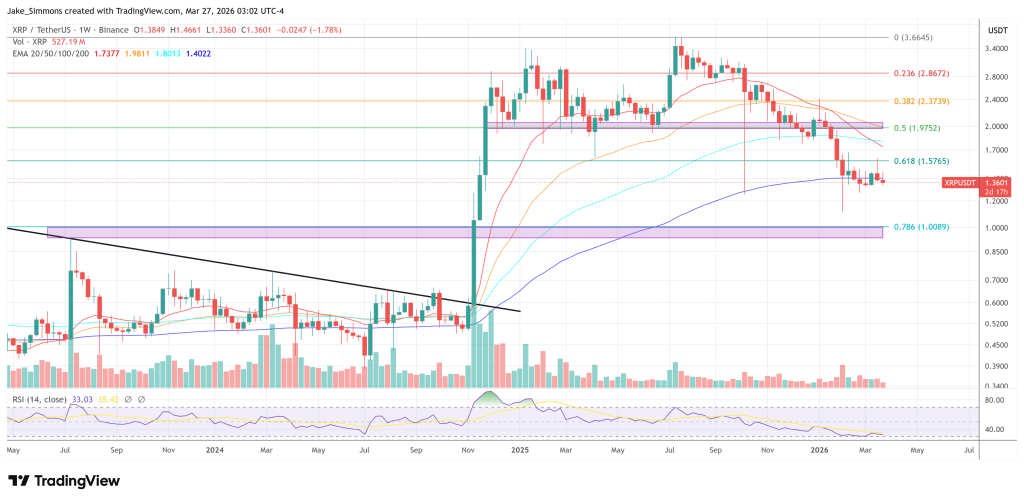
XRP drops below the 200-week EMA again, 1-week chart | Source: XRPUSDT on TradingView.com

Пов'язані питання

QWhat was the main reason Ripple decided to launch its own stablecoin, RLUSD?

ARipple decided to launch RLUSD because its role in stablecoin flows had grown so large that building its own product became the logical next step. The company was already minting 20% of all USDC and processing over $100 billion in payment flows, making it a major engine behind stablecoin usage.

QAccording to Brad Garlinghouse, what event in the stablecoin market highlighted the importance of a strong balance sheet for institutional users?

AGarlinghouse pointed to USDC's temporary depeg during the Silicon Valley Bank collapse as the event that highlighted the importance of balance-sheet strength for institutional users, noting that Circle lacked the balance sheet to guarantee the peg at that time.

QHow does Garlinghouse compare the current state of the crypto industry to the internet in the 1990s?

AGarlinghouse compared the current state of crypto to the internet industry in the late 1990s, where companies led with the technology rather than the use case. He stated that just as we no longer talk about 'internet companies' because the technology is now prevalent in the background, blockchain and crypto-based solutions are heading in the same direction.

QWhat does Garlinghouse believe will be the key competitive differentiators in the mature stablecoin market?

AGarlinghouse believes that trust, licensing, and reserve transparency will become the real competitive variables as the stablecoin market matures.

QWhat positive developments in US policy and regulation did Garlinghouse highlight?

AGarlinghouse was upbeat on US policy, citing the passage of the Genius Act as a major unlock for demand. He also mentioned improved coordination between the SEC and CFTC and predicted that further legislative clarity would be achieved by the end of May.

Пов'язані матеріали

Annual Salary of Millions Competing for Electricians, Meta Rushes to Open Its Own Technical School

The AI boom is facing an unexpected bottleneck: a severe shortage of skilled construction workers and electricians. As tech giants like Meta, OpenAI, and Alphabet race to build massive data centers—such as OpenAI's $16 billion "Stargate" project—they are hitting a critical labor wall. The U.S. needs an estimated 130,000 more electricians, 240,000 construction workers, and 150,000 supervisors by 2030 for AI infrastructure alone, but tens of thousands of electrician jobs go unfilled each year. While AI companies offer high premiums, with electricians earning up to $280,000 annually, worker scarcity still causes massive losses—delays on a single project can cost $14.2 million per month. The complexity of building AI data centers, which require immense power (equivalent to powering hundreds of thousands of homes), sophisticated electrical systems, and advanced liquid cooling solutions, demands highly skilled technicians who are in short supply. To combat this, companies are investing heavily in training. Meta has committed $115 million to a free training school offering tuition, housing, and stipends, targeting 5,000 new workers. OpenAI is partnering with unions to secure skilled labor. These efforts are paying off, with a significant rise in Gen Z interest in trade schools over college. However, the power demands are staggering. AI data centers are driving a rapid surge in electricity consumption, projected to account for up to 12% of U.S. power use by 2028 and raising costs for consumers. Furthermore, the construction boom is project-based, leading to a potential future glut of trained workers once building peaks, which could depress wages industry-wide. The race for AI supremacy now depends as much on skilled hands as on advanced chips.

marsbit1 год тому

Annual Salary of Millions Competing for Electricians, Meta Rushes to Open Its Own Technical School

marsbit1 год тому

OpenAI No Longer Sells Its Most Expensive Model for Profit

OpenAI is shifting its business strategy away from promoting its most expensive, flagship models for every task. Recent price cuts—80% for GPT-5.6 Luna and 20% for Terra—signal a deeper change: the company now actively advises users that many tasks don't require the most powerful model. Instead, OpenAI recommends a tiered approach: use the high-end GPT-5.6 Sol for complex planning and analysis, then delegate execution to cheaper models like Luna. This mirrors moves by Anthropic, which recently launched Claude Opus 5 at half the price of its top model, Fable 5. Both companies are de-emphasizing flagship models as primary revenue drivers, using them instead for brand prestige and technological showcases. The industry is entering a "mass-market" phase, similar to automotive, where high-volume, cost-effective models handle daily operations and drive scale. OpenAI's price reductions are partly enabled by AI models themselves optimizing underlying code and infrastructure, creating a self-reinforcing cycle of efficiency gains and cost reduction. Competition is shifting from "who is smartest" to "who offers the best value." The goal is no longer selling individual models but fostering widespread API adoption and ecosystem lock-in. By making AI calls cheap and ubiquitous, companies like OpenAI aim to become the indispensable, utility-like infrastructure powering automated workflows—the "water and electricity" of software, quietly embedded everywhere.

marsbit1 год тому

OpenAI No Longer Sells Its Most Expensive Model for Profit

marsbit1 год тому

Торгівля

Спот
活动图片





