Full Text of the Fed Decision: 25 Basis Point Rate Cut, $40 Billion Treasury Bill Purchases Within 30 Days

比推Опубліковано о 2025-12-10Востаннє оновлено о 2025-12-10

Анотація

The Federal Reserve lowered the target range for the federal funds rate by 25 basis points to 3.50%-3.75% on December 10, 2025, marking the third consecutive rate cut. The decision was approved by a 9-3 vote. The policy statement removed the description of unemployment as "low," and the latest dot plot maintained the projection of an additional 25 basis point rate cut in 2026. Additionally, the Fed will purchase $40 billion in Treasury bills over 30 days starting December 12 to maintain ample reserve levels. The policy stance reflects concerns over moderating economic activity, a rise in unemployment, and inflation that remains elevated. The committee emphasized its commitment to achieving maximum employment and a 2% inflation target, noting increased downside risks to employment. Voting against the decision were Stephen Miran, who preferred a 50 basis point cut, and Austan Goolsbee and Jeffrey Schmid, who favored no change. The Board also unanimously approved a reduction in the primary credit rate to 3.75%.

On December 10, 2025, local time, the Federal Reserve lowered the benchmark interest rate by 25 basis points to 3.50%-3.75% in a 9-3 vote, marking the third consecutive meeting with a rate cut. The policy statement removed the description of the unemployment rate as "low." The latest dot plot maintains the forecast of a 25 basis point rate cut in 2026.

Additionally, the Federal Reserve will purchase $40 billion in Treasury bills within 30 days starting December 12 to maintain ample reserve supply.

Full Text of the Interest Rate Decision

Available data indicate that economic activity is expanding at a moderate pace. Job growth has slowed this year, and the unemployment rate has risen as of September. More recent indicators are consistent with this situation. Inflation has increased compared to the beginning of the year and remains elevated.

The Committee's long-term goals are to achieve maximum employment and 2% inflation. Uncertainty about the economic outlook remains high. The Committee is closely monitoring risks on both sides of its dual mandate and believes that downside risks in employment have increased in recent months.

To support these goals and considering changes in the risk balance, the Committee decided to lower the target range for the federal funds rate by 25 basis points to 3.50% to 3.75%. In assessing the appropriate timing and magnitude of any further adjustments to the target range for the federal funds rate, the Committee will carefully evaluate incoming data, the evolving economic outlook, and the balance of risks. The Committee is strongly committed to supporting maximum employment and returning inflation to its 2% target.

In evaluating the appropriate monetary policy stance, the Committee will continue to monitor the implications of incoming information for the economic outlook. The Committee would be prepared to adjust the stance of monetary policy as appropriate if risks emerge that could impede the attainment of the Committee's goals. The Committee's assessments will take into account a wide range of information, including labor market conditions, inflationary pressures and inflation expectations, and financial and international developments.

The Committee believes that reserve balances have declined to ample levels and will initiate purchases of short-term U.S. Treasury securities as needed to maintain ample reserve supply on an ongoing basis.

Voting in favor of this monetary policy action were: Chair Jerome H. Powell, Vice Chair John C. Williams, Michael S. Barr, Michelle W. Bowman, Susan M. Collins, Lisa D. Cook, Philip N. Jefferson, Alberto G. Musalem, and Christopher J. Waller. Voting against were Stephen I. Miran, who preferred to lower the target range for the federal funds rate by 1/2 percentage point at this meeting; and Austan D. Goolsbee and Jeffrey R. Schmid, who preferred to maintain the target range for the federal funds rate unchanged at this meeting.
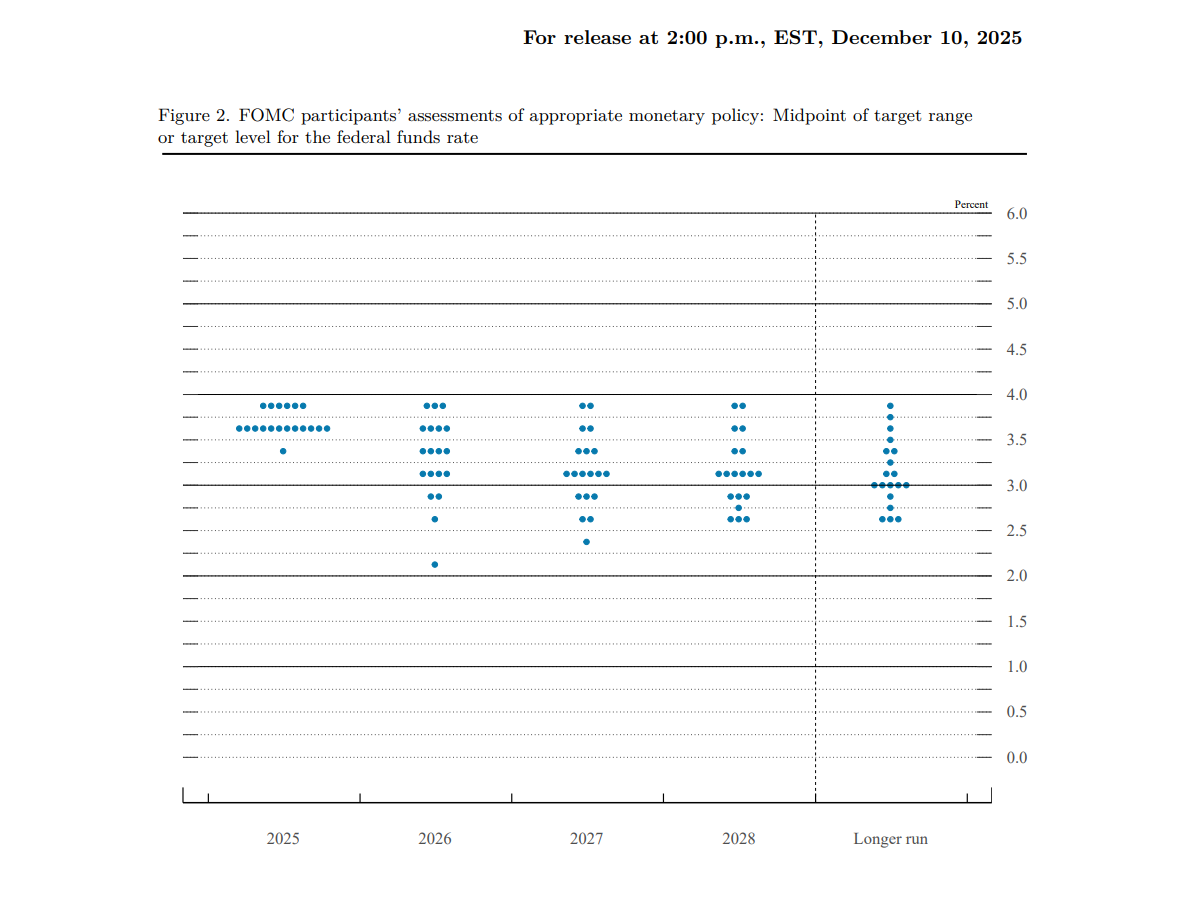
Median Fed Dot Plot: Cumulative 25 Basis Point Rate Cut in 2026

Decisions Regarding Monetary Policy Operations

To implement the monetary policy stance announced in the Federal Open Market Committee's statement on December 10, 2025, the Federal Reserve makes the following decisions:

The Board of Governors of the Federal Reserve System unanimously voted to lower the interest rate on reserve balances to 3.65%, effective December 11, 2025.

As part of the policy decision, the Federal Open Market Committee voted to direct the Open Market Trading Desk at the Federal Reserve Bank of New York, until further notice, to execute transactions in the System Open Market Account in accordance with the following domestic policy directive:

"Effective December 11, 2025, the Federal Open Market Committee directs the Desk:

To conduct open market operations as necessary to maintain the federal funds rate in a target range of 3.50% to 3.75%.

To conduct standing overnight repurchase agreement operations at an offering rate of 3.75%.

To conduct standing overnight reverse repurchase agreement operations at an offering rate of 3.50%, with a per-counterparty limit of $160 billion per day.

To increase the System Open Market Account's holdings of securities by purchasing Treasury bills and, if necessary, other U.S. Treasury securities with remaining maturities of three years or less, to maintain ample levels of reserves.

To reinvest all principal payments from the Federal Reserve's holdings of U.S. Treasury securities at auction. To roll over all principal payments from the Federal Reserve's holdings of agency securities into Treasury bills."

In related actions, the Board of Governors of the Federal Reserve System unanimously voted to approve a 25 basis point reduction in the primary credit rate to 3.75%, effective December 11, 2025. In taking this action, the Board approved requests submitted by the Boards of Directors of the Federal Reserve Banks of New York, Philadelphia, St. Louis, and San Francisco to set this rate.


Twitter:https://twitter.com/BitpushNewsCN

Bitpush TG Discussion Group:https://t.me/BitPushCommunity

Bitpush TG Subscription: https://t.me/bitpush

Original link:https://www.bitpush.news/articles/7594706

Пов'язані питання

QWhat was the new target range for the Federal Funds Rate after the December 10, 2025, Fed decision?

AThe new target range for the Federal Funds Rate is 3.50% to 3.75%.

QHow many members of the Federal Open Market Committee (FOMC) voted against the policy action, and what were their preferred actions?

AThree members voted against the policy action. Stephen I. Miran preferred to lower the target range by 1/2 percentage point, while Austan D. Goolsbee and Jeffrey R. Schmid preferred to maintain the target range unchanged.

QWhat specific action did the Fed announce regarding its balance sheet and Treasury securities?

AThe Fed announced it will purchase $40 billion in Treasury bills over 30 days starting December 12 to maintain ample reserve supplies. It will also reinvest principal payments from its holdings of U.S. Treasury securities and agency securities into Treasury bills.

QAccording to the latest dot plot, what is the median projection for interest rate changes in 2026?

AThe median projection from the latest dot plot is for a cumulative 25 basis point rate cut in 2026.

QWhat changes were made to the policy statement regarding the description of the labor market?

AThe policy statement removed the description of the unemployment rate as 'low'.

Пов'язані матеріали

BIP-110 Controversy Intensifies: Bitcoin May Face Its Most Divisive Hard Fork Battle in Years

Bitcoin is approaching a critical block height of 961,632, which could activate the controversial BIP-110 proposal. This proposal aims to restrict the amount of non-financial data, such as inscriptions and other large data payloads, within Bitcoin transactions. Supporters, including some node operators and Bitcoin purists, argue that BIP-110 is necessary to preserve Bitcoin's core function as a monetary settlement layer by reducing network congestion and node operational burdens caused by non-essential data. They frame it as a correction to keep the network true to its original purpose. However, critics, including prominent figures like Blockstream's Adam Back and developer Jameson Lopp, warn that the proposal's implementation mechanism is dangerously flawed. They highlight that its low 55% miner signaling threshold, coupled with a contentious enforcement mechanism allowing nodes to unilaterally reject non-compliant blocks, significantly increases the risk of a chain split. Opponents argue this sets a dangerous precedent for transaction censorship, undermines Bitcoin's protocol neutrality, and creates excessive uncertainty for developers and businesses, especially since the rule is proposed as a temporary one-year measure. Market analysts, such as those from Bitfinex, suggest a full-scale network split is unlikely due to a lack of broad economic consensus. Major mining pools remain neutral, and adoption of the new rules is minimal. They view the situation more as a governance stress test. The primary risk is operational disruption: if a minority chain persists, major exchanges and custodians may need to temporarily suspend Bitcoin deposits and withdrawals to manage security and liquidity, potentially unsettling newer institutional investors. While BIP-110 is not expected to succeed in overtaking the main chain, its approach has ignited a significant debate about Bitcoin's governance, core values, and resilience.

Foresight News2 хв тому

BIP-110 Controversy Intensifies: Bitcoin May Face Its Most Divisive Hard Fork Battle in Years

Foresight News2 хв тому

NEAR to Airdrop 330,000 Tokens, Betting on TVL Reaching $70 Million

On June 11th, NEAR Protocol launched the Near@3.33 Milestone Incentive Program, targeting users of its Confidential Intents privacy cross-chain execution feature. The program will distribute 333,333 milestone tokens when the Confidential Intents Total Value Locked (TVL) reaches $70 million. Users must have conducted Confidential transactions on near.com and maintain a Confidential balance above $100 in any asset to qualify, with a single wallet capped at 2% of the current airdrop pool. The milestone tokens will be locked upon receipt and cannot be sold or transferred. They can only be converted 1:1 to NEAR tokens once NEAR's Volume Weighted Average Price (VWAP) maintains $3.33 or higher for three consecutive trading days. As of the report, Confidential Intents TVL exceeds $20.69 million, needing roughly a 3x increase to trigger the airdrop. Confidential Intents, launched in February 2026, is NEAR's privacy execution layer designed to prevent MEV, front-running, and strategy leaks by building confidentiality directly into the execution environment. Its TVL has grown from zero to approximately $15 million in about three months. NEAR token price, which surged from around $1 in April to a peak of $3.08, currently trades near $2. The program aims to boost user activity for Confidential Intents, with future incentive rounds planned as community engagement increases.

Foresight News1 год тому

NEAR to Airdrop 330,000 Tokens, Betting on TVL Reaching $70 Million

Foresight News1 год тому

Crypto Market Makers Are Collectively Seeking Change as Money Becomes Harder to Earn

**Summary: Crypto Market Makers Adapt as Margins Shrink** Leading crypto market maker GSR exemplifies a broader industry shift, moving beyond traditional market-making to become a full-service "Web3 investment bank." Its recent strategic acquisitions—including an SEC-registered broker-dealer, rebranded as GSR Securities—and purchases of token advisory firms aim to create an integrated platform covering token design, fundraising, listing, liquidity provision, and asset management. This includes launching an ETF and investing in tokenization platforms like Libeara, backed by a strategic investment from Standard Chartered's SC Ventures. This transformation is not unique to GSR. Other major players like Keyrock, B2C2, Wintermute, and DWF Labs are also expanding geographically, pursuing regulatory licenses (especially under frameworks like MiCA in the EU), and diversifying into over-the-counter (OTC) trading, asset management, and real-world asset tokenization. The driving force behind this collective pivot is a rapidly changing market. Profits from traditional altcoin market-making are declining due to fewer viable projects, reduced client budgets, increased competition, and smarter, more demanding clients. Simultaneously, regulatory pressures are mounting, making compliance a baseline cost. Extreme market events further expose teams lacking robust risk controls. Consequently, the crypto market-making business model is evolving from one reliant on information asymmetry and volatility to a more institutionalized, regulated, and service-diverse industry. Survival now depends on building systemic capabilities beyond mere liquidity provision.

marsbit1 год тому

Crypto Market Makers Are Collectively Seeking Change as Money Becomes Harder to Earn

marsbit1 год тому

Market Adjusts Following Google's $84.7 Billion Fundraising, AI Valuations Now Focus on Payback Speed

After Alphabet's announcement of an $84.75 billion equity financing round, market focus for AI investment is shifting from pure growth narratives to capital efficiency and payback periods. The core argument is that AI is being re-priced from a software-like growth story into a heavy-asset infrastructure cycle, requiring massive capital expenditure (CapEx) on chips, data centers, and power grids. While Alphabet's financing itself is not a distress signal—part of it is for administrative purposes like tax obligations on stock compensation—it highlights the enormous capital demands of AI infrastructure. This demand extends beyond tech giants to pure-play AI model companies (like OpenAI, Anthropic), data center REITs, and utilities. Major tech firms are projected to spend heavily on AI data centers in 2026, signaling a broad-based capital cycle the market must absorb. Consequently, valuation logic is changing. Investors are moving away from questions about who has the strongest AI narrative and are now prioritizing clear visibility into orders, stable cash flows, and the cost of capital. This has led to recent pressure on high-multiple AI software and semiconductor stocks, while "picks-and-shovels" hardware, data center, and power assets with firmer near-term demand may see relative support. The key going forward will be monitoring whether rising CapEx guidance across companies is matched by a timely monetization of AI investments into revenue and cash flow. The market's tolerance for high spending depends on demonstrable returns. While the long-term AI thesis remains intact, the valuation framework has fundamentally shifted to emphasize capital discipline and payback speed.

marsbit1 год тому

Market Adjusts Following Google's $84.7 Billion Fundraising, AI Valuations Now Focus on Payback Speed

marsbit1 год тому

Торгівля

Спот
Ф'ючерси
活动图片





