Frontline Insights | Web3 Lawyer Deciphers the Latest Developments in U.S. Stock Tokenization!

深潮Опубліковано о 2025-12-18Востаннє оновлено о 2025-12-18

Анотація

Summary: On December 15, 2025, Nasdaq submitted a proposal to the SEC to extend U.S. stock trading hours to 23/5, sparking speculation about tokenization, though the filing did not mention it. More significantly, on December 11, the SEC issued a No-Action Letter (NAL) to DTCC, allowing its subsidiary DTC to conduct a pilot for tokenizing traditional securities under strict conditions. The NAL exempts DTC from certain procedural filing requirements but does not constitute a full regulatory endorsement. DTC's pilot involves creating tokenized representations of securities on a permissioned blockchain, allowing direct transfers between approved wallets while maintaining central oversight through its LedgerScan system. This move signals cautious regulatory openness to blockchain efficiency improvements in settlement and asset tracking, without altering the fundamental nature of securities. The development represents a step toward modernizing market infrastructure, with two parallel paths emerging: backend efficiency gains led by institutions like DTCC, and front-end user-facing innovations from brokers and trading platforms, all within evolving regulatory boundaries.

On December 15, 2025, U.S. time, Nasdaq officially submitted Form 19b-4 to the SEC, applying to extend the trading hours for U.S. stocks and exchange products to 23/5 (23 hours per day, 5 days per week).

However, Nasdaq's application for extended trading hours is not a simple extension but rather a change to two formal trading sessions:

Day Session (ET 4:00-20:00) and Night Session (ET 21:00-4:00 the next day). Trading is suspended from 20:00-21:00, and all unfilled orders are canceled uniformly during this pause.

Many readers got excited upon seeing the news, wondering if this is the U.S. preparing for 24/7 tokenized stock trading? But after carefully studying the document, Crypto Salad wants to say, don't jump to conclusions just yet, because Nasdaq stated in the document that many traditional securities trading rules and complex orders do not apply to the night session, and some functions will also be limited.

We have been paying close attention to U.S. stock tokenization; it is one of the most important targets for real-world asset tokenization, especially with the various official moves from the U.S. SEC (Securities and Exchange Commission) recently, which have been层出不穷 (emerging one after another).

This application document has sparked renewed anticipation for U.S. stock tokenization because it represents a significant step by the U.S. to align securities trading hours closer to the 24/7 nature of digital asset markets.However, upon closer look:

This Nasdaq document doesn't mention tokenization at all; it's solely about reforms to the traditional securities system.

If you want a deeper understanding of Nasdaq's move, Crypto Salad can write another article for a detailed interpretation. But today, we want to talk about the tangible news related to U.S. stock tokenization—

The SEC has formally "allowed" attempts by a major U.S. securities depository giant to provide tokenization services.

------【Dividing Line】------

On December 11, 2025, U.S. time, the SEC's Division of Trading and Markets staff issued a<极span style="color:#000000">《No-Action Letter (NAL)》 to DTCC, which was subsequently published on the SEC website. The letter clearly states that, subject to specific conditions, the SEC will not take enforcement action against DTC for conducting tokenization services related to the securities it custodies.

At first glance, many readers felt the SEC had officially "exempted" the use of tokenization technology on U.S. stocks. But upon closer examination, the reality is quite different.

So,what exactly does this letter say? How far has the latest development in U.S. stock tokenization actually progressed? Let's start with the main character of the letter:

1. Who are DTCC and DTC?

DTCC, full name Depository Trust & Clearing Corporation, is a U.S. group company comprising different institutions responsible for custody, stock clearing, and bond clearing.

DTC, full name Depository Trust Company, is a subsidiary of DTCC and the largest securities central depository in the U.S., responsible for the centralized custody of stocks, bonds, and other securities, as well as settlement and transfer. It currently custodies and accounts for over $100 trillion in securities assets. You can think of DTC as the ledger administrator for the entire U.S. stock market.

2. What is the relationship between DTC and U.S. stock tokenization?

Remember the news in early September 2025 about Nasdaq applying to the SEC to issue stocks in tokenized form? DTC already appeared in that application.

Nasdaq stated that the only difference between tokenized stocks and traditional stocks lies in the clearing and settlement of orders at DTC.
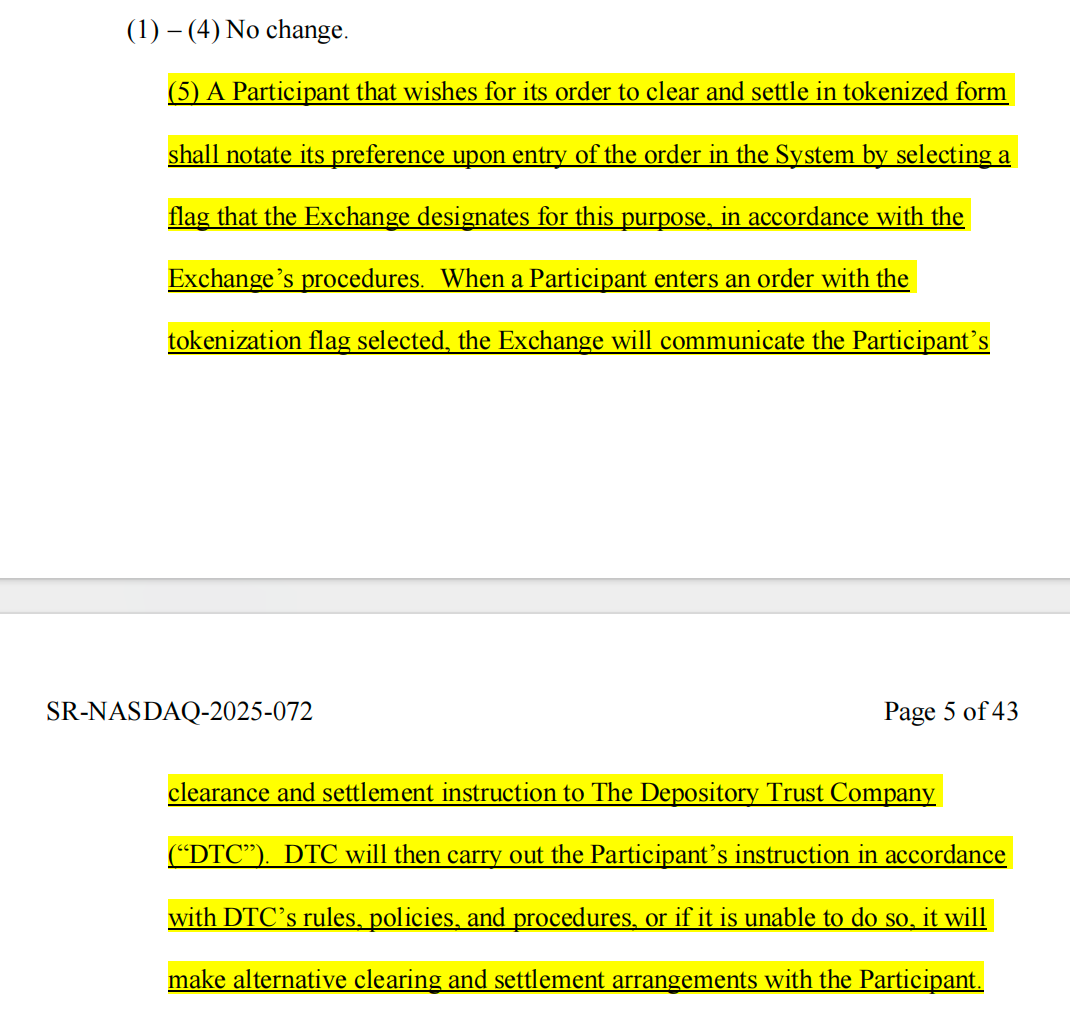
(The above image is截自 (screenshot from) Nasdaq's application proposal)

To make this easier to understand, we've drawn a flowchart. The blue part represents the changes Nasdaq applied for in its September proposal. It's clear that DTC is the key implementation and operational institution for U.S. stock tokenization.

3. What does the newly published《No-Action Letter》say?

Many people directly equate this document with the SEC approving DTC's use of blockchain for U.S. stock record-keeping, which is not entirely accurate. To understand this correctly, we must recognize a clause in the U.S. Securities Exchange Act:

Section 19(b) of the《Securities Exchange Act of 1934》 stipulates that any self-regulatory organization (including clearing agencies) must submit a rule change application to the SEC and obtain approval before changing its rules or significant business arrangements.

Nasdaq's two proposals were submitted based on this provision.

However, the rule申报 (filing) process is usually very long, potentially拖延 (delayed) for months, up to 240 days at maximum. If every single change requires application and approval, the time cost would be too high. Therefore, to ensure its securities tokenization pilot activities can proceed smoothly, DTC applied for an exemption from its obligation to fully comply with the 19b filing process during the pilot period, and the SEC granted its agreement.

In other words, the SEC has only temporarily exempted DTC from certain procedural filing obligations; it is not a substantive permission for the application of tokenization technology in the securities market.

---【Dividing Line】---

So, how will U.S. stock tokenization develop next? We need to clarify the following two questions:

(1) What pilot activities can DTC conduct without filing?

Currently, the custody and bookkeeping of U.S. stocks operate in this mode:假设 (Assuming) a broker has an account at DTC, DTC uses a centralized system to record every buy and sell order and share. This time, DTC proposed: could we provide brokers with an option to also record these stock holdings using blockchain tokens?

In practice, participants would first register a qualified, DTC-approved Registered Wallet. When a participant issues a tokenization instruction to DTC, DTC will do three things:

a) Move this portion of stocks from the original account to a general ledger pool;

b) Mint tokens on the blockchain;

c) Transfer the tokens to the participant's wallet, representing the participant's权益 (interest/rights) in these securities.

After this, these tokens can be transferred directly between these brokers without needing to go through DTC's centralized ledger for every single transfer. However, all token transfers will be monitored and recorded in real-time by DTC through an off-chain system called LedgerScan, and the records of LedgerScan will constitute DTC's official books. If a participant wishes to exit the tokenized state, they can随时 (at any time) issue a "de-tokenization" instruction to DTC, which will destroy the tokens and re-record the securities权益 (interest) back into the traditional account.

The NAL also details technical and risk control limitations, including: tokens can only be transferred between DTC-approved wallets, so DTC even has the authority to强制转移 (forcibly transfer) or destroy tokens in wallets under specific circumstances; the token system is strictly isolated from DTC's core clearing system, etc.

(2) What is the significance of this letter?

From a legal perspective, Crypto Salad must emphasize that an NAL is not equivalent to legal authorization or a rule change; it does not have universally applicable legal force and only represents the enforcement attitude of the SEC staff under given facts and assumed conditions.

The U.S. securities law system does not have a separate provision "prohibiting the use of blockchain for bookkeeping." Regulation is more concerned with whether the existing market structure, custody responsibilities, risk controls, and filing obligations are still met after adopting new technology.

Furthermore, in the U.S. securities regulatory system, letters like NAL have long been regarded as important indicators of regulatory stance, especially when the recipient is a systemically important financial institution like DTC; its symbolic significance is actually greater than the specific business itself.

------【Dividing Line】------

Judging from the disclosed content, the premise of the SEC's exemption is very clear: DTC is not directly issuing or trading securities on-chain but is creating a tokenized representation of the existing securities权益 (interests) within its custody system.

This kind of token is essentially an "interest mapping" or "ledger expression" used to improve back-office processing efficiency, not to change the legal attributes or ownership structure of the securities. The related services run on a controlled environment and a permissioned blockchain, with participants, scope of use, and technical architecture all subject to strict limitations.

Crypto Salad believes this regulatory attitude is very reasonable. On-chain assets are most susceptible to financial crimes like money laundering and illegal fundraising. Tokenization technology is new, but it must not become an accomplice to crime. Regulation needs to affirm the application potential of blockchain in securities infrastructure while坚守 (adhering to) the boundaries of the existing securities law and custody system.

4. The Latest Development Progress of U.S. Stock Tokenization

The discussion around U.S. stock tokenization has begun to shift from "is it compliant" to "how to implement it." If we拆解 (deconstruct) the current market practices, we can see at least two parallel but logically different paths forming:

· Represented by DTCC and DTC, is the official opinion-led tokenization path. Its core goal is to improve settlement, reconciliation, and asset transfer efficiency, serving mainly institutional and wholesale market participants. In this model, tokenization is almost "invisible"; for end investors, stocks remain stocks, only the backend system has undergone a technical upgrade.

· In contrast is the potential front-end role played by brokers and trading platforms. Taking Robinhood and MSX (Maiton) as examples, they have持续进行 (continuously conducted) product exploration in recent years regarding crypto assets, fractional stock trading, and extended trading hours. If U.S. stock tokenization matures regulatory-wise, such platforms naturally have the advantage of becoming user entry points. For them, tokenization does not mean重塑 (reshaping) the business model but is more likely a technical extension of the existing investment experience, such as near-real-time settlement, more flexible asset splitting, and the integration of cross-market product forms. Of course, the prerequisite for all this is the gradual clarification of the regulatory framework. This type of exploration often walks near the regulatory boundary, with risk and innovation coexisting. Its value lies not in short-term scale but in validating the next-generation securities market形态 (form). From a practical perspective, they更像是 (are more like) providing samples for institutional evolution rather than directly replacing the existing U.S. stock market.

To help everyone understand more intuitively, refer to the following comparison chart:

From a broader perspective, what U.S. stock tokenization真正试图解决 (is really trying to solve) is not "turning stocks into coins" but how to improve asset transfer efficiency, reduce operational costs, and reserve interfaces for future cross-market collaboration while maintaining legal certainty and system security. In this process, compliance, technology, and market structure will博弈 (game) in parallel for a long time, and the evolutionary path will必然 (inevitably) be gradual rather than radical.

It can be expected that U.S. stock tokenization will not fundamentally change how Wall Street operates in the short term, but it is already an important item on the U.S. financial infrastructure agenda. This interaction between the SEC and DTCC is more like a制度层面的 (institutional level) "test of the waters," delineating preliminary boundaries for subsequent broader exploration. For market participants, this is perhaps not the终点 (end point) but a真正值得持续观察的起点 (truly worthwhile starting point for持续 observation).


Пов'язані питання

QWhat is the significance of Nasdaq's Form 19b-4 filing regarding extended trading hours, and does it directly relate to stock tokenization?

ANasdaq's Form 19b-4 filing proposes extending trading hours to 23/5 (23 hours a day, 5 days a week) with two distinct sessions: a day session (4:00-20:00 ET) and a night session (21:00-4:00 ET), with a one-hour break. However, the filing explicitly states that it is a reform for traditional securities and does not mention tokenization. It is not a direct preparation for 24/7 tokenized stock trading, as many traditional rules and complex orders do not apply to the night session, and some functions are limited.

QWhat did the SEC's No-Action Letter (NAL) to DTCC allow regarding tokenization services?

AThe SEC's No-Action Letter to DTCC stated that, under specific conditions, the SEC would not take enforcement action against DTC (a DTCC subsidiary) for providing tokenization services related to the securities it custodies. This is not a formal authorization or rule change but a temporary exemption from certain procedural filing requirements under Section 19(b) of the Securities Exchange Act of 1934, allowing DTC to conduct a pilot program without lengthy approval processes for each change.

QHow does DTC's proposed tokenization pilot work technically?

AIn DTC's pilot, participants can register a DTC-approved wallet. Upon instruction, DTC will: a) move the specified securities to a general ledger pool, b) mint tokens on a blockchain representing the securities, and c) transfer the tokens to the participant's wallet. These tokens can then be transferred directly between approved participants without DTC's centralized ledger for each transaction, though all transfers are monitored and recorded by DTC's LedgerScan system. Participants can reverse the process by requesting 'detokenization,' where tokens are burned and securities are returned to the traditional account.

QWhat are the key limitations or controls mentioned in the NAL for DTC's tokenization services?

AThe NAL imposes strict controls: tokens can only be transferred between DTC-approved wallets, DTC has the authority to forcibly transfer or destroy tokens in specific circumstances, the token system is strictly isolated from DTC's core clearing systems, and the pilot operates on a permissioned blockchain with limited participants and scope. This ensures the tokenization is a 'mapping of权益' for efficiency without altering the legal attributes or ownership structure of the securities.

QWhat are the two main paths for stock tokenization development mentioned in the article?

AThe two paths are: 1) The DTCC/DTC-led path, which is regulator-guided and focuses on improving back-office efficiency (e.g., settlement, asset transfer) for institutional and wholesale markets, making tokenization 'invisible' to end investors. 2) The broker and trading platform path (e.g., Robinhood, MSX MaiTong), which explores front-end user experiences like fractional trading and extended hours. This path extends existing services with tokenization technology, pending regulatory clarity, and serves as a testing ground for future market structures without replacing the current stock market.

Пов'язані матеріали

Торгівля

Спот
Ф'ючерси

Популярні статті

Що таке $S$

Розуміння SPERO: Комплексний огляд Вступ до SPERO Оскільки ландшафт інновацій продовжує еволюціонувати, виникнення технологій web3 та криптовалютних проектів відіграє ключову роль у формуванні цифрового майбутнього. Один з проектів, який привернув увагу в цій динамічній сфері, — це SPERO, позначений як SPERO,$$s$. Ця стаття має на меті зібрати та представити детальну інформацію про SPERO, щоб допомогти ентузіастам та інвесторам зрозуміти його основи, цілі та інновації в рамках web3 та крипто-сектору. Що таке SPERO,$$s$? SPERO,$$s$ — це унікальний проект у криптопросторі, який прагне використати принципи децентралізації та технології блокчейн для створення екосистеми, що сприяє залученню, корисності та фінансовій інклюзії. Проект розроблений для полегшення взаємодії між користувачами новими способами, надаючи їм інноваційні фінансові рішення та послуги. У своїй основі SPERO,$$s$ прагне надати можливості індивідам, забезпечуючи інструменти та платформи, які покращують користувацький досвід у криптовалютному просторі. Це включає в себе можливість більш гнучких методів транзакцій, сприяння ініціативам, що підтримуються спільнотою, та створення шляхів для фінансових можливостей через децентралізовані додатки (dApps). Основна концепція SPERO,$$s$ обертається навколо інклюзивності, прагнучи зменшити розриви в традиційній фінансовій системі, використовуючи переваги технології блокчейн. Хто є творцем SPERO,$$s$? Особистість творця SPERO,$$s$ залишається дещо невідомою, оскільки є обмежені публічно доступні ресурси, що надають детальну інформацію про його засновників. Ця відсутність прозорості може бути наслідком зобов'язання проекту до децентралізації — етики, яку багато проектів web3 поділяють, ставлячи колективні внески вище за індивідуальне визнання. Зосереджуючи обговорення навколо спільноти та її колективних цілей, SPERO,$$s$ втілює суть наділення без виділення конкретних осіб. Таким чином, розуміння етики та місії SPERO є більш важливим, ніж ідентифікація єдиного творця. Хто є інвесторами SPERO,$$s$? SPERO,$$s$ підтримується різноманітними інвесторами, починаючи від венчурних капіталістів до ангельських інвесторів, які прагнуть сприяти інноваціям у крипто-секторі. Зосередження цих інвесторів зазвичай узгоджується з місією SPERO — пріоритет надається проектам, які обіцяють технологічний прогрес у суспільстві, фінансову інклюзію та децентралізоване управління. Ці інвесторські фонди зазвичай зацікавлені в проектах, які не лише пропонують інноваційні продукти, але й позитивно впливають на спільноту блокчейн та її екосистеми. Підтримка з боку цих інвесторів підкріплює SPERO,$$s$ як значного конкурента в швидко змінюваній сфері крипто-проектів. Як працює SPERO,$$s$? SPERO,$$s$ використовує багатогранну структуру, яка відрізняє його від традиційних криптовалютних проектів. Ось деякі ключові особливості, які підкреслюють його унікальність та інноваційність: Децентралізоване управління: SPERO,$$s$ інтегрує моделі децентралізованого управління, надаючи користувачам можливість активно брати участь у процесах прийняття рішень щодо майбутнього проекту. Цей підхід сприяє відчуттю власності та відповідальності серед членів спільноти. Корисність токена: SPERO,$$s$ використовує свій власний криптовалютний токен, розроблений для виконання різних функцій в екосистемі. Ці токени дозволяють здійснювати транзакції, отримувати винагороди та полегшувати послуги, що пропонуються на платформі, підвищуючи загальну залученість та корисність. Шарова архітектура: Технічна архітектура SPERO,$$s$ підтримує модульність та масштабованість, що дозволяє безперешкодно інтегрувати додаткові функції та додатки в міру розвитку проекту. Ця адаптивність є надзвичайно важливою для збереження актуальності в постійно змінюваному крипто-ландшафті. Залучення спільноти: Проект підкреслює ініціативи, що підтримуються спільнотою, використовуючи механізми, які стимулюють співпрацю та зворотний зв'язок. Підтримуючи сильну спільноту, SPERO,$$s$ може краще задовольняти потреби користувачів та адаптуватися до ринкових тенденцій. Фокус на інклюзію: Пропонуючи низькі комісії за транзакції та зручні інтерфейси, SPERO,$$s$ прагне залучити різноманітну базу користувачів, включаючи осіб, які раніше не брали участі в крипто-просторі. Це зобов'язання до інклюзії узгоджується з його загальною місією наділення через доступність. Хронологія SPERO,$$s$ Розуміння історії проекту надає важливі уявлення про його розвиток та етапи. Нижче наведено пропоновану хронологію, що відображає значні події в еволюції SPERO,$$s$: Етап концептуалізації та ідеації: Початкові ідеї, що стали основою SPERO,$$s$, були сформовані, тісно пов'язані з принципами децентралізації та фокусом на спільноті в індустрії блокчейн. Запуск білого паперу проекту: Після концептуального етапу був випущений комплексний білий папір, що детально описує бачення, цілі та технологічну інфраструктуру SPERO,$$s$, щоб залучити інтерес та зворотний зв'язок від спільноти. Створення спільноти та ранні залучення: Активні зусилля були спрямовані на створення спільноти ранніх прихильників та потенційних інвесторів, що полегшило обговорення цілей проекту та отримання підтримки. Подія генерації токенів: SPERO,$$s$ провів подію генерації токенів (TGE) для розподілу своїх рідних токенів серед ранніх прихильників та встановлення початкової ліквідності в екосистемі. Запуск початкового dApp: Перший децентралізований додаток (dApp), пов'язаний з SPERO,$$s$, став доступним, дозволяючи користувачам взаємодіяти з основними функціями платформи. Постійний розвиток та партнерства: Безперервні оновлення та вдосконалення пропозицій проекту, включаючи стратегічні партнерства з іншими учасниками блокчейн-простору, сформували SPERO,$$s$ у конкурентоспроможного та еволюціонуючого гравця на крипто-ринку. Висновок SPERO,$$s$ є свідченням потенціалу web3 та криптовалют для революціонізації фінансових систем та наділення індивідів. Завдяки зобов'язанню до децентралізованого управління, залучення спільноти та інноваційно спроектованих функцій, він прокладає шлях до більш інклюзивного фінансового ландшафту. Як і з будь-якими інвестиціями в швидко змінюваному крипто-просторі, потенційним інвесторам та користувачам рекомендується ретельно досліджувати та обдумано взаємодіяти з поточними подіями в SPERO,$$s$. Проект демонструє інноваційний дух крипто-індустрії, запрошуючи до подальшого дослідження його численних можливостей. Хоча подорож SPERO,$$s$ ще триває, його основні принципи можуть справді вплинути на майбутнє того, як ми взаємодіємо з технологією, фінансами та один з одним у взаємопов'язаних цифрових екосистемах.

73 переглядів усьогоОпубліковано 2024.12.17Оновлено 2024.12.17

Що таке $S$

Що таке AGENT S

Агент S: Майбутнє автономної взаємодії в Web3 Вступ У постійно змінюваному ландшафті Web3 та криптовалюти інновації постійно переосмислюють, як люди взаємодіють з цифровими платформами. Один з таких новаторських проектів, Агент S, обіцяє революціонізувати взаємодію людини з комп'ютером через свою відкриту агентну структуру. Прокладаючи шлях для автономних взаємодій, Агент S прагне спростити складні завдання, пропонуючи трансформаційні застосування в штучному інтелекті (ШІ). Це детальне дослідження заглиблюється в складності проекту, його унікальні особливості та наслідки для сфери криптовалюти. Що таке Агент S? Агент S є революційною відкритою агентною структурою, спеціально розробленою для вирішення трьох основних викликів в автоматизації комп'ютерних завдань: Набуття специфічних знань у галузі: Структура інтелектуально навчається з різних зовнішніх джерел знань та внутрішнього досвіду. Цей подвійний підхід дозволяє їй створити багатий репозиторій специфічних знань у галузі, покращуючи її продуктивність у виконанні завдань. Планування на довгих горизонтах завдань: Агент S використовує планування з підкріпленням досвіду, стратегічний підхід, який полегшує ефективний розподіл та виконання складних завдань. Ця функція значно підвищує її здатність ефективно та результативно управляти кількома підзавданнями. Обробка динамічних, неоднорідних інтерфейсів: Проект представляє Інтерфейс Агент-Комп'ютер (ACI), інноваційне рішення, яке покращує взаємодію між агентами та користувачами. Використовуючи багатомодальні великі мовні моделі (MLLMs), Агент S може безперешкодно орієнтуватися та маніпулювати різноманітними графічними інтерфейсами користувача. Завдяки цим новаторським функціям Агент S надає надійну структуру, яка вирішує складнощі, пов'язані з автоматизацією людської взаємодії з машинами, прокладаючи шлях для численних застосувань у ШІ та за його межами. Хто є творцем Агент S? Хоча концепція Агент S є фундаментально новаторською, конкретна інформація про його творця залишається невідомою. Творець наразі невідомий, що підкреслює або початкову стадію проекту, або стратегічний вибір зберегти засновників у таємниці. Незважаючи на анонімність, акцент залишається на можливостях та потенціалі структури. Хто є інвесторами Агент S? Оскільки Агент S є відносно новим у криптографічній екосистемі, детальна інформація про його інвесторів та фінансових спонсорів не задокументована. Відсутність публічно доступних відомостей про інвестиційні фонди або організації, що підтримують проект, викликає питання щодо його фінансової структури та дорожньої карти розвитку. Розуміння підтримки є критично важливим для оцінки стійкості проекту та потенційного впливу на ринок. Як працює Агент S? В основі Агент S лежить передова технологія, яка дозволяє йому ефективно функціонувати в різних умовах. Його операційна модель побудована навколо кількох ключових функцій: Взаємодія з комп'ютером, подібна до людської: Структура пропонує розширене планування ШІ, прагнучи зробити взаємодії з комп'ютерами більш інтуїтивними. Імітуючи людську поведінку при виконанні завдань, вона обіцяє підвищити досвід користувачів. Наративна пам'ять: Використовується для використання високорівневого досвіду, Агент S використовує наративну пам'ять для відстеження історій завдань, тим самим покращуючи свої процеси прийняття рішень. Епізодична пам'ять: Ця функція надає користувачам покрокові інструкції, дозволяючи структурі пропонувати контекстуальну підтримку в міру виконання завдань. Підтримка OpenACI: Завдяки можливості працювати локально, Агент S дозволяє користувачам зберігати контроль над своїми взаємодіями та робочими процесами, узгоджуючи з децентралізованою етикою Web3. Легка інтеграція з зовнішніми API: Його універсальність і сумісність з різними платформами ШІ забезпечують те, що Агент S може безперешкодно вписатися в існуючі технологічні екосистеми, роблячи його привабливим вибором для розробників та організацій. Ці функціональні можливості колективно сприяють унікальному положенню Агент S у крипто-просторі, оскільки він автоматизує складні, багатоступеневі завдання з мінімальним втручанням людини. У міру розвитку проекту його потенційні застосування в Web3 можуть переосмислити, як відбуваються цифрові взаємодії. Хронологія Агент S Розробка та етапи Агент S можуть бути узагальнені в хронології, яка підкреслює його значні події: 27 вересня 2024 року: Концепція Агент S була представлена в комплексній науковій статті під назвою “Відкрита агентна структура, яка використовує комп'ютери як людина”, що демонструє основи проекту. 10 жовтня 2024 року: Наукова стаття була опублікована на arXiv, пропонуючи детальне дослідження структури та її оцінки продуктивності на основі бенчмарку OSWorld. 12 жовтня 2024 року: Було випущено відеопрезентацію, що надає візуальне уявлення про можливості та особливості Агент S, ще більше залучаючи потенційних користувачів та інвесторів. Ці маркери в хронології не лише ілюструють прогрес Агент S, але й вказують на його прихильність до прозорості та залучення громади. Ключові моменти про Агент S У міру розвитку структури Агент S кілька ключових характеристик виділяються, підкреслюючи її новаторський характер та потенціал: Інноваційна структура: Розроблена для забезпечення інтуїтивного використання комп'ютерів, подібного до людської взаємодії, Агент S пропонує новий підхід до автоматизації завдань. Автономна взаємодія: Здатність автономно взаємодіяти з комп'ютерами через GUI означає стрибок до більш інтелектуальних та ефективних обчислювальних рішень. Автоматизація складних завдань: Завдяки своїй надійній методології він може автоматизувати складні, багатоступеневі завдання, роблячи процеси швидшими та менш схильними до помилок. Безперервне вдосконалення: Механізми навчання дозволяють Агенту S покращуватися на основі минулого досвіду, постійно підвищуючи свою продуктивність та ефективність. Універсальність: Його адаптивність до різних операційних середовищ, таких як OSWorld та WindowsAgentArena, забезпечує його здатність служити широкому спектру застосувань. Оскільки Агент S займає своє місце в ландшафті Web3 та криптовалюти, його потенціал покращити можливості взаємодії та автоматизувати процеси означає значний прогрес у технологіях ШІ. Завдяки своїй інноваційній структурі Агент S є прикладом майбутнього цифрових взаємодій, обіцяючи більш безперешкодний та ефективний досвід для користувачів у різних галузях. Висновок Агент S представляє собою сміливий крок вперед у поєднанні ШІ та Web3, з можливістю переосмислити, як ми взаємодіємо з технологією. Хоча проект все ще на ранніх стадіях, можливості для його застосування є величезними та переконливими. Завдяки своїй комплексній структурі, що вирішує критичні виклики, Агент S прагне вивести автономні взаємодії на передній план цифрового досвіду. У міру того, як ми заглиблюємося в сфери криптовалюти та децентралізації, проекти, подібні до Агент S, безсумнівно, відіграватимуть ключову роль у формуванні майбутнього технологій та співпраці людини з комп'ютером.

503 переглядів усьогоОпубліковано 2025.01.14Оновлено 2025.01.14

Що таке AGENT S

Як купити S

Ласкаво просимо до HTX.com! Ми зробили покупку Sonic (S) простою та зручною. Дотримуйтесь нашої покрокової інструкції, щоб розпочати свою криптовалютну подорож.Крок 1: Створіть обліковий запис на HTXВикористовуйте свою електронну пошту або номер телефону, щоб зареєструвати обліковий запис на HTX безплатно. Пройдіть безпроблемну реєстрацію й отримайте доступ до всіх функцій.ЗареєструватисьКрок 2: Перейдіть до розділу Купити крипту і виберіть спосіб оплатиКредитна/дебетова картка: використовуйте вашу картку Visa або Mastercard, щоб миттєво купити Sonic (S).Баланс: використовуйте кошти з балансу вашого рахунку HTX для безперешкодної торгівлі.Треті особи: ми додали популярні способи оплати, такі як Google Pay та Apple Pay, щоб підвищити зручність.P2P: Торгуйте безпосередньо з іншими користувачами на HTX.Позабіржова торгівля (OTC): ми пропонуємо індивідуальні послуги та конкурентні обмінні курси для трейдерів.Крок 3: Зберігайте свої Sonic (S)Після придбання Sonic (S) збережіть його у своєму обліковому записі на HTX. Крім того, ви можете відправити його в інше місце за допомогою блокчейн-переказу або використовувати його для торгівлі іншими криптовалютами.Крок 4: Торгівля Sonic (S)Легко торгуйте Sonic (S) на спотовому ринку HTX. Просто увійдіть до свого облікового запису, виберіть торгову пару, укладайте угоди та спостерігайте за ними в режимі реального часу. Ми пропонуємо зручний досвід як для початківців, так і для досвідчених трейдерів.

1.3k переглядів усьогоОпубліковано 2025.01.15Оновлено 2025.03.21

Як купити S

Обговорення

Ласкаво просимо до спільноти HTX. Тут ви можете бути в курсі останніх подій розвитку платформи та отримати доступ до професійної ринкової інформації. Нижче представлені думки користувачів щодо ціни S (S).

活动图片