From the 'Babson Break' to AI and Meme Coins: A Global Bubble Driven by FOMO Is Taking Shape

marsbitОпубліковано о 2025-12-18Востаннє оновлено о 2025-12-18

Анотація

The article draws a parallel between the 1929 "Babson Break" and current warnings about an AI bubble, suggesting a global FOMO-driven speculative mania is forming across multiple asset classes. It highlights concerns over unsustainable valuations in AI tech companies, where massive data center investments (projected near $1.6 trillion annually by 2030) are fueled by hype around unproven AGI capabilities. Beyond AI, bubbles are identified in gold, government bonds, private credit (dubbed "crap loans"), and particularly meme coins like TRUMP and MELANIA, which saw values plummet over 88%. The author argues speculative frenzy is amplified by social media, creating a global "attention economy" where collective obsession—from AI to pop culture trends—drives synchronized global market movements. While tech giants may withstand the AI investment rush, risky leverage by newer players and opaque financing structures (like SPVs buying Nvidia chips) raise systemic concerns. Experts warn that a collapse in AI or crypto could trigger a global crisis, emphasizing that productive eras historically follow only after speculative excesses are disciplined by regulation.

Two months before the stock market crash of "Black Monday" that triggered the Great Depression, an economist from Massachusetts named Roger Babson was deeply concerned about the frenzy of retail investors borrowing money to speculate in stocks. In a speech, he declared, "Sooner or later, a crash is coming, and it may be terrific." The market immediately fell by 3%, a drop that became known as the "Babson Break." But as Andrew Ross Sorkin writes in his captivating new book, "1929: The Inside Story of Wall Street's Worst Crash and How It Destroyed a Nation," in the following weeks, "the market shook off Babson's ominous prediction," partly due to optimistic expectations for new mass consumer goods like radios and cars. "Imaginative' investors once again gained the upper hand."

Today, there are many such "prophets of doom" like Babson warning of risks in the artificial intelligence (AI) sector, particularly regarding the valuations of public and private tech companies and their blind pursuit of the elusive goal of Artificial General Intelligence (AGI) — systems that can perform almost all human tasks, even surpassing human capabilities. Data from analytics firm Omdia shows that by 2030, tech companies will be spending nearly $1.6 trillion annually on data centers. The hype surrounding AI is immense, but its prospects as a profit-generating tool remain entirely hypothetical, leaving many clear-headed investors perplexed. Yet, just like a century ago, a "fear of missing out on the next big thing" mindset is driving many companies to ignore these "doomsday prophecies." Advait Arun, an analyst for climate finance and energy infrastructure at the Center for Public Enterprise, stated: "These companies are playing a game of 'Mad Libs,' believing these bold technologies can solve all existing problems." He recently published a report in the vein of Babson's views titled "It's a Bubble or It's Nothing," questioning the financing schemes behind data center projects and noting, "We are undoubtedly still in a phase of irrational exuberance."

Tech stocks have been soaring:
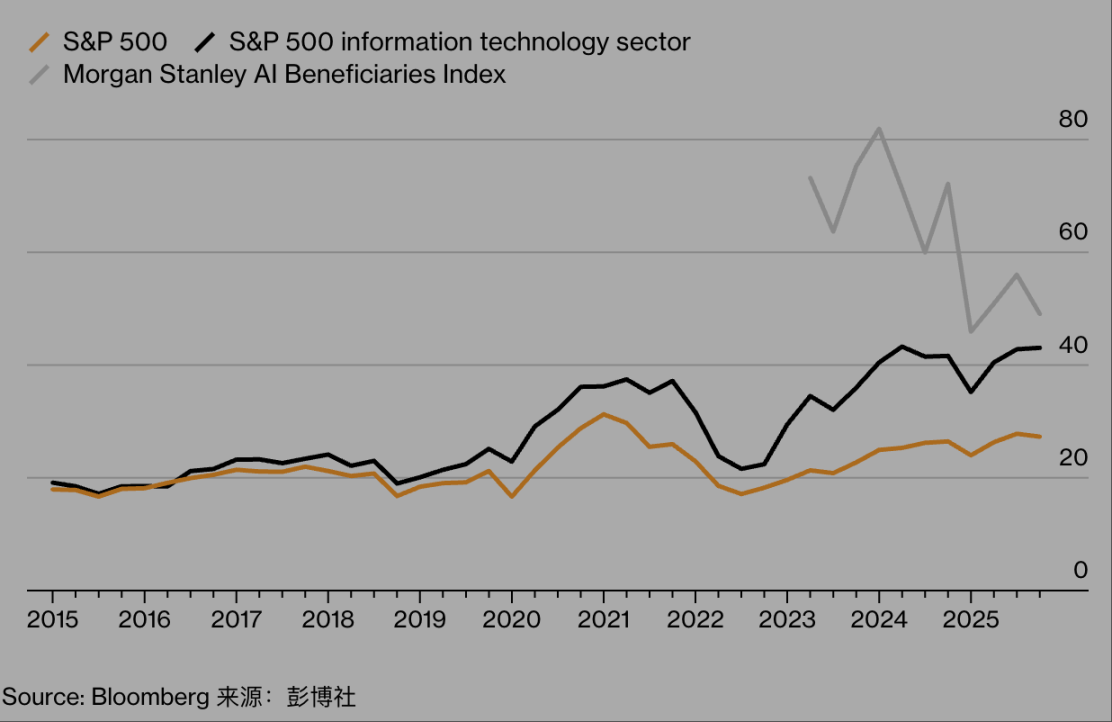
Source: Bloomberg

(This chart uses three index lines (S&P 500, S&P 500 Information Technology Sector, Morgan Stanley AI Beneficiaries Index) to show the process in US stocks from 2015 to 2025 where AI-related concept stocks first surged significantly on hype, then fell back as the bubble receded, diverging from the trends of the broader market and traditional tech sectors, reflecting the speculative frenzy and retreat risks in the AI field.)

Journalists should generally avoid arguing whether a particular resource or technology is overvalued. I don't have a strong stance on whether we are in an "AI bubble," but I suspect the question itself might be too narrow. If we define a "speculative bubble" as "an unsustainable rise in the value of an asset detached from its determinable fundamentals," then looking around, bubbles seem to be almost everywhere, and they appear to be inflating and contracting in sync.

World Economic Forum CEO Børge Brende pointed out that bubbles may exist in gold and government bonds. He recently stated that overall national debt levels haven't been this severe since World War II; and as of December 12th, gold prices had surged nearly 64% in a year. Many financial practitioners believe a bubble also exists in the private credit sector. This market, worth $3 trillion, involves large investment institutions providing loans (many for building AI data centers) and operates outside the constraints of the strictly regulated commercial banking system. Jeffrey Gundlach, founder and CEO of asset management firm DoubleLine Capital, recently called this opaque, unregulated, chaotic lending phenomenon "junk loans" on Bloomberg's "Odd Lots" podcast; JPMorgan Chase CEO Jamie Dimon referred to it as a "fuse for a financial crisis."

The most absurd phenomena occur in areas where "intrinsic value is difficult to judge." For example, from the beginning of the year to October 6th, the total market capitalization of BTC increased by $636 billion, but by December 12th, not only had all those gains been erased, but it had fallen even further. According to data from cryptocurrency media company Blockworks, the trading volume of "Meme coins," virtual currencies commemorating internet trends, peaked at $170 billion in January but plummeted to $19 billion by September. Leading the decline were TRUMP and MELANIA — coins launched by the US First Family two days before the presidential inauguration, which have fallen 88% and 99% in value since January 19th, respectively.

Many investors evaluating these cryptocurrencies do not focus on their potential to create intrinsic value for shareholders and society (as one would when assessing a traditional company's stock that reports profits), but rather solely attracted by the opportunity to "quickly make a lot of money." Their attitude towards cryptocurrencies is purely speculative, like joining a craps table during a trip to Las Vegas.

There might be demographic reasons behind investors (especially those attracted to cryptocurrencies, sports betting, and online prediction markets) trying to "manipulate" financial markets like a casino. A recent survey by Harris Poll showed that 60% of Americans today desire to amass huge wealth; among Gen Z and Millennial respondents, 70% said they want to be billionaires, compared to only 51% among Gen X and Baby Boomers. A study last year by financial firm Empower found that Gen Z believes "financial success" requires an annual salary of nearly $600,000 and a net worth of $10 million.

Thanks to TikTok videos, group chats, Reddit, and the "instant and unavoidable" nature of the internet, people around the world can now learn about money-making opportunities simultaneously. In principle, this seems fine, but in practice, it triggers imitation frenzies, fierce competition, and "groupthink" — a phenomenon that makes the new Apple TV+ series "Pluribus" particularly timely. The traditional economy, with its complex and diverse dimensions, has been replaced by the "attention economy": what is collectively obsessed over by everyone globally at any given moment.

In the business world, the focus of this "collective obsession" is AI; in pop culture, following "Pedro Pascal fever," there's "Sydney Sweeney fever," and "6-7 fever" (if you don't have teenagers at home, try Googling it). Over the past year, thanks to celebrities like BLACKPINK member Lisa, the "cute but practically worthless animal-shaped plush toys" launched by Chinese toymaker Pop Mart International Group have become a global craze, which we might call "Labubble" (referring to Labubu fever).

There's also a clear "protein bubble" in the food sector: from popcorn makers to breakfast cereal producers, everyone is promoting the "protein content" of their products to attract health-conscious consumers and GLP-1 (a blood sugar-lowering drug often used for weight loss) users. In the media sector, there might be bubbles in Substack newsletters, podcasts hosted by celebrities (like Amy Poehler's "Say More" and Meghan Markle's "Archetypes"), and the almost weekly release of "authorized celebrity documentary biopics" (Netflix's latest include: "Being Eddie" about Eddie Murphy and a biopic about Victoria Beckham). W. David Marx, author of "Status and Culture: How Our Desire for Social Rank Creates Taste, Identity, Art, Fashion, and Constant Change," said: "Today, everyone's 'reference group' is global, far beyond their immediate surroundings and surpassing their actual class and status. In these markets, 'globally synchronized movements' that were absolutely impossible in the past can occur."

Of course, the risks in the AI field are far higher than those related to "Labubu fever" products. No company wants to fall behind, so all industry giants are pushing forward, building computing infrastructure through "complex financing arrangements." In some cases, this involves "special purpose vehicles" (remember those from the 2008 financial crisis?) — entities that take on debt to purchase graphics processing units (AI chips) from Nvidia, which some observers believe could depreciate faster than expected.

Tech giants have the capacity to withstand any consequences of this "FOMO-induced frenzy": they primarily rely on strong balance sheets to pay for data centers, and can handle it even if white-collar workers widely believe "the current version of ChatGPT is sufficient for writing annual self-evaluations." But other companies are taking riskier moves. Oracle — a conservative database provider unlikely to be a challenger in the AI boom — is raising $38 billion in debt to build data centers in Texas and Wisconsin.

Other so-called "new cloud providers" (like relatively young companies such as CoreWeave and Fluidstack) are building specialized data centers for AI, Bitcoin mining, and other uses, and they are also borrowing heavily. At this point, the "cumulative impact" of the AI bubble begins to look increasingly severe. Gil Luria, Managing Director at investment firm D.A. Davidson & Co., echoing Roger Babson from a century ago, said: "When some institutions borrow money to build multi-billion dollar data centers without even having real customers, I start to worry. Lending for speculative investments has never been wise."

Carlota Perez, a British-Venezuelan researcher who has studied economic boom and bust cycles for decades, is also concerned. She points out that technological innovation is being transformed into high-risk speculation within a "over-leveraged, fragile, casino-like economy where bubbles burst once doubts spread." She wrote in an email: "If the AI and cryptocurrency sectors crash, it could trigger a global crisis of unimaginable scale. Historically, truly productive golden ages only arrive when the financial sector pays for its own actions (rather than being consistently bailed out) and society constrains it through proper regulation." Until then, hold tight to your Labubu plush toy.

Пов'язані питання

QWhat historical event and figure does the article use as a parallel to the current AI investment frenzy, and what was the initial market reaction?

AThe article uses the 1929 stock market crash and the economist Roger Babson as a parallel. Babson warned of an impending crash, which initially caused a 3% market drop, an event known as the 'Babson Break.' However, the market soon recovered as optimistic investors took over.

QAccording to the article, what is the primary driver causing companies to ignore warnings about an AI bubble?

AThe primary driver is the 'Fear Of Missing Out' (FOMO) on the next big opportunity. This mindset, similar to a century ago, pushes companies to invest heavily despite the risks and unproven profitability of AI as a tool.

QBeyond AI, what other areas does the article identify as potential speculative bubbles?

AThe article identifies several other potential bubbles, including gold and government bonds (due to high global debt), the $3 trillion private credit market (called 'crap loans'), and the extreme volatility in cryptocurrencies and meme coins like TRUMP and MELANIA.

QWhat demographic trend does the article suggest is fueling the desire to treat financial markets like a casino?

AThe article cites a demographic trend where a significant majority of younger generations (70% of Gen Z and Millennials) aspire to become billionaires, compared to 51% of Gen X and Baby Boomers. This desire for immense wealth fuels speculative behavior in crypto, sports betting, and online prediction markets.

QWhat is the 'cumulative impact' of the AI bubble that the article suggests is becoming increasingly severe?

AThe 'cumulative impact' is the massive, and often risky, debt being taken on by companies to build AI infrastructure. This includes established giants and new 'cloud providers' borrowing billions, sometimes without confirmed customers, creating a fragile, over-leveraged system that could lead to a severe crisis if the bubble bursts.

Пов'язані матеріали

Торгівля

Спот
Ф'ючерси

Популярні статті

Що таке MEME 2.0

Memecoin 2.0: Поява $MEME 2.0 у світі криптовалюти Вступ У постійно змінному ландшафті криптовалюти з'явився новий претендент. Memecoin 2.0, що символізується як $MEME 2.0, підносить концепцію мем-криптовалют на захоплюючий новий рівень. Як побічний продукт оригінального Memecoin, цей проєкт привернув увагу крипто-спільноти, змістивши акцент з типової фінансової вигоди на захоплюючий і розважальний досвід. Працюючи на блокчейні Ethereum, Memecoin 2.0 сміливо переосмислює залучення спільноти у криптосфері. Що таке Memecoin 2.0, $MEME 2.0? У своїй основі, Memecoin 2.0 є криптовалютним проєктом, який надає пріоритет спільнотному духу і розвагам, пов'язаним з мем-культурою. На відміну від звичайних криптовалют, які зосереджені на практичних випадках використання та матеріальних вигодах, Memecoin 2.0 вирізняється тим, що обіймає легшу сторону цифрової валюти. Цей проєкт існує без обіцянок утиліти, структурованої дорожньої карти чи фінансових повернень, зосереджуючи увагу на створенні яскравої спільноти навколо мемів та спільних розваг. Зробивши це, він використовує зростаючу тенденцію мем-культури у онлайн-пробі, що робить його унікальним гравцем у світі цифрових активів. Творець Memecoin 2.0, $MEME 2.0 Не зважаючи на численні дослідження витоків Memecoin 2.0, чітка особистість його творця залишається невідомою. Ця анонімність не є рідкістю у крипто-спільноті, де багато проєктів очолюються особами або групами, які надають перевагу залишатися за лаштунками. Відсутність публічно доступної інформації про творця може розглядатися як стратегічний крок, що ставить в центр уваги залучення спільноти, а не індивідуальної популярності у цій сфері. Інвестори Memecoin 2.0, $MEME 2.0 Інформації щодо інвесторів або фінансової підтримки Memecoin 2.0 замало. Відсутність деталей може свідчити про те, що проєкт є самофінансованим або що його увага до спільноти, а не традиційних інвестиційних структур, привабила інший тип підтримки. Оскільки світ мем-криптовалют зазвичай передбачає більше участі низового рівня, а не інституційних інвестицій, цей підхід узгоджується з етосом проєктів, що управляються спільнотою. Як працює Memecoin 2.0, $MEME 2.0? Memecoin 2.0 повністю працює на блокчейні Ethereum, використовуючи його потужні функції безпеки та масштабованості. Використовуючи сильні сторони Ethereum, Memecoin 2.0 може запропонувати безпечне середовище для взаємодії користувачів, забезпечуючи при цьому, що транзакції є ефективними та економічними. Одна з унікальних характеристик Memecoin 2.0 полягає в його структурі, що керується спільнотою. Цінність та популярність токена $MEME 2.0 походять з активної участі його користувачів, а не з вродженої утиліти. Ця концепція підкреслює акцент проєкту на розважальному аспекті криптовалюти, натякаючи на те, що сміх та залучення спільноти є справжніми валютами, що ведуть до його успіху. Крім того, проєкт вписується в ширшу екосистему мем-криптовалют, де цінність кожної мем-криптовалюти коливається залежно від культури, тенденцій і участі спільноти, а не традиційних економічних принципів. Хронологія Memecoin 2.0, $MEME 2.0 Щоб краще зрозуміти еволюцію та віхи Memecoin 2.0, ось хронологія, що підкреслює значні події в його історії: 2024: Зародження Memecoin 2.0 вважається відгалуженням оригінального Memecoin, яке встановлює себе в процвітаючому контексті мем-криптовалют, працюючи на блокчейні Ethereum. 13 липня 2024: Memecoin 2.0 офіційно позиціонує себе як мем-криптовалюта, орієнтована на спільноту, в мережі Ethereum, підкреслюючи свій підхід, зосереджений на розвагах, який запрошує користувачів брати участь у його розвитку. Ключові моменти про Memecoin 2.0, $MEME 2.0 Кілька критичних характеристик визначають Memecoin 2.0: Спільнотно-центричний підхід: Основною метою Memecoin 2.0 є створення веселого, захоплюючого досвіду для спільноти, використовуючи колективне задоволення, що випливає з меметичної культури. Побудовано на Ethereum: Робота на блокчейні Ethereum надає проєкту важливу інфраструктуру, що забезпечує безпеку та масштабованість. Відсутність утиліти або дорожньої карти: У вражаючому відході від традиційних криптовалют, Memecoin 2.0 не обіцяє жодних утилітарних функцій або фінансових повернень, підтверджуючи свою прихильність до участі спільноти та соціального залучення. Акцент на меметичній культурі: Обіймаючи гумористичні та культурні аспекти мем-періоду, Memecoin 2.0 надає платформу для користувачів для залучення до крипти офлайн та онлайн. Додатковий контекст: Значення мем-криптовалют Мем-криптовалюти з'явилися як окрема класифікація криптовалюти, часто керуючись гумором та легким підходом до торгівлі. Ці валюти, як правило, не мають значної утиліти або розробницьких дорожніх карт, залучаючи користувачів обіцянкою розваг, взаємодії в спільноті та культурної значущості. В рамках ширшої екосистеми криптовалют, мем-криптовалюти відновлюють важливість залучення спільноти, протистоячи лише прибутковим підходам. Проєкти, такі як Memecoin 2.0, відкривають еру, в якій розваги можуть гармонізувати з фінансовими прагненнями, перетворюючи блокчейн на ігровий майданчик для творчості та соціальної взаємодії. Висновок Memecoin 2.0, або $MEME 2.0, втілює нову хвилю криптовалюти, яка надає пріоритет залученню спільноти над жорсткими фінансовими структурами. Зосереджуючись на гуморі та соціальній взаємодії, він використовує захоплення навколо мем-культури. Працюючи на блокчейні Ethereum, Memecoin 2.0 використовує можливості технології, залишаючись непохитним у своїй прихильності до розважальної цінності цифрової валюти. Коли простір навколо криптовалют продовжує еволюціонувати, Memecoin 2.0 служить доказом того, що майбутнє цифрових активів може значною мірою залежати від спільних досвідів, сміху та надійних зв'язків у спільноті. У непередбачуваному світі крипто, можливо, радість може бути такою ж цінною, як і традиційний фінансовий прибуток.

110 переглядів усьогоОпубліковано 2024.04.04Оновлено 2024.12.03

Що таке MEME 2.0

Як купити MEME

Ласкаво просимо до HTX.com! Ми зробили покупку Memeland (MEME) простою та зручною. Дотримуйтесь нашої покрокової інструкції, щоб розпочати свою криптовалютну подорож.Крок 1: Створіть обліковий запис на HTXВикористовуйте свою електронну пошту або номер телефону, щоб зареєструвати обліковий запис на HTX безплатно. Пройдіть безпроблемну реєстрацію й отримайте доступ до всіх функцій.ЗареєструватисьКрок 2: Перейдіть до розділу Купити крипту і виберіть спосіб оплатиКредитна/дебетова картка: використовуйте вашу картку Visa або Mastercard, щоб миттєво купити Memeland (MEME).Баланс: використовуйте кошти з балансу вашого рахунку HTX для безперешкодної торгівлі.Треті особи: ми додали популярні способи оплати, такі як Google Pay та Apple Pay, щоб підвищити зручність.P2P: Торгуйте безпосередньо з іншими користувачами на HTX.Позабіржова торгівля (OTC): ми пропонуємо індивідуальні послуги та конкурентні обмінні курси для трейдерів.Крок 3: Зберігайте свої Memeland (MEME)Після придбання Memeland (MEME) збережіть його у своєму обліковому записі на HTX. Крім того, ви можете відправити його в інше місце за допомогою блокчейн-переказу або використовувати його для торгівлі іншими криптовалютами.Крок 4: Торгівля Memeland (MEME)Легко торгуйте Memeland (MEME) на спотовому ринку HTX. Просто увійдіть до свого облікового запису, виберіть торгову пару, укладайте угоди та спостерігайте за ними в режимі реального часу. Ми пропонуємо зручний досвід як для початківців, так і для досвідчених трейдерів.

292 переглядів усьогоОпубліковано 2024.12.12Оновлено 2025.03.21

Як купити MEME

Обговорення

Ласкаво просимо до спільноти HTX. Тут ви можете бути в курсі останніх подій розвитку платформи та отримати доступ до професійної ринкової інформації. Нижче представлені думки користувачів щодо ціни MEME (MEME).

活动图片