The narrative of the "execution line" first caught my attention in November within X and Substack circles. It originated from Mike Green's "$140k poverty line" theory, which went viral in the U.S. I didn't expect that over a month later, this narrative would spread and mutate into the "execution line" in China, which is quite fascinating.
It's a pity my AI narrative radar (see here) wasn't ready at that time; otherwise, I would have loved to see if AI could track the spread and evolution of this narrative.
01
At the end of November, I read three articles by Mike Green on Substack:

These are three extremely long articles that feel like they take an eternity to read; the three combined have the word count of a small book.
I'll summarize the main points in plain language as follows:
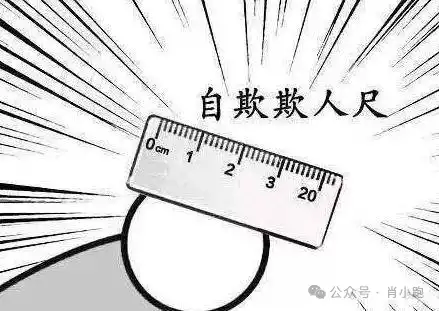
The gist of the articles is: If you feel that current economic data looks good, but life is still tight, and a $100,000 annual salary still leaves you poor, it's not your fault. It's because the ruler used to measure wealth and poverty is like Doraemon's self-deceiving ruler.
The articles present three main points:
1. The "Poverty Line" is Actually Like Carving on a Moving Boat (刻舟求剑 - missing the point by using outdated methods)
The official U.S. poverty line is an annual income of $31,200 for a family of four; if your income exceeds $30,000, you are not considered poor.
But this ruler was created in 1963. The logic back then was simple: a family spent about one-third of its money on food, so by calculating the minimum food cost and multiplying it by 3, you got the poverty line.
But the situation is vastly different now. You've probably all seen that famous chart—"Baumol's Cost Disease":
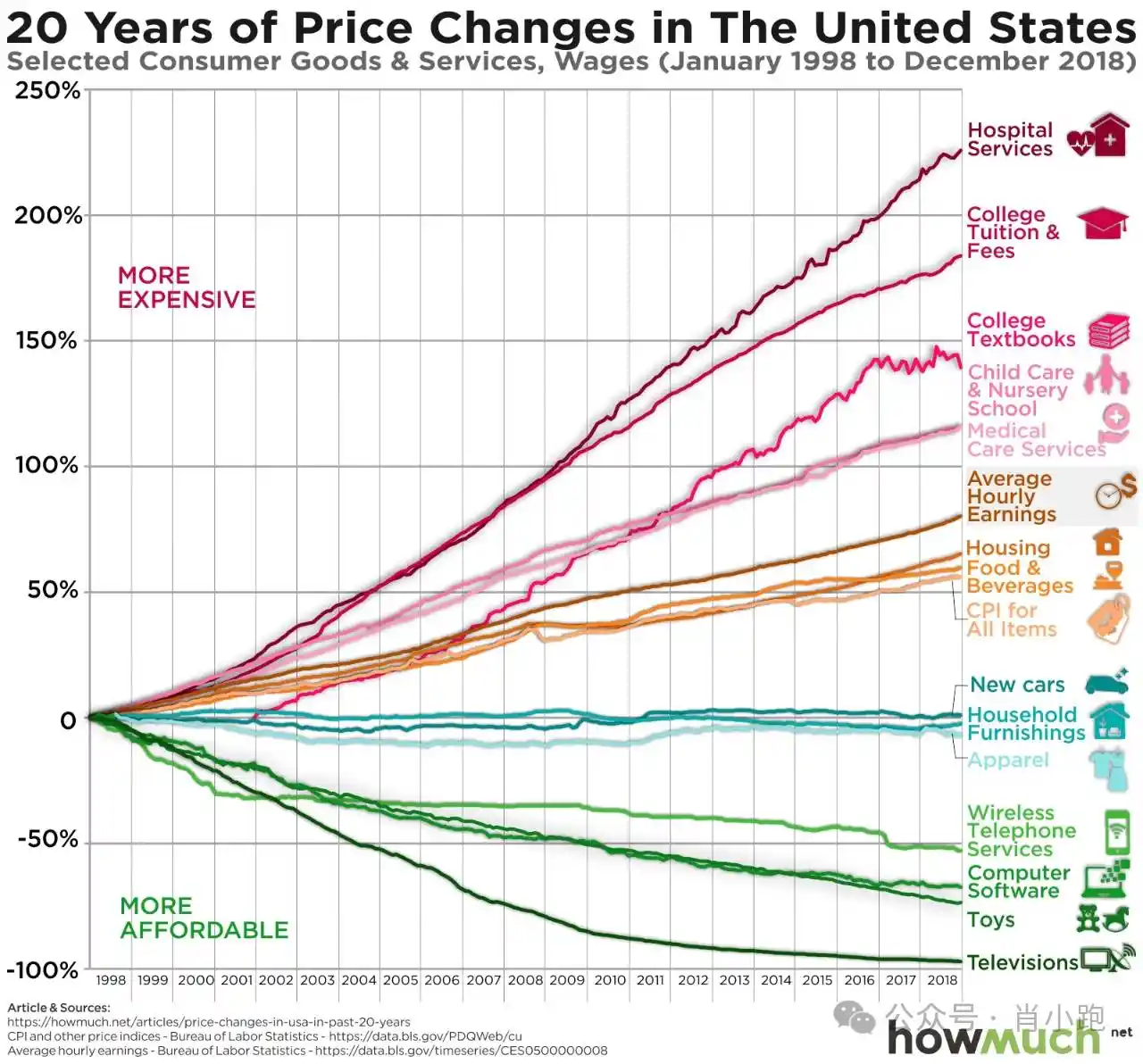
Food has become cheaper, but the costs of housing, healthcare, and childcare have skyrocketed. If you recalculate based on the 1963 standard of living—meaning the ability to normally "participate" in society (having a place to live, a car to drive, childcare, and access to healthcare when sick)—the real poverty line today is not $30,000+, but $140,000 (approx. 1 million RMB), just to live decently in this society.
2. The Harder You Work, The Poorer You Become
There's a huge bug in the design of the U.S. welfare system: When your annual salary is $40,000, you are officially poor. The state gives you food stamps, covers your healthcare (Medicaid), and subsidizes childcare costs. Life is tight, but there's a safety net.
But when you work hard and your salary to $60,000, $80,000, or even $100,000, disaster strikes: Your income is higher, but the benefits disappear. Now you need to pay for expensive health insurance and rent in full.
The result is: A family with a $100,000 annual salary might have less disposable cash left at the end of each month than a family with a $40,000 salary (receiving benefits).
This is the origin of the "execution line" and the "execution line specifically targets the middle class" narrative on Chinese social networks: Just like in a game where your health drops to a certain threshold, a skill can instantly kill you, taking you out in one hit; the middle class, stuck in the middle,刚好踩在 (just steps on) the point where benefits are withdrawn, tax burdens increase, and all kinds of rigid expenses (health insurance, rent, childcare, student loans) fully kick in. They lose subsidies while bearing high costs. Once they encounter unemployment, illness, or rent increases, they are locked in by the execution line.
3. The Assets You Own Are Actually Inflated (很水 - watery, not substantial)
Because:
Your house is not an asset; it's prepaid rent: Did you get richer if your house appreciated from $200,000 to $800,000? No. Because if you sell it, you still have to spend $800,000 to buy a similar house to live in. You haven't gained additional purchasing power; your cost of living has just increased.
The inheritance you're waiting for isn't a wealth transfer: The inheritance from the Baby Boomer generation won't be passed down to you; it will go to nursing homes and the healthcare system. Nursing care (dementia care, nursing homes) in the U.S. now costs $6,000 to over $10,000 per month. An $800,000 house owned by parents will most likely turn into medical bills, collected by medical institutions and insurance companies.
Your class has become a caste: In the past, you could跨越阶级 (cross classes) through hard work. Now it depends on "admission tickets"—Ivy League degrees, recommendation letters from core circles. The inflation rate of these "assets" is even higher than that of houses. So a $150,000 salary allows you to survive, but it can't buy the ticket for your children to enter the upper class.
02
What exactly caused the great inflation of the U.S. "poverty line" (or, in our context—the great shift of the "execution line")?
Mike Green believes it's three turning points in U.S. history:
Turning Point 1: The deterioration and monopolization of unions in the 60s, leading to decreased efficiency and increased costs.
Turning Point 2: The major antitrust shift in the 70s, where large companies疯狂兼并 (frantically merged), controlled the market, and suppressed wages.
Turning Point 3 (which everyone can probably guess): The China Shock. But the article's viewpoint isn't that China forcibly took away jobs, but that U.S. capitalists engaged in capital arbitrage—moving almost all factories out of the U.S. to profit from the differential.
But Teacher Green didn't just kill and not bury (只管杀不管埋 - criticize without offering solutions); he finally proposed a very hardcore solution called the "Rule of 65,"核心思路 (core idea) is very familiar to us Chinese: "打土豪分田地" (beat the local tyrants and distribute the land): (1) Increase taxes on corporations (but exempt investments from taxes); (2) Prevent large companies from deducting interest on borrowed money,坚决打击 (resolutely crack down on) financial空转 (idling - unproductive financial activities); (3) Reduce the burden on the workhorses (牛马):大幅降低 (significantly reduce) the payroll tax (FICA) for ordinary people, putting more cash in their hands. Where does the missing money come from? Make the rich pay more, remove the cap on social security taxes for the wealthy.
Chinese experience is absolutely practical.
03
Teacher Mike Green's views were enthusiastically shared among the U.S. middle-class masses. But it激起 (stirred up) collective resistance from the elite class and various economists.
There are indeed many data漏洞 (loopholes/flaws) in his articles. For example, using data from affluent areas (Essex County, top 6% in U.S. housing prices) as the national average; assuming all children go to expensive daycare centers (over $30,000 per year), when in fact most American families still take care of their own kids; some concepts are also somewhat混淆 (confused), like equating "average expenditure" with "minimum survival needs."
Later, Green appeared on many podcasts to补 (make up for/excuse) himself: This $140,000 does not refer to the traditional poverty of "not having enough to eat," but rather the "decent living threshold" for an ordinary family that does not rely on government subsidies and can still save some money.
Although Teacher Green's math seems indeed wrong, the critics didn't win either, because regardless of what the exact poverty line is, people's "poverty feeling" is very real. And the "feeling of being executed" is becoming more and more real—whether for Americans or Chinese.
Why? I think the real reason is still "Baumol's Disease."
"Baumol's Cost Disease" was proposed by economist William Baumol in 1965 to describe an economic phenomenon:
Some industries (like manufacturing) rely on machines and technology, becoming more and more efficient, with unit costs getting lower and lower; but some industries (like education, healthcare) rely mainly on people, where efficiency is difficult to significantly improve—one lesson still takes an hour, one doctor seeing one patient also takes time, impossible to speed up multiples like a factory.
So here's the problem: Wages across society will rise along with those efficient industries. To prevent teachers and doctors from jumping to higher-paying industries, schools and hospitals also have to raise wages. But their efficiency hasn't improved much, yet wages have risen, resulting in higher and higher costs and prices rising accordingly.
In other words: Industries that can be sped up by machines raise overall wages. Industries that cannot be sped up also have to raise wages to retain people, but efficiency hasn't changed, so they become more expensive. This is "Baumol's Cost Disease."
This is why on the chart at the beginning of the article: The lines representing industrial goods like TVs, phones, and toys go downward, getting cheaper and cheaper; while the lines representing education, healthcare, and childcare costs soar.
The logic behind this is actually very realistic:
In areas that can be replaced by machines and automation, efficiency will only get higher. For example, phones, although the price doesn't seem to have dropped much, their performance is worlds apart from a few years ago, with computing power and storage multiplying several times—this is essentially a kind of "invisible price reduction" brought by technology. Not to mention Chinese manufacturing, photovoltaics, EVs, and lithium batteries, where automation is increasing, and costs are driven straight to the floor price.
But the problem lies in those places where "machines cannot replace people." When I was little, the nanny aunt who took care of me could look after four kids by herself. Even today, she can still only look after four at most, and because today's parents have higher demands, she might even be able to look after fewer children. This means that the production efficiency of the service industry hasn't changed for decades, or has even regressed.
However, the service industry (specifically in the U.S.) must raise wages for nannies and nurses to prevent them from running off to deliver food or work in factories; they have to keep up with the overall income level of society. The coffee beans in a coffee shop aren't expensive, but the exorbitant price you pay is mostly for the staff's labor, rent, and utilities. Efficiency hasn't increased, but wages have to rise, so the cost can only be passed on to the consumer. (Note: This specifically refers to the U.S.)
So the American middle-class families being "executed" are not poor to the point of not having enough to eat. They have cars, iPhones, and various video memberships, but when facing "service-based expenditures" like buying a house, seeing a doctor, or raising children, their wallets are instantly emptied. Therefore, it's not that the American people have truly become poorer; it's that the American people's money becomes less and less spendable in the face of those "inefficient but死贵 (dead expensive)" services.
Writing到这里 (up to here), I know everyone has been wanting to ask: Does China have an execution line? Does China's execution line execute the middle class? Has China's poverty line also risen?
The answer is most likely no.
So our "execution line" might not appear. I discussed this with Dean Liu in the "Wall Crack Forum" (墙裂坛) podcast episode: "When China Becomes an Industrial Cthulhu, What's Left of Trade? Higher Productivity, Why Lower Wages?"

The situation in China, we Chinese should know: Chinese society is more sensitive to service prices. For things that are "non-production tools," people are generally unwilling to pay, especially for services. In the expenditure structure of labor force reproduction, certain service expenditures have long been suppressed very low in China, even to the extent that "this part of the wage doesn't have to be paid." When services are undervalued and the welfare stage is different, the wage system naturally presents a structure completely different from the West.
This creates a奇妙的现象 (wonderful phenomenon): One can always "survive" no matter what. Because the cost of living can be pressed extremely low.
Therefore, China might not have an "execution line," but that doesn't mean there isn't an invisible threshold. For example, how low can the dignity of service workers be pressed? How high can the intensity be pushed?
So it's still that saying: Everything comes at a cost.