From Technology to Institutions: Analyzing the Four Core Turning Points of Ethereum in 2026

marsbitОпубліковано о 2026-01-07Востаннє оновлено о 2026-01-07

Анотація

This analysis examines four pivotal turning points for Ethereum in 2026, highlighting its potential transition into a structural bull market driven by institutional adoption and technical upgrades. 1. **Staking Reversal**: A dramatic shift in staking dynamics has emerged, with the exit queue dropping to only 80,000 ETH while the entry queue surged to nearly 1 million ETH—a 15-fold difference. This indicates reduced selling pressure and increased investor confidence, with whales accumulating over $3.1 billion in ETH since July 2025. 2. **Institutional Participation**: Institutions are shifting from passive holding to active staking. BitMine Immersion Technologies, holding over 4.11 million ETH, staked 590,000 ETH in just eight days, worth $1.8 billion. ETH spot ETFs saw cumulative inflows exceeding $125 billion, with single-day net inflows reaching $1.74 billion in early 2026. Major firms like BlackRock and Grayscale predict an "institutional era" for Ethereum. 3. **Technical Upgrades**: The Pectra and Fusaka upgrades in 2025 laid the groundwork for Ethereum’s evolution into a global settlement layer. Key improvements include increased validator staking limits, enhanced blob capacity, and PeerDAS for scalable data availability. Future upgrades like Glamsterdam aim to boost Layer 1 TPS beyond 12,000 and improve MEV capture. 4. **RWA Dominance**: Ethereum leads in real-world asset (RWA) tokenization with a 65.5% market share and $12.5 billion TVL. Traditional finance giants ...

Author: Nikka / WolfDAO (X: @10xWolfdao)

Market Status and Core Turning Points
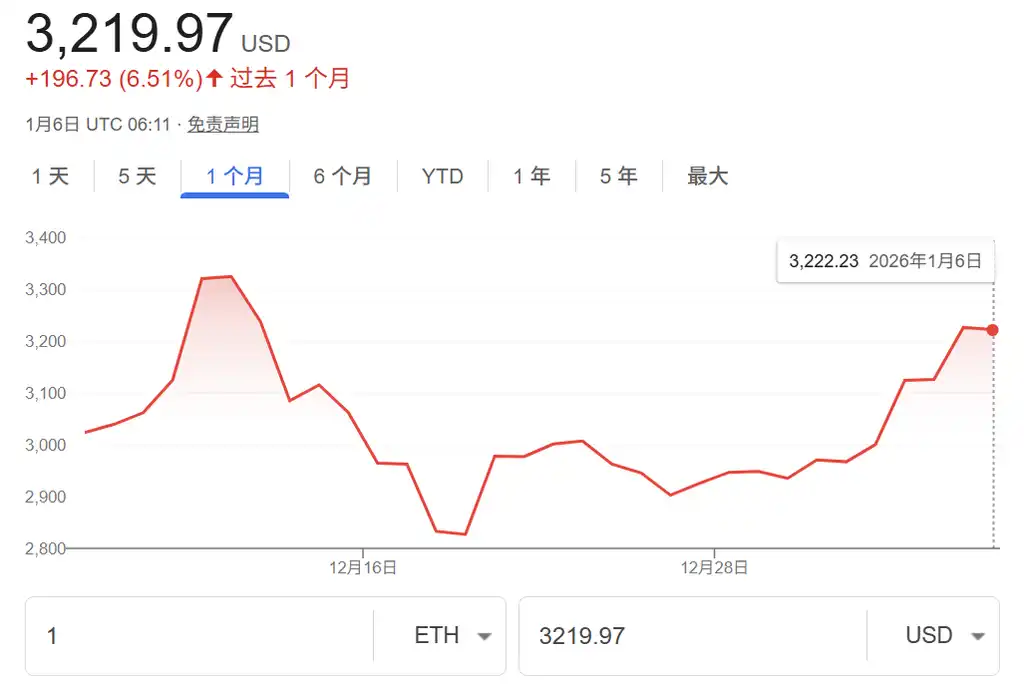
Entering 2026, the total market capitalization of the crypto market has returned to over $3 trillion, with Bitcoin's dominance briefly falling below 60%, sparking discussions about an "altcoin season." Ethereum stands at a critical turning point. In the short term, it has broken through $3,200, showing a significant rebound from the lows at the end of 2025. Although it is still 34% away from the high of $4,700 in September 2025, multiple early signals indicate that ETH may be brewing a structural rally.

1. Staking Queue Reversal: Selling Pressure Significantly Reduced
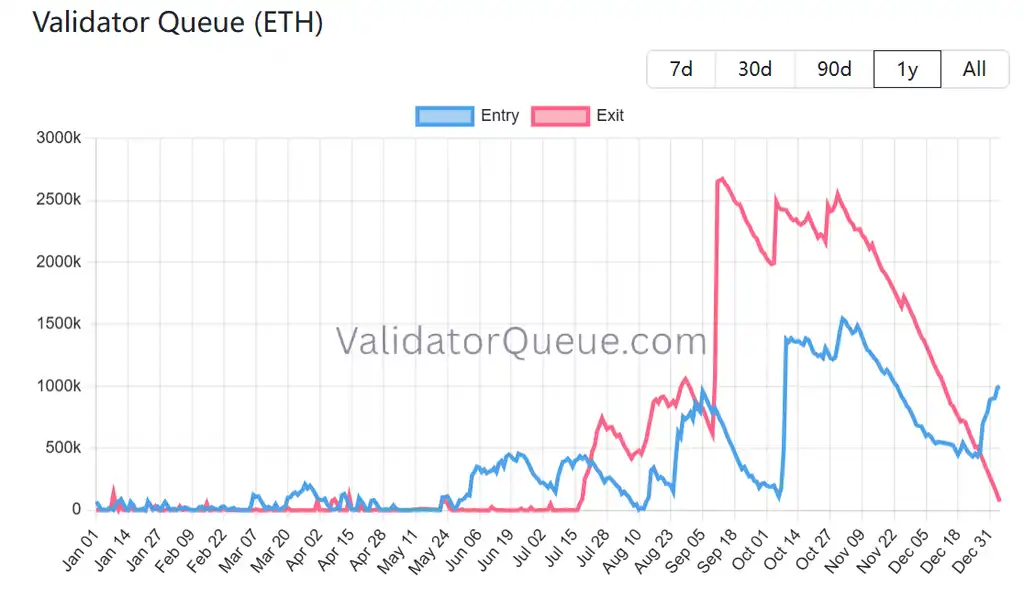
The most important catalyst in 2026 comes from the dramatic reversal of the staking queue. For the first time since July 2025, there has been a "shift in momentum," marking a change in investor confidence from retreating to locking in.

Specifically, when the ETH price surged to around $4,700 in mid-September 2025, a cumulative 2.66 million ETH chose to unstake, creating selling pressure that lasted for months. After three and a half months of digestion, only about 80,000 ETH remain waiting to be unstaked, meaning the source of selling pressure has largely been eliminated. Meanwhile, ETH waiting to enter staking has surged to 900,000–1 million, an increase of about 120% from 410,000 at the end of December. This number is 15 times that of the exit queue, causing the validator activation wait time to extend to 17 days.

Currently, the total staked amount of Ethereum has reached 35.5 million ETH, accounting for 28.91% of the circulating supply, with an annualized yield maintained at 3–3.5%. Historical data shows that when the entry queue significantly leads the exit queue, it often signals a price increase. This supply lock-up will significantly reduce the liquid ETH on the market. Combined with whales buying over $3.1 billion since July 2025, this forms a strong foundation for a rally.

2. Institutional Entry: From Passive Holding to Active Participation

If the staking reversal is a supply-side signal, then the frenzy of institutional entry is the core driver on the demand side. The world's largest Ethereum treasury company, BitMine Immersion Technologies, is rewriting the rules of the game. The company holds over 4.11 million ETH, accounting for 3.41% of the total supply, but more importantly, it is shifting from "passive holding" to "active yield generation."

In the last 8 days, BitMine staked over 590,000 ETH, worth over $1.8 billion. On January 3 alone, it staked 82,560 ETH in a single transaction, worth approximately $259 million. The company plans to stake 5% of Ethereum's total supply through its own validator network, MAVAN, in the first quarter, with an expected annualized revenue of $374 million. This aggressive action not only pushed up the staking queue but also caused BMNR's share price to surge by 14%.
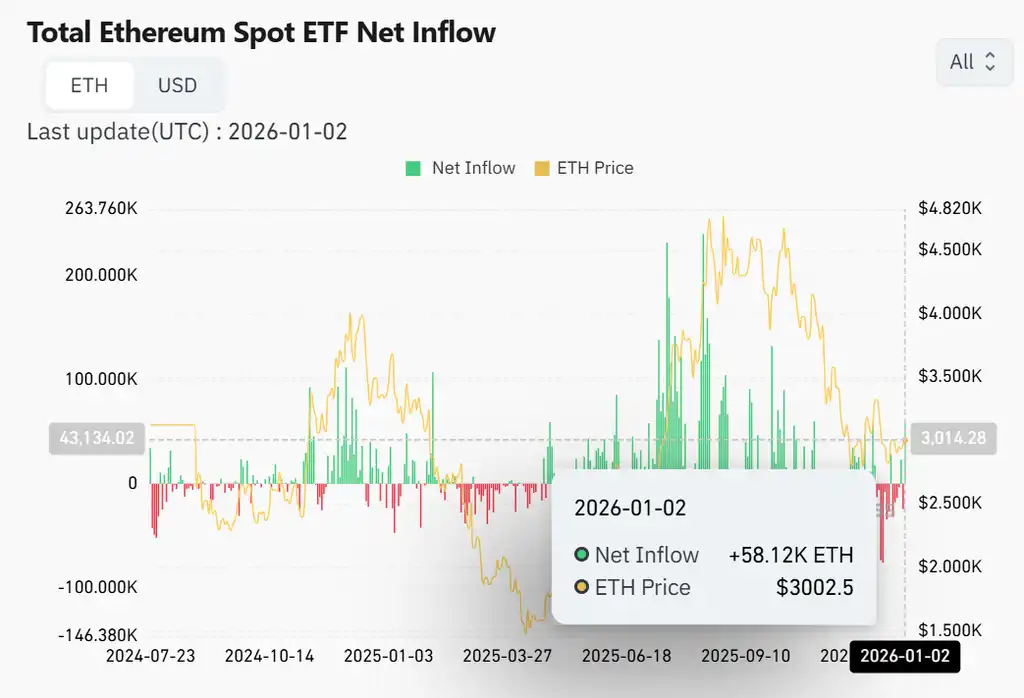
The broader institutional trend is equally remarkable. ETH spot ETFs accumulated inflows of over $9.6 billion in 2025, with historical total inflows exceeding $125 billion. At the beginning of 2026, single-day net inflows reached $1.74 billion. BlackRock's ETHA fund holds about 3 million ETH, worth nearly $9 billion. Institutions like Coinbase and Grayscale predict that 2026 will usher in an "era of institutions," with more ETP products and on-chain vaults expected to double the assets under management.

Meanwhile, on-chain accumulation addresses bought over 10 million ETH in 2025, setting a historical record. These data collectively point to one fact: institutions no longer view ETH as a purely speculative asset but as an infrastructure asset with yield potential.

3. Technical Updates: Evolving into a Global Settlement Layer

2025 was a big year for Ethereum's technology. The Pectra and Fusaka upgrades were successively implemented, laying a solid foundation for further growth in 2026. This is not just a simple performance optimization but a strategic transformation—turning Ethereum into a high-throughput, low-cost global settlement layer.

The Pectra upgrade was completed in the first half of 2025, with its core breakthrough being EIP-7251, which increased the validator staking limit from 32 ETH to 2,048 ETH, greatly facilitating large-scale institutional staking. It also increased blob capacity and optimized validator mechanisms, reducing network congestion. This cleared technical obstacles for aggressive staking actions by institutions like BitMine.

More critical is the Fusaka upgrade. Launched in December 2025, this upgrade introduced PeerDAS (Peer-to-Peer Data Availability Sampling), fundamentally changing the way Layer 2 data is stored. Full nodes no longer need to download all blob data, theoretically supporting an 8x or more increase in blob capacity. Layer 2 fees are expected to decrease by 40–90% in 2026. EIP-7892 allows for dynamic adjustment of blob parameters in the future, enabling continuous scaling without hard forks—this is an institutional guarantee for long-term scalability.

The roadmap for 2026 is even more aggressive. The planned Glamsterdam upgrade will introduce Verkle Trees, enshrined proposer-builder separation (ePBS), and block-level access lists, pushing Layer 1 TPS beyond 12,000+ and strengthening MEV extraction mechanisms, significantly improving network efficiency and revenue capture capabilities. These technical advancements are not just theoretical—smart contract deployments and call counts have hit historical highs, with on-chain activity reaching unprecedented levels.

4. RWA Monopoly: Dominating Trillion-Dollar Opportunities

Ethereum's dominant position in the tokenization of real-world assets is becoming the strongest narrative engine for 2026. This is not just hype within the crypto circle but a vote of confidence from traditional financial institutions with real money.
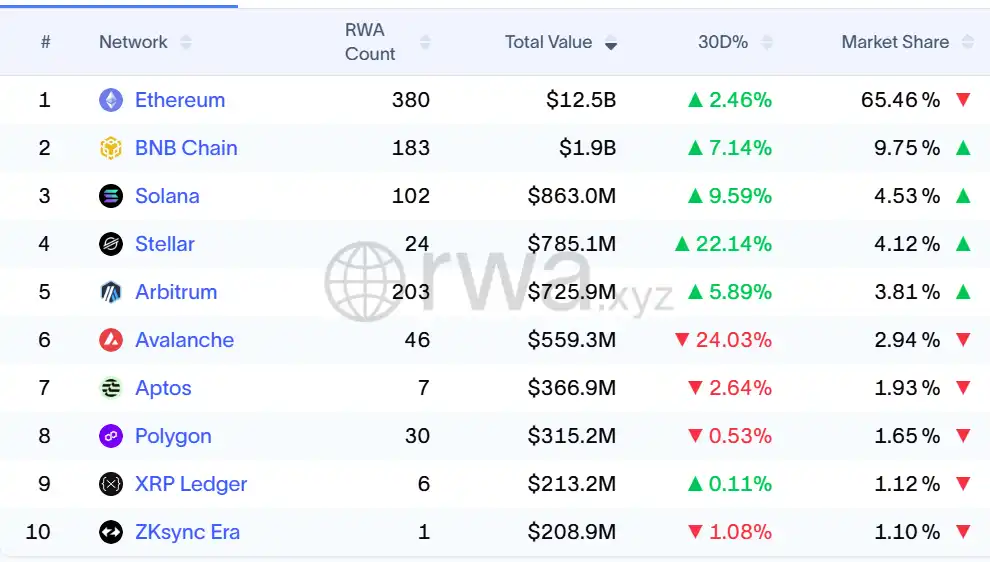
According to the latest statistics from RWA.xyz, the TVL of tokenized assets on Ethereum has reached $12.5 billion, with a market share of 65.5%, far surpassing BNB Chain's $2 billion, and Solana and Arbitrum's less than $1 billion each. Wall Street giants like BlackRock and JPMorgan have already tokenized treasury bonds, private credit, and fund products on a large scale. The RWA market grew by over 212% in 2025, with a total scale exceeding $12.5 billion, and institutional surveys show that 76% of asset management companies plan to invest in tokenized assets by 2026.

Institutions predict that the RWA market will expand by more than 10x in 2026. As the most mature and secure settlement layer, Ethereum will capture the vast majority of value from this trillion-dollar opportunity. The clarification of regulatory frameworks—especially the expected passage of the CLARITY Act and stablecoin legislation in the first half of the year—will further accelerate this process.

The stablecoin sector is similarly one-sided. Ethereum hosts over $62 billion in circulation, accounting for more than 62% of the market, and 68% of DeFi TVL. B2B payments, cross-border settlements, and other institutional-level scenarios are rapidly migrating on-chain. Artemis reports show that Ethereum's stablecoin B2B payment volume grew steadily between 2024 and 2025. This is not speculative capital but real demand from the实体经济.

Conclusion

Combining the three forces of supply, demand, and technology, Ethereum is highly likely to achieve a narrative shift from "follower" to "leader" in 2026. This will be an institution-driven structural bull market, not a speculative frenzy driven by retail sentiment.

For the ETH loyalists who have endured tough times over the past few years, 2026 may be the year of兑现. However, this is a possibility, not a certainty. Patience and rationality remain essential in this残酷 market.


Трендові криптовалюти

Пов'язані питання

QWhat are the four core turning points for Ethereum in 2026 as analyzed in the article?

AThe four core turning points are: 1. The dramatic reversal of the staking queue, which significantly reduces selling pressure. 2. Institutional entry, shifting from passive holding to active participation and staking. 3. Technical upgrades (Pectra and Fusaka), evolving Ethereum into a high-throughput, low-cost global settlement layer. 4. Dominance in the Real World Asset (RWA) tokenization market, capturing a trillion-dollar opportunity.

QWhat does the reversal of the staking queue indicate for Ethereum's market dynamics?

AThe reversal indicates a major shift in investor sentiment from withdrawing and selling to locking up their ETH. With the exit queue nearly empty (only ~80k ETH) and the entry queue surging to 90-100k ETH, it creates significant supply lock-up, reducing liquid ETH on the market and forming a strong foundation for price appreciation.

QHow is BitMine Immersion Technologies changing its strategy regarding its Ethereum holdings?

ABitMine is shifting from passive holding to active yield generation. The company, which holds over 4.11 million ETH, has staked over 590,000 ETH (worth over $1.8 billion) in just 8 days. It plans to stake 5% of Ethereum's total supply through its own validator network, MAVAN, in Q1, targeting an estimated annualized yield of $374 million.

QWhat were the key technical improvements introduced by the Pectra and Fusaka upgrades?

AThe Pectra upgrade introduced EIP-7251, which increased the validator staking limit from 32 ETH to 2048 ETH, facilitating large-scale institutional staking. The Fusaka upgrade introduced PeerDAS (Peer-to-Peer Data Availability Sampling), which allows for an 8x+ increase in blob capacity and is expected to reduce Layer 2 fees by 40-90% in 2026. It also included EIP-7892 for dynamic blob parameter adjustments.

QWhy is Ethereum considered the dominant platform for Real World Asset (RWA) tokenization?

AEthereum dominates with $12.5 billion in tokenized asset TVL, capturing a 65.5% market share. Major traditional financial giants like BlackRock and JPMorgan are using it to tokenize assets such as treasury bonds and private credit. Its mature, secure infrastructure and upcoming clear regulatory frameworks are expected to allow it to capture the majority of value from this rapidly expanding trillion-dollar market.

Пов'язані матеріали

After Three Consecutive Quarters of Decline, Can the Crypto Market Find a Window for Stabilization in Q3?

The cryptocurrency market has just concluded its worst-performing quarter since 2022, with total capitalization dropping 12.6% to $2.1 trillion. All core metrics indicate capital is leaving the sector, not just rotating within it. Bitcoin fell 14.2% and Ethereum dropped 25.4% in Q2, breaking their previous correlation with US tech stocks. A key driver is the reversal in US spot Bitcoin ETF flows, which saw a net outflow of approximately $4.67 billion in Q2, including a record monthly outflow near $4.5 billion in June. While recent data suggests long-term holders are accumulating again, sustained ETF outflows mean continued selling pressure. Market focus is now singularly on the Federal Reserve. The upcoming July FOMC meeting is seen as the most critical event for Q3. A dovish signal could support Bitcoin reclaiming a $68,000-$84,000 range, while a hawkish stance might establish a new trading band around $50,000-$56,000. Additionally, regulatory uncertainty persists, with the progress of the crucial *CLARITY Act* stalling in the Senate, reducing its perceived 2026 passage probability to 40-45%. Despite the broad downturn, a few sectors showed growth. Prediction markets saw nominal volume surge 48.7% year-over-year to $113.8 billion, and tokenized collectibles transaction volume rose 143% quarterly to $1.4 billion. The Real-World Asset (RWA) tokenization sector also continued steady growth, now representing ~$28.1 billion in on-chain value. The market's foundation for an extreme crash appears limited, with Bitcoin price hovering near its 200-week moving average. However, the trading paradigm has shifted from narrative-driven speculation to decisions based on price action, policy developments, and interest rate expectations, making a broad sentiment-driven rally unlikely in the near term.

marsbit10 год тому

After Three Consecutive Quarters of Decline, Can the Crypto Market Find a Window for Stabilization in Q3?

marsbit10 год тому

BIT Trading Moment: BTC Still Suppressed by Weekly 200 EMA, Rejection May Restart Decline; Storage and Semiconductors that Surged Last Night Begin Falling in Evening Trading

**Crypto & Stock Market Wrap: Bitcoin Tests Resistance, Stocks Retreat After AI Surge** Bitcoin consolidates around $66,000, facing key resistance near $68,000—an area seen as a major psychological and technical hurdle where previous rallies have failed. Analysts note the cryptocurrency is caught between its 200-week moving average (~$63,333) and 200-week EMA (~$68,328). A clear break above $68k is needed to signal a stronger bullish trend, while a rejection could lead to a retest of $63k support. Market sentiment remains cautious, with low futures open interest pointing to a low-liquidity rebound rather than a full bull market. Bitcoin spot ETFs saw another $203 million inflow. US stock futures pointed lower after a strong Tuesday session led by a massive rebound in semiconductors and memory stocks. The rally was fueled by renewed optimism about AI-driven hardware demand, with Micron, SanDisk, and SK Hynix surging. However, those gains reversed in pre-market trading. Super Micro Computer (SMCI) soared over 20% after hours on strong guidance and a record backlog. Other standouts included Rocket Lab and nuclear energy plays Oklo and X-Energy. Rising oil prices (Brent above $91) and climbing Treasury yields (10-year near 4.64%), however, are reigniting inflation concerns and acting as a headwind for equities. In Asia, markets were mixed. South Korea's KOSPI pared early gains to close slightly higher as semiconductor stocks like SK Hynix gave back initial surges. Japan's Nikkei edged lower as the yen hit a fresh 38-year low against the dollar, raising fears of potential market intervention. Key events to watch include the Samsung Galaxy launch, AMD's AI event, and a slew of major tech earnings from Alphabet, Tesla, and IBM after the close on Wednesday, followed by the ECB meeting and Intel's earnings on Thursday.

marsbit10 год тому

BIT Trading Moment: BTC Still Suppressed by Weekly 200 EMA, Rejection May Restart Decline; Storage and Semiconductors that Surged Last Night Begin Falling in Evening Trading

marsbit10 год тому

Former CFTC Chairman, Circle President Tarbert: Preaching Long-Termism While Cashing Out $30 Million Himself

Former CFTC Chairman and Circle President Heath Tarbert has consistently advocated for a long-term vision in public, urging patience from investors as Circle’s stock price has fallen significantly from its peak. However, it has been revealed that since Circle’s IPO, Tarbert has continuously sold his CRCL shares through pre-arranged trading plans, cashing out approximately $30 million, without making any public market purchases. This contrast between his public messaging and personal actions has drawn criticism. Tarbert joined Circle in July 2023 as Chief Legal Officer, leveraging his regulatory experience to help guide the company through its IPO and expansion. Despite promoting stablecoins as long-term infrastructure, he established a 10b5-1 trading plan just before Circle went public, leading to substantial stock sales over the following year. In March 2026, he initiated another plan to sell more shares. His career trajectory highlights a pattern of moving between high-level regulatory roles and influential positions in the financial sector. After resigning as CFTC Chairman in early 2021, he joined Citadel Securities as Chief Legal Officer just 27 days later, during a period of intense regulatory scrutiny for the firm. He later joined Circle, aiding its efforts to navigate regulatory challenges for its public listing. While Tarbert's expertise in policy and compliance is valuable to companies like Circle, his actions—advocating long-term confidence while personally divesting—raise questions about the alignment between his public statements and his private financial decisions, leaving investors who followed his advice to bear the market risks.

marsbit11 год тому

Former CFTC Chairman, Circle President Tarbert: Preaching Long-Termism While Cashing Out $30 Million Himself

marsbit11 год тому

Gate Research Institute: The 'Wall Street-ization' Wave of Crypto Financial Products – Competition or Integration?

The article titled "Gate Research Institute: Are Crypto Financial Products Sparking a 'Wall Street' Wave—Competition or Convergence?" explores the evolving relationship between the crypto ecosystem and traditional finance (TradFi). The piece begins by reflecting on Bitcoin's original 2009 vision of decentralization, disintermediation, and moving away from banks. It then contrasts this with the 2024 landscape, where key crypto assets like Bitcoin are increasingly held through Wall Street products like ETFs issued by giants like BlackRock. The article questions whether this signifies that TradFi is systematically taking over the rights to issue, price, custody, and distribute crypto financial assets. The core argument is that this is not a zero-sum takeover but rather a bidirectional convergence where each side addresses the other's weaknesses. Crypto offers 24/7 global markets, programmable settlement, and open access but lacks compliant channels, institutional-grade custody, deep fiat liquidity, and mainstream distribution. TradFi possesses these but is constrained by legacy systems, limited operating hours, and slow settlement. Two primary convergence paths are highlighted: * **Path A (CEX to TradFi):** Exemplified by Gate, which has progressed from offering tokenized stocks and CFDs to providing direct, real stock trading (US, Hong Kong, South Korea) within its platform, using USDT. * **Path B (TradFi to Crypto):** Exemplified by Robinhood, which has integrated crypto trading, acquired exchanges like Bitstamp, and is moving traditional assets like stocks onto the blockchain via tokenization and its own Layer 2. Both paths are ultimately competing to become the next-generation, unified financial account—a "super account" where users can seamlessly trade cryptocurrencies, stocks, ETFs, RWA (Real World Assets), and tokenized treasury products in one interface. The growth of RWA and tokenized treasuries (e.g., BlackRock's BUIDL) is presented as the asset-layer fusion, providing stable, yield-bearing assets on-chain and acting as a bridge between the two worlds. In conclusion, the "Wall Street-ization" of crypto is framed as a mutual transformation. Decentralized ideals persist in the protocol layer, while at the application layer, a more efficient, global, and accessible unified capital market is emerging from this convergence. The future competition lies not between crypto exchanges and stockbrokers, but between platforms vying to offer the most comprehensive asset coverage, liquidity, and user experience within a single account.

marsbit11 год тому

Gate Research Institute: The 'Wall Street-ization' Wave of Crypto Financial Products – Competition or Integration?

marsbit11 год тому

Торгівля

Спот

Популярні статті

Що таке ETH 2.0

ETH 2.0: Нова ера для Ethereum Вступ ETH 2.0, широко відомий як Ethereum 2.0, є величезним оновленням для блокчейну Ethereum. Ця трансформація не є лише косметичною зміною; вона має на меті фундаментально покращити масштабованість, безпеку та сталий розвиток мережі. З переходом від енергомісткого механізму консенсусу Proof of Work (PoW) до більш ефективного Proof of Stake (PoS), ETH 2.0 обіцяє трансформаційний підхід до екосистеми блокчейнів. Що таке ETH 2.0? ETH 2.0 — це збірка особливих, взаємопов’язаних оновлень, спрямованих на оптимізацію можливостей та продуктивності Ethereum. Це перетворення розроблене для вирішення критичних викликів, з якими стикалося існуюче механізм Ethereum, зокрема щодо швидкості транзакцій та заторів у мережі. Мета ETH 2.0 Основні цілі ETH 2.0 зосереджені на покращенні трьох ключових аспектів: Масштабованість: Мета — значно підвищити кількість транзакцій, які мережа може обробити за секунду; ETH 2.0 прагне вийти за межі поточного обмеження приблизно в 15 транзакцій на секунду, потенційно досягнувши тисяч. Безпека: Підвищені заходи безпеки є невід’ємною частиною ETH 2.0, зокрема через покращену стійкість до кібератак і збереження децентралізованої етики Ethereum. Сталий розвиток: Новий механізм PoS розроблений не тільки для підвищення ефективності, але й для різкого зменшення споживання енергії, що узгоджує операційну структуру Ethereum з екологічними міркуваннями. Хто є творцем ETH 2.0? Створення ETH 2.0 можна віднести до Ethereum Foundation. Ця неприбуткова організація, яка відіграє важливу роль у підтримці розвитку Ethereum, очолюється відомим співавтором Віталіком Бутеріним. Його бачення більш масштабованого та стійкого Ethereum стало рушійною силою цього оновлення, залучаючи внески зі всього світу від розробників і ентузіастів, які прагнуть покращити протокол. Хто є інвесторами ETH 2.0? Хоча подробиці про інвесторів ETH 2.0 не були оприлюднені, відомо, що Ethereum Foundation отримує підтримку від різних організацій та осіб у сфері блокчейну та технологій. Ці партнери включають венчурні капітальні компанії, технологічні компанії та філантропічні організації, які мають спільний інтерес у підтримці розвитку децентралізованих технологій та інфраструктури блокчейну. Як працює ETH 2.0? ETH 2.0 відзначається введенням низки ключових функцій, які відрізняють його від попередника. Proof of Stake (PoS) Перехід до механізму консенсусу PoS є одним із знакових змін ETH 2.0. На відміну від PoW, який покладається на енергомісткий видобуток для перевірки транзакцій, PoS дозволяє користувачам підтверджувати транзакції та створювати нові блоки відповідно до кількості ETH, яку вони ставлять у мережі. Це призводить до підвищення енергоефективності, зменшуючи споживання приблизно на 99,95%, завдяки чому Ethereum 2.0 стає значно більш екологічною альтернативою. Шардові ланцюги Шардові ланцюги є ще одним ключовим нововведенням ETH 2.0. Ці менші ланцюги працюють паралельно з основним ланцюгом Ethereum, що дозволяє обробляти кілька транзакцій одночасно. Це підходи покращує загальну ємність мережі, усуваючи проблеми масштабованості, які переслідували Ethereum. Beacon Chain У центрі ETH 2.0 знаходиться Beacon Chain, яка координує мережу і управляє протоколом PoS. Вона виконує роль організатора: контролює валідаторів, забезпечує з’єднання шард з мережею і моніторить загальний стан екосистеми блокчейнів. Хронологія ETH 2.0 Шлях ETH 2.0 характеризується кількома ключовими етапами, які відображають еволюцію цього значного оновлення: Грудень 2020: Запуск Beacon Chain ознаменував введення PoS, проклавши шлях до міграції на ETH 2.0. Вересень 2022: Завершення "Злиття" є знаковим моментом, коли мережа Ethereum успішно перейшла з PoW на PoS, відкриваючи нову еру для Ethereum. 2023: Очікуване розгортання шардових ланцюгів має на меті подальше покращення масштабованості мережі Ethereum, закріплюючи ETH 2.0 як надійну платформу для децентралізованих додатків і послуг. Ключові особливості та переваги Покращена масштабованість Однією з найзначніших переваг ETH 2.0 є його покращена масштабованість. Поєднання PoS та шардових ланцюгів дозволяє мережі розширити свою ємність, що дозволяє їй обробляти набагато більший обсяг транзакцій в порівнянні з класичною системою. Енергоефективність Запровадження PoS є величезним кроком до енергоефективності в технології блокчейн. Значно зменшуючи споживання енергії, ETH 2.0 не тільки знижує операційні витрати, але також ближче узгоджується з глобальними цілями сталого розвитку. Підвищена безпека Оновлені механізми ETH 2.0 сприяють підвищенню безпеки по всій мережі. Впровадження PoS, поряд з інноваційними контрольними заходами, встановленими через шардові ланцюги та Beacon Chain, забезпечує вищий рівень захисту від потенційних загроз. Зниження витрат для користувачів З покращенням масштабованості вплив на витрати на транзакції також стане очевидним. Збільшена ємність і зменшені затори, як очікується, призведуть до зниження зборів для користувачів, що зробить Ethereum більш доступним для повсякденних транзакцій. Висновок ETH 2.0 є значною еволюцією в екосистемі блокчейну Ethereum. Оскільки він вирішує важливі питання, такі як масштабованість, споживання енергії, ефективність транзакцій і загальна безпека, важливість цього оновлення не можна недооцінювати. Перехід до Proof of Stake, введення шардових ланцюгів і фундаментальна робота Beacon Chain свідчать про майбутнє, в якому Ethereum може задовольнити зростаючі вимоги децентралізованого ринку. В індустрії, що рухається вперед завдяки інноваціям та прогресу, ETH 2.0 є підтвердженням можливостей технології блокчейн у прокладенні шляху до більш сталого та ефективного цифрового економіки.

201 переглядів усьогоОпубліковано 2024.04.04Оновлено 2024.12.03

Що таке ETH 2.0

Що таке ETH 3.0

ETH3.0 та $eth 3.0: Глибоке дослідження майбутнього Ethereum Вступ У швидко змінюваному світі криптовалют та технології блокчейн, ETH3.0, часто позначуваний як $eth 3.0, став темою значного інтересу та спекуляцій. Цей термін охоплює два основні концепти, які потребують уточнення: Ethereum 3.0: Це потенційне майбутнє оновлення, яке має на меті покращення можливостей існуючого блокчейну Ethereum, зокрема, фокусуючись на поліпшенні масштабованості та продуктивності. ETH3.0 Мем Токен: Цей окремий криптовалютний проект прагне використовувати блокчейн Ethereum для створення екосистеми, орієнтованої на меми, сприяючи залученню до криптовалютної громади. Розуміння цих аспектів ETH3.0 є важливим не лише для криптоентузіастів, але й для тих, хто спостерігає за широкими технологічними тенденціями у цифровому просторі. Що таке ETH3.0? Ethereum 3.0 Ethereum 3.0 пропонується як оновлення вже існуючої мережі Ethereum, яка стала основою багатьох децентралізованих додатків (dApps) та смарт-контрактів з моменту свого виникнення. Передбачувані удосконалення зосереджені в основному на масштабованості — інтегруючи передові технології, такі як шардінг та нульові знання (zk-докази). Ці технологічні нововведення націлені на забезпечення безпрецедентної кількості транзакцій на секунду (TPS), потенційно досягаючи мільйонів, тим самим вирішуючи одну з найзначніших обмежень, з якими стикається сучасна технологія блокчейн. Покращення є не лише технічним, а й стратегічним; воно спрямоване на підготовку мережі Ethereum до широкого прийняття та корисності в майбутньому, позначеному збільшеним попитом на децентралізовані рішення. ETH3.0 Мем Токен На відміну від Ethereum 3.0, ETH3.0 Мем Токен пропонує легшу та грайливішу домену, поєднуючи культуру інтернет-мемів із динамікою криптовалют. Цей проект дозволяє користувачам купувати, продавати та обмінювати меми на блокчейні Ethereum, надаючи платформу, яка сприяє залученню громади через креативність та спільні інтереси. ETH3.0 Мем Токен має на меті продемонструвати, як технологія блокчейн може перетинатися з цифровою культурою, створюючи випадки використання, які є водночас розважальними та фінансово життєздатними. Хто є творцем ETH3.0? Ethereum 3.0 Ініціатива щодо Ethereum 3.0 переважно підтримується консорціумом розробників та дослідників у межах громади Ethereum, зокрема, до складу якого входить Джастін Дрейк. Відомий своїми думками та внеском у розвиток Ethereum, Дрейк є помітною особистістю в обговореннях щодо переходу Ethereum на новий рівень консенсусу, який називається «Beam Chain». Цей колабораційний підхід до розробки свідчить про те, що Ethereum 3.0 не є продуктом єдиного творця, а скоріше втіленням колективної винахідливості, спрямованої на просування технології блокчейн. ETH3.0 Мем Токен Деталі про творця ETH3.0 Мем Токена наразі не відстежуються. Природа мем-токенів часто призводить до більш децентралізованої та громартової структури, що може пояснити відсутність специфічної атрибуції. Це узгоджується з етикою ширшої крипто-спільноти, де інновації часто виникають з колективних, а не індивідуальних зусиль. Хто є інвесторами ETH3.0? Ethereum 3.0 Підтримка Ethereum 3.0 переважно надходить від Фонду Ethereum поряд з ентузіастичною спільнотою розробників та інвесторів. Це базове співробітництво надає значний градус легітимності та підвищує ймовірність успішної реалізації, оскільки воно використовує довіру та авторитет, накопичені за роки роботи мережі. У швидко змінюваному кліматі криптовалют підтримка громади займає важливу роль у розвитку та прийнятті, позиціонуючи Ethereum 3.0 як серйозного конкурента для майбутніх блокчейн-інновацій. ETH3.0 Мем Токен Хоча наразі доступні джерела не надають явної інформації щодо інвестиційних фондів або організацій, що підтримують ETH3.0 Мем Токен, це свідчить про типову модель фінансування для мем-токенів, яка часто спирається на підтримку знизу та залучення громади. Інвестори в такі проекти зазвичай складаються з осіб, які мотивовані потенціалом інновацій, що керуються спільнотою, та духом співпраці, притаманним крипто-спільноті. Як працює ETH3.0? Ethereum 3.0 Відмінні риси Ethereum 3.0 полягають у його запропонованій реалізації технології шардінгу та zk-proof. Шардінг — це метод розподілу блокчейну на менші, керовані частини чи «шарди», які можуть обробляти транзакції одночасно, а не послідовно. Це децентралізоване оброблення допомагає запобігти заторам та забезпечити оперативність мережі навіть під великим навантаженням. Технологія нульових доказів (zk-proof) надає ще один рівень складності, дозволяючи валідацію транзакцій без розкриття підпорядкованих даних. Цей аспект не лише підвищує конфіденційність, а й збільшує загальну ефективність мережі. Також обговорюється включення нульової Ефірної віртуальної машини (zkEVM) в це оновлення, що ще більше підвищить можливості та корисність мережі. ETH3.0 Мем Токен ETH3.0 Мем Токен виділяється завдяки використанню популярності культури мемів. Він створює ринок, на якому користувачі можуть брати участь у торгівлі мемами не лише для розваги, але й для потенційного економічного вигоди. Інтегруючи функції, такі як стейкінг, забезпечення ліквідності та механізми управління, проект сприяє створенню середовища, яке заохочує взаємодію та участь громади. Пропонуючи унікальне поєднання розваг та економічних можливостей, ETH3.0 Мем Токен прагне залучити різну аудиторію, яка охоплює від криптоентузіастів до casual-консумерів мемів. Хронологія ETH3.0 Ethereum 3.0 11 листопада 2024: Джастін Дрейк натякає на майбутнє оновлення ETH 3.0, яке зосереджене на поліпшеннях масштабованості. Це оголошення означає початок формальних обговорень щодо майбутньої архітектури Ethereum. 12 листопада 2024: Очікується, що запропоновану пропозицію для Ethereum 3.0 буде представлено на Devcon у Бангкоку, що готує ґрунт для більш широкого зворотного зв'язку від громади та потенційних наступних кроків у розвитку. ETH3.0 Мем Токен 21 березня 2024: ETH3.0 Мем Токен офіційно потрапляє у список на CoinMarketCap, що означає його дебют у публічному крипто-просторі та підвищує видимість для його меморієнтованої екосистеми. Ключові моменти На завершення, Ethereum 3.0 представляє значну еволюцію в межах мережі Ethereum, зосереджуючись на подоланні обмежень щодо масштабованості та продуктивності через передові технології. Його запропоновані оновлення відображають проактивний підхід до майбутніх вимог і корисності. Натомість ETH3.0 Мем Токен втілює суть культури, керованої громадою, у сфері криптовалют, використовуючи культуру мемів для створення привабливих платформ, які заохочують творчість і участь користувачів. Розуміння окремих цілей і функцій ETH3.0 та $eth 3.0 є надзвичайно важливим для кожного, хто цікавиться поточними подіями в крипто-просторі. З обома ініціативами, які прокладають унікальні шляхи, вони разом підкреслюють динамічну та багатогранну природу інновацій у блокчейн-технологіях.

193 переглядів усьогоОпубліковано 2024.04.04Оновлено 2024.12.03

Що таке ETH 3.0

Як купити ETH

Ласкаво просимо до HTX.com! Ми зробили покупку Ethereum (ETH) простою та зручною. Дотримуйтесь нашої покрокової інструкції, щоб розпочати свою криптовалютну подорож.Крок 1: Створіть обліковий запис на HTXВикористовуйте свою електронну пошту або номер телефону, щоб зареєструвати обліковий запис на HTX безплатно. Пройдіть безпроблемну реєстрацію й отримайте доступ до всіх функцій.ЗареєструватисьКрок 2: Перейдіть до розділу Купити крипту і виберіть спосіб оплатиКредитна/дебетова картка: використовуйте вашу картку Visa або Mastercard, щоб миттєво купити Ethereum (ETH).Баланс: використовуйте кошти з балансу вашого рахунку HTX для безперешкодної торгівлі.Треті особи: ми додали популярні способи оплати, такі як Google Pay та Apple Pay, щоб підвищити зручність.P2P: Торгуйте безпосередньо з іншими користувачами на HTX.Позабіржова торгівля (OTC): ми пропонуємо індивідуальні послуги та конкурентні обмінні курси для трейдерів.Крок 3: Зберігайте свої Ethereum (ETH)Після придбання Ethereum (ETH) збережіть його у своєму обліковому записі на HTX. Крім того, ви можете відправити його в інше місце за допомогою блокчейн-переказу або використовувати його для торгівлі іншими криптовалютами.Крок 4: Торгівля Ethereum (ETH)Легко торгуйте Ethereum (ETH) на спотовому ринку HTX. Просто увійдіть до свого облікового запису, виберіть торгову пару, укладайте угоди та спостерігайте за ними в режимі реального часу. Ми пропонуємо зручний досвід як для початківців, так і для досвідчених трейдерів.

3.3k переглядів усьогоОпубліковано 2024.12.10Оновлено 2026.06.02

Як купити ETH

Обговорення

Ласкаво просимо до спільноти HTX. Тут ви можете бути в курсі останніх подій розвитку платформи та отримати доступ до професійної ринкової інформації. Нижче представлені думки користувачів щодо ціни ETH (ETH).

活动图片













