From Precious Metals to U.S. Stocks: Crypto Platforms Are Reshaping Global Asset Pricing Power

marsbitОпубліковано о 2026-03-17Востаннє оновлено о 2026-03-17

Анотація

Amidst geopolitical tensions and attacks on Middle Eastern facilities, cryptocurrency platforms are rapidly gaining influence in global asset pricing, particularly for commodities like oil. While traditional markets were closed over a weekend, platforms such as MEXC saw surging activity in WTI oil perpetual futures, with prices to spike ahead of formal market reopenings. These crypto-based perpetual contracts—leveraged, speculative, and operating 24/7—allow instant reactions to breaking news, attracting a new generation of traders unwilling to wait for conventional exchanges. The trend extends beyond oil. Tokenized stocks and perpetual contracts for assets like gold, silver, and U.S. equities (e.g., AMD) are increasingly available on crypto exchanges, appealing to investors seeking real-time responsiveness. This shift highlights a broader movement toward digitized, continuous trading, challenging traditional market hours and structures. However, this high-leverage, always-on model carries significant risks, including extreme volatility and forced liquidations. Despite these challenges, the integration of crypto mechanisms into traditional finance appears inevitable, positioning crypto platforms at the forefront of a new, borderless financial paradigm.

When geopolitical black swans take flight on weekends, traditional financial market investors often find themselves helpless. Recently, attacks on facilities in the UAE and other regions have intensified oil price volatility. Since the U.S. and Israel launched airstrikes against Iran, numerous traders have flocked to crypto platforms to trade oil perpetual contracts. While traditional energy investors were counting down the hours last weekend, waiting for the futures market to reopen on Sunday, overseas cryptocurrency traders had already begun betting on oil price trends.
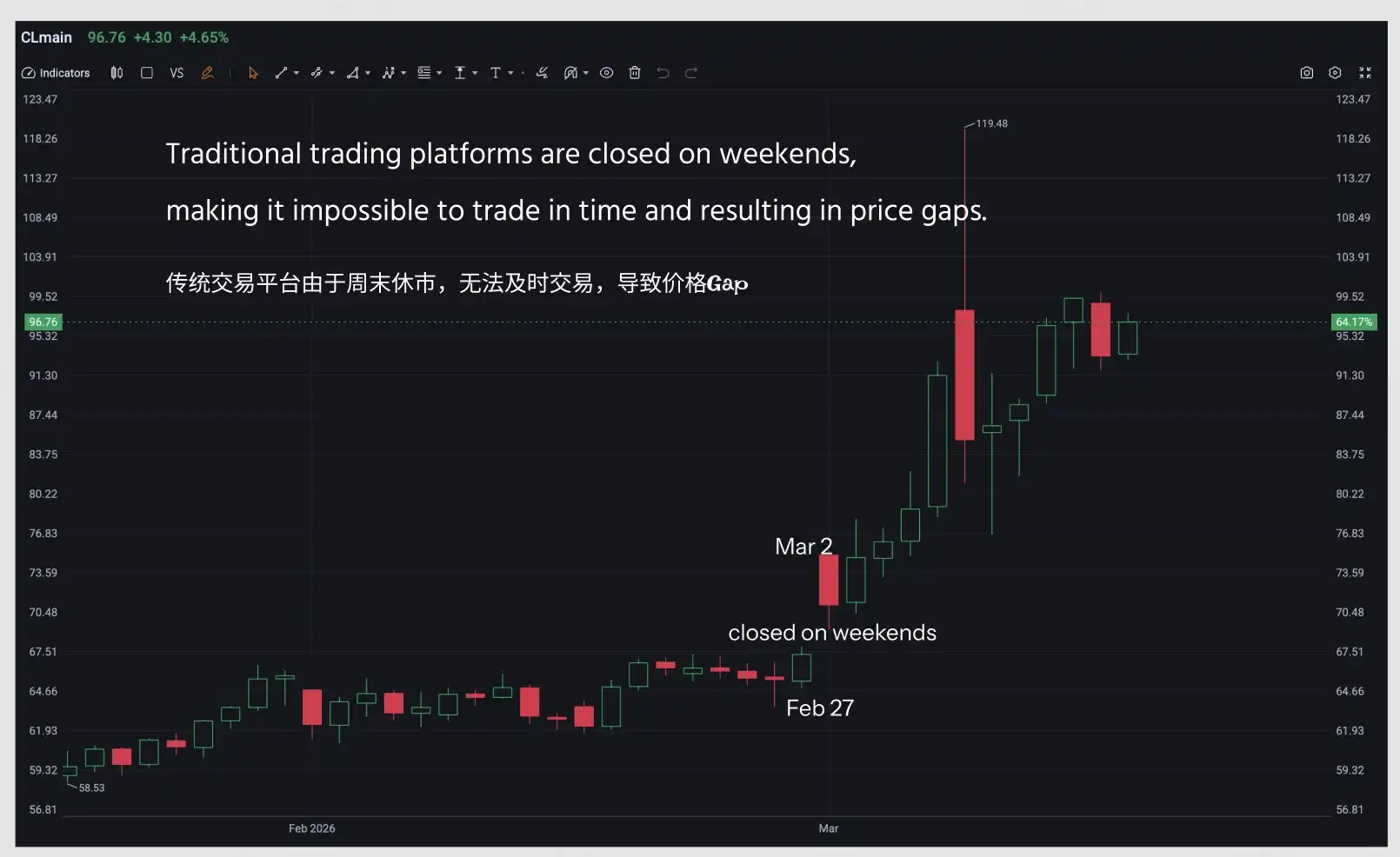
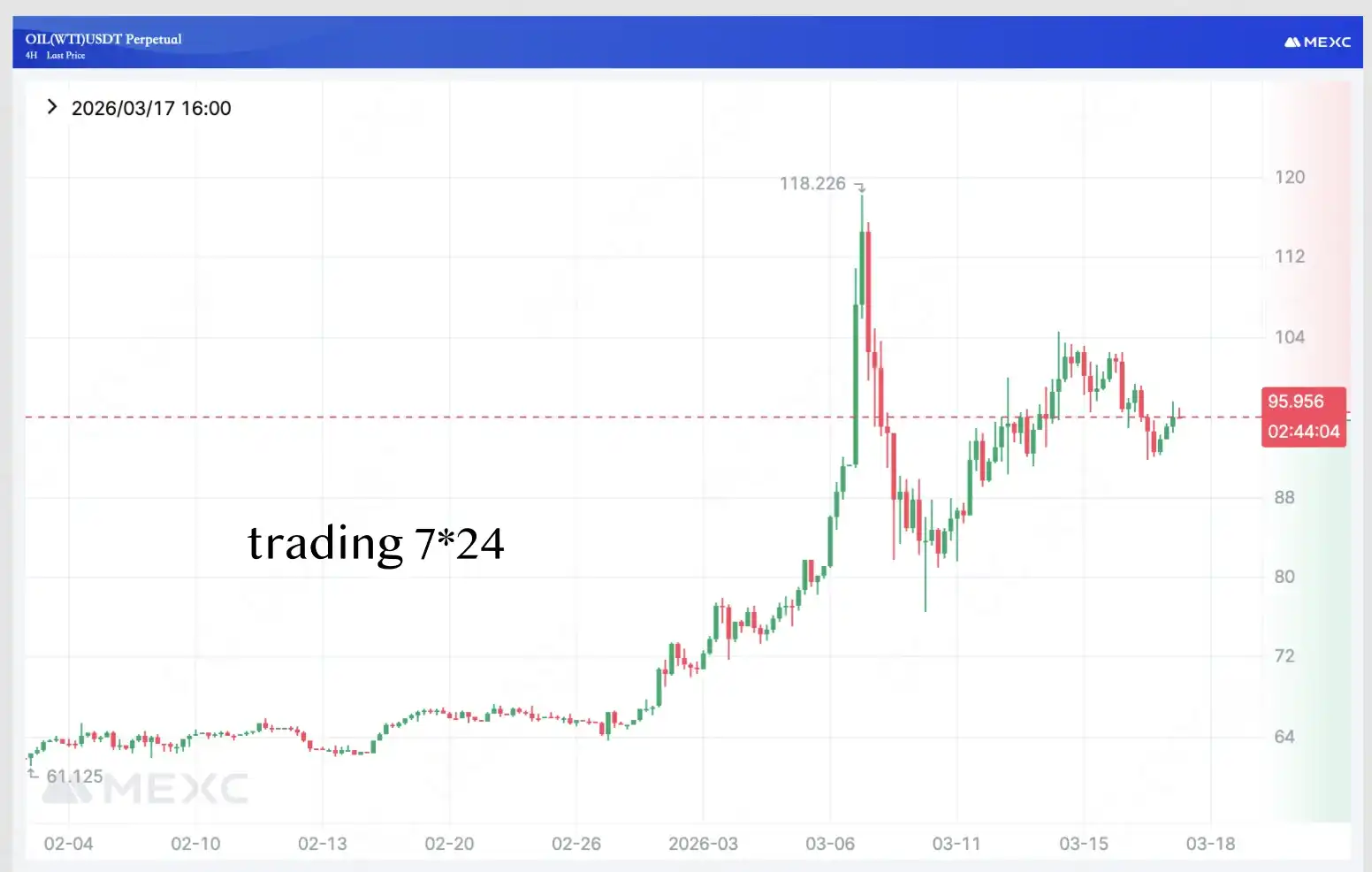
Last Saturday evening, about 20 hours before the opening of mainstream derivatives markets, the price of WTI crude oil perpetual futures on the MEXC platform surged to approximately $96 per barrel, higher than the regular crude oil futures closing price of $90.90 on Friday afternoon. In this market movement triggered by sudden conflict, crypto platforms were the first to complete the repricing of assets. Their seamless operating mechanisms made the fixed closing hours of traditional exchanges appear incredibly outdated.
The Wall Street Journal: Accelerating Integration of Traditional and Digital Finance

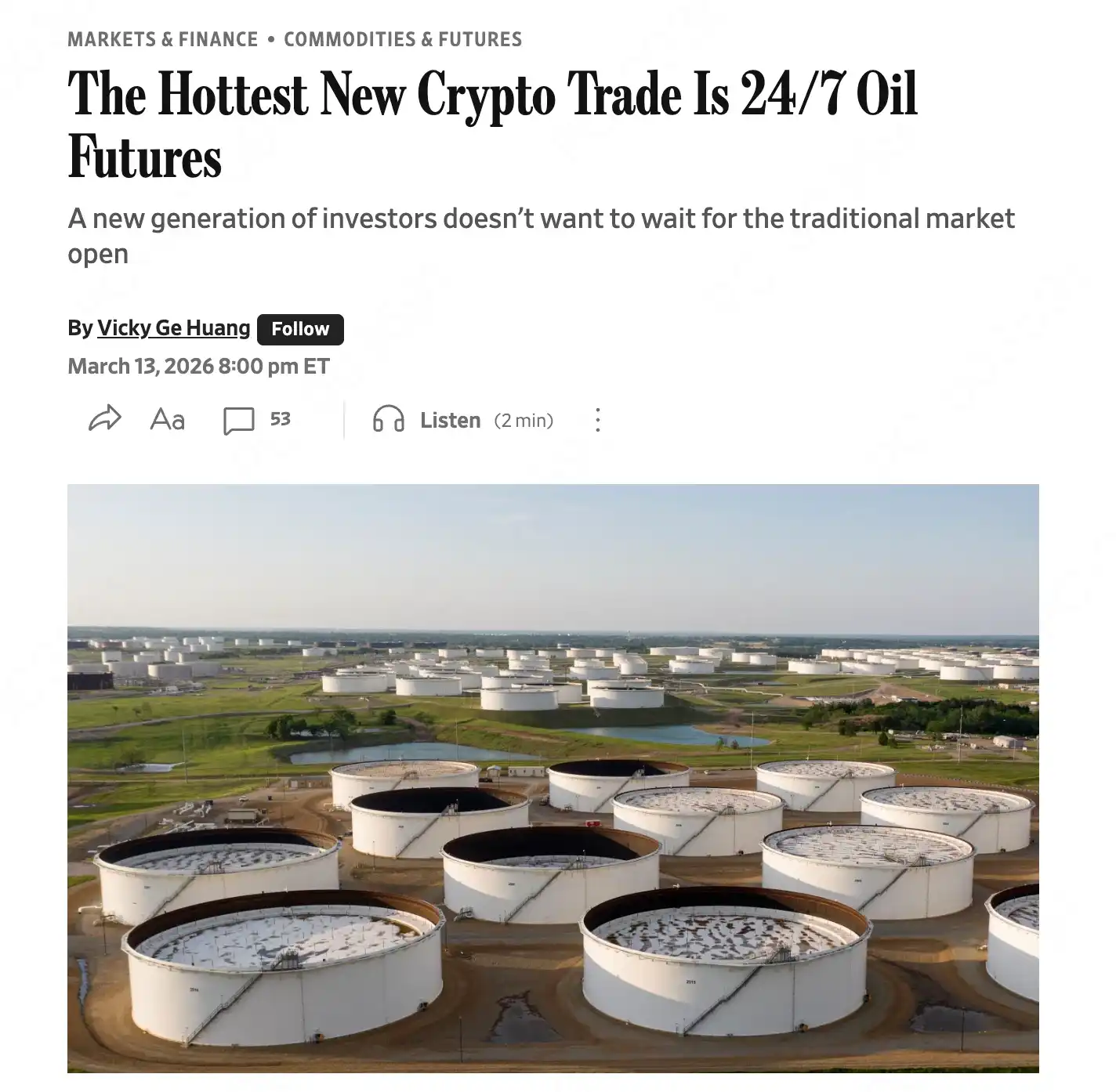
This disruptive market phenomenon quickly caught the attention of The Wall Street Journal. The report pointed out that a new generation of investors is no longer willing to wait for traditional markets to open. Crypto platforms now offer perpetual futures that track commodities, a highly speculative derivative.
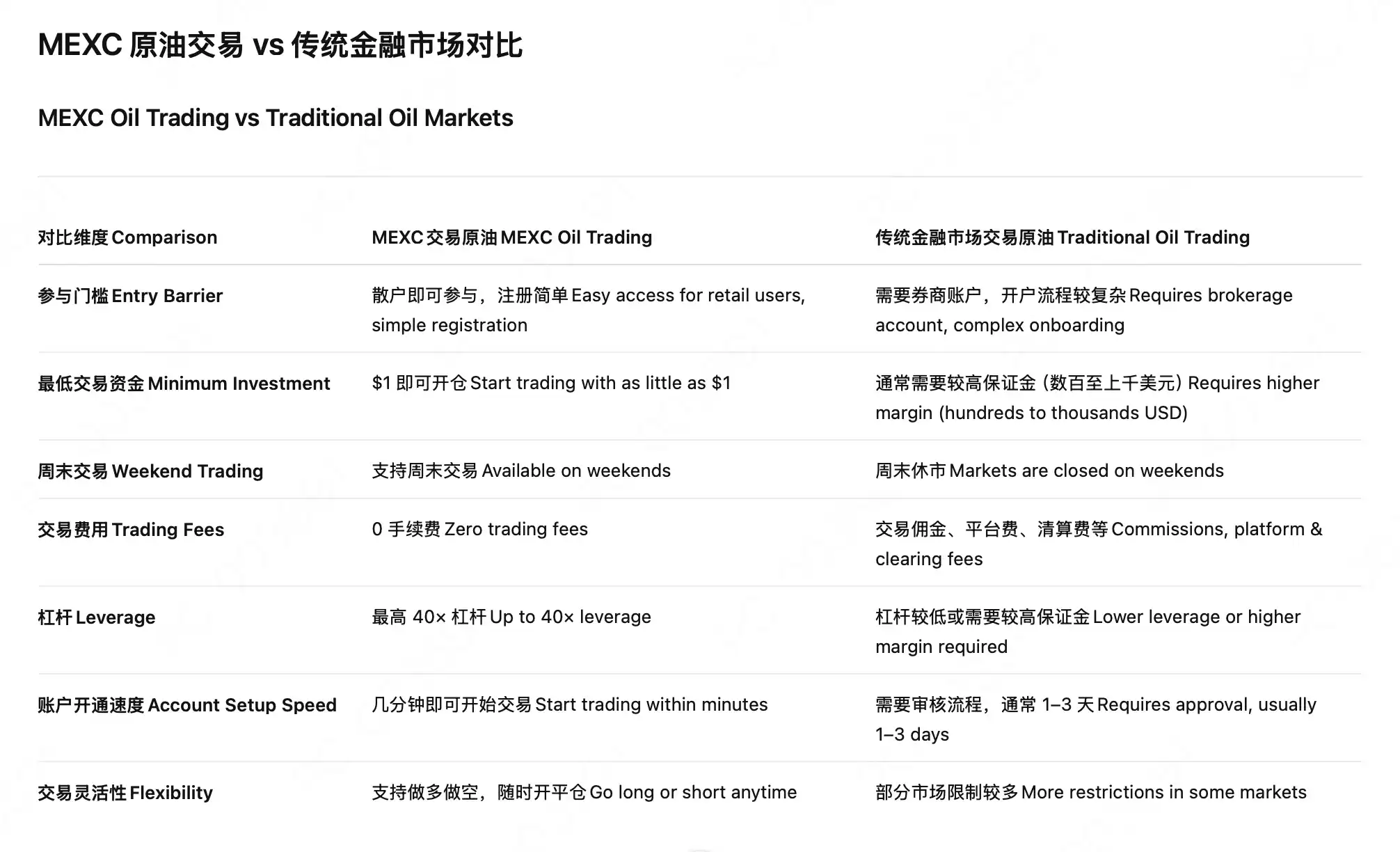
Perpetual contracts never expire and have no strike price (the point at which the contract becomes effective). They also allow traders to use extremely high leverage, which can amplify profits but also lead to the loss of the entire investment. As industry professionals have stated: "You don't need to wait until Monday for the market to open before everyone starts acting." This is changing the traditional model, enabling real participants to take action when weekend events occur.

Market data vividly reflects this vote of confidence with capital. In just a few days, the cumulative trading volume of oil futures surged from $339 million on February 28th to approximately $7.3 billion on Thursday.

Crossing Asset Boundaries: The 24/7 Wave from Crude Oil to U.S. Stocks

Time arbitrage in the oil market is just the beginning. Round-the-clock trading is already commonplace for cryptocurrency investors. For modern traders, the trading mechanisms provided by crypto platforms are demonstrating significant appeal for U.S. stocks and other commodities.

Wall Street is racing to utilize the digital ledger technology underpinning Bitcoin and other cryptocurrencies to tokenize stocks and other traditional assets. Similar to digital assets and prediction markets, so-called tokenized stocks are increasingly attracting the younger generation of investors who wish to trade 24/7 and react in real-time to geopolitical events and breaking company news. For example, investors can now trade contracts for popular U.S. stocks like AMD on crypto platforms at any time.
In addition to oil, crypto platforms have recently launched perpetual contracts for gold and silver, and the prices of these precious metals have also experienced abnormal volatility. Both metals saw their prices soar to historic highs, only to plummet subsequently.

As liquidity and trading habits migrate, an irreversible trend is emerging: Crypto platforms, with their advantages of seamless 24/7 trading, high capital efficiency, and disregard for geographical and time limitations, are continuously eating into the market share of traditional trading platforms. While traditional financial institutions remain constrained by rigid operating hours, the crypto ecosystem is gradually accommodating the trading needs of a massive volume of global assets, becoming the core hub for a new generation of pricing power.

A New Paradigm of Coexisting Opportunities and Challenges

Objectively speaking, this trading model combining high leverage and 24/7 operation is a double-edged sword. The author believes that cryptocurrency traders have short attention spans, so they desire quick returns and also crave volatility. On Sunday, the author observed that oil had reached unsustainable levels and began shorting—a judgment confirmed correct: On Monday, after President Trump stated that the war with Iran was "pretty much over," crude oil futures prices fell back below $100 per barrel.

This volatility can backfire once problems arise.

For many traders, the ability to trade these assets with leverage 24/7 is highly attractive, especially on weekends when traditional markets are closed. That said, trading highly volatile assets with leverage carries genuine market risks, and the author has also noted large-scale liquidations during sudden price swings.

Despite the challenges, the recent debut of oil futures contracts on multiple crypto platforms foreshadows a future of integration between traditional and digital finance—a time when all forms of assets can be traded at any time. In this historical process, crypto exchanges are at the forefront of this transformation. For traders eager to always maintain market initiative, a trading ecosystem that never sleeps is undoubtedly the most attractive battleground for the future.


Пов'язані питання

QWhat key advantage do cryptocurrency platforms offer over traditional financial markets for trading commodities like oil, according to the article?

ACryptocurrency platforms offer 24/7 trading, allowing investors to react to geopolitical events and market-moving news in real-time, even when traditional markets are closed, thus enabling faster asset repricing.

QWhat specific financial instrument on crypto platforms is highlighted as being used to speculate on oil prices during the recent Middle East conflict?

AOil perpetual futures contracts are the instrument used, which never expire, have no strike price, and allow for the use of high leverage.

QBesides oil, what other traditional assets are mentioned as being available for trading on crypto platforms?

AThe article mentions that crypto platforms also offer perpetual contracts for gold, silver, and tokenized stocks of companies like AMD.

QWhat is one of the major risks associated with the high-leverage, 24/7 trading model described in the article?

AA major risk is the potential for massive liquidations (forced closing of positions) during periods of sudden price volatility, which can lead to traders losing their entire investment.

QWhat broader trend does the article suggest is an irreversible shift in global finance?

AThe article suggests an irreversible trend of crypto platforms, with their 24/7 operation and high capital efficiency, reshaping global asset pricing power and eroding the market share of traditional trading platforms.

Пов'язані матеріали

$9.4 Billion: The Largest Robotics Funding This Year Has Emerged

Munich-based humanoid robotics company Neura has completed a $1.4 billion (approximately RMB 94.9 billion) Series C funding round, valuing the company at around $7 billion and positioning it among the global leaders in the sector. The investment round is notable not just for its size—reportedly the largest in robotics this year—but also for its strategic backers, which include tech giants like NVIDIA and Amazon, alongside established industrial players such as German engineering firms Bosch and Schaeffler. This mix of investors signals a significant shift in the industry's focus from technological demonstrations and general-purpose narratives toward practical, industrial deployment and commercialization. Neura's approach centers on developing humanoid robots for defined, high-value industrial tasks rather than pursuing a general-purpose model. Its early validation comes from a partnership with BMW, where its robots are being tested on actual production lines. The involvement of Bosch and Schaeffler, companies deeply embedded in global manufacturing, underscores a growing belief that humanoid robots are transitioning from labs to viable factory-floor solutions. The article highlights two converging trends driving investment: advancements in AI and large language models, which enhance robots' perception and decision-making in unstructured environments, and mounting pressure from labor shortages and rising costs in major manufacturing regions. The funding landscape is now bifurcating between companies like Figure AI, focusing on versatile general-purpose robots, and firms like Neura, targeting specific vertical industrial applications with clearer, shorter paths to ROI. While technical hurdles remain, the core challenges for widespread adoption are increasingly seen as engineering and commercial in nature: managing the high integration and customization costs for different factory environments and establishing robust, localized maintenance and service networks. The record investment in Neura, particularly from industrial capital, indicates the industry's growing confidence in moving from proving feasibility to solving the practical problems of scalability, reliability, and building sustainable business models around humanoid robots in real-world settings like automotive manufacturing and hazardous labor environments.

marsbit4 год тому

$9.4 Billion: The Largest Robotics Funding This Year Has Emerged

marsbit4 год тому

"119 to 176 Dollars": Behind SpaceX's Listing, MSX Once Again Successfully Executes the Pre-IPO Closed Loop

Following May's 300% gain on Cerebras, MSX delivered another outstanding performance during SpaceX's listing night. On June 12, SpaceX (SPCX) launched on Nasdaq, reaching a high of $176. This marked the successful culmination of MSX's Pre-IPO project launched in March, where users subscribed at $119, achieving gains of approximately 40-48%. This event validated MSX's complete Pre-IPO mechanism, a crucial advantage in a market where access to top-tier private company equity is typically limited to institutions. MSX's model provides a full cycle for users: subscription (at $119 for SpaceX), real-time on-chain portfolio tracking, optional early redemption, seamless conversion to tradable spot assets (SPCX.M) upon IPO, and final settlement in stablecoins. This end-to-end process distinguishes MSX from platforms that faced settlement issues during the SpaceX IPO, highlighting that the core challenge of Pre-IPO is not just access, but a clear exit and conversion path post-listing. This success with SpaceX is MSX's second major Pre-IPO verification, following the Cerebras listing in May, which yielded ~300% returns for early participants. These back-to-back achievements demonstrate MSX's capability to source, structure, and deliver real assets through a replicable on-chain model. The true barrier for Pre-IPO products lies not in providing an entry point, but in ensuring reliable fulfillment from subscription through to post-IPO liquidity. MSX's proven闭环 (closed-loop) process addresses this, offering Web3 users a structured way to access high-growth, pre-public companies in sectors like AI and frontier tech. MSX plans to continue expanding its Pre-IPO portfolio with this focus on authenticity, transparency, and post-listing execution.

Odaily星球日报16 год тому

"119 to 176 Dollars": Behind SpaceX's Listing, MSX Once Again Successfully Executes the Pre-IPO Closed Loop

Odaily星球日报16 год тому

Торгівля

Спот
Ф'ючерси
活动图片




