From Parallel Finance to Mainstream Finance: The On-Chain Securities Era Ushers in a Historic Window

marsbitОпубліковано о 2026-06-01Востаннє оновлено о 2026-06-01

Анотація

From Parallel Finance to Mainstream: The Dawn of On-Chain Securities For over a decade, the crypto industry has operated as a parallel financial system with its own currencies, markets, and assets—from Bitcoin and ICOs to DeFi, NFTs, and memecoins. Despite building a robust internal ecosystem, a wall has separated it from the traditional financial world. That barrier is now crumbling. The industry's first act was one of internal evolution: ICOs streamlined fundraising, DeFi recreated financial services on-chain, and layer-2 networks competed for scalability—all within the crypto bubble. While innovative, this cycle remained closed, with capital and users circulating internally, leading to volatile boom-bust cycles. Even Bitcoin ETFs, while attracting Wall Street capital, merely provided a channel to buy crypto assets without bridging the systems. The next, larger narrative is Real-World Assets (RWA) moving on-chain. This involves tokenizing stocks, bonds, funds, and future cash flows. Blockchain can compress the complex traditional processes of trading, settlement, clearing, and custody into a seamless, automated network operating in seconds. This shift is creating a new financial gateway: the native crypto securities broker. This entity will combine functions of an exchange, broker, bank, and custodian into a unified global financial operating system. Consequently, the next major battleground won't be the "public chain wars" focused on speed and cost, but the competition ...

Author: Climber, CryptoPulse Labs

For over a decade, the crypto industry has been like a financial experiment operating independently from the real world. It has its own monetary system, its own trading markets, its own logic for asset pricing, and its own set of beliefs and narratives.

From the birth of Bitcoin, through the ICO boom, to the explosion of DeFi, NFTs, Layer 2s, meme coins, and on-chain derivatives, the crypto world has gradually built an almost complete financial ecosystem.

But no matter how it has developed, one question has always remained. That is, a wall still separates the crypto world and the real-world financial system. Now, this wall is being dismantled. In the next decade, an era of native crypto securities brokerage that integrates with the global financial system is opening up.

I: The First Half of the Crypto Industry: The Self-Evolution of a Closed Ecosystem

In recent years, the U.S. CFTC has been gradually promoting a regulatory framework for compliant perpetual contracts, and the U.S. SEC has also begun to consistently signal policy support for tokenizing securities. The recent news about SpaceX's upcoming super IPO event has also made the market realize that the world's highest-quality assets in the future may be seeking new ways to circulate.

Scenarios that once sounded like science fiction are now step by step becoming reality. This means the crypto industry is about to enter a new stage.

However, looking back at the history of the crypto industry, it becomes clear that the past decade-plus has actually been an ongoing, escalating internal financial experiment.

The 2017 ICO frenzy essentially solved the fundraising problem. For the first time, startup projects didn't need traditional VCs or IPO approvals; with just a whitepaper and a token model, they could raise funds globally. The market saw for the first time the immense efficiency gains blockchain could bring to capital formation.

The subsequent DeFi Summer then began to address the issue of financial services. Lending, trading, market-making, yield aggregation began to move on-chain. Functions originally performed by banks, brokerages, and financial institutions were gradually replaced by smart contracts. The most important change during this period was not the emergence of a particular killer protocol, but the fact that the entire financial infrastructure began to be reconstructed.

Next, the industry entered the era of the public chain war. Due to Ethereum's performance limitations, numerous high-performance public chains began competing for developers, users, and liquidity. Faster speeds, lower costs, and higher TPS became the focus of market competition. However, looking back, this competition was still essentially internal.

Because the participants didn't change—users were still crypto users, capital was still crypto capital, and assets were still crypto assets.

Later, the NFT boom shifted the industry narrative from finance to culture and social interaction. Digital collectibles, on-chain identity, and gaming assets entered the market. This was followed by the meme coin frenzy, decentralized perpetual contracts, DAT, and other new models continuously emerging.

While the industry seems to have been evolving, most of these changes occurred within the same circle. The crypto world has been more like an ever-expanding closed economy, with capital flowing internally, users circulating internally, new assets constantly being created, and then being bought up by new capital.

This is also why every cycle has seen obvious bubbles and pullbacks—because truly massive external capital had never fully entered.

Even with Bitcoin ETFs starting to attract Wall Street capital, the crypto industry has still not truly connected with the real-world financial system. Because ETFs only allow traditional capital to buy crypto assets; real-world assets have not yet truly moved on-chain.

II. A Bigger Story than ETFs: Real-World Assets Begin Moving On-Chain

Many believe that Bitcoin ETFs opened the door for traditional finance to embrace crypto. But in reality, ETFs are only the first step.

Because they merely add a channel for the traditional financial system to purchase crypto assets. What could truly change the industry's structure is another matter—securities assets beginning to enter the on-chain world.
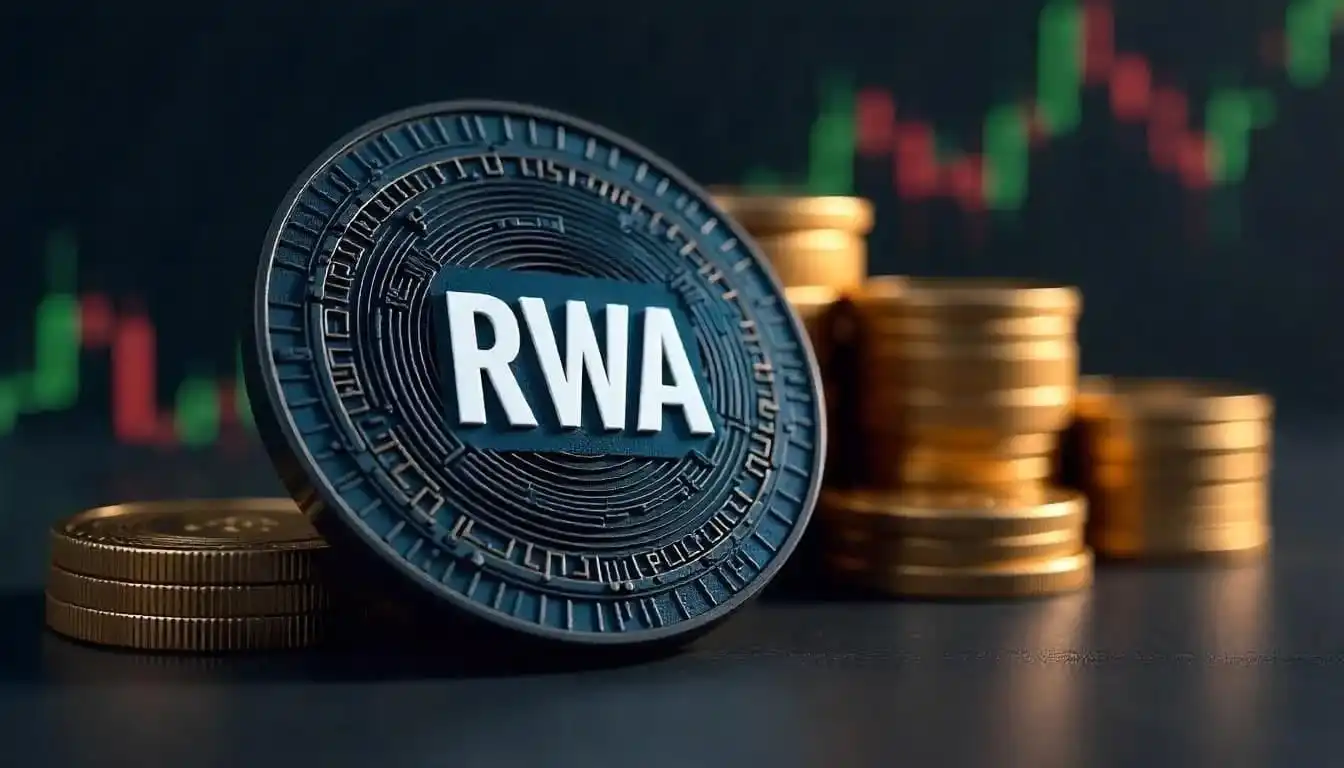
This means stocks, bonds, funds, income rights, and even future cash flows could all be digitized.

In the past, buying a stock required a securities account, cross-border trading required a broker, asset custody required a bank, and after trading, a clearinghouse was needed for final settlement—the entire system was extremely complex.

But blockchain offers a new perspective. If assets natively exist on-chain, then trading, settlement, clearing, custody, and even identity verification could all be completed within the same network.

Processes that used to take days to complete could end in seconds in the future. Work that previously relied on multiple institutions could potentially be executed automatically by smart contracts. This is actually changing the financial infrastructure itself.

What makes Wall Street truly powerful has never been just the scale of its capital. More importantly, it controls the underlying financial network. Exchanges, brokerages, banks, custodians, clearinghouses together constitute a vast system. And blockchain is gradually compressing these links.

In the future, many financial services may no longer be performed by multiple institutions, but run directly within a unified network.

Therefore, the protagonists of the crypto industry's next phase may no longer be trading platforms. They will be new financial gateways.

The so-called native crypto securities brokerage is essentially this new gateway. It not only handles trading functions but also assumes the roles of wallet, asset management, custody, clearing, and financial services.

It might be like an exchange, and also like a broker. Like a bank, and also like a payment system—even more like a global financial operating system.

III. The Next War: Not Public Chain Competition, but Financial System Competition

In recent years, the crypto market has been debating who will become the next king of public chains. The market compares TPS, gas fees, number of ecosystems, and developer size. But in the future, the importance of these metrics may gradually decline.

Because what truly matters in financial markets is not speed, but assets. Even if a chain has a million TPS, it's hard to create long-term value without high-quality assets entering.

What is truly valuable is liquidity. And the core of liquidity is asset quality.

If in the future, users can buy global stocks, index funds, bonds, and even shares in top-tier tech companies like SpaceX on-chain, the entire industry logic will change.

Because the boundary between the on-chain world and the real world will gradually disappear.

In the past, the crypto industry competed for the internal market; in the future, it will compete for the global capital market. These are two completely different stories.

Currently, the global crypto market remains in the multi-trillion dollar range, while the global stock market is close to a hundred trillion dollars, and the bond market is even larger. They are not on the same order of magnitude.

In the past, the industry discussed the next billion-dollar project; in the future, it may discuss how to accommodate the flow of tens of trillions of dollars in assets. The ICO era solved the fundraising problem; the DeFi era solved the on-chain finance problem; the ETF era solved the capital gateway problem; and the native crypto securities brokerage era may solve the problem of integrating real-world finance with crypto finance.

Conclusion

For over a decade, the crypto industry has been trying to create a new world. In the next decade, it may no longer need to recreate the world.

Because it will directly connect to the original world.

When traditional finance and the crypto ecosystem truly converge, the industry's biggest growth story may just be beginning.


Трендові криптовалюти

Пов'язані питання

QAccording to the article, what is the fundamental problem that the crypto industry has faced despite its development over the past decade?

AThe fundamental problem is that there has been a 'wall' separating the crypto world from the traditional real-world financial system. The crypto ecosystem developed independently with its own currency, markets, and logic, but remained largely disconnected from mainstream global finance.

QWhat event does the author suggest is an even bigger development than the introduction of Bitcoin ETFs?

AThe author suggests that the migration of traditional securities (like stocks, bonds, and funds) onto the blockchain is an even bigger story. This process of real-world asset tokenization has the potential to fundamentally change the industry's structure by blurring the lines between crypto and traditional finance.

QWhat new type of entity does the article predict will be a key player in the next phase of the crypto industry?

AThe article predicts that 'native crypto securities brokerages' will be key players. These entities will act as new financial gateways, combining functions of exchanges, brokers, banks, custodians, and payment systems, essentially serving as a global financial operating system.

QWhat does the author argue will be the primary focus of competition in the future, replacing the past focus on 'public chain wars'?

AThe author argues that future competition will shift from 'public chain wars' (focusing on TPS, fees, etc.) to a competition over financial systems. The true value will lie in attracting high-quality assets and liquidity, with the ultimate prize being a share of the global capital markets, which are orders of magnitude larger than the current crypto market.

QWhat is the core thesis of the article regarding the future relationship between crypto and traditional finance?

AThe article's core thesis is that the crypto industry is transitioning from being a parallel, closed financial experiment to becoming integrated into the mainstream global financial system. The next decade will be defined not by creating a separate new world, but by directly connecting to and reshaping the existing world of finance through the tokenization of real-world assets.

Пов'язані матеріали

The White House's "Exclusive" Teleprompter Operator Makes Over $100,000 by Profiting from Insider Information Predictions

"White House Speech Prompt Operator Earns Over $100,000 Using Insider Information on Prediction Markets" U.S. White House staffer Gabriel Perez, a long-time teleprompter operator for former President Donald Trump, has been suspended without pay for using non-public information to profit on prediction markets. As one of the few individuals with advance access to Trump's prepared speech texts, Perez placed bets on specific words or phrases Trump would mention in speeches over a three-month period, earning over $100,000. His activities were flagged by the prediction platform Kalshi, which froze over $90,000 in his account and reported him to the Commodity Futures Trading Commission (CFTC). While Perez avoided criminal charges, he is required to return his profits and cease such trading. This case marks the third major instance of insider trading on prediction markets involving government or corporate insiders, following earlier cases involving a special forces soldier and a Google engineer. The incident highlights the vulnerability of "mention" markets on prediction platforms, where individuals with advance knowledge or even the speakers themselves can easily manipulate outcomes. In response, platforms like Kalshi are tightening rules, now requiring users to disclose their employers to help prevent similar abuses.

marsbit1 год тому

The White House's "Exclusive" Teleprompter Operator Makes Over $100,000 by Profiting from Insider Information Predictions

marsbit1 год тому

Bitcoin Mining Farms Are Becoming AI Factories

Bitcoin mines are transforming into AI factories. This shift is driven by the convergence of three key assets from the previous crypto cycle: infrastructure, talent, and capital. Crypto mining companies like Crusoe, CoreWeave, and Bitdeer are repurposing their core competency—securing power, land, and grid connections in remote locations—to build data centers for AI clients. These firms are signing multi-billion dollar, long-term contracts with companies like Anthropic, AWS, and Microsoft, as AI's demand for reliable, high-capacity compute surpasses the profitability of Bitcoin mining. Simultaneously, crypto entrepreneurs and engineers are applying their skills to new AI ventures. Examples include OpenSea's co-founder launching OpenRouter (an AI model aggregator), and former Coinbase engineers building Fal.ai (a generative media infrastructure platform). Their experience in building scalable, global software networks translates effectively to the AI space. Furthermore, capital accumulated during the crypto boom is now fueling AI. Figures like Jed McCaleb (co-founder of Ripple) funded Voltage Park, a large-scale GPU cloud provider. Notably, some crypto investments, like FTX's early bets on Anthropic and Cursor, have generated astronomical paper returns, demonstrating how high-risk crypto capital flowed into AI before it became mainstream. The transition is not just about repurposing hardware, but about redirecting critical resources—power infrastructure, distributed systems expertise, and venture funding—to the next technological frontier: artificial intelligence.

链捕手1 год тому

Bitcoin Mining Farms Are Becoming AI Factories

链捕手1 год тому

Morpho Launches Fixed-Rate Product Midnight: Lenders and Borrowers Set Their Own Rates, Ending the Era of Interest Rate Models

Morpho Launches Fixed-Rate Product Midnight: Lenders and Borrowers Set Their Own Rates, Ending the Era of Algorithmic Interest Models On-chain lending has grown to $60 billion but remains minuscule compared to traditional finance's $200 trillion annual credit volume. Morpho identifies the lack of fixed rates and maturity dates as key bottlenecks. Institutions need predictability, not the passive floating rates set by algorithmic models. Midnight allows lenders and borrowers to directly quote rates, set terms, and become price makers, not takers. Fixed-rate lending is now viable due to cheaper, faster blockchains and the entry of institutions demanding control and certainty over returns, costs, and duration. Morpho Blue previously gave users control over risk; Midnight adds control over interest rates. Past attempts at on-chain fixed-rate lending failed primarily because they were built on top of floating-rate pools (creating unpredictability) or lacked sufficient active participants. Midnight avoids these pitfalls as a standalone primitive with fixed rates at its core, built upon Morpho Blue's existing large and active user base. Midnight offers distinct value: institutions gain predictable term structures and full control; fintech companies can offer tailored fixed-rate products; lenders/borrowers achieve predictability and efficiency; and curators can now differentiate by configuring both risk and interest rates. Morpho Midnight is not a replacement for Morpho Blue. The Morpho network will now feature two complementary market structures: floating-rate/open-term (Blue) for flexibility and fixed-rate/fixed-term (Midnight) for predictability. Liquidity can flow between them. The launch will be gradual, prioritizing security. Initially, it will support direct lending on Base network with one trading pair (cbBTC/USDC) and limited maturity dates. Advanced features like auto-rollovers will be introduced later.

marsbit1 год тому

Morpho Launches Fixed-Rate Product Midnight: Lenders and Borrowers Set Their Own Rates, Ending the Era of Interest Rate Models

marsbit1 год тому

Торгівля

Спот

Популярні статті

Як купити ERA

Ласкаво просимо до HTX.com! Ми зробили покупку Caldera (ERA) простою та зручною. Дотримуйтесь нашої покрокової інструкції, щоб розпочати свою криптовалютну подорож.Крок 1: Створіть обліковий запис на HTXВикористовуйте свою електронну пошту або номер телефону, щоб зареєструвати обліковий запис на HTX безплатно. Пройдіть безпроблемну реєстрацію й отримайте доступ до всіх функцій.ЗареєструватисьКрок 2: Перейдіть до розділу Купити крипту і виберіть спосіб оплатиКредитна/дебетова картка: використовуйте вашу картку Visa або Mastercard, щоб миттєво купити Caldera (ERA).Баланс: використовуйте кошти з балансу вашого рахунку HTX для безперешкодної торгівлі.Треті особи: ми додали популярні способи оплати, такі як Google Pay та Apple Pay, щоб підвищити зручність.P2P: Торгуйте безпосередньо з іншими користувачами на HTX.Позабіржова торгівля (OTC): ми пропонуємо індивідуальні послуги та конкурентні обмінні курси для трейдерів.Крок 3: Зберігайте свої Caldera (ERA)Після придбання Caldera (ERA) збережіть його у своєму обліковому записі на HTX. Крім того, ви можете відправити його в інше місце за допомогою блокчейн-переказу або використовувати його для торгівлі іншими криптовалютами.Крок 4: Торгівля Caldera (ERA)Легко торгуйте Caldera (ERA) на спотовому ринку HTX. Просто увійдіть до свого облікового запису, виберіть торгову пару, укладайте угоди та спостерігайте за ними в режимі реального часу. Ми пропонуємо зручний досвід як для початківців, так і для досвідчених трейдерів.

501 переглядів усьогоОпубліковано 2025.07.17Оновлено 2026.06.02

Як купити ERA

Обговорення

Ласкаво просимо до спільноти HTX. Тут ви можете бути в курсі останніх подій розвитку платформи та отримати доступ до професійної ринкової інформації. Нижче представлені думки користувачів щодо ціни ERA (ERA).

活动图片