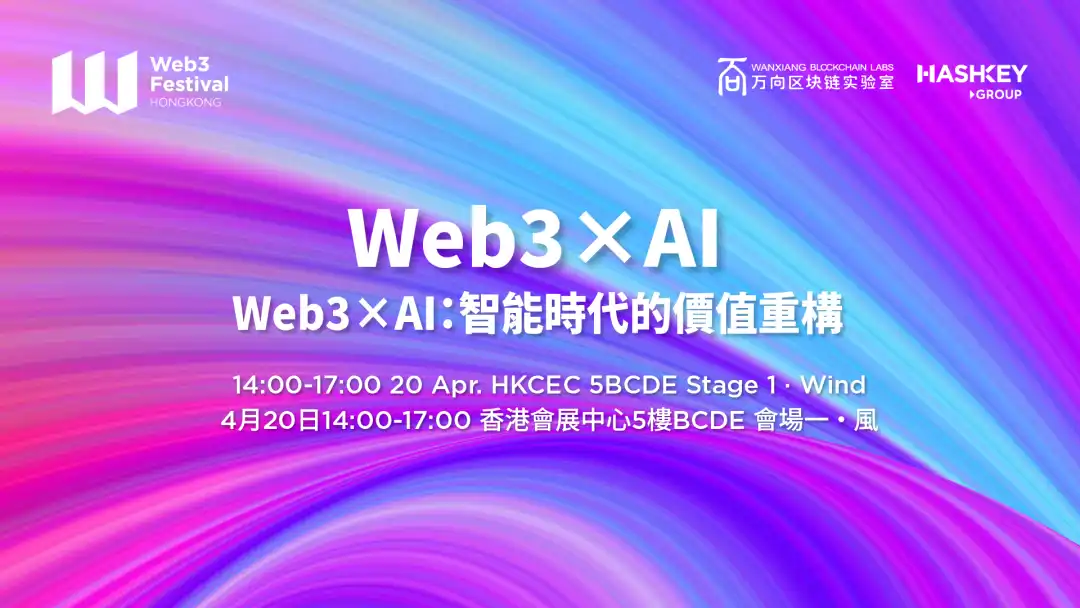
From "National Shrimp Farming" to the Intelligent Economy: The 2026 Hong Kong Web3 Carnival AI x Web3 Summit Agenda Unveiled!

marsbitОпубліковано о 2026-04-08Востаннє оновлено о 2026-04-08

Анотація

The 2026 Hong Kong Web3 Carnival will host a pivotal forum titled "Web3×AI: Value Reconstruction in the Intelligent Era" on the afternoon of April 20. This event brings together global pioneers in AI and Web3 to explore the deep integration of these transformative technologies. Discussions will cover topics ranging from Silicon Valley’s innovative uses of AI lobsters to practical implementation of AI and Web3 beyond the lab. Industry leaders from TON Foundation, Qtum, Cobo, MaxQuant, and Anoma will share insights on security, financial applications, and decentralized AI ecosystems. Key roundtables will address critical questions: Does AI truly need Web3? Experts will debate issues like data privacy, decentralized computing, and value attribution. Another session will focus on AI Agents and the future of human-computer interaction, examining how agentic AI could reshape industries by moving beyond traditional interfaces. This forum aims to cut through the hype and provide actionable insights into how AI and Web3 can move from technological overlap to symbiotic value creation.

The explosive popularity of OpenClaw has ignited a "national shrimp farming" trend. When the "intelligent emergence" of artificial intelligence meets the "trust machine" of Web3 head-on, what we are ushering in is far more than just a technological overlay—it is a profound revolution in value creation, distribution, and revaluation. When AI Agents make interfaces "disappear," what is the ultimate form of human-computer interaction? Does AI really need Web3?

On the afternoon of April 20th, Venue 1·Feng at the 2026 Hong Kong Web3 Carnival will host the "Web3 x AI: Value Reconstruction in the Intelligent Era" thematic forum. It will bring together pioneering forces from the global AI and Web3 fields, from the "lobster secrets" at the Silicon Valley frontier to the underlying logic of enterprise practice, from practical experience in security collaboration to future previews of human-machine symbiosis. It will provide in-depth analysis and forward-looking insights, exploring the new possibilities of Web3 and AI integration in the intelligent era.

Silicon Valley AI tech blogger Lang Hanwei will reveal what Silicon Valley is using lobsters for, decoding the wildest cutting-edge trends overseas from a unique tech blogger's perspective. John, Head of Asia-Pacific at TON Foundation, will share innovative explorations of TON ecosystem and AI collaboration. Qtum Co-founder Miguel Palencia will break down how to drive AI and Web3 from the "lab" to the "application field," building efficient and collaborative technical bridges for developers and enterprises.

Cobo Co-founder and CTO Changhao Jiang, based on practical experience, will thoroughly explain the collaboration between Web3 security and AI, safeguarding the steady progress of the integrated ecosystem. MaxQuant CEO Jeffery Zeng will focus on the innovative application of AI technology in asset analysis and risk control, showcasing the new value of finance and technology integration. Anoma Co-founder Adrian Brink will also explore the future blueprint of AI and Web3 symbiosis, leading the decentralized ecosystem to new intelligent heights.

In addition to keynote speeches that address core issues, high-quality roundtable discussions will bring together industry elites to discuss the central topics of current AI and Web3 integration.

On one side is AI's centralized reliance on data, computing power, and models; on the other is Web3's pursuit of decentralization, privacy, and rights confirmation. Are the two naturally complementary, or is it a "forced match"? Hosted by Gen Labs Limited CEO He Xiaoyang, alongside guests including Keywolf, Partner and Product Head of SlowMist, and Michael Yung, Strategic Advisor at Google Cloud, the roundtable discussion "Does AI Really Need Web3?" will take place. From data privacy and decentralized computing power to value rights, it will dissect the complementary space between AI and Web3, explore possible paths from "technological overlay" to "value symbiosis," and interpret the new changes in Web3 security in the AI era.

As AI Agents rapidly penetrate various industries, human-computer interaction is undergoing a revolution of "disappearing interfaces." From the "you-click, I-search" GUI, to the "you-say, I-do" conversational interface, and further to the "you-think, I-act" autonomous Agent, what exactly does the ultimate form of human-computer interaction look like? Guests including Zolo Xiong, Co-founder of Deep Chao TechFlow, KK, COO of Virtuals Protocol, Cindy Shi, CMO of Kite AI, and Bob, CEO of Questflow, will discuss topics such as the autonomy of AI Agents, user incentives, and experience. They will break down how AI Agents are breaking the boundaries of traditional human-computer interaction and reconstructing new paradigms for production, life, and industrial operations.

Value reconstruction in the intelligent era does not wait for bystanders; the best opportunities are always reserved for those who are present. This time, stand shoulder-to-shoulder with top global tech guests, penetrate the fog of technology, decode the core secrets of Web3 and AI integration, and jointly discover new possibilities for value in the intelligent era.


Пов'язані питання

QWhat is the main theme of the 'Web3×AI: Value Reconstruction in the Intelligent Era' forum at the 2026 Hong Kong Web3 Festival?

AThe forum focuses on the convergence of AI and Web3 technologies, exploring how their integration can revolutionize value creation, distribution, and re-evaluation, featuring discussions on AI agents, decentralized ecosystems, security, and practical applications.

QWhich speakers will discuss the practical implementation of AI and Web3 technologies moving from 'laboratory to application field'?

AMiguel Palencia, Co-founder of Qtum, will address how to drive AI and Web3 from the 'laboratory' to the 'application field,' building efficient technical bridges for developers and enterprises.

QWhat specific topic will Changhao Jiang, CTO of Cobo, cover regarding AI and Web3 integration?

AChanghao Jiang will share practical experiences on the synergy between Web3 security and AI, focusing on safeguarding the robust development of the integrated ecosystem.

QWhat is the central debate question in the roundtable discussion 'Does AI Really Need Web3?'

AThe roundtable debates whether AI's centralized reliance on data, computing power, and models is naturally complementary or fundamentally incompatible with Web3's pursuit of decentralization, privacy, and value attribution.

QHow will the panel on AI Agents address the evolution of human-computer interaction?

AThe panel, featuring experts like Zolo Xiong and KK, will discuss how AI Agents are transforming interaction from GUI to conversational interfaces and autonomous agents, breaking traditional boundaries and reshaping paradigms in production and daily life.

Пов'язані матеріали

Breaking: OpenAI Undergoes Major Reorganization, President Brockman Assumes Command

OpenAI has announced a major internal reorganization just months before its anticipated IPO. The company is merging its three flagship product lines—ChatGPT, Codex, and the API platform—into a single, unified product organization. The most significant leadership change involves co-founder and President Greg Brockman moving from a background technical role to take full, permanent control over all product strategy. This follows the indefinite medical leave of AGI Deployment CEO Fidji Simo. Additionally, ChatGPT's longtime lead, Nick Turley, has been reassigned to enterprise products, with former Instagram executive Ashley Alexander taking over consumer offerings. The consolidation, internally framed as a strategic move towards an "Agentic Future," aims to break down internal silos and create a cohesive "Super App." This planned desktop application would integrate ChatGPT's conversational abilities, Codex's coding power, and a rumored internal web browser named "Atlas" to autonomously perform complex user tasks. The reorganization occurs amid significant internal and external pressures. OpenAI has recently seen a wave of high-profile departures, including Sora co-lead Bill Peebles and other senior technical leaders, leading to concerns about a thinning executive bench. Externally, rival Anthropic recently secured funding at a staggering $900 billion valuation, surpassing OpenAI's own. Google's upcoming I/O developer conference also poses a competitive threat. Analysts suggest the dramatic restructure is a pre-IPO move to present a clearer, more focused narrative to Wall Street—streamlining operations and demonstrating decisive leadership under Brockman to counter internal turbulence and intense market competition.

marsbit3 год тому

Breaking: OpenAI Undergoes Major Reorganization, President Brockman Assumes Command

marsbit3 год тому

Two Survival Structures of Market Makers and Arbitrageurs

Market makers and arbitrageurs represent two distinct survival structures in high-frequency trading. Market makers primarily use limit orders (makers) to profit from the bid-ask spread, enjoying high capital efficiency (nominally 100%) but bearing inventory risk. This "inventory risk" arises from passive, fragmented, and discontinuous order fills in the limit order book (LOB). This risk, while a potential cost, can also contribute to excess profit if managed within control boundaries, allowing for mean reversion. Market makers essentially sell "time" (uncertainty over execution timing) to the market for price control and low fees. In contrast, cross-exchange arbitrageurs typically use market orders (takers) to exploit price differences or funding rates, resulting in lower nominal capital efficiency (requiring capital on both exchanges) and higher transaction costs. Their risk exposure stems from asymmetries in exchange rules (e.g., minimum order sizes), execution latency, and infrastructure risks (e.g., ADL, oracle drift). These exposures are active, exogenous gaps that primarily erode profits rather than contribute to them. Arbitrageurs essentially sell "space" (capital sunk across venues) for localized, immediate certainty. Both strategies engage in a trade-off between execution friction and residual risk. Optimal systems allow for temporary, controlled risk exposure rather than enforcing zero exposure at all costs. Their evolution converges towards hybrid models: arbitrageurs may use maker orders to reduce costs, while market makers may use taker orders or hedges for risk management. Ultimately, both use different forms of risk exposure—market makers exposing inventory, arbitrageurs immobilizing capital—to extract marginal, hard-won certainty from the market.

链捕手3 год тому

Two Survival Structures of Market Makers and Arbitrageurs

链捕手3 год тому

Who Will Define the Rules of the AI Era? Anthropic Discusses the 2028 US-China AI Landscape

This article, based on Anthropic's analysis, outlines the intensifying systemic competition between the U.S./allies and China for AI leadership by 2028. It argues that access to advanced computing power ("compute") is the critical bottleneck, where the U.S. currently holds a significant advantage through chip export controls and allied innovation. However, China's AI labs remain competitive by exploiting policy loopholes—via chip smuggling, overseas data center access, and "model distillation" attacks to copy U.S. model capabilities—keeping them close to the frontier. The piece presents two contrasting scenarios for 2028. In the first, decisive U.S. action to tighten compute controls and curb distillation locks in a 12-24 month AI capability lead, cementing democratic influence over global AI norms, security, and economic infrastructure. In the second, policy inaction allows China to achieve near-parity through continued access to U.S. technology, enabling Beijing to promote its AI stack globally and integrate advanced AI into its military and governance systems, altering the strategic balance. Anthropic contends that maintaining a decisive U.S. lead is essential for shaping safe AI development and governance. The core recommendation is for U.S. policymakers to urgently close compute and model access loopholes while promoting global adoption of the U.S. AI technology stack to secure a lasting strategic advantage.

marsbit5 год тому

Who Will Define the Rules of the AI Era? Anthropic Discusses the 2028 US-China AI Landscape

marsbit5 год тому

Торгівля

Спот
Ф'ючерси
活动图片




