From Hyperliquid to Solana: How an ICO Promise of 'Chain Switching' Shakes Investor Trust?

比推Опубліковано о 2026-01-19Востаннє оновлено о 2026-01-19

Анотація

In a controversial move, the digital collectibles platform Trove announced its sudden migration from Hyperliquid to Solana on January 19, citing a liquidity partner’s decision to liquidate a significant HYPE position. This shift contradicts earlier ICO promises that emphasized Hyperliquid integration and HYPE token backing, triggering backlash from investors who now demand refunds. The ICO, which initially raised over $11.5 million, faced scrutiny after the team briefly prolonged the fundraising period, causing speculative spikes on prediction market Polymarket. Investigations revealed that Trove had transferred $45,000 from its angel round directly into prediction markets, and allegations emerged that the team offered paid promotions to influencers. Community trust eroded further as Trove proceeded with token generation and distribution plans without addressing refund requests, despite the fundamental change in platform and tokenomics. The incident highlights risks in crypto investing, especially around anonymous teams, opaque fund management, and unilateral post-ICO changes.

Author: Sanqing, Foresight News

Original Title: Trove Raises Tens of Millions Then 'Switcheroo', Suspected of Misusing Funds and Manipulating Prediction Markets


On January 19, unwise, a team member of the digital collectibles contract platform Trove, tweeted that Trove would migrate to Solana. The member stated that this was because the liquidity partner supporting its Hyperliquid path chose to liquidate its 500,000 HYPE position. Subsequently, the HYPE purchase address disclosed on its ICO page began selling.
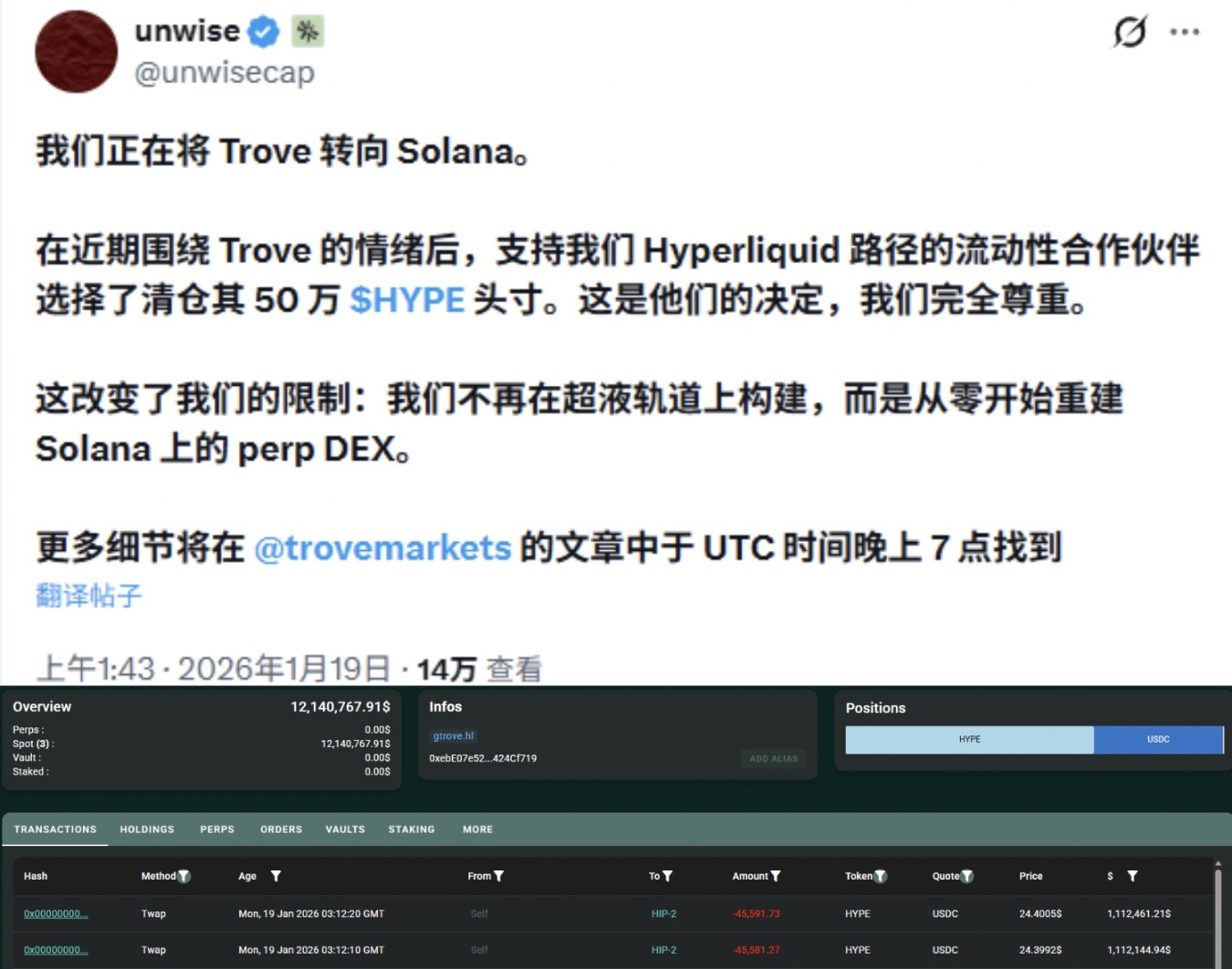
unwise's tweet (top), Trove-associated address HYPE transaction record (bottom) | Source: X (top, translated), HypurrScan (bottom)

Previously, Trove repeatedly mentioned that it had raised $20 million, would launch a token on Hyperliquid, and would build its digital collectibles contract platform based on HIP-3. Based on this public information, it completed an ICO with a $20 million FDV, selling 12.5% of the total supply.

ICO Flip-Flopping, Transferring Raised Funds to Prediction Markets

The Trove ICO was originally scheduled to start on January 9 at 1:00 and end on January 12 at 1:00.

On January 12, the project team announced it had raised over $11.5 million and extended the ICO by 5 days until January 16 at 1:00. 42 minutes later, they posted again revoking this decision and stated the ICO would end as originally scheduled.

Affected by this, the probabilities on Polymarket for the Trove ICO total raising over 15M, 20M, 25M, and 30M all sharply increased from near zero to 40% – 80% within a short time.

On January 17, on-chain detective ZachXBT tweeted that Trove had directly moved $45,000 from its Trove angel round financing into prediction markets on January 11. Trove team member unwise replied, attributing the operation to TJR (an English crypto KOL).
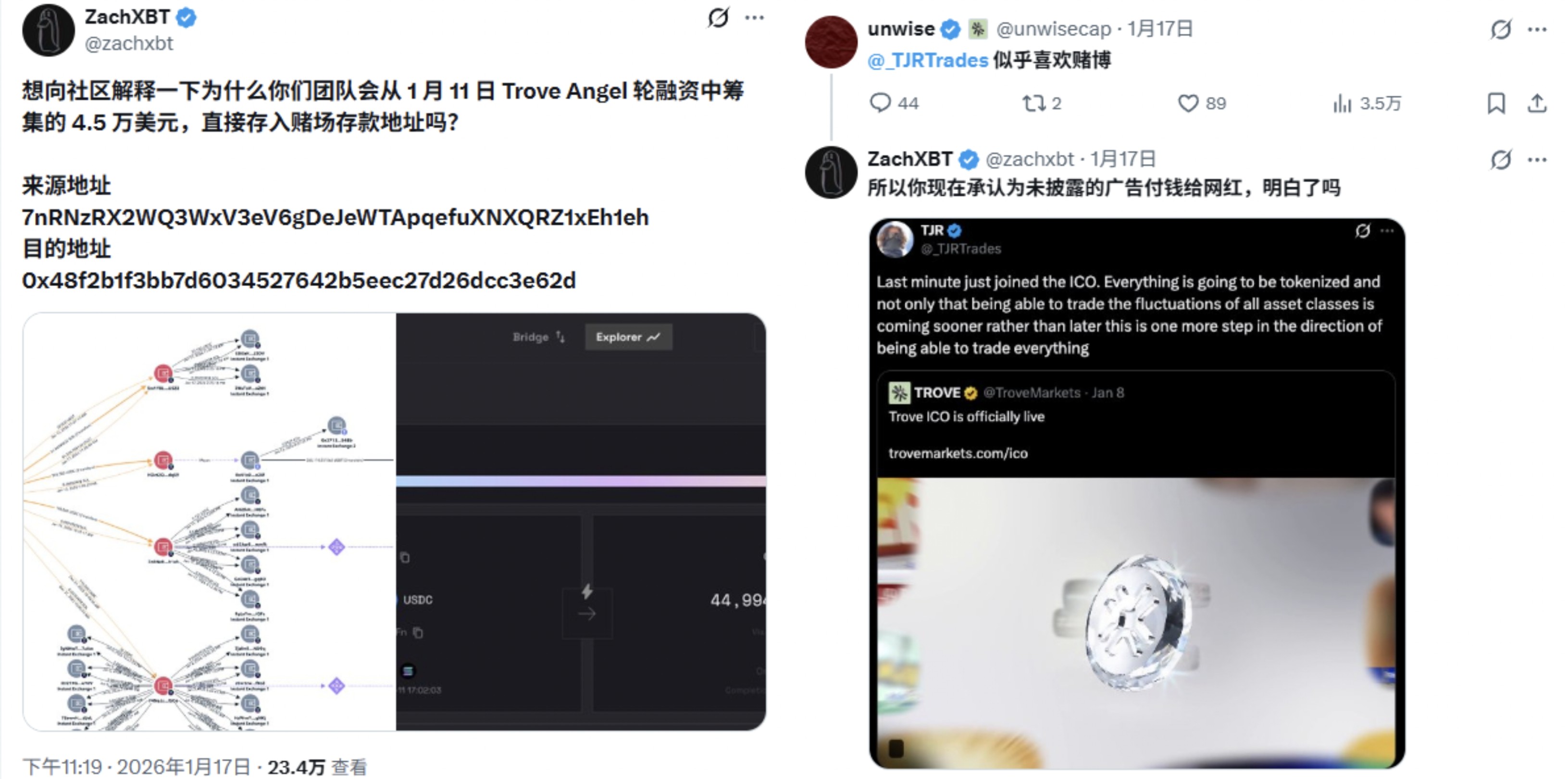
Source: ZachXBT and uniwise tweets (translated)

Furthermore, according to crypto KOL hrithik, they received multiple messages from the Trove team promising additional compensation for promoting their ICO bids and posts.
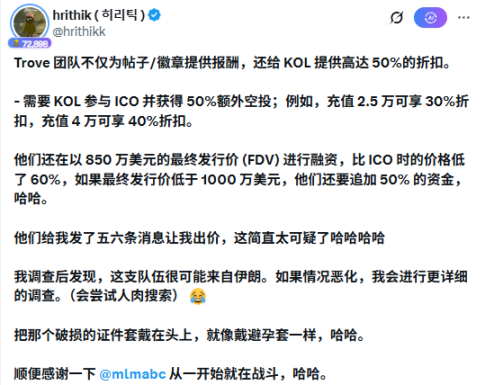
Source: hrithik tweet (translated)

Community feedback on the ICO changes and Polymarket activities included criticism that the extension decision increased uncertainty and damaged trust.
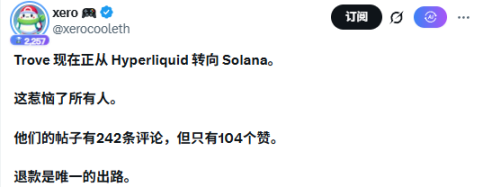
Source: xero tweet (translated)

Regarding Polymarket, users accused the team of manipulation and non-disclosure, turning a previously promising ICO into demands for refunds, with some calling it insider trading, leading to a shift in sentiment from excitement to caution.
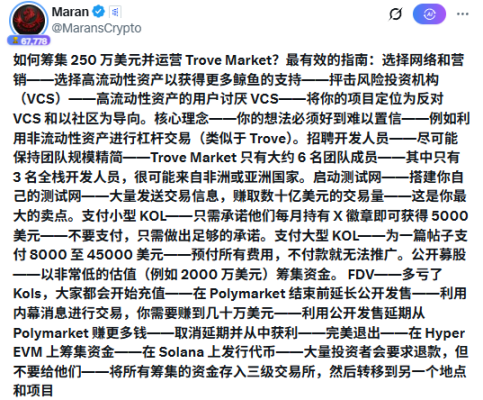
Source: Maran tweet (translated)

Violating ICO Public Information, Temporarily Migrating to Solana

Previously, Trove repeatedly stated on its official Twitter that it had purchased HYPE tokens, would build its digital collectibles contract platform based on HIP-3, and had launched a test website.
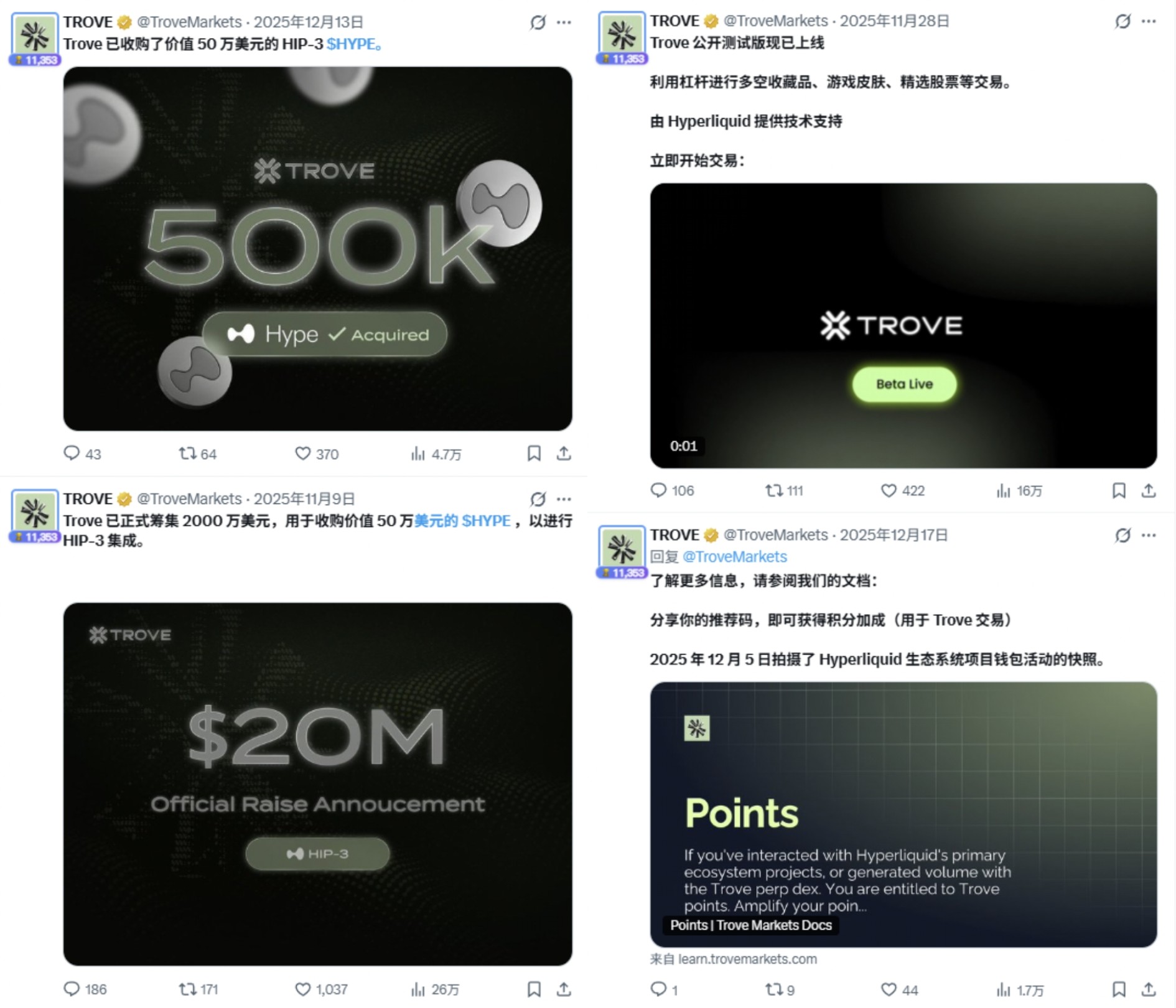
Source: TROVE tweet (translated)

During its ICO, it did not make any changes to this related information.
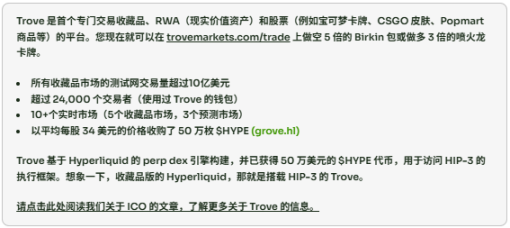
Trove related information | Source: Trove ICO page (translated)

The community strongly opposed the migration to Solana, viewing the shift as a deviation from the initial Hyperliquid promise. Some participants demanded full refunds, stating it no longer aligned with the investment logic.
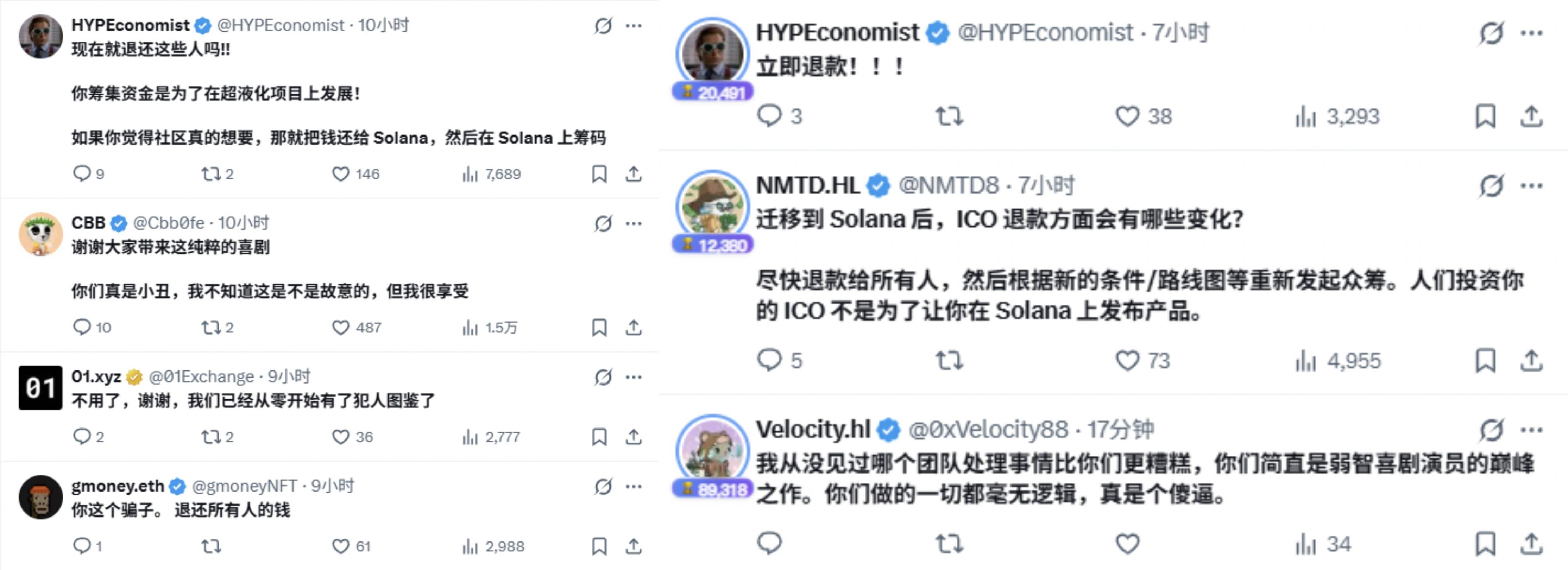
Source: unwise (left) and Trove official Twitter reply (right), translated
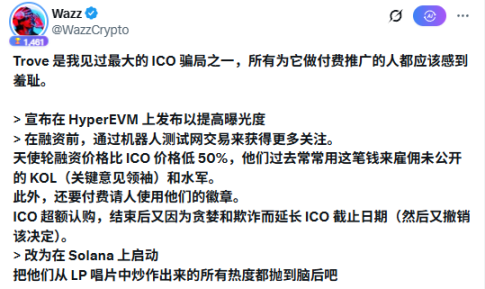
Source: Wazz tweet (translated)

As of now, Trove has not responded to related refund requests. It stated that TGE will occur on January 20 at 00:00, followed by ICO token distribution and oversubscription refunds.
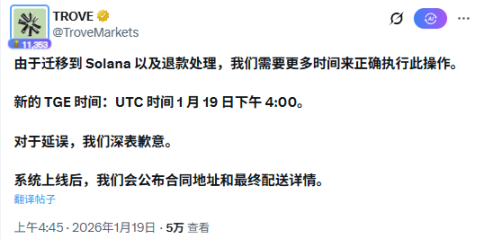
Source: Trove official Twitter (translated)

The Boundary Between ICO Promises and Investor Protection

The changes in Trove's actual execution have deviated from the core path, technical dependencies, and liquidity promises publicly during the ICO. These are major substantive changes, not mere technical optimizations or iterations.
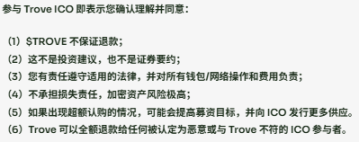
Source: Trove ICO page (translated)

This behavior of诱导 (inducing) first and switching later changes the essence of the investment target; the initial investment logic should be invalidated. Investors'诉求 (demands) for refunds to protect their rights should receive broad support.

The crypto investment environment is highly speculative and uncertain. Participants must carefully review project whitepapers, on-chain fund flows, team track records, etc., before deciding, and specifically evaluate the project team's communication transparency, timeliness, and compensation mechanisms for any major changes.

Investors need to be especially vigilant towards project parties with non-public team information, high anonymity, or those with delayed communication after changes.


Twitter:https://twitter.com/BitpushNewsCN

Bitpush TG Discussion Group:https://t.me/BitPushCommunity

Bitpush TG Subscription: https://t.me/bitpush

Original link:https://www.bitpush.news/articles/7604143

Пов'язані питання

QWhat was the main reason given by the Trove team for migrating from Hyperliquid to Solana?

AThe Trove team member unwise stated that the migration was due to their liquidity partner liquidating its 500,000 HYPE position, which was a key support for their Hyperliquid path.

QHow much funding did Trove claim to have raised during its ICO, and what percentage of the total token supply was sold?

ATrove claimed to have raised $20 million at a $200 million fully diluted valuation (FDV) and sold 12.5% of the total token supply in its ICO.

QWhat controversial action did Trove take regarding the ICO timeline, and how did it affect the Polymarket prediction market?

ATrove initially extended the ICO by 5 days on January 12 but reversed the decision 42 minutes later. This caused short-term spikes in probabilities on Polymarket for various fundraising milestones (15M, 20M, 25M, 30M) from near zero to 40-80%.

QWhat allegation did ZachXBT make about Trove's use of funds, and how did the team respond?

AZachXBT alleged that Trove transferred $45,000 from its angel funding round directly into a prediction market on January 11. The Trove team member unwise responded by attributing the action to TJR, an English crypto KOL.

QHow did the community react to Trove's decision to migrate to Solana, and what did many investors demand?

AThe community strongly opposed the migration, viewing it as a deviation from the initial Hyperliquid promise. Many investors demanded full refunds, arguing that the investment logic was no longer valid.

Пов'язані матеріали

In Conversation with Ray Dalio: We Are Currently in an AI Bubble, with 1% of My Portfolio in Bitcoin

Ray Dalio, founder of Bridgewater Associates, warns in an interview that the current AI boom shows classic bubble characteristics, which could lead to significant economic downturns as seen in past cycles like 1929 or 2000. He explains that speculative enthusiasm, fueled by debt and overvaluation, often precedes a crash when rising rates or taxation force asset sales, causing widespread losses and recession. Dalio also outlines his "Big Cycle" theory, describing an approximate 80-year pattern where widening wealth gaps, massive government deficits, and shifting geopolitical power (like China's rise) create internal conflict and global instability. He emphasizes that we are in a late-cycle, transitional phase where traditional powers like the US and UK face decline. For personal wealth protection, Dalio advises diversification beyond cash into assets like stocks, bonds, real estate, and particularly gold, which he prefers over Bitcoin. While he holds about 1% of his portfolio in Bitcoin as a non-printable hard asset, he views gold as more secure from technological or governmental threats. Regarding AI's impact, Dalio believes it will disproportionately benefit capital owners, worsening inequality by replacing both physical and cognitive labor. He suggests that human intuition and emotional intelligence, combined with AI, will be key for future workers. On taxation, Dalio argues that wealth taxes are impractical and risk triggering asset sell-offs, reducing productive investment. He points to the UK as a cautionary example of debt, low productivity, and political strife. Geopolitically, Dalio foresees a more regionalized world, with the US showing weakness in prolonged conflicts like with Iran, akin to past imperial declines. The ideal outcome, he suggests, is coexisting powerful blocs (e.g., Americas, China-Asia Pacific) without major war.

marsbit1 год тому

In Conversation with Ray Dalio: We Are Currently in an AI Bubble, with 1% of My Portfolio in Bitcoin

marsbit1 год тому

Daily 7.2 Trillion KRW: Foreign Capital's Record Net Buying on Friday! Wall Street Says Headwinds for Korean Stock Fund Flows Have Subsided

South Korean stock market sees a dramatic shift in fund flows. On July 31, foreign investors made a record net purchase of approximately KRW 7.2 trillion in KOSPI stocks, marking a fundamental reversal from the persistent large-scale net outflows seen in previous months. This contributed to a significant narrowing of foreign net selling in July to KRW 9.8 trillion, down sharply from KRW 48.4 trillion in June and KRW 44.5 trillion in May. Simultaneously, domestic institutional pressure eased. South Korean pension funds and asset managers turned to a net buying position in July, purchasing KRW 1.0 trillion worth of KOSPI shares, contrasting with net sales in May and June. Market volatility is expected to be dampened by new financial regulations. Effective July 31, the Financial Services Commission tightened access for retail investors to single-stock leveraged ETFs by raising the minimum cash deposit requirement. Trading volumes for these products subsequently dropped to about 50% of their monthly average. Citigroup Research maintains its year-end KOSPI target of 10,000 points. The firm cites several supportive factors: the substantial easing of headwinds from capital outflows, a robust fundamental outlook for the semiconductor sector, historically low market valuations, strong economic fundamentals, and the potential for policy support from financial authorities if needed.

marsbit1 год тому

Daily 7.2 Trillion KRW: Foreign Capital's Record Net Buying on Friday! Wall Street Says Headwinds for Korean Stock Fund Flows Have Subsided

marsbit1 год тому

Thanks to Dice Rolls, Bitcoin Keys Are Stored Offline, But Not Everyone Will Do It

The article discusses using dice rolls to generate secure Bitcoin wallet seeds, providing entropy independent of potentially flawed hardware random number generators. It explains that each fair dice roll offers about 2.585 bits of entropy, with around 50 rolls needed for a standard 12-word seed phrase and 99+ recommended for higher security. This method gained attention after a vulnerability was revealed in some Coldcard hardware wallets, where a faulty firmware RNG (dating back to 2021) compromised generated keys. The analysis notes that while a dice-generated main seed was safe from this specific flaw, other Coldcard functions (like creating paper wallets, backup keys, or passwords) could still be vulnerable if they used the defective RNG. The piece argues that while dice-based entropy is technically robust, the manual process is error-prone, tedious, and unrealistic for most new users, who might make mistakes in recording or inputting rolls. It concludes that while manual entropy generation should remain an option for advanced users, the long-term goal is to develop reliable, user-friendly hardware and software that securely generates randomness without requiring specialized knowledge. Coldcard users are advised to check their firmware version and replace any secondary secrets (like paper wallet keys) created with vulnerable devices, while also considering multi-signature setups with devices from different manufacturers for added security.

cryptonews.ru6 год тому

Thanks to Dice Rolls, Bitcoin Keys Are Stored Offline, But Not Everyone Will Do It

cryptonews.ru6 год тому

Торгівля

Спот
活动图片





