From Hot Storage to Cold Memory: Decentralized Storage in the AI Era's Storage Boom

marsbitОпубліковано о 2026-07-27Востаннє оновлено о 2026-07-27

Анотація

"From Hot Storage to Cold Memory: Decentralized Storage in the Era of AI Storage Boom" This article explores the divergent market trajectories of AI-driven centralized storage and Web3's decentralized storage. It argues that while AI storage is experiencing a massive revaluation focused on "hot data efficiency" — maximizing computational throughput via technologies like HBM, enterprise SSDs, and sophisticated data pipelines — decentralized storage projects like Filecoin and Arweave are currently sidelined. Their core value proposition lies in "cold data trust," prioritizing data integrity, censorship resistance, and long-term archival over raw speed. The piece details the AI storage architecture, emphasizing its role as a "performance engine" critical for feeding GPUs, contrasted with decentralized storage's focus on serving as a permanent, verifiable ledger for humanity's collective memory. It analyzes the challenges decentralized storage faces, including product-market fit, enterprise readiness, and token economic misalignment, but concludes that its fundamental value in preserving provenance, public datasets, and civilizational archives positions it for potential long-term revaluation as issues of data sovereignty, AI auditability, and historical preservation become more acute. The current market rewards efficiency, but the pendulum may eventually swing back towards trust.

Author: Jacob Zhao @ IOSG


Today, "China's first domestic memory stock," Changxin Storage Technology (CXMT), officially debuted on the ChiNext board, igniting the market with a staggering 500% surge. Although the overall storage sector is still experiencing some residual volatility from recent corrections, AI storage continues to be frantically revalued by capital amid the current wave of tech narrative. At the same time, decentralized storage in the Web3 realm has fallen into a prolonged period of silence and despondency. Why do entities both bearing the name "storage" exhibit such a stark contrast in market performance? The fundamental answer lies in a complete divergence of their underlying value functions.

The revaluation of storage in the AI era is essentially a frenzy surrounding "hot data efficiency," serving the ultimate maximization of computing utilization and commercial realization. What decentralized storage adheres to, however, is the value proposition of "cold data trustworthiness," defending data fairness, censorship resistance, and the long-term memory of human civilization. The former is an efficiency system for hot data; the latter is a trustworthiness system for cold data. The current capital market undoubtedly stands firmly on the side of "efficiency," but human civilization ultimately still needs a tamper-proof memory foundation. The long-term value of trustworthy cold storage has never disappeared; it merely lies dormant in the dark side of the cycle, waiting to be repriced by the times.

Why Storage Has Regained Spotlight in the AI Industry Chain

In the traditional IT era, storage was a "capacity business." Enterprise CIOs focused on cost per unit capacity, hard drive reliability, disaster recovery solutions, archival strategies, and equipment refresh cycles spanning 3-5 years. Storage was seen as an accessory accompanying server procurement.

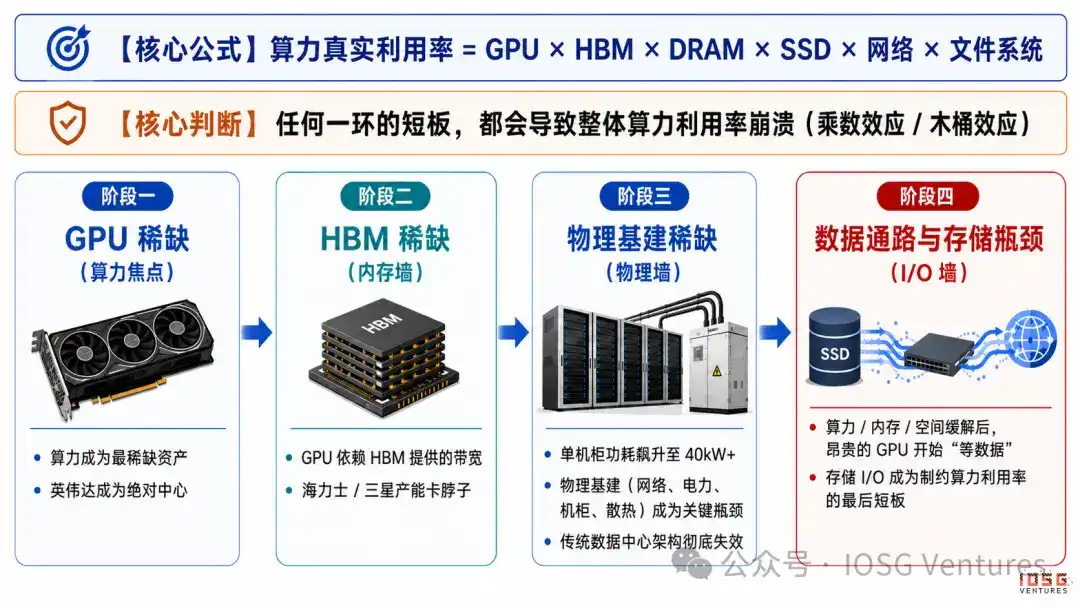
This round of storage fervor is not a traditional cyclical recovery but rather a repricing of data flow capabilities by AI. In the era of large models, the storage logic has qualitatively shifted from "capacity first" to "efficiency supreme," relentlessly pursuing extreme metrics such as GPU feeding rate, Checkpoint write speeds, and ultra-low latency for RAG. This signifies that the value of storage is leaping from "the final parking place for data" to "the high-speed channel for data entry into computation."

The evolution of resource bottlenecks in AI infrastructure is essentially a battle to fill the gaps in the "barrel effect." The real utilization of computing power is not a linear sum of individual assets but a stringent multiplicative effect: Real Compute Utilization = GPU × HBM × DRAM × SSD × Network × File System. A shortfall in any single link can cause overall computing efficiency to collapse. In the AI era, storage has transformed for the first time from a "cost center" to an "efficiency engine." This is the fundamental logic behind storage's repricing.
Panorama of AI Storage Architecture: From HBM Bandwidth Organ to Data Lake Foundation

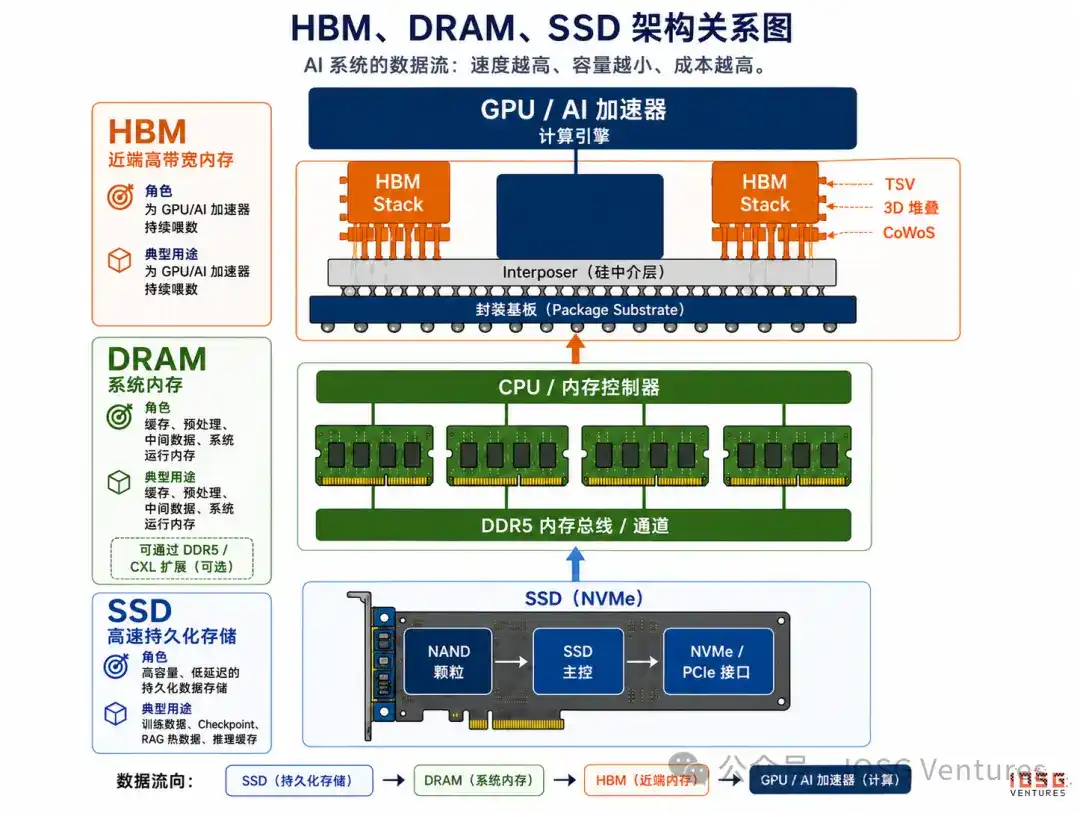
AI storage is by no means a mere pile of individual hardware components; it is a complex, tightly coupled, and hierarchically managed system. Within this system, industrial value and capital focus are highly concentrated on HBM, enterprise SSDs, SSD controllers, NVMe/CXL protocols, and high-performance storage systems. To clearly deconstruct its value flow, we divide the AI storage architecture into four core hierarchical layers:
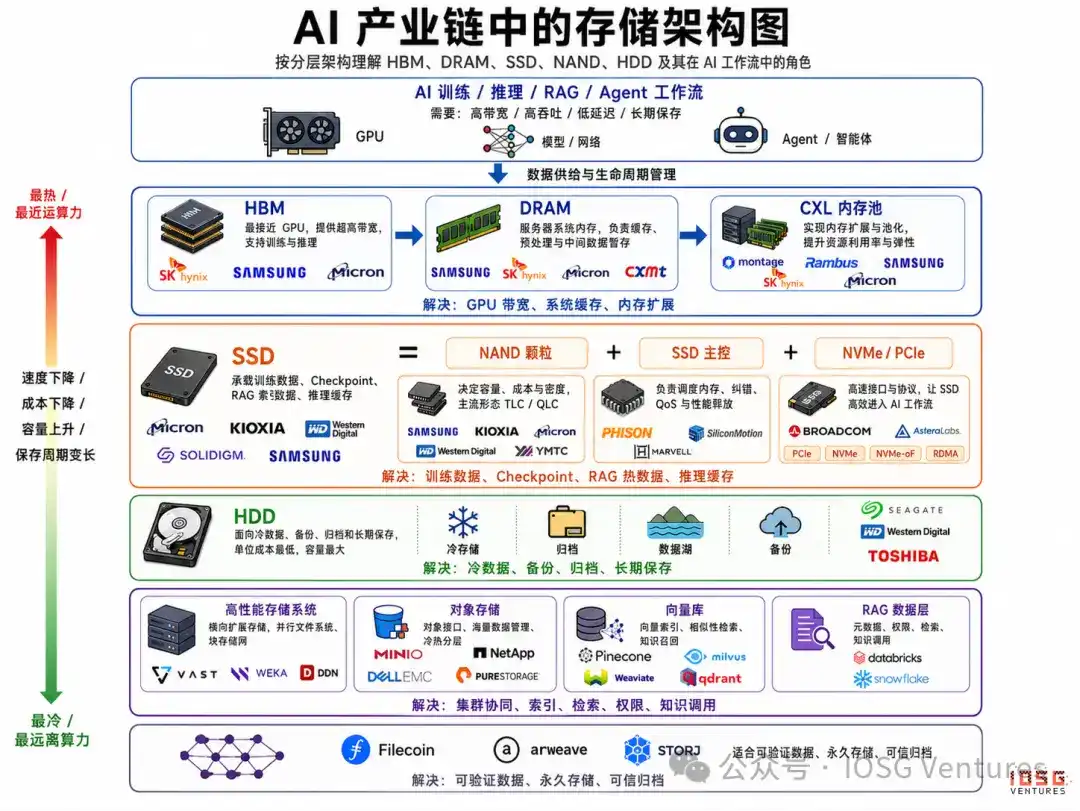
  • Compute-Near Memory Layer (Bandwidth Core): Dominated by HBM, supplemented by DRAM and CXL memory pooling technology. This layer is directly attached to GPU/CPU packaging or the bus, aiming to break the "memory wall." It is the first gate determining whether computing power can be fully unleashed.

  • High-Speed Persistent Storage Layer (I/O Hub): The core logic is Enterprise SSD = NAND Flash + SSD Controller + NVMe/PCIe Data Path. This layer handles high-frequency Checkpoint writes, massive training dataset loading, and RAG hot data caching. It represents the most definitive increment in persistent storage for AI data centers.

  • Low-Cost, High-Capacity Storage Layer (Capacity Base): Consisting of HDDs, cold storage, and data lake archival systems. Faced with the exponential growth of multimodal raw data, historical logs, and compliance backups, this layer still provides irreplaceable TCO (Total Cost of Ownership) advantages.

  • AI Storage Systems & Data Software (Scheduling Brain): Includes high-performance parallel file systems, distributed object storage, vector databases, and RAG data governance layers. What AI truly consumes is not bare hardware, but the data availability efficiently organized, indexed, and secured by the software stack.

As an ecosystem extension, decentralized storage does not directly engage in the millisecond-level race of AI hot data. Instead, it anchors positions like public dataset attestation, AI training data provenance, and long-term cold memory archival, establishing its unique niche as the "trustworthy cold layer."

HBM: The "Bandwidth Organ" Closest to Compute in the AI Storage Chain

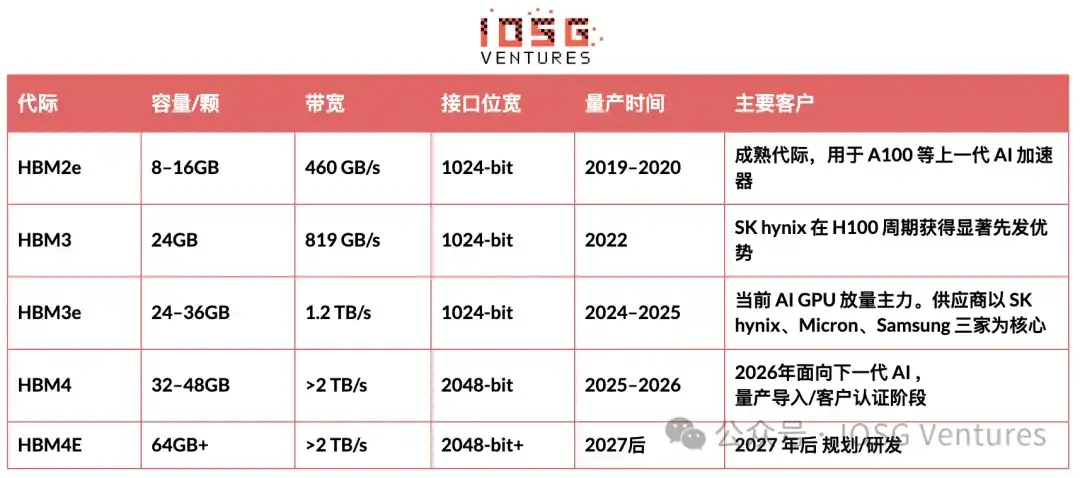
High Bandwidth Memory (HBM) is not traditional storage; it is a high-bandwidth memory layer proximate to the GPU. Its core mission is not to save data, but to continuously "feed" data to the compute units with extremely high bandwidth. HBM is the link in the AI storage chain that is closest to compute, with the highest certainty. It directly determines whether GPUs can be "fed adequately" and is the most critical supply chain bottleneck currently.

The core architecture of HBM is "3D DRAM stacking + 2.5D advanced packaging": Through TSV vertical stacking and CoWoS heterogeneous integration, the distance between memory and compute is compressed to the extreme, achieving generational leaps in bandwidth. Its industrial barriers encompass not just DRAM design, but a system engineering effort involving DRAM process technology, TSV, ultra-thin stacking, packaging, thermal management, testing, and customer certification. A defect in any single link can cause the entire HBM stack to be scrapped.

Currently, only three giants worldwide can stably mass-produce HBM: SK hynix, Samsung, and Micron, who have built a triple moat of top-tier DRAM process, packaging capabilities, and NVIDIA/AMD customer certifications.
DRAM & CXL: The System Memory Base and Memory Pooling Engine

HBM solves the extreme bandwidth problem near the GPU, DRAM solidifies the server's system memory foundation, while CXL attempts to break physical boundaries and reorganize memory resource allocation within data centers.

  • DRAM: Primarily handles CPU-side caching, data preprocessing, intermediate state storage, and system operation. It is the most fundamental system memory layer in servers. The global DRAM market is highly concentrated among three giants: SK hynix, Samsung, and Micron; Changxin Storage (CXMT) is the core variable in China's domestic DRAM substitution strategy.

  • CXL (Compute Express Link): A new-generation cache-coherent interconnect protocol for data centers, aiming to overcome the limitations of traditional DIMM slots, local memory capacity, and server memory resource silos, driving memory architecture towards expansion, pooling, and sharing. CXL is currently still in its early stages, transitioning from platform support to scaled deployment, but holds significant medium-to-long-term architectural value. Key companies include Astera Labs and Montage Technology.
Enterprise SSD: The Data Hub Built on NAND, Controllers, and NVMe

Enterprise SSDs represent the most critical high-throughput persistent storage increment in AI data centers. They continuously "feed" data to GPUs with extremely high throughput, ultra-low latency, and stable QoS, covering the entire lifecycle including training data loading, Checkpoint writes, RAG retrieval, inference caching, and log streaming.

Within the AI storage architecture, SSDs are not isolated hardware but a highly coupled system, which can be distilled into an industrial formula: Enterprise SSD = NAND Flash + SSD Controller + NVMe/PCIe Data Path. These three layers represent independent industrial chain segments:

  • NAND Flash (Raw Material Layer): Determines storage density and unit cost. Representative companies: Samsung, SK hynix (Solidigm), Micron, Kioxia, Western Digital, Yangtze Memory Technologies (YMTC).

  • SSD Controller (Performance Enablement Layer): Determines performance delivery, data error correction, QoS stability, and wear-leveling. Representative companies: Phison, Silicon Motion, Marvell, Maxio (Rayson).

  • NVMe/PCIe (Data Path Layer): Determines the efficiency of data transfer from storage to compute. Combined with technologies like GPUDirect Storage, it reduces CPU memory bounce buffers and CPU involvement, significantly alleviating I/O bottlenecks. Representative companies: Broadcom, Marvell, Astera Labs.

HDD / Cold Storage / Archival: The Low-Cost Base for AI Data Lakes

AI will not eliminate HDDs. With multimodal large models' voracious appetite for video and image data, and the exponential growth of enterprise compliance logs and historical datasets, demand for low-cost cold data storage is simultaneously exploding. In AI storage architecture, SSDs and HDDs collaborate based on a tiered business value approach: SSDs handle hot data and high throughput, while HDDs handle low cost and long-term preservation. Representative companies include Seagate, Western Digital, and Toshiba.

AI Storage Software Stack: The Scheduling Hub for Data Availability

What AI truly consumes is never bare drives, but "data services" meticulously organized by the software stack. This architecture transforms underlying hardware into knowledge assets directly callable by upper-layer AI. It can be divided into four specific layers:

  • High-Performance Storage Systems (Feeding System): Focus on concurrent throughput and low latency. Parallel file systems address the GPU cluster's "data hunger," ensuring rapid flow for training and inference. Representative companies: VAST Data, WEKA, Pure Storage.

  • Object Storage (Raw Data Lake): Core concepts are Object, Key, and Metadata management, hosting massive unstructured data. It doesn't pursue extreme low latency but builds capacity bases with low cost and cloud-native characteristics. Representative company: AWS S3.

  • Vector Databases (Semantic Indexing Layer): Vector databases store, index, and retrieve vectors generated by embedding models, enabling AI to precisely locate relevant content from vast knowledge bases. Representative companies: Pinecone, Milvus.

  • RAG Data Layer (Knowledge Invocation Layer): Goes beyond simple retrieval, encompassing data chunking, cleaning, access control, and citation provenance, ensuring enterprise data can be safely, accurately, and traceably invoked by large models. Representative company: Databricks.

From AI Hot Storage to Decentralized Cold Memory: Efficiency Maximization vs. Trust Maximization

AI Storage is an extreme efficiency-driven system whose value function focuses on maximizing computational output. HBM bandwidth determines whether GPUs can be fed adequately, SSD throughput determines dataset and Checkpoint read/write efficiency, and low latency is critical for RAG and real-time inference experiences. These metrics ultimately converge into GPU utilization and per-Token cost, directly deciding the commercial profitability of AI applications. The ultimate goal of AI storage is not preservation but acceleration, serving productivity.

Conversely, the value function of decentralized storage is fundamentally different. It questions whether data will still exist in ten years, whether it has been tampered with, and whether it can resist single-point censorship. Through cryptographic proofs and distributed networks, it builds an openly accessible, permanently preserved public data foundation. Its ultimate goal is to defend the absolute truth and sovereign independence of data, serving fairness, censorship resistance, and civilizational memory.
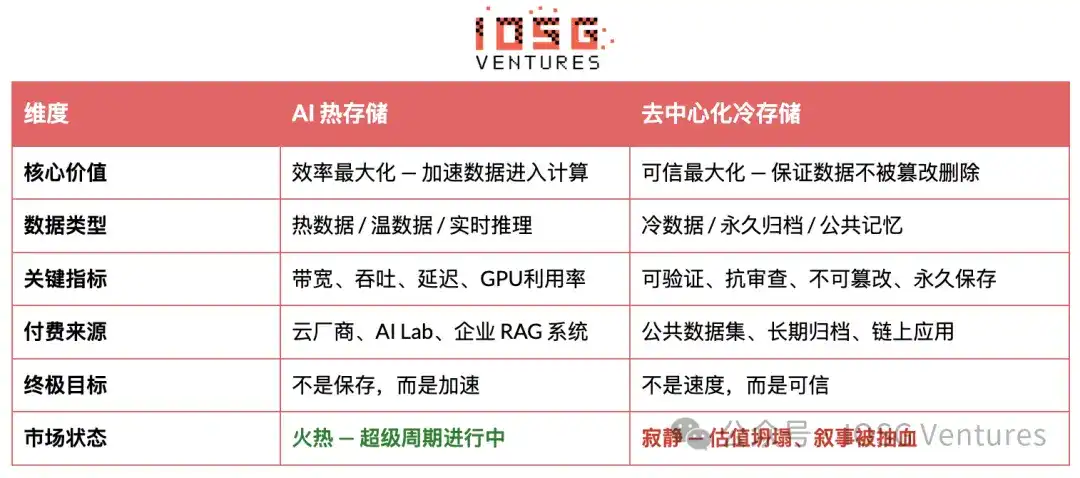
AI storage is "hot storage" providing fuel for future productivity; decentralized storage is "cold memory" preserving undeletable historical records for human civilization. The former serves efficiency, pursuing extreme speed; the latter serves trustworthiness, defending silent memory. The former determines how fast models run; the latter determines whether memories might be deleted. Currently, market mechanisms reward productive efficiency. AI storage is at the forefront of the wave, while decentralized storage seems to be experiencing a silence of valuation collapse and narrative bloodletting.

The Vision and Reality of Decentralized Storage

There are numerous decentralized storage projects, but in terms of industry mindshare and ecosystem depth, the core representatives remain Filecoin and Arweave. Although both fall under "decentralized storage," their underlying architectural philosophies are almost entirely divergent paths—the former approximates AWS-like elasticity through market-based contracts, while the latter approximates the permanence of a library through a one-time social contract.

  • Filecoin: Has built the most complete verifiable economic system through PoRep and PoSt. It should not continue to compete directly with AWS on consumer-grade cloud storage. Instead, it should pivot towards AI data provenance, public dataset hosting, and compliance archiving, providing verifiable chains for model auditing and copyright proof. The necessary path is to package itself as an S3-compatible API supporting fiat payments, upgrading from a "cheap storage marketplace" to "verifiable computational infrastructure."

  • Arweave: With its "pay once, store forever" narrative, it uses Blockweave and SPoRA mechanisms to incentivize miners to preserve and quickly access as much data as possible, especially scarce historical data. Its best fit is as a public memory foundation for human civilization—preserving human rights records, evidence of war crimes, cultural archives, archiving legal and financial history, and providing permanent, accessible long-term memory for AI Agents. Arweave's value lies not in speed but in its capacity to carry civilizational memory across cycles.
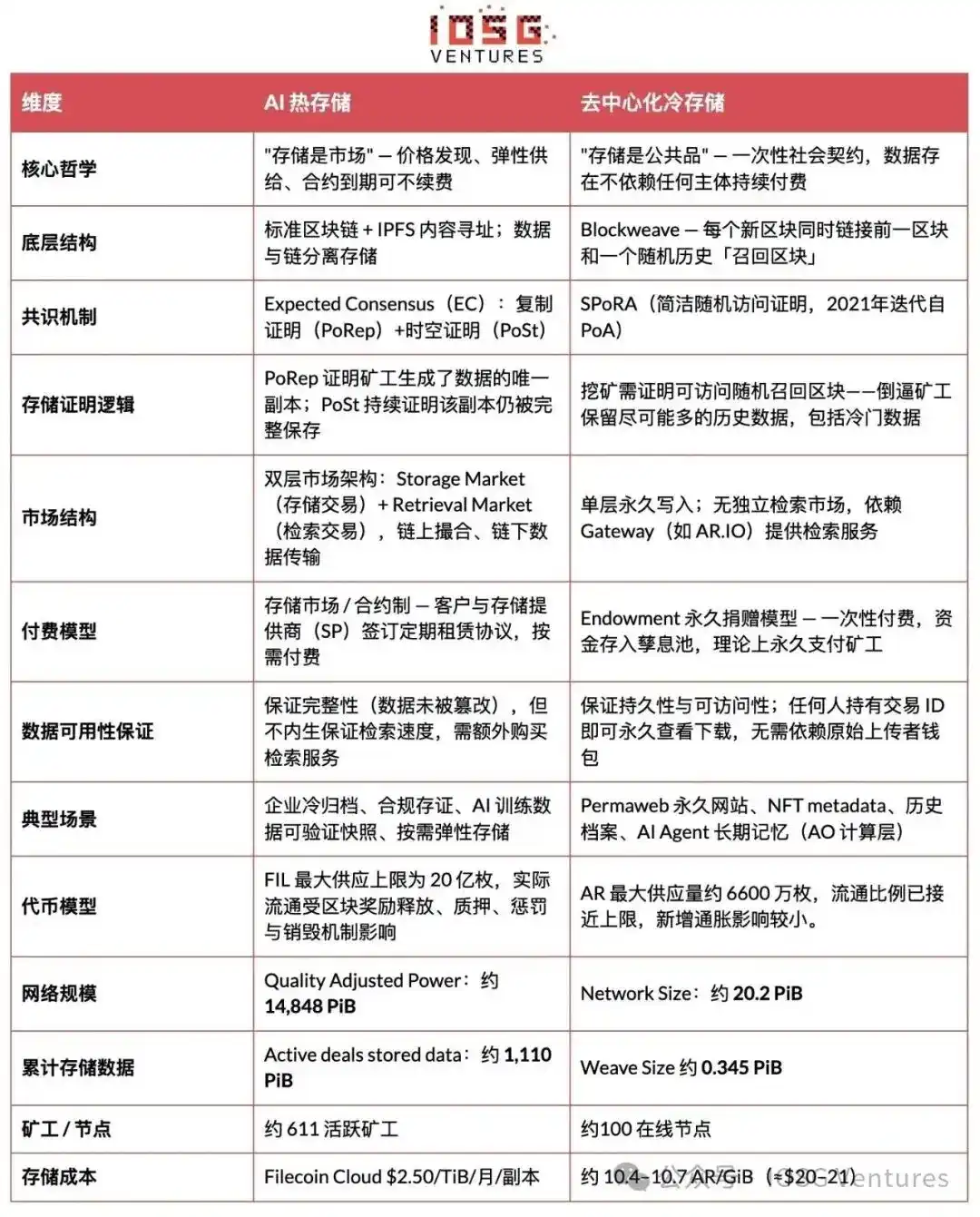
The predicament of decentralized storage projects like Filecoin and Arweave lies not in a flawed value proposition, but in the long-term misalignment among productization, retrieval experience, real-world demand, and token incentives. This reveals a significant gap between geek idealism and mainstream commercial adoption:

  • Supply-Demand Incentive Misalignment: Early networks like Filecoin rapidly expanded capacity via token incentives but failed to build sufficiently strong paid demand, resulting in vast capacity but low utilization and conversion. It rewards "I can store" rather than "need me to store."

  • Lack of Enterprise-Grade Service Capabilities: AWS's moat isn't hard drives, but the "data operating system" composed of APIs, SLAs, access management, compliance auditing, and technical support. Enterprises buy "peace of mind," not experimental infrastructure requiring them to handle keys and node selection themselves.

  • Retrieval Experience Shortcomings: "Storing in" does not equal "retrieving stably and with low latency." Distributed nodes, complex topology, and a lack of unified SLAs make it difficult to handle AI hot data workflows. It's more suitable for trustworthy cold archiving and data provenance.

  • Inadequate Privacy & Compliance: Enterprise private data cannot simply be written to a public, permanent network; the right to be forgotten inherently conflicts with permanent immutability. Decentralized storage is better suited for public data and long-term archives, not indiscriminately hosting core private data.

  • Token Economics Amplifying Cycles: Bull market financialization masks insufficient demand; bear market ROI decline for miners exposes commercialization shortcomings. Tokens can bootstrap supply but cannot automatically create demand and sustainable revenue.

Other decentralized storage projects mostly focus on specific ecosystems or niche segments: Storj/Sia have weaker cross-cycle industry mindshare and Web3 narrative influence compared to Filecoin/Arweave; BNB Greenfield/Walrus are tied to specific public chain ecosystems like BNB or SUI; Celestia/EigenDA belong to the Data Availability (DA) layer, serving Rollup transaction confirmation rather than long-term archival; AI/DA hybrid narrative projects like 0G attempt to integrate storage, data availability, computation, and AI agent settlement into an AI-native modular infrastructure, but their real-world demand, developer adoption, and commercial closure remain to be validated.

Future Opportunities for Decentralized Storage: The Long-Term Pendulum of Efficiency and Trust

During periods of technological红利爆发, capital frantically chases efficiency. Assets like GPUs and HBM are assigned extremely high premiums, while decentralized storage advocating "trust and fairness" is naturally marginalized. However, history's pendulum will not remain forever on the side of efficiency. Unjustifiable platform bans and content takedowns, AI copyright lawsuits forcing data provenance, geopolitical conflicts sparking data sovereignty disputes, data monopolies leading to the disappearance of public archives, and regulatory pressure for compliance auditing of model training data—all such events could potentially brew a repricing of "trustworthy storage." Decentralized storage's future opportunities may still manifest unique value in the following directions:

  • AI Data Provenance: Combining cryptographic proofs to build "data lineage proofs," addressing regulatory and audit pressures.

  • Public Datasets & Civilizational Archives: Anchoring censored archives and cultural heritage, building irreplaceable, undeletable memory.

  • Trustworthy Archival & Compliance Attestation: Achieving trustworthy self-attestation through hash storage, providing high-grade digital notarization.

  • Integration with ZK/TEE/DID Technologies: Mitigating privacy tensions, upgrading from a single "storage protocol" to "trustworthy data infrastructure."

  • Invisible Product Route: Offering S3-compatible APIs and fiat billing, allowing users to directly purchase "trustworthy archival" services.

AI storage and decentralized storage—one pursues ultimate efficiency, providing fuel for our sprint into the future; the other defends silent memory, safeguarding our right to look back at the past. The current market unhesitatingly rewards efficiency, which is why decentralized storage appears silent, even collapsing. However, when the AI era further amplifies data monopolies, copyright disputes, and the fragility of historical memory, decentralized storage may experience a revaluation as a "trustworthy cold layer." Those memories that cannot be easily erased by platforms, corporations, or any single authority might transition from an idealistic romance, from a fringe belief, into necessary infrastructure.


Трендові криптовалюти

Пов'язані питання

QWhat is the fundamental difference between the value proposition of AI storage and decentralized storage, according to the article?

AThe core difference lies in their value functions. AI storage is driven by efficiency maximization, focusing on maximizing GPU utilization and lowering per-token costs to accelerate computing power and serve productivity. Decentralized storage is driven by trust maximization, focusing on data permanence, censorship resistance, authenticity, and serving as a long-term, immutable memory base for fairness and civilizational heritage.

QWhy is HBM considered a critical and bottleneck component in the AI storage chain?

AHBM is critical because it is the 'bandwidth organ' closest to the compute unit (GPU/CPU). Its core mission is not to preserve data but to feed data to the compute unit with extremely high bandwidth, directly determining whether the GPU can be fully utilized ('fed'). Its production involves complex system engineering with high barriers including advanced DRAM process, TSV technology, ultra-thin stacking, packaging, thermal management, and customer certification. Currently, only SK hynix, Samsung, and Micron can produce it stably.

QWhat are the four core layers of the AI storage architecture as outlined in the article?

AThe four core layers are: 1) Compute-proximate memory layer (Bandwidth Core), primarily HBM, supplemented by DRAM and CXL memory pooling. 2) High-speed persistent storage layer (I/O Hub), centered on enterprise SSD components. 3) Low-cost, high-capacity storage layer (Capacity Base), consisting of HDDs and cold storage/archive systems. 4) AI storage system and data software (Orchestration Brain), including parallel file systems, object storage, vector databases, and RAG data governance layers.

QWhat are the main challenges or mismatches currently facing decentralized storage projects like Filecoin and Arweave?

AThe main challenges include: 1) Supply-demand incentive mismatch, where networks incentivize storage capacity but lack strong paying demand. 2) Lack of enterprise-grade service capabilities like comprehensive APIs, SLA guarantees, permission management, and support. 3) Poor retrieval experience, making them unsuitable for hot data workflows. 4) Privacy and compliance issues, as permanent storage conflicts with deletion rights. 5) Token economies amplifying market cycles, where bull market speculation masks weak fundamentals.

QAccording to the article, what are the potential future opportunities for decentralized storage to demonstrate unique value?

APotential opportunities include: 1) AI Data Provenance: Providing cryptographic proof for data lineage and model training data to meet audit and regulatory needs. 2) Public Datasets & Civilizational Archives: Hosting censored records, cultural heritage, and public data. 3) Trusted Archiving & Compliance Attestation: Offering immutable hash-based proof for digital notarization. 4) Integration with technologies like ZK, TEE, and DID to enhance privacy and evolve into trusted data infrastructure. 5) An 'invisible' product route, offering S3-compatible APIs and fiat billing for easy enterprise adoption of 'trusted archive' services.

Пов'язані матеріали

Торгівля

Спот

Популярні статті

Що таке $S$

Розуміння SPERO: Комплексний огляд Вступ до SPERO Оскільки ландшафт інновацій продовжує еволюціонувати, виникнення технологій web3 та криптовалютних проектів відіграє ключову роль у формуванні цифрового майбутнього. Один з проектів, який привернув увагу в цій динамічній сфері, — це SPERO, позначений як SPERO,$$s$. Ця стаття має на меті зібрати та представити детальну інформацію про SPERO, щоб допомогти ентузіастам та інвесторам зрозуміти його основи, цілі та інновації в рамках web3 та крипто-сектору. Що таке SPERO,$$s$? SPERO,$$s$ — це унікальний проект у криптопросторі, який прагне використати принципи децентралізації та технології блокчейн для створення екосистеми, що сприяє залученню, корисності та фінансовій інклюзії. Проект розроблений для полегшення взаємодії між користувачами новими способами, надаючи їм інноваційні фінансові рішення та послуги. У своїй основі SPERO,$$s$ прагне надати можливості індивідам, забезпечуючи інструменти та платформи, які покращують користувацький досвід у криптовалютному просторі. Це включає в себе можливість більш гнучких методів транзакцій, сприяння ініціативам, що підтримуються спільнотою, та створення шляхів для фінансових можливостей через децентралізовані додатки (dApps). Основна концепція SPERO,$$s$ обертається навколо інклюзивності, прагнучи зменшити розриви в традиційній фінансовій системі, використовуючи переваги технології блокчейн. Хто є творцем SPERO,$$s$? Особистість творця SPERO,$$s$ залишається дещо невідомою, оскільки є обмежені публічно доступні ресурси, що надають детальну інформацію про його засновників. Ця відсутність прозорості може бути наслідком зобов'язання проекту до децентралізації — етики, яку багато проектів web3 поділяють, ставлячи колективні внески вище за індивідуальне визнання. Зосереджуючи обговорення навколо спільноти та її колективних цілей, SPERO,$$s$ втілює суть наділення без виділення конкретних осіб. Таким чином, розуміння етики та місії SPERO є більш важливим, ніж ідентифікація єдиного творця. Хто є інвесторами SPERO,$$s$? SPERO,$$s$ підтримується різноманітними інвесторами, починаючи від венчурних капіталістів до ангельських інвесторів, які прагнуть сприяти інноваціям у крипто-секторі. Зосередження цих інвесторів зазвичай узгоджується з місією SPERO — пріоритет надається проектам, які обіцяють технологічний прогрес у суспільстві, фінансову інклюзію та децентралізоване управління. Ці інвесторські фонди зазвичай зацікавлені в проектах, які не лише пропонують інноваційні продукти, але й позитивно впливають на спільноту блокчейн та її екосистеми. Підтримка з боку цих інвесторів підкріплює SPERO,$$s$ як значного конкурента в швидко змінюваній сфері крипто-проектів. Як працює SPERO,$$s$? SPERO,$$s$ використовує багатогранну структуру, яка відрізняє його від традиційних криптовалютних проектів. Ось деякі ключові особливості, які підкреслюють його унікальність та інноваційність: Децентралізоване управління: SPERO,$$s$ інтегрує моделі децентралізованого управління, надаючи користувачам можливість активно брати участь у процесах прийняття рішень щодо майбутнього проекту. Цей підхід сприяє відчуттю власності та відповідальності серед членів спільноти. Корисність токена: SPERO,$$s$ використовує свій власний криптовалютний токен, розроблений для виконання різних функцій в екосистемі. Ці токени дозволяють здійснювати транзакції, отримувати винагороди та полегшувати послуги, що пропонуються на платформі, підвищуючи загальну залученість та корисність. Шарова архітектура: Технічна архітектура SPERO,$$s$ підтримує модульність та масштабованість, що дозволяє безперешкодно інтегрувати додаткові функції та додатки в міру розвитку проекту. Ця адаптивність є надзвичайно важливою для збереження актуальності в постійно змінюваному крипто-ландшафті. Залучення спільноти: Проект підкреслює ініціативи, що підтримуються спільнотою, використовуючи механізми, які стимулюють співпрацю та зворотний зв'язок. Підтримуючи сильну спільноту, SPERO,$$s$ може краще задовольняти потреби користувачів та адаптуватися до ринкових тенденцій. Фокус на інклюзію: Пропонуючи низькі комісії за транзакції та зручні інтерфейси, SPERO,$$s$ прагне залучити різноманітну базу користувачів, включаючи осіб, які раніше не брали участі в крипто-просторі. Це зобов'язання до інклюзії узгоджується з його загальною місією наділення через доступність. Хронологія SPERO,$$s$ Розуміння історії проекту надає важливі уявлення про його розвиток та етапи. Нижче наведено пропоновану хронологію, що відображає значні події в еволюції SPERO,$$s$: Етап концептуалізації та ідеації: Початкові ідеї, що стали основою SPERO,$$s$, були сформовані, тісно пов'язані з принципами децентралізації та фокусом на спільноті в індустрії блокчейн. Запуск білого паперу проекту: Після концептуального етапу був випущений комплексний білий папір, що детально описує бачення, цілі та технологічну інфраструктуру SPERO,$$s$, щоб залучити інтерес та зворотний зв'язок від спільноти. Створення спільноти та ранні залучення: Активні зусилля були спрямовані на створення спільноти ранніх прихильників та потенційних інвесторів, що полегшило обговорення цілей проекту та отримання підтримки. Подія генерації токенів: SPERO,$$s$ провів подію генерації токенів (TGE) для розподілу своїх рідних токенів серед ранніх прихильників та встановлення початкової ліквідності в екосистемі. Запуск початкового dApp: Перший децентралізований додаток (dApp), пов'язаний з SPERO,$$s$, став доступним, дозволяючи користувачам взаємодіяти з основними функціями платформи. Постійний розвиток та партнерства: Безперервні оновлення та вдосконалення пропозицій проекту, включаючи стратегічні партнерства з іншими учасниками блокчейн-простору, сформували SPERO,$$s$ у конкурентоспроможного та еволюціонуючого гравця на крипто-ринку. Висновок SPERO,$$s$ є свідченням потенціалу web3 та криптовалют для революціонізації фінансових систем та наділення індивідів. Завдяки зобов'язанню до децентралізованого управління, залучення спільноти та інноваційно спроектованих функцій, він прокладає шлях до більш інклюзивного фінансового ландшафту. Як і з будь-якими інвестиціями в швидко змінюваному крипто-просторі, потенційним інвесторам та користувачам рекомендується ретельно досліджувати та обдумано взаємодіяти з поточними подіями в SPERO,$$s$. Проект демонструє інноваційний дух крипто-індустрії, запрошуючи до подальшого дослідження його численних можливостей. Хоча подорож SPERO,$$s$ ще триває, його основні принципи можуть справді вплинути на майбутнє того, як ми взаємодіємо з технологією, фінансами та один з одним у взаємопов'язаних цифрових екосистемах.

182 переглядів усьогоОпубліковано 2024.12.17Оновлено 2024.12.17

Що таке $S$

Що таке AGENT S

Агент S: Майбутнє автономної взаємодії в Web3 Вступ У постійно змінюваному ландшафті Web3 та криптовалюти інновації постійно переосмислюють, як люди взаємодіють з цифровими платформами. Один з таких новаторських проектів, Агент S, обіцяє революціонізувати взаємодію людини з комп'ютером через свою відкриту агентну структуру. Прокладаючи шлях для автономних взаємодій, Агент S прагне спростити складні завдання, пропонуючи трансформаційні застосування в штучному інтелекті (ШІ). Це детальне дослідження заглиблюється в складності проекту, його унікальні особливості та наслідки для сфери криптовалюти. Що таке Агент S? Агент S є революційною відкритою агентною структурою, спеціально розробленою для вирішення трьох основних викликів в автоматизації комп'ютерних завдань: Набуття специфічних знань у галузі: Структура інтелектуально навчається з різних зовнішніх джерел знань та внутрішнього досвіду. Цей подвійний підхід дозволяє їй створити багатий репозиторій специфічних знань у галузі, покращуючи її продуктивність у виконанні завдань. Планування на довгих горизонтах завдань: Агент S використовує планування з підкріпленням досвіду, стратегічний підхід, який полегшує ефективний розподіл та виконання складних завдань. Ця функція значно підвищує її здатність ефективно та результативно управляти кількома підзавданнями. Обробка динамічних, неоднорідних інтерфейсів: Проект представляє Інтерфейс Агент-Комп'ютер (ACI), інноваційне рішення, яке покращує взаємодію між агентами та користувачами. Використовуючи багатомодальні великі мовні моделі (MLLMs), Агент S може безперешкодно орієнтуватися та маніпулювати різноманітними графічними інтерфейсами користувача. Завдяки цим новаторським функціям Агент S надає надійну структуру, яка вирішує складнощі, пов'язані з автоматизацією людської взаємодії з машинами, прокладаючи шлях для численних застосувань у ШІ та за його межами. Хто є творцем Агент S? Хоча концепція Агент S є фундаментально новаторською, конкретна інформація про його творця залишається невідомою. Творець наразі невідомий, що підкреслює або початкову стадію проекту, або стратегічний вибір зберегти засновників у таємниці. Незважаючи на анонімність, акцент залишається на можливостях та потенціалі структури. Хто є інвесторами Агент S? Оскільки Агент S є відносно новим у криптографічній екосистемі, детальна інформація про його інвесторів та фінансових спонсорів не задокументована. Відсутність публічно доступних відомостей про інвестиційні фонди або організації, що підтримують проект, викликає питання щодо його фінансової структури та дорожньої карти розвитку. Розуміння підтримки є критично важливим для оцінки стійкості проекту та потенційного впливу на ринок. Як працює Агент S? В основі Агент S лежить передова технологія, яка дозволяє йому ефективно функціонувати в різних умовах. Його операційна модель побудована навколо кількох ключових функцій: Взаємодія з комп'ютером, подібна до людської: Структура пропонує розширене планування ШІ, прагнучи зробити взаємодії з комп'ютерами більш інтуїтивними. Імітуючи людську поведінку при виконанні завдань, вона обіцяє підвищити досвід користувачів. Наративна пам'ять: Використовується для використання високорівневого досвіду, Агент S використовує наративну пам'ять для відстеження історій завдань, тим самим покращуючи свої процеси прийняття рішень. Епізодична пам'ять: Ця функція надає користувачам покрокові інструкції, дозволяючи структурі пропонувати контекстуальну підтримку в міру виконання завдань. Підтримка OpenACI: Завдяки можливості працювати локально, Агент S дозволяє користувачам зберігати контроль над своїми взаємодіями та робочими процесами, узгоджуючи з децентралізованою етикою Web3. Легка інтеграція з зовнішніми API: Його універсальність і сумісність з різними платформами ШІ забезпечують те, що Агент S може безперешкодно вписатися в існуючі технологічні екосистеми, роблячи його привабливим вибором для розробників та організацій. Ці функціональні можливості колективно сприяють унікальному положенню Агент S у крипто-просторі, оскільки він автоматизує складні, багатоступеневі завдання з мінімальним втручанням людини. У міру розвитку проекту його потенційні застосування в Web3 можуть переосмислити, як відбуваються цифрові взаємодії. Хронологія Агент S Розробка та етапи Агент S можуть бути узагальнені в хронології, яка підкреслює його значні події: 27 вересня 2024 року: Концепція Агент S була представлена в комплексній науковій статті під назвою “Відкрита агентна структура, яка використовує комп'ютери як людина”, що демонструє основи проекту. 10 жовтня 2024 року: Наукова стаття була опублікована на arXiv, пропонуючи детальне дослідження структури та її оцінки продуктивності на основі бенчмарку OSWorld. 12 жовтня 2024 року: Було випущено відеопрезентацію, що надає візуальне уявлення про можливості та особливості Агент S, ще більше залучаючи потенційних користувачів та інвесторів. Ці маркери в хронології не лише ілюструють прогрес Агент S, але й вказують на його прихильність до прозорості та залучення громади. Ключові моменти про Агент S У міру розвитку структури Агент S кілька ключових характеристик виділяються, підкреслюючи її новаторський характер та потенціал: Інноваційна структура: Розроблена для забезпечення інтуїтивного використання комп'ютерів, подібного до людської взаємодії, Агент S пропонує новий підхід до автоматизації завдань. Автономна взаємодія: Здатність автономно взаємодіяти з комп'ютерами через GUI означає стрибок до більш інтелектуальних та ефективних обчислювальних рішень. Автоматизація складних завдань: Завдяки своїй надійній методології він може автоматизувати складні, багатоступеневі завдання, роблячи процеси швидшими та менш схильними до помилок. Безперервне вдосконалення: Механізми навчання дозволяють Агенту S покращуватися на основі минулого досвіду, постійно підвищуючи свою продуктивність та ефективність. Універсальність: Його адаптивність до різних операційних середовищ, таких як OSWorld та WindowsAgentArena, забезпечує його здатність служити широкому спектру застосувань. Оскільки Агент S займає своє місце в ландшафті Web3 та криптовалюти, його потенціал покращити можливості взаємодії та автоматизувати процеси означає значний прогрес у технологіях ШІ. Завдяки своїй інноваційній структурі Агент S є прикладом майбутнього цифрових взаємодій, обіцяючи більш безперешкодний та ефективний досвід для користувачів у різних галузях. Висновок Агент S представляє собою сміливий крок вперед у поєднанні ШІ та Web3, з можливістю переосмислити, як ми взаємодіємо з технологією. Хоча проект все ще на ранніх стадіях, можливості для його застосування є величезними та переконливими. Завдяки своїй комплексній структурі, що вирішує критичні виклики, Агент S прагне вивести автономні взаємодії на передній план цифрового досвіду. У міру того, як ми заглиблюємося в сфери криптовалюти та децентралізації, проекти, подібні до Агент S, безсумнівно, відіграватимуть ключову роль у формуванні майбутнього технологій та співпраці людини з комп'ютером.

803 переглядів усьогоОпубліковано 2025.01.14Оновлено 2025.01.14

Що таке AGENT S

Як купити S

Ласкаво просимо до HTX.com! Ми зробили покупку Sonic (S) простою та зручною. Дотримуйтесь нашої покрокової інструкції, щоб розпочати свою криптовалютну подорож.Крок 1: Створіть обліковий запис на HTXВикористовуйте свою електронну пошту або номер телефону, щоб зареєструвати обліковий запис на HTX безплатно. Пройдіть безпроблемну реєстрацію й отримайте доступ до всіх функцій.ЗареєструватисьКрок 2: Перейдіть до розділу Купити крипту і виберіть спосіб оплатиКредитна/дебетова картка: використовуйте вашу картку Visa або Mastercard, щоб миттєво купити Sonic (S).Баланс: використовуйте кошти з балансу вашого рахунку HTX для безперешкодної торгівлі.Треті особи: ми додали популярні способи оплати, такі як Google Pay та Apple Pay, щоб підвищити зручність.P2P: Торгуйте безпосередньо з іншими користувачами на HTX.Позабіржова торгівля (OTC): ми пропонуємо індивідуальні послуги та конкурентні обмінні курси для трейдерів.Крок 3: Зберігайте свої Sonic (S)Після придбання Sonic (S) збережіть його у своєму обліковому записі на HTX. Крім того, ви можете відправити його в інше місце за допомогою блокчейн-переказу або використовувати його для торгівлі іншими криптовалютами.Крок 4: Торгівля Sonic (S)Легко торгуйте Sonic (S) на спотовому ринку HTX. Просто увійдіть до свого облікового запису, виберіть торгову пару, укладайте угоди та спостерігайте за ними в режимі реального часу. Ми пропонуємо зручний досвід як для початківців, так і для досвідчених трейдерів.

1.8k переглядів усьогоОпубліковано 2025.01.15Оновлено 2026.06.02

Як купити S

Обговорення

Ласкаво просимо до спільноти HTX. Тут ви можете бути в курсі останніх подій розвитку платформи та отримати доступ до професійної ринкової інформації. Нижче представлені думки користувачів щодо ціни S (S).

活动图片