From FOMO to Apathy: Altcoin Volumes Reflect Deepening Market Fatigue

bitcoinistОпубліковано о 2026-03-21Востаннє оновлено о 2026-03-21

Анотація

The altcoin market is experiencing sustained weakness and declining trading volumes, reflecting deep investor fatigue and a risk-off environment. Analysis by CryptoQuant highlights a significant drop in activity, with Binance's altcoin volumes falling to around $7.7 billion and other major exchanges totaling approximately $18.8 billion—a sharp contrast to the $40–$50 billion and $63–$91 billion seen during more active periods in late 2024 and early 2025. This contraction signals reduced participation from both retail and institutional traders. Capital continues to flow into Bitcoin rather than altcoins, exacerbating the downturn. Macroeconomic uncertainty and geopolitical tensions are further suppressing risk appetite. Historically, such low-volume environments have often preceded opportunity, but current conditions suggest a prolonged phase of apathy rather than imminent recovery.

The altcoin market continues to struggle under sustained selling pressure, with weakness persisting for several months as broader conditions remain unfavorable for risk assets. Despite intermittent relief rallies, most altcoins have failed to establish meaningful recoveries, reflecting a market still dominated by caution rather than conviction.

Recent insights shared by CryptoQuant analyst Darkfost reinforce this view. The analysis of trading volumes across Binance and other major exchanges highlights a clear and persistent decline in investor interest. Activity levels have dropped significantly compared to previous expansion phases, signaling reduced participation from both retail and institutional traders.

This trend comes as the broader bear market remains firmly in place. Altcoins are not only failing to recover but are also underperforming Bitcoin, which continues to absorb the majority of available liquidity. In risk-off environments, capital typically consolidates into stronger assets, leaving higher-beta altcoins more exposed to prolonged downside.

At the same time, macro conditions continue to weigh on sentiment. Ongoing geopolitical tensions and global economic uncertainty are limiting risk appetite, discouraging aggressive positioning in speculative assets. In this context, the altcoin market reflects a structural contraction, where declining volumes and sustained selling pressure point to a prolonged phase of weakness rather than an imminent recovery.

Altcoin Volumes Collapse as Market Participation Contracts

Darkfost further contextualizes the current weakness by pointing to a sharp decline in altcoin trading volumes across major exchanges. On Binance, volumes have dropped to approximately $7.7 billion, while other leading platforms combined account for around $18.8 billion. These figures mark a significant contraction in activity, reinforcing the view that investor participation has materially declined.
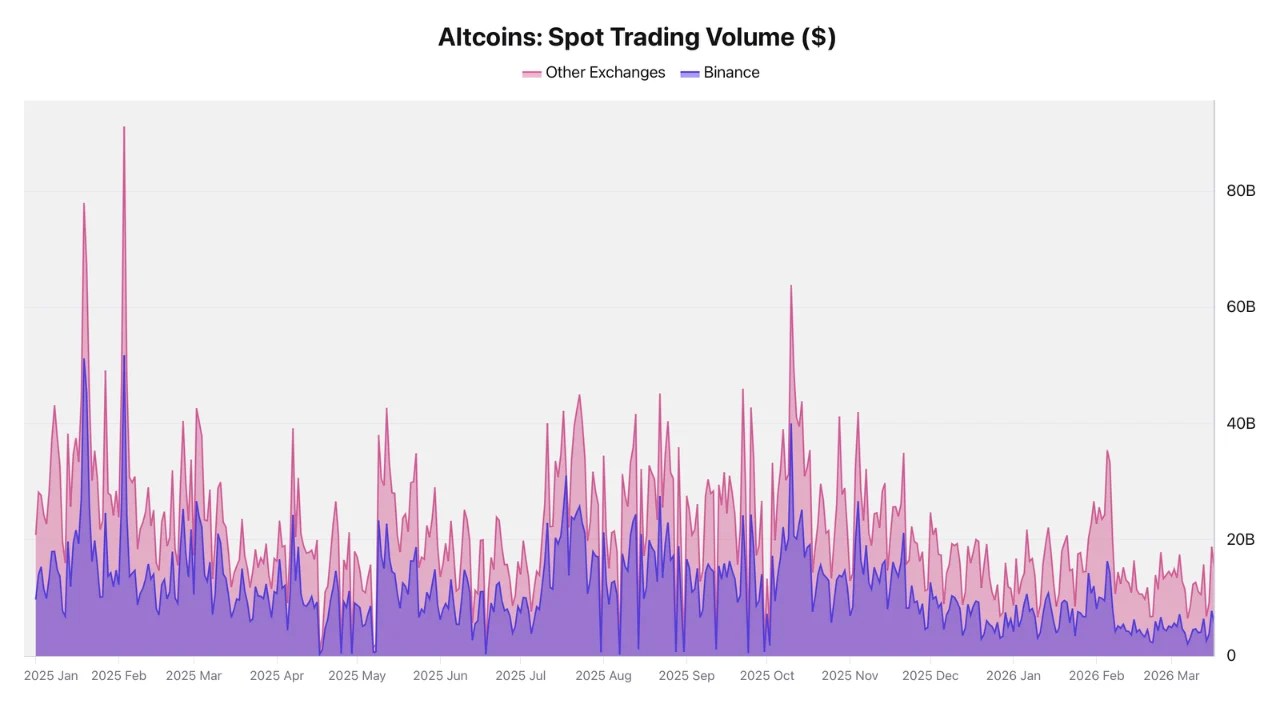
Altcoin Spot Trading Volume | Source: CryptoQuant

The contrast with previous market phases is stark. During more active periods such as October and February 2025, Binance recorded between $40 billion and $50 billion in altcoin trading volume, while other exchanges reached levels between $63 billion and $91 billion. The current environment, therefore, reflects a substantial loss of liquidity and engagement.

In relative terms, Binance now represents roughly 40% of total altcoin trading volume, underscoring its dominance as the primary venue for activity. This concentration suggests that liquidity is not only shrinking but also becoming more centralized.

Importantly, prior volume spikes coincided with local market tops, often driven by FOMO, where late entrants provided exit liquidity for more strategic participants. In contrast, today’s depressed volumes indicate a lack of speculative demand. Historically, however, such conditions have often preceded opportunity, as the most attractive setups tend to emerge when interest is minimal and positioning remains light.

Пов'язані питання

QWhat is the main trend observed in the altcoin market according to the article?

AThe altcoin market is experiencing sustained selling pressure and a persistent decline in trading volumes, reflecting deepening market fatigue and reduced investor participation.

QHow do current altcoin trading volumes on Binance compare to previous active phases?

ACurrent altcoin trading volumes on Binance have dropped to approximately $7.7 billion, a significant decline from the $40 billion to $50 billion recorded during more active periods like October and February 2025.

QWhat broader market conditions are contributing to the weakness in altcoins?

ABroader bear market conditions, ongoing geopolitical tensions, and global economic uncertainty are limiting risk appetite and discouraging aggressive positioning in speculative assets like altcoins.

QWhy are altcoins underperforming Bitcoin in the current environment?

AIn risk-off environments, capital typically consolidates into stronger assets like Bitcoin, which continues to absorb the majority of available liquidity, leaving higher-beta altcoins more exposed to prolonged downside.

QWhat does the concentration of altcoin trading volume on Binance indicate about market liquidity?

ABinance now represents roughly 40% of total altcoin trading volume, indicating that liquidity is not only shrinking but also becoming more centralized on a single exchange.

Пов'язані матеріали

Winter for Crypto IPOs: Consensys and Ledger Withdraw Applications

The crypto IPO window is tightening significantly in 2026, marked by prominent companies delaying or pausing their public listing plans. Following a successful 2025 "harvest year" that saw Circle, Bullish, and Gemini go public amidst a bull market, the tide has turned. Consensys, developer of MetaMask, recently postponed its IPO until at least fall 2026. Hardware wallet leader Ledger also suspended its planned US listing due to unfavorable market conditions, with Kraken having previously delayed its own plans. This shift is driven by a cooling market in 2026, characterized by a significant Bitcoin price correction, declining trading volumes, and reduced investor risk appetite for crypto stocks. The poor post-IPO performance of 2025 listings like Circle and Bullish, which saw major share price declines, has heightened investor caution. This contrasts sharply with the current AI sector, where companies like SpaceX, OpenAI, and Anthropic are commanding massive valuations and investor enthusiasm based on narratives of stable, exponential growth. Crypto companies now face pressure to transition from hype-driven models to demonstrating reliable cash flows and robust compliance. While the paused IPO plans may lead to valuation resets and affect ecosystem liquidity, they also accelerate industry consolidation toward stronger, more compliant infrastructure players. A potential recovery in Bitcoin's price and clearer regulations could reopen the IPO window in the latter half of 2026.

marsbit59 хв тому

Winter for Crypto IPOs: Consensys and Ledger Withdraw Applications

marsbit59 хв тому

ChatGPT Can Manage Your Money for You. Would You Trust It with Your Bank Account?

OpenAI has launched a personal finance tool for ChatGPT, currently in preview for US-based ChatGPT Pro users. This feature allows users to connect their bank and investment accounts (via Plaid, supporting over 12,000 institutions) directly to ChatGPT. It analyzes transactions, generates visual dashboards, and offers conversational financial advice—such as budgeting or planning for major purchases—based on the user's actual data. This move follows OpenAI's acquisitions of fintech startups Roi and Hiro Finance, signaling a strategic push into vertical "super assistant" applications, similar to its earlier health-focused feature. However, the launch has sparked significant privacy concerns. Critics question the safety of granting such sensitive financial access to an AI, especially amid ongoing lawsuits alleging OpenAI shared user chat data with third parties like Meta and Google. OpenAI emphasizes that ChatGPT only reads data (no transaction capabilities), deletes it within 30 days if disconnected, and offers opt-out options for model training. Yet, trust remains a major hurdle. The trend reflects a broader industry shift: AI companies like Anthropic and Perplexity are also targeting high-value, data-rich domains like finance and health. While technically promising, the tool operates in a regulatory gray area—it provides personalized guidance but disclaims formal financial advice or liability. Ultimately, OpenAI's challenge is convincing users to trust an AI with their most private financial information.

marsbit1 год тому

ChatGPT Can Manage Your Money for You. Would You Trust It with Your Bank Account?

marsbit1 год тому

Торгівля

Спот
Ф'ючерси
活动图片