From Ban Threats To Bank Licenses: Russia’s New Crypto Play

bitcoinistОпубліковано о 2026-03-07Востаннє оновлено о 2026-03-07

Анотація

The Bank of Russia has proposed allowing banks and brokerage firms to obtain licenses to operate cryptocurrency exchanges through a simplified notification process based on existing licenses. Central Bank Governor Elvira Nabiullina stated that this move aims to leverage the banking sector’s experience in anti-money laundering and fraud prevention to protect digital asset market clients. Under the proposal, crypto and stablecoins would be classified as "currency valuables"—permissible for ownership and trading but restricted as a domestic payment method. Banks would face a temporary risk cap of 1% of their capital when dealing with crypto. Qualified investors may trade without limits, while non-qualified investors are restricted to purchasing up to 300,000 rubles annually per intermediary. This regulatory shift reflects Russia’s gradual move from hostility toward crypto to tightly managed acceptance, with the goal of bringing activity onshore, enforcing taxation, and sidelining unlicensed foreign platforms. The central bank aims to finalize the legal framework by mid-2026.

The Bank of Russia has proposed letting banks and brokerage firms obtain licenses to operate crypto exchanges.

A New Crypto Play

A report published by Interfax on March 5 states that The Central Bank of Russia (CBR) Governor Elvira Nabiullina has proposed to allow banks and brokers to obtain crypto exchange licenses via a notification process, as based on their current licenses. This statement was made at the annual meeting of lending institutions with the Central Bank.

According to Nabiullina, the proposal aims to leverage the banking sector’s infrastructure for fighting money laundering and countering the financing of terrorism and fraud in order to better protect digital assets market clients. In what appears to be a conciliatory move between regulators and digital asset’s traders, Nabiullina directly addresses some of the main concerns typically raised by TradFi when arguing against crypto assets:

We hope that your extensive banking experience in AML/CFT [anti-money laundering and countering the financing of terrorism], as well as your experience in countering fraud, will help protect your clients in the crypto market once it is legalized.

The Crypto Proposal

The exchange permissions being notification‐based means that institutions could bolt cryptocurrency services onto existing financial licenses instead of going through a separate, standalone approval process.

Under the draft rules, crypto and stablecoins would be treated as “currency valuables”: Russians could own and trade them but using them as a domestic means of payment would remain restricted.

Regarding the risk level, Naibullina remain cautious. She clarified that there would be a temporary threshold for banks’ involvement in the asset class:

However, we would still like to limit the level of risk a bank takes in this area to one percent of capital. Let’s start by seeing how banks operate within the one percent cap, and then see whether we need to move forward.

According to the Interfax report, qualified investors may acquire crypto assets without restrictions, while non-qualified investors are limited to purchasing up to 300,000 rubles per year through a single intermediary. The proposal effectively turns banks into the primary regulated gateways for digital asset trading.

Russia’s Back-And-Forth

Since 2020, Russia has recognized digital assets as property but banned them as a means of payment. Russia flirted with a full ban in 2022 and then shifted to “regulate, don’t ban.” By 2024–2025, Russia allowed limited cross‐border use, legalized mining, and opened the market only to banks and “super qualified” investors, keeping retail, P2P, and foreign platforms in a gray zone.

A Change In The Tide

Russia has slowly but surely moved from hostility to tightly managed acceptance: the new push to license banks and brokers as cryptocurrency intermediaries is about pulling activity onshore, taxing it, preserving capital controls, and sidelining unlicensed foreign exchanges rather than outlawing crypto itself.

The central bank is pushing to finish the broader legal framework by mid‐2026, after which penalties for unlicensed intermediaries and offshore platforms that do not localize in Russia are expected to kick in.
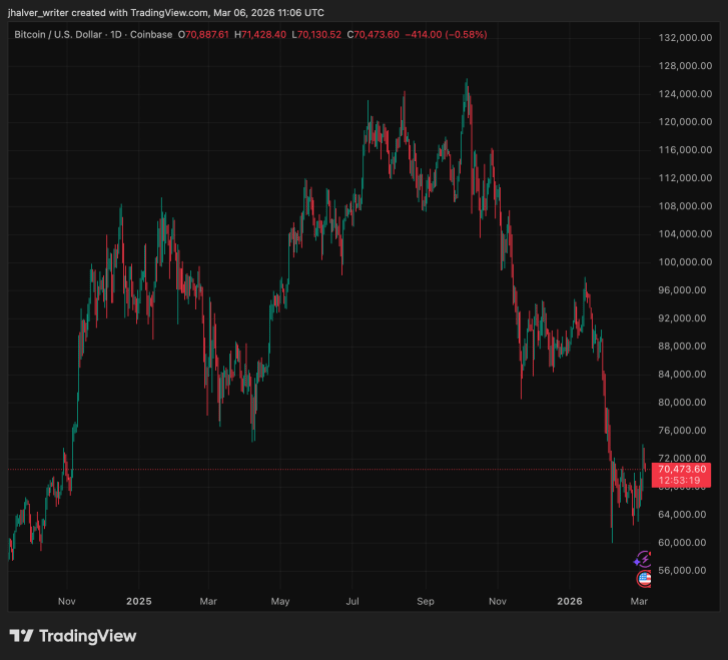
BTC's price trends to the downside on the daily chart. Source: BTCUSD on Tradingview

Cover image from ChatGPT, BTCUSD chart from Tradingview

Трендові криптовалюти

Пов'язані питання

QWhat is the Bank of Russia's new proposal regarding cryptocurrency exchanges?

AThe Bank of Russia has proposed allowing banks and brokerage firms to obtain licenses to operate crypto exchanges through a notification process based on their existing licenses.

QWhat is the primary reason given by Governor Elvira Nabiullina for this new crypto proposal?

AThe proposal aims to leverage the banking sector's infrastructure for anti-money laundering (AML) and countering the financing of terrorism and fraud (CFT) to better protect clients in the digital assets market.

QHow would crypto assets be treated under the draft rules, and what key restriction remains?

ACrypto and stablecoins would be treated as 'currency valuables,' meaning Russians can own and trade them, but using them as a domestic means of payment would remain restricted.

QWhat risk limitation does the Central Bank propose for banks involved in crypto assets?

AThe Central Bank proposes to limit the level of risk a bank takes in this area to one percent of its capital as a temporary measure.

QHow has Russia's overall stance on cryptocurrency evolved from 2020 to the present, according to the article?

ARussia has evolved from recognizing digital assets as property but banning them as payment in 2020, to flirting with a full ban in 2022, and then shifting to a 'regulate, don't ban' approach. By 2024-2025, it allowed limited cross-border use, legalized mining, and is now opening the market to banks and qualified investors to pull activity onshore and tax it.

Пов'язані матеріали

From South Korea to the United States: Blue-Collar Jobs Are Becoming Increasingly Popular, Thanks to AI

AI is reshaping the labor market's value proposition. The traditional four-year college degree is losing its appeal as a guaranteed career path, while skilled blue-collar trades like electricians, welders, and plumbers are experiencing historic demand and wage premiums. This shift is driven by dual pressures: AI's displacement of certain white-collar roles and a booming need for physical infrastructure and data center construction. Data confirms the trend. In the U.S., vocational school revenue surged, and a significant portion of recent layoffs are AI-related. Surveys show a majority of Gen Z adults plan to pursue blue-collar work, citing better job security against AI automation. Vocational education interest has exploded recently. Experts cite a psychological shift as younger generations seek tangible, AI-resistant careers and avoid high student debt. In many cases, salaries for skilled trades now match or exceed those requiring a bachelor's degree. In South Korea, semiconductor vocational high schools boast near-total employment, with graduates securing high-paying roles at companies like Samsung. The shortage is structural, exacerbated by a retiring baby boomer workforce and massive infrastructure projects. Companies like JPMorgan Chase, Meta, and Lowe's are investing heavily in training programs. However, overcoming historical stigma and a "perception gap" around trade careers remains a key challenge to closing the talent gap.

marsbit30 хв тому

From South Korea to the United States: Blue-Collar Jobs Are Becoming Increasingly Popular, Thanks to AI

marsbit30 хв тому

Qualcomm: AI Hype Subsides, When Will Smartphones Emerge from the Gloom?

Qualcomm reported its Q3 FY2026 results (ending June 2026), with revenue of $9.95B, down 4% YoY but above expectations. Gross margin declined to 53.1%, pressured by rising costs across manufacturing and memory. Key business segments showed mixed performance: Handset revenue fell 19.6% YoY to $5.09B, dragged by an 11% decline in non-Apple Android shipments and weaker high-end mix. Conversely, Automotive revenue surged 61% to $1.59B, and IoT grew 9% to $1.83B. Core operating profit dropped 41% YoY due to margin compression and higher expenses. Management's Q4 FY2026 guidance projects revenue of $9.7B-$10.5B, in line with consensus, but Non-GAAP EPS guidance of $2.05-$2.25 fell short of expectations. Amidst persistent weakness in its core handset market, Qualcomm is pursuing growth in AI, focusing on Edge AI (smartphones, PCs, automotive) and Data Center AI. Its data center strategy includes four pillars: AI accelerators (e.g., AI200), commercial CPUs (Dragonfly C1000), custom silicon, and connectivity solutions. While these initiatives initially boosted its stock, concerns over AI capital expenditure sustainability have since erased those gains. The company targets $5B in data center revenue for FY2027 and $15B for FY2029. The report concludes that with the traditional handset business still under pressure, the data center opportunity is currently viewed as a longer-term option, and a more conservative valuation based on core operations may be warranted until AI contributions materialize.

marsbit34 хв тому

Qualcomm: AI Hype Subsides, When Will Smartphones Emerge from the Gloom?

marsbit34 хв тому

From TPU to Self-Evolving Agents: How Jeff Dean Predicts the Next Step in AI

At the 2026 YC Startup School, Jeff Dean outlined his vision for AI's next phase, shifting focus from simply scaling models to building intelligent, autonomous systems. He believes AI's progress is no longer just about creating smarter models, but about integrating them into systems capable of long-term, iterative work, automated experimentation, and continuous learning. This evolution moves the competition from "who has the bigger model" to "who can best organize intelligence." Dean suggests AI capabilities are now comparable to a junior engineer, enabling the automation of complex workflows. However, the true challenge and opportunity lie in managing these AI "workers" at scale. He emphasizes the importance of **context engineering**—structuring tools, memory, and feedback loops—over raw model power. For startups, this means building deep expertise in niche domains where general models currently fail (near 0-1% success rates), leveraging proprietary data, specialized tools, and domain-specific evaluators. A recurring theme is re-examining fundamental constraints. Dean's past work, like moving Google's search index to memory or creating the TPU, stemmed from questioning outdated assumptions about hardware and cost. He sees similar inflection points today, particularly in **specialized inference hardware** to drastically reduce latency and energy consumption for real-time Agent operation. Notably, he points out that in modern AI systems, the dominant cost is often not computation but **data movement**. Reliable, long-running Agents require robust system design, borrowing concepts from distributed computing like checkpointing, state management, and parallel exploration to handle failures and maintain progress over days or weeks. As AI automates execution, the scarcest human skills will shift to **defining clear specifications**, **judging what problems are worth solving** (taste), and designing effective feedback loops. Ultimately, Dean's framework prioritizes understanding the problem deeply, identifying the true bottlenecks, and systematically building closed-loop systems where AI can not only perform tasks but also improve AI itself.

marsbit34 хв тому

From TPU to Self-Evolving Agents: How Jeff Dean Predicts the Next Step in AI

marsbit34 хв тому

Торгівля

Спот

Популярні статті

Як купити BAN

Ласкаво просимо до HTX.com! Ми зробили покупку Comedian (BAN) простою та зручною. Дотримуйтесь нашої покрокової інструкції, щоб розпочати свою криптовалютну подорож.Крок 1: Створіть обліковий запис на HTXВикористовуйте свою електронну пошту або номер телефону, щоб зареєструвати обліковий запис на HTX безплатно. Пройдіть безпроблемну реєстрацію й отримайте доступ до всіх функцій.ЗареєструватисьКрок 2: Перейдіть до розділу Купити крипту і виберіть спосіб оплатиКредитна/дебетова картка: використовуйте вашу картку Visa або Mastercard, щоб миттєво купити Comedian (BAN).Баланс: використовуйте кошти з балансу вашого рахунку HTX для безперешкодної торгівлі.Треті особи: ми додали популярні способи оплати, такі як Google Pay та Apple Pay, щоб підвищити зручність.P2P: Торгуйте безпосередньо з іншими користувачами на HTX.Позабіржова торгівля (OTC): ми пропонуємо індивідуальні послуги та конкурентні обмінні курси для трейдерів.Крок 3: Зберігайте свої Comedian (BAN)Після придбання Comedian (BAN) збережіть його у своєму обліковому записі на HTX. Крім того, ви можете відправити його в інше місце за допомогою блокчейн-переказу або використовувати його для торгівлі іншими криптовалютами.Крок 4: Торгівля Comedian (BAN)Легко торгуйте Comedian (BAN) на спотовому ринку HTX. Просто увійдіть до свого облікового запису, виберіть торгову пару, укладайте угоди та спостерігайте за ними в режимі реального часу. Ми пропонуємо зручний досвід як для початківців, так і для досвідчених трейдерів.

614 переглядів усьогоОпубліковано 2024.12.11Оновлено 2026.06.02

Як купити BAN

Обговорення

Ласкаво просимо до спільноти HTX. Тут ви можете бути в курсі останніх подій розвитку платформи та отримати доступ до професійної ринкової інформації. Нижче представлені думки користувачів щодо ціни BAN (BAN).

活动图片













