From Aave to Ether.fi: Who Captures the Most Value in the On-Chain Credit System?

marsbitОпубліковано о 2025-12-24Востаннє оновлено о 2025-12-24

Анотація

In the DeFi lending ecosystem, lending protocols like Aave and SparkLend capture more value than the vaults and asset issuers built on top of them, despite the narrative that distribution is king. Analysis shows that major vaults, including Ether.fi, Fluid, and Mellow, pay more in interest fees to lending protocols than they earn in platform revenue. For example, Ether.fi’s ETH vault pays Aave ~$4.5M annually in interest while earning only ~$1.07M in fees. Even when combining vault strategy revenue and issuer fees (e.g., Lido), lending layer value capture remains higher. Lending protocol income is tied to borrowing scale and remains stable, whereas vault earnings depend heavily on fee structures. The true moat in on-chain credit lies with lending protocols, not distribution or asset issuance.

Author | @SilvioBusonero

Compiled by | Odaily Planet Daily (@OdailyChina)

Translated by | DingDang (@XiaMiPP)

As the market share of Vaults and Curators continues to grow in the DeFi world, the market has begun to question: Are lending protocols having their profit margins constantly squeezed? Is lending no longer a good business?

But if we shift our perspective back to the entire on-chain credit value chain, the conclusion is quite the opposite. Lending protocols still occupy the most solid moat in this value chain. We can quantify this with data.

On Aave and SparkLend, the interest fees paid by Vaults to lending protocols actually exceed the revenue generated by the Vaults themselves. This fact directly challenges the mainstream narrative that "distribution is king".
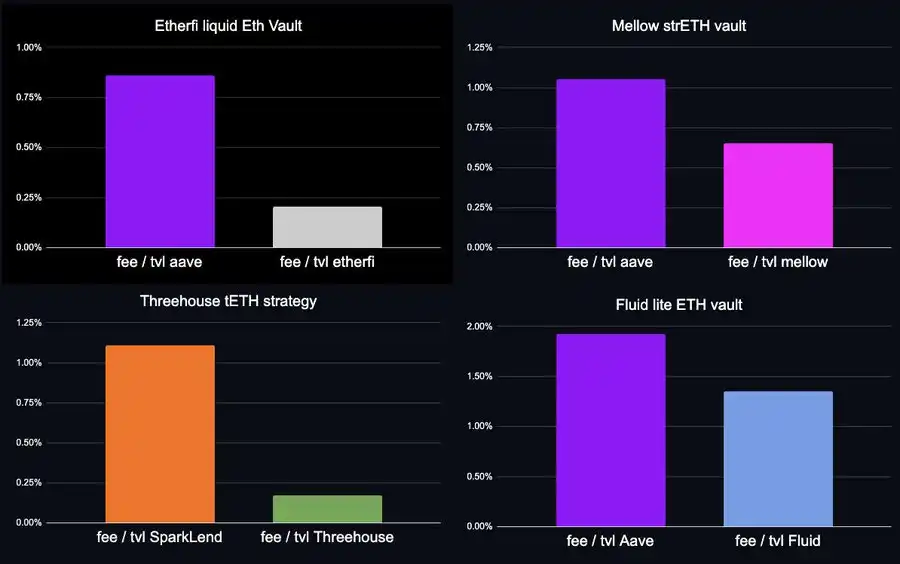
At least in the lending space, distribution is not king.

Simply put: Aave not only earns more than the various Vaults built on top of it, but also more than the issuers of the assets used for lending, such as Lido and Ether.fi.

To understand why, we need to deconstruct the complete value chain of DeFi lending and re-examine the value capture capabilities of various roles by following the flow of funds and fees.

Deconstructing the Lending Value Chain
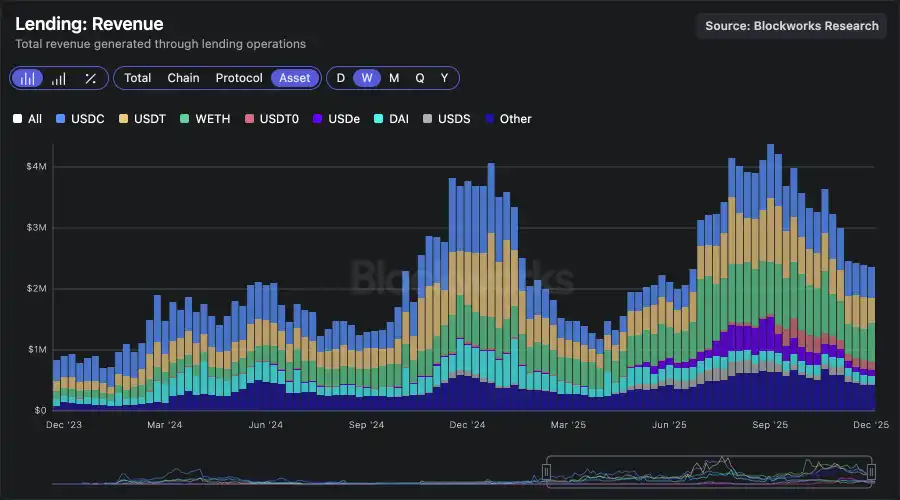
The annualized revenue scale of the entire lending market has exceeded $100 million. This value is not generated by a single link but is composed of a complex stack: the underlying settlement blockchain, asset issuers, capital lenders, the lending protocol itself, and the Vaults responsible for distribution and strategy execution.

As mentioned in previous articles, a large number of use cases in the current lending market originate from basis trading and liquidity mining opportunities, and we have deconstructed the main strategy logic.

So, who actually "demands" the capital in the lending market?

I analyzed the top 50 wallet addresses on Aave and SparkLend and labeled the main borrowers.
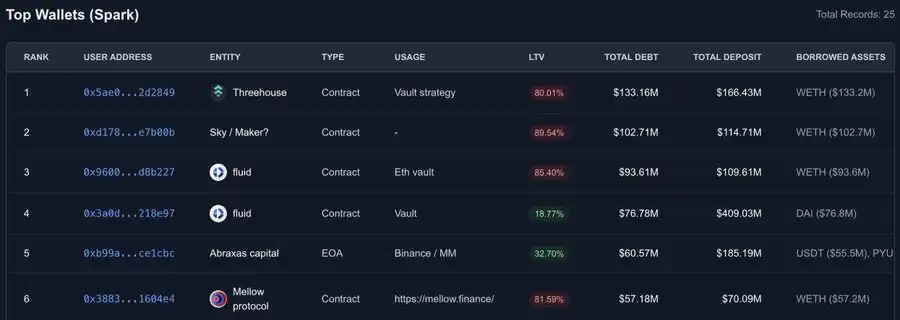
  1. The largest borrowers are various Vaults and strategy platforms like Fluid, Treehouse, Mellow, Ether.fi, Lido (who are also asset issuers). They control the distribution capability to end-users, helping users obtain higher yields without having to manage complex loops and risks themselves.
  2. There are also large institutional capital providers, such as Abraxas Capital, which deploy external capital into similar strategies. Their economic model is essentially very similar to that of Vaults.
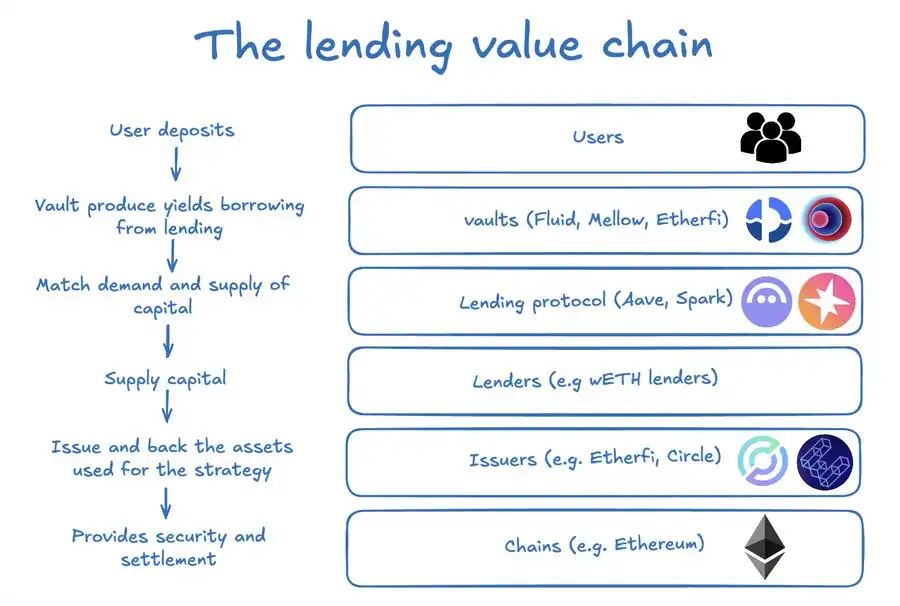
But Vaults are not the whole story. This chain involves at least the following participants:

  • Users: Deposit assets, hoping to obtain additional yield through Vaults or strategy managers.
  • Lending Protocols: Provide infrastructure and liquidity matching, generating protocol revenue by charging interest to the borrowing side and taking a cut.
  • Lenders: Capital suppliers, who can be either ordinary users or other Vaults.
  • Asset Issuers: Most on-chain lending assets have underlying collateral assets that themselves generate yield, part of which is captured by the issuer.
  • Blockchain Network: The underlying "rail" where all activity takes place.

Lending Protocols Earn More Than Downstream Vaults

Take Ether.fi's ETH liquid staking vault as an example. It is the second-largest borrower on Aave, with an outstanding loan size of approximately $1.5 billion. The strategy itself is very typical:

  • Deposit weETH (approx. +2.9%)
  • Borrow wETH (approx. –2%)
  • The vault charges a 0.5% platform management fee on TVL.

Out of Ether.fi's total TVL, approximately $215 million is the net liquidity actually deployed on Aave. This portion of TVL generates about $1.07 million in annual platform fee revenue for the vault.

However, simultaneously, this strategy pays Aave approximately $4.5 million in annual interest fees (calculated as: $1.5B borrowed × 2% borrow APY × 15% reserve factor).

Even for one of the largest and most successful loop strategies in DeFi, the value captured by the lending protocol is still multiples of that captured by the vault.
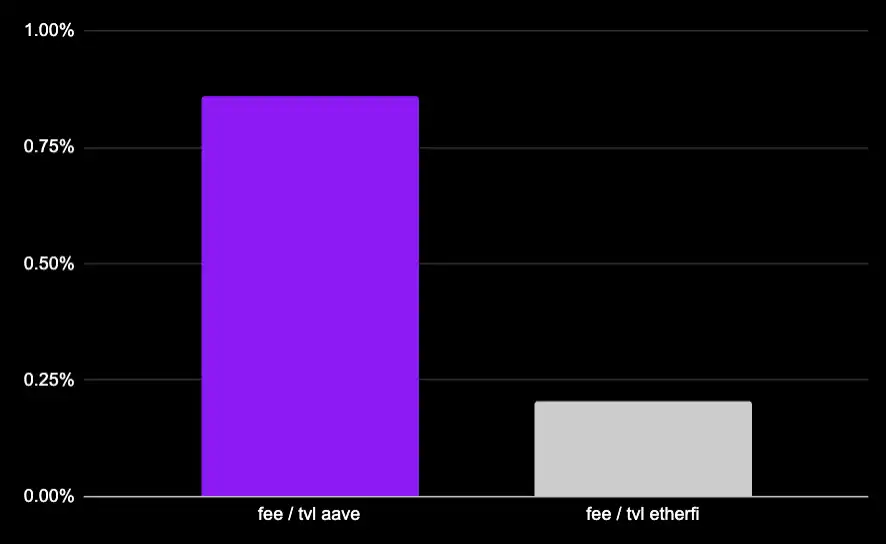
Of course, Ether.fi is also the issuer of weETH, and this vault itself directly creates demand for weETH.
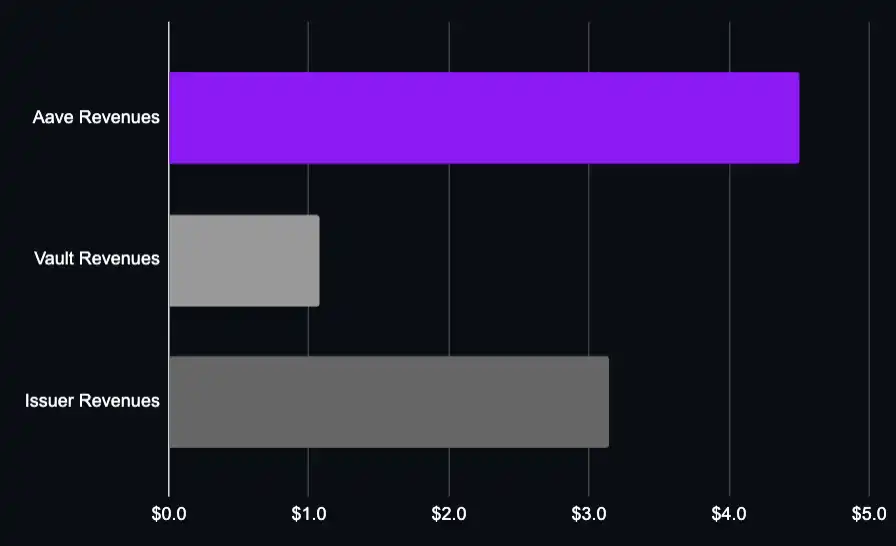
But even considering the vault strategy revenue + asset issuer revenue together, the economic value created by the lending layer (Aave) is still higher.

In other words, the lending protocol is the link in the entire stack that creates the most incremental value.

We can perform the same analysis on other commonly used vaults:

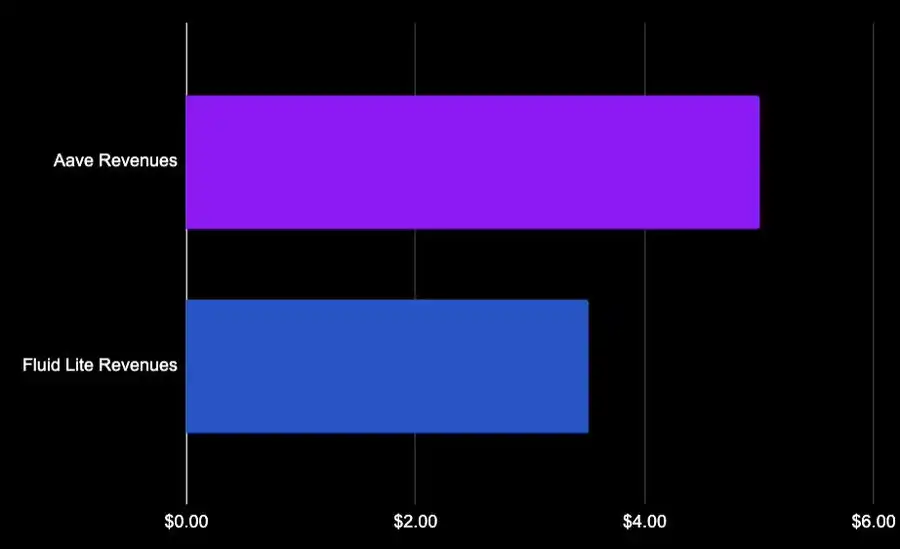
Fluid Lite ETH: 20% performance fee + 0.05% exit fee, no platform management fee. Borrows $1.7B wETH from Aave, paying ~$33M in interest, of which ~$5M goes to Aave. Fluid's own revenue is close to $4M.
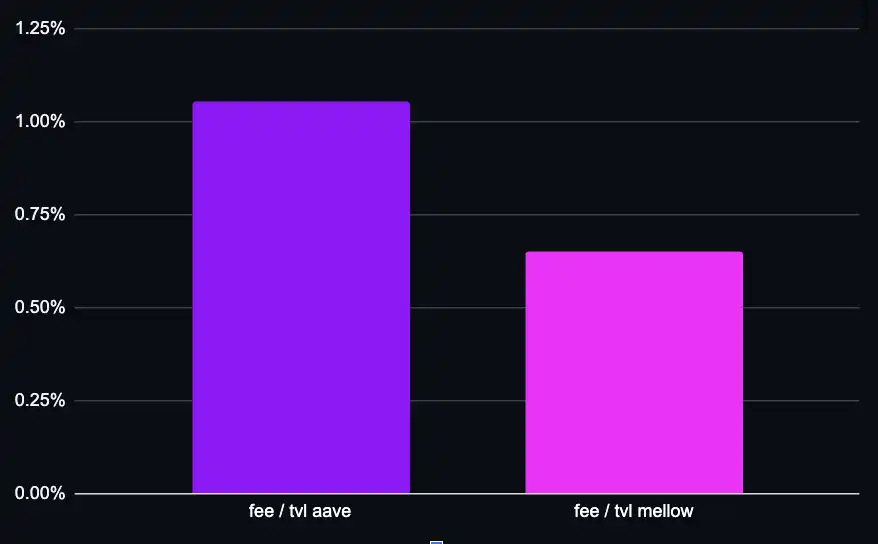
Mellow Protocol strETH charges a 10% performance fee, with a borrow size of $165M and a TVL of only ~$37M. Again, we see that on a TVL basis, Aave captures more value than the vault itself.
Let's look at another example. On SparkLend, the second-largest lending protocol on Ethereum, Treehouse is a key participant, operating an ETH loop strategy:
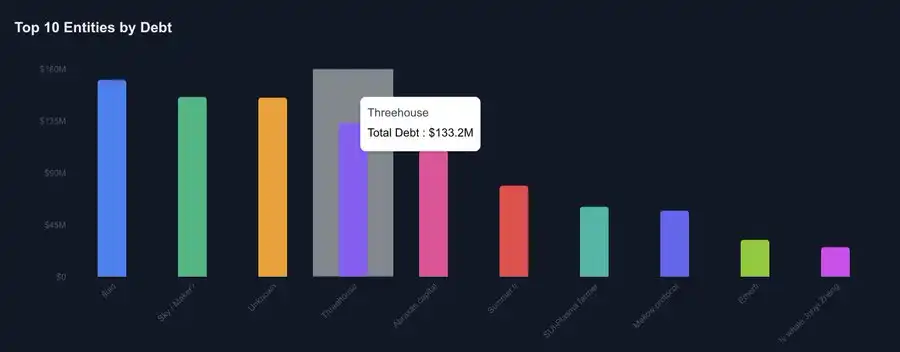
  • TVL ~$34M
  • Borrows $133M
  • Charges performance fee only on marginal yield above 2.6%
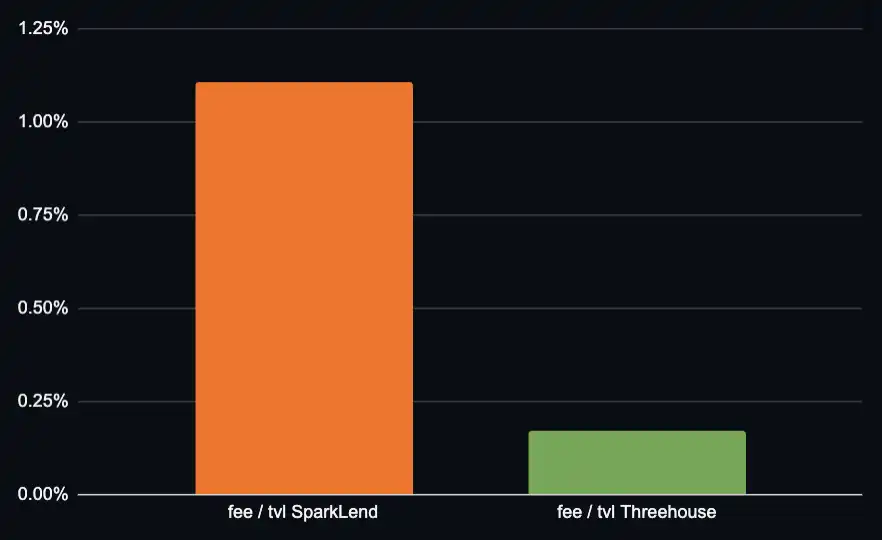
SparkLend, as a lending protocol, captures more value on a TVL basis than the vault.

The pricing structure of a vault greatly influences its own capturable value; but for lending protocols, their revenue depends more on the nominal size of borrowing, which is relatively stable.

Even shifting to USD-denominated strategies, which have lower leverage, the higher interest rates often offset this effect. I don't believe the conclusion would fundamentally change.

In relatively closed markets, more value might flow to curators, such as Stakehouse Prime Vault (26% performance fee, incentives provided by Morpho). But this is not the end state of Morpho's pricing mechanism, and curators themselves also partner with other platforms for distribution.

Lending Protocol vs. Asset Issuer

So the question arises: Is it better to be Aave or Lido?

This question is more complex than comparing vaults because staking assets not only generate yield themselves but also indirectly create stablecoin interest income for the protocol through the lending market. We can only make an approximate estimate.

Lido has approximately $4.42 billion in assets in the core Ethereum market used to support lending positions, generating annualized performance fee revenue of approximately $11 million.

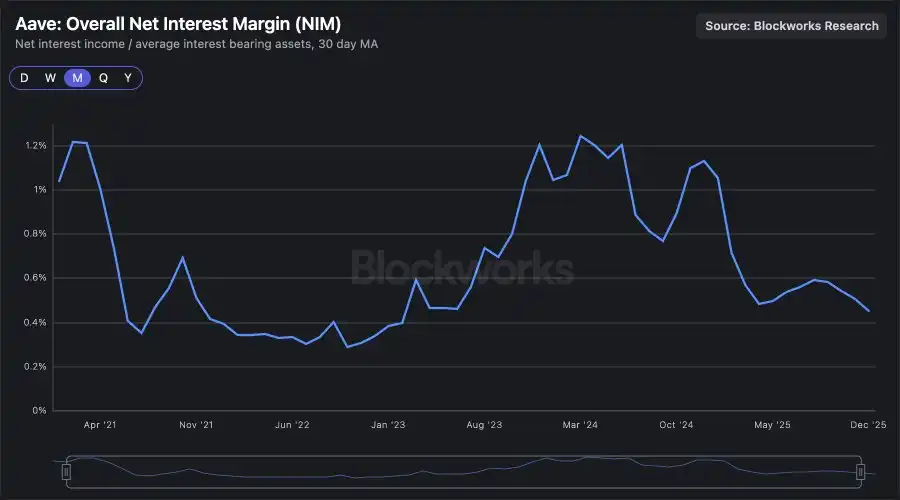
These positions roughly equally support ETH and stablecoin borrowing. At the current net interest margin (NIM) of ~0.4%, the corresponding lending yield is about $17 million, already significantly higher than Lido's direct revenue (and this is at a historically low NIM level).
The True Moat of Lending Protocols

If we only use the traditional financial deposit profitability model for comparison, DeFi lending protocols seem to be a low-margin industry. But this comparison ignores where the real moat lies.

In the on-chain credit system, the value captured by lending protocols exceeds that of the distribution layer downstream and, overall, exceeds that of the upstream asset issuers.

Viewed in isolation, lending seems like a thin-margin business; but placed within the complete credit stack, it is the layer with the strongest value capture capability relative to all other participants—vaults, issuers, distribution channels.


Трендові криптовалюти

Пов'язані питання

QAccording to the article, which layer in the DeFi lending value chain captures the most value?

AThe lending protocol layer, such as Aave and SparkLend, captures the most value in the entire on-chain credit value chain, even more than the downstream vaults/curators and the upstream asset issuers.

QWhat is the main reason that lending protocols can capture more value than the yield strategies (vaults) built on top of them?

AThe lending protocol's revenue is primarily determined by the nominal size of the loans, which is stable and large. In contrast, a vault's income depends heavily on its specific fee structure (e.g., performance fees) and is often a smaller portion of the total value flow, with a significant portion paid as interest to the lending protocol.

QUsing the Ether.fi vault as an example, how much more value did Aave capture compared to the vault itself?

AThe Ether.fi vault paid approximately $4.5 million in annual interest fees to Aave, while the vault itself only generated about $1.07 million in platform fee revenue from its TVL, meaning Aave captured over 4 times more value.

QBesides vaults, who are the other major borrowers in the DeFi lending market mentioned in the analysis?

AOther major borrowers include large institutional capital providers, such as Abraxas Capital, which deploy external capital into yield strategies that are economically similar to vaults.

QWhat is the key takeaway about the business of DeFi lending protocols when viewed within the entire credit stack?

AWhile lending may appear to be a low-margin business when viewed in isolation through a traditional deposit profitability lens, it actually has the strongest and most defensible moat in the entire on-chain credit value stack, capturing more value than any other participant, including distributors and asset issuers.

Пов'язані матеріали

From Gold to Bitcoin: Fixed Supply + Institutional Frenzy, Might It Repeat the 'Explosive' Price Trend?

"From Gold to Bitcoin: Fixed Supply and Institutional Frenzy May Lead to 'Explosive' Price Rally Analysts suggest Bitcoin's price action could mirror gold's over the past two decades, following the launch of spot Bitcoin ETFs. Gold ETFs, introduced in 2004, drove gold's price surge to a current market cap near $28 trillion. Both gold and Bitcoin are non-yielding stores of value, with prices driven purely by investor sentiment rather than cash flows or credit. Gold ETFs experienced dramatic cycles: explosive growth, painful drawdowns, and slow recoveries, with each cycle reaching higher peaks. Bitcoin ETFs, approved in early 2024, saw rapid institutional adoption but are now facing similar volatility. Recent warnings highlight the risk of significant ETF outflows disrupting the current rebound. BlackRock's IBIT, a leading Bitcoin ETF, has sold nearly 100,000 BTC to meet redemptions while still holding over 733,000. The core parallel is fixed supply: when demand surges, prices explode, but demand is often volatile and wave-like, not steady. Institutional interest, through ETFs and corporate adoption, remains a key support pillar, helping to cushion sell-offs. If Bitcoin captures even a fraction of gold's role as a store of value, its upside potential is immense, though the path will be marked by high volatility. For investors, focusing on long-term trends and managing risk is crucial as this 'price explosion' narrative unfolds."

Foresight News24 хв тому

From Gold to Bitcoin: Fixed Supply + Institutional Frenzy, Might It Repeat the 'Explosive' Price Trend?

Foresight News24 хв тому

Why Is AI Agent Shopping Hard to Popularize?

The article argues that the popular narrative of "AI agent shopping" – equipping AI with a wallet to autonomously handle purchases – is fundamentally flawed and oversimplifies the complexity of shopping. It deconstructs shopping into two core actions: **information retrieval** (standardized, easily automated) and **value judgment** (deeply subjective and human-centric). The narrative mistakenly assumes AI can fully handle both. Value judgment itself has two layers: **evaluation** (assessing options against criteria) and **demand definition** (setting the criteria, weights, and values). The latter is inherently human and dynamic, as preferences are not fixed but constructed during the decision-making process ("constructive preferences"). The real dividing line for automation is not product standardization, but whether the **act of choosing** itself holds experiential value. For mundane purchases (e.g., printer paper), full AI delegation works. For experiential goods (e.g., wine, furniture), the joy of selection is core to consumption, so AI should act as an assistant that narrows options, leaving the final choice to humans. The "AI wallet" concept confuses three separate elements: decision-making, execution, and fund custody. Current payment industry solutions (e.g., from Stripe, Mastercard, Google, Visa) show that limited, scoped payment authorization tokens are sufficient for most consumer scenarios, not full fund custody. The true use case for autonomous AI wallets is in **B2B procurement** and **machine-to-machine (M2M) settlements** for standardized, high-frequency, low-value transactions. The real bottlenecks for AI shopping are not payment technology, but **1) the lack of trusted data sources** (e.g., fake reviews, counterfeit goods) and **2) the impossibility of automating human demand definition**. The conclusion is that the focus should be on safely automating the assessment and filtering process while reserving for humans the rights to define their criteria and enjoy the final act of choice. For experiential goods, the platform's competitive advantage shifts to providing a superior selection experience.

Foresight News1 год тому

Why Is AI Agent Shopping Hard to Popularize?

Foresight News1 год тому

After Nine Months of Shorting, a Full Turn to Long: Renowned Trader Opens Bitcoin Positions Around 64K, Crypto Market Long-Short Divergence Intensifies

After nine months of being short, prominent crypto trader Doctor Profit has closed all his bearish positions and started buying Bitcoin near $64,000, signaling a complete bullish reversal. He argues that structural market changes—such as impending U.S. regulation (CLARITY Act) and institutional adoption via securities tokenization—are rewriting the traditional four-year cycle script, potentially bringing the market bottom forward from the widely expected September/October timeframe. This view finds some technical support from on-chain analyst gumsays, who notes a bullish divergence on Bitcoin's weekly chart has persisted for 147 days, nearing the 161-day duration seen before the 2022 cycle low. However, cycle researcher Jake Pahor presents a counter-argument based on historical data. Analyzing patterns since 2014, he identifies three common features of past bear market bottoms: a ~12-month duration from peak to trough, a sustained period of extreme fear (with a proprietary risk score below 20), and the price falling below Bitcoin's realized price (~$53,000 currently). The current cycle, only nine months from its October 2025 peak, meets none of these conditions. The debate highlights a market torn between "front-running" a potential early bottom driven by new fundamentals and waiting for confirmation through traditional on-chain and sentiment metrics. While Doctor Profit opts for aggressive buying, Pahor maintains a disciplined, tiered accumulation strategy, continuing weekly buys at current risk levels but reserving larger orders for if more extreme fear emerges.

marsbit1 год тому

After Nine Months of Shorting, a Full Turn to Long: Renowned Trader Opens Bitcoin Positions Around 64K, Crypto Market Long-Short Divergence Intensifies

marsbit1 год тому

Торгівля

Спот

Популярні статті

Як купити AAVE

Ласкаво просимо до HTX.com! Ми зробили покупку Aave Protocol (AAVE) простою та зручною. Дотримуйтесь нашої покрокової інструкції, щоб розпочати свою криптовалютну подорож.Крок 1: Створіть обліковий запис на HTXВикористовуйте свою електронну пошту або номер телефону, щоб зареєструвати обліковий запис на HTX безплатно. Пройдіть безпроблемну реєстрацію й отримайте доступ до всіх функцій.ЗареєструватисьКрок 2: Перейдіть до розділу Купити крипту і виберіть спосіб оплатиКредитна/дебетова картка: використовуйте вашу картку Visa або Mastercard, щоб миттєво купити Aave Protocol (AAVE).Баланс: використовуйте кошти з балансу вашого рахунку HTX для безперешкодної торгівлі.Треті особи: ми додали популярні способи оплати, такі як Google Pay та Apple Pay, щоб підвищити зручність.P2P: Торгуйте безпосередньо з іншими користувачами на HTX.Позабіржова торгівля (OTC): ми пропонуємо індивідуальні послуги та конкурентні обмінні курси для трейдерів.Крок 3: Зберігайте свої Aave Protocol (AAVE)Після придбання Aave Protocol (AAVE) збережіть його у своєму обліковому записі на HTX. Крім того, ви можете відправити його в інше місце за допомогою блокчейн-переказу або використовувати його для торгівлі іншими криптовалютами.Крок 4: Торгівля Aave Protocol (AAVE)Легко торгуйте Aave Protocol (AAVE) на спотовому ринку HTX. Просто увійдіть до свого облікового запису, виберіть торгову пару, укладайте угоди та спостерігайте за ними в режимі реального часу. Ми пропонуємо зручний досвід як для початківців, так і для досвідчених трейдерів.

326 переглядів усьогоОпубліковано 2024.12.11Оновлено 2026.06.02

Як купити AAVE

Обговорення

Ласкаво просимо до спільноти HTX. Тут ви можете бути в курсі останніх подій розвитку платформи та отримати доступ до професійної ринкової інформації. Нижче представлені думки користувачів щодо ціни AAVE (AAVE).

活动图片