From a $70 Million Sky-High Transaction to a First-Day Crash: The "Amateur" Debut of ai.com

Odaily星球日报Опубліковано о 2026-02-09Востаннє оновлено о 2026-02-09

Анотація

An article titled "From a $70 Million Record-Bomain Deal to Launch Day Downtime: The Rocky Debut of AI.com" reports that the highly sought-after domain AI.com, which had been at the center of speculation and bidding among AI giants, was acquired for $70 million in April 2025 by Kris Marszalek, co-founder and CEO of cryptocurrency exchange Crypto.com. The transaction, paid for in cryptocurrency, set a new public record for domain sales. The domain, first registered in 1993, had previously been linked to OpenAI and later to Elon Musk’s xAI in what was seen as a marketing tactic to drive up its value. Marszalek stated that he received even higher offers after the purchase but chose to retain the domain, believing it would be crucial for future business credibility. Over Super Bowl weekend, Marszalek launched AI.com, promoting it as a platform where users could deploy AI agents for tasks like stock trading and workflow automation. However, within 48 hours of going live, the site experienced significant downtime, drawing criticism and mockery online, particularly from an Nvidia engineer who highlighted the irony of such a high-value domain failing under load. The article also touches on how other crypto executives are diversifying their investments—from buying real estate and power plants to expanding business operations—signaling a broader trend of cryptocurrency leaders integrating into mainstream economic and technological landscapes.

Original|Odaily Planet Daily(@OdailyChina)

Author|Wenser(@wenser 2010)

Last weekend, besides the "Bithumb airdrops 620,000 BTC" misinformation incident, another breaking news story sparked widespread discussion: the mysterious buyer behind the premium domain ai.com has finally been revealed. Contrary to many expectations, the buyer was not from an AI giant but Kris Marszalek, co-founder and CEO of the cryptocurrency exchange Crypto.com.

This transaction, finalized in April 2025, amounted to a staggering $70 million, giving the outside world a direct glimpse into the astonishing financial power of crypto big shots. This deal not only ended the ownership battle surrounding the domain but also drew a conclusion to the previous "premium domain pointing war" among giants like OpenAI and xAI.

The Battle for ai.com: A Three-Year, Sky-High Transaction War

In November 2022, with the groundbreaking launch of ChatGPT (GPT 3.5), AI instantly became the prominent field of the era, and the prices of related domain names naturally soared.

In February 2023, rumors suggested that OpenAI, the parent company behind ChatGPT, had purchased ai.com. This was later confirmed as fake news, though the domain's listed selling price of $11 million in 2021 was still jaw-dropping.

In August 2023, the ai.com domain's pointing address was changed to xAI, the AI company under Musk's umbrella, which again attracted significant attention.

From then on, more information about this premium domain was uncovered: the domain was first registered in May 1993, making it over 30 years old, a veteran in the domain world. However, Musk remained indifferent to the matter, making the market realize once again that changing the domain's pointing address was merely a marketing tactic by the ai.com holder to "wait for the highest bidder."

It reappeared in the public eye recently with the news that it was "sold for a whopping $70 million."

Public information reveals that Crypto.com co-founder and CEO Kris Marszalek successfully acquired this premium domain, setting one of the highest publicly disclosed domain sale records to date; the transaction was facilitated by domain broker Larry Fischer and was paid for in cryptocurrency. For reference, this sky-high price is double the previous sale price of the premium domain voice.com.

As an established crypto exchange founded in 2016, Crypto.com has long been renowned in the industry for its "massive marketing moves," having previously engaged in market promotion through sports sponsorships and celebrity endorsements; in 2021, it even splurged $700 million just to secure the naming rights for a sports stadium in Los Angeles.

In an interview with the media, Kris Marszalek revealed that he had "received even more outrageous resale offers but chose to hold onto the domain" because he believes it will be crucial for the future business's trust and recognition. Moreover, he boldly declared: "We fought our way to the top among thousands of crypto exchanges back then, and this time we will make ai.com a success again."

Thus, the years-long battle over the ai.com premium domain came to an end; just as the market was anticipating and speculating on how Kris Marszalek would use this domain, he unexpectedly "pulled a big one."

The Botched "Product Launch": ai.com Went Down Within 48 Hours of Going Live

Crypto.com co-founder and CEO Kris Marszalek posted that after buying the domain, he had been building quietly and would launch the product during the Super Bowl on Sunday (February 8). He later stated that with the AI Agent on the ai.com platform, users would soon be able to deploy their own agents to perform a series of actions on their behalf, such as stock trading, automating workflows, using calendars to schedule and execute daily tasks, all while maintaining privacy, based on user permissions, and entirely under user control.

But amidst great anticipation, ai.com staged a "downtime drama" within less than 48 hours of its launch.

This morning, NVIDIA engineer yuhang posted, "This $70m domain, after $8m in ads(Odaily Planet Daily note: the general price of a Super Bowl ad), 504'd".
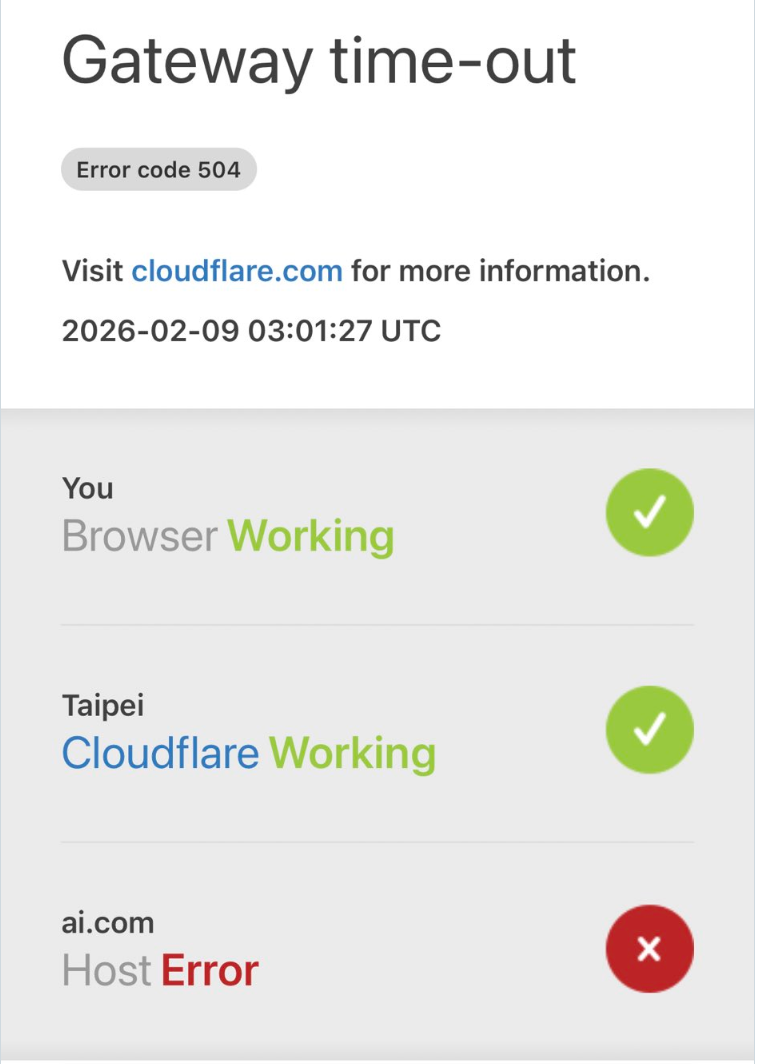
It has to be said, this incident once again confirms that saying—"The whole world is just a slightly larger amateur operation."

As of the time of writing, the ai.com website has returned to normal. Users can抢先 register personal subdomains and AI Agent subdomains to experience the platform's corresponding functions later; as for whether it can deliver on the "autonomous AI Agent" promised in Kris Marszalek's grand vision, the author will reserve judgment for now.

The "Mainstreaming Path" of Crypto Big Shots: Some Buy Houses, Some Buy Power Plants

Another hot topic brought up by the Crypto.com co-founder and CEO spending $70 million on a premium domain is the various paths to mainstreaming that crypto big shots choose for themselves.

Previously, there was Justin Sun spending millions on a lunch with Warren Buffett. Recently, the moves by crypto大佬 have become more diverse:

Aave founder Stani Kulechov bought a mansion worth £22 million (approximately $30 million) in London's Notting Hill last November.

Tether CEO Paolo focuses more on "putting eggs in different baskets." Reliable sources indicate that Tether has invested profits from its stablecoin business into 140 investments covering fields from agriculture to sports and plans to expand its workforce to 450 people; additionally, Tether's gold reserves exceed $23 billion.

Last November, Justin Sun, through his family office SunFund Energy, acquired two small hydropower plants in Norway at once, with a total installed capacity of 86 MW and an annual electricity generation of about 350 GWh, equivalent to the annual electricity consumption of 40,000 European households. In the era of the AI great navigation, the ever-bold Justin Sun chose to hold a "power ticket" to board this era's train.

Regardless of the investment outcomes, cryptocurrency is thereby becoming known to more people through its various forms in news—as a payment currency, a character symbol, an asset class, etc. Perhaps this is an indispensable part of cryptocurrency's journey into the mainstream.

Пов'язані питання

QWho purchased the ai.com domain and for how much?

AKris Marszalek, the co-founder and CEO of Crypto.com, purchased the ai.com domain for $70 million.

QWhat was the initial reaction to the launch of the ai.com platform?

AThe ai.com platform experienced a宕机 (downtime) within 48 hours of its launch, leading to public criticism and being described as a botched 'product launch'.

QWhat was the historical significance of the ai.com domain prior to its sale?

AThe ai.com domain was first registered in May 1993, making it over 30 years old. It was at the center of a bidding war among AI giants like OpenAI and xAI after the rise of ChatGPT, and its pointing address was once changed to Musk's xAI company as a marketing tactic.

QHow did Kris Marszalek justify the enormous cost of the ai.com domain?

AKris Marszalek stated that he believed the domain was crucial for the future trust and recognition of his business. He also mentioned receiving even higher resale offers but chose to keep it, confident in his ability to succeed with it as he did with Crypto.com.

QWhat are some examples of how other crypto billionaires are diversifying their investments?

AOther crypto billionaires are diversifying in various ways: Aave's founder bought a £22 million mansion in London; Tether's CEO invested profits into 140 ventures ranging from agriculture to sports and expanded gold reserves; and Sun Yuchen acquired two small hydropower plants in Norway to secure a 'power ticket' for the AI era.

Пов'язані матеріали

STAR 50 Soars 10.73%, Why Did A-Shares Stage a "V-Shaped Reversal"?

After a prolonged decline, the Chinese A-share market staged a strong rally on July 21. The STAR 50 index surged 10.73%, its largest single-day gain in nearly a year, leading a broad-based "V-shaped" reversal. The Shanghai Composite Index rose 1.79%, the Shenzhen Component Index gained 4.81%, and the ChiNext Index jumped 7.05%. Total market turnover reached 2.97 trillion yuan, an increase of 256.1 billion yuan from the previous session, with over 3,100 stocks advancing. The semiconductor sector spearheaded the rebound, with related ETFs posting significant gains. Analysts attribute the surge to three converging factors. First, coordinated capital inflows from "national team" institutions, insurance funds, listed company buybacks, and fund house self-purchases have bolstered market liquidity and confidence. Second, supportive policy signals, including commitments from regulators to ensure stable market operations, provided a favorable backdrop. Third, a stabilization and recovery in overseas markets, notably South Korea, created a positive external environment. Institutions suggest the most severe panic selling phase for the tech sector has likely passed, following a significant digestion of crowded positions and leveraged funds. While short-term volatility may persist, the medium to long-term outlook remains underpinned by enduring trends like AI computing demand expansion and semiconductor localization. The market's focus now shifts to the sustainability of supportive fund flows, earnings reports, and upcoming catalysts from the global AI industry chain.

marsbit31 хв тому

STAR 50 Soars 10.73%, Why Did A-Shares Stage a "V-Shaped Reversal"?

marsbit31 хв тому

U.S. Tech Momentum Stocks Post Largest Single-Day Gain Ever, But Is the Plunge Over?

US tech momentum stocks staged a sharp rebound on Tuesday (July 21st). Morgan Stanley's TMT Momentum Factor surged over 12%, marking its largest single-day gain on record, exceeding even peaks from the 2000 dot-com bubble. Key momentum indices from Goldman Sachs also posted their strongest daily performances in years. The rally was led by semiconductors, with the Philadelphia Semiconductor Index jumping 4.6%. This rebound followed three consecutive down days and a cumulative 33% plunge in momentum stocks, one of the steepest drawdowns since the dot-com era. Analysts attribute the surge largely to a short squeeze. Heavy selling had pushed high-beta momentum stocks into deeply oversold territory, forcing many short sellers, particularly in Asia, to cover their positions, creating a self-reinforcing buying spiral. However, the rebound's internals appear weak. Trading volume was notably low, and advancing stocks still lagged decliners on the S&P 500, indicating a narrow, concentrated rally rather than broad market participation. Diverging views emerge on the outlook. BTIG warns the bounce has hit key resistance and recommends selling into strength, citing extreme volatility and historical parallels to past market tops. Conversely, Goldman Sachs and UBS believe the momentum unwind is nearing its end, suggesting it may be time to gradually add exposure, as positioning has been significantly reduced. They caution, however, that high volatility warrants a measured approach, potentially using defined-risk strategies. The upcoming earnings season, particularly reports from major tech firms like Alphabet, is seen as a critical test for the rally's sustainability. Simultaneously, bond markets flashed a warning, with yields rising partly due to spiking oil prices. Analysts note that if long-term Treasury yields break decisively higher, it could pose a significant headwind for equities, especially growth stocks.

marsbit38 хв тому

U.S. Tech Momentum Stocks Post Largest Single-Day Gain Ever, But Is the Plunge Over?

marsbit38 хв тому

U.S. Tech Momentum Stocks Record Largest Single-Day Gain Ever, but Has the Rout Ended?

U.S. tech momentum stocks staged a dramatic rebound on Tuesday, July 21st. Key momentum indices like the Morgan Stanley TMT Momentum Factor and Goldman Sachs' High Beta Momentum Long Index posted historic or near-historic single-day gains, fueled largely by semiconductor stocks. This sharp rally followed a severe three-day sell-off that saw momentum stocks plunge 33%, marking one of the steepest pullbacks since the dot-com bubble. Analysts attribute the bounce primarily to a short squeeze, as forced covering from over-leveraged traders, particularly in Asia, created a buying spiral. However, the rally's health is questioned due to weak market breadth—overall trading volume was low, and decliners outnumbered advancers in the S&P 500 despite the index's gain—suggesting a narrow, concentrated surge rather than broad recovery. Opinions on the sustainability diverge. BTIG strategists warn the rebound has hit key resistance levels, citing extreme volatility and historic stock dispersion as signs of an ongoing broader correction, and recommend selling into strength. Conversely, Goldman Sachs and UBS view the aggressive momentum unwinding as nearing its end, noting reduced positioning and a lack of new fundamental catalysts. They suggest the sell-off presents a selective opportunity to add exposure, albeit cautiously and gradually using defined-risk strategies. The immediate trajectory hinges on the ongoing earnings season, with market focus on Alphabet's capital expenditure guidance for AI investment clarity. Meanwhile, bond markets present a risk, with rising Treasury yields—potentially heading toward 5.5%—and widening credit spreads for mega-cap tech companies posing a threat to equity valuations. The combination of technical factors, earnings results, and macro conditions leaves the durability of the rebound in doubt.

链捕手40 хв тому

U.S. Tech Momentum Stocks Record Largest Single-Day Gain Ever, but Has the Rout Ended?

链捕手40 хв тому

Long-Divided Must Unite, Long-United Must Divide: When L1 Becomes Its Own Rollup, What Is Ethereum's Endgame?

"The Inevitable Cycle: When L1 Becomes Its Own Rollup – What is Ethereum's Endgame?" For years, the Ethereum community grappled with concerns that L2s were fragmenting the ecosystem and eroding L1's value. While L2s provided cheaper execution, they also splintered liquidity and the unified user experience of a single chain. This has prompted a fundamental reassessment of the relationship between L1 and L2. Ethereum's roadmap is evolving. The "Scale" initiative merges L1 and L2 expansion into a holistic framework. L1 itself is advancing with higher gas limits, statelessness, and zkEVM verification, no longer content to be just a low-throughput settlement layer. Consequently, the primary value proposition of L2s is shifting from merely providing cheap blockspace to offering L1 cannot easily provide: application-specific optimizations, privacy features, and flexible governance models. L2s are becoming a spectrum of execution environments with varying degrees of security inheritance from Ethereum. A critical challenge in this multi-chain future is interoperability. The vision is to make Ethereum "feel like one chain again." This relies on advancements in native account abstraction (like EIP-7702) and intent-based architectures (Open Intents Framework), where users declare desired outcomes, and solvers handle the complex cross-chain execution. Furthermore, shortening Ethereum's finality time from minutes to seconds is crucial, as it underpins trust between chains for bridges, stablecoins, and cross-chain applications. Perhaps the most provocative idea is that Ethereum L1 itself could become a form of "its own Rollup." As zkEVM and proof systems mature, high-performance nodes could execute transactions and generate validity proofs. Regular validators would then verify these proofs instead of re-executing all transactions. This blurs the traditional L1/L2 hierarchy, making "Rollup" more of a general execution-verification architecture. Native Rollup aims to integrate L2 validation more directly into the Ethereum protocol, allowing L2s to inherit L1's security more fully and move away from reliance on security councils. In the end, L2s are not destined to replace L1 or be made obsolete by it. The likely future is a unified system where diverse execution environments—each optimized for specific use cases like DeFi, gaming, or privacy—coexist. They will share a common foundation of security, liquidity, and verifiable state, seamlessly connected to restore a cohesive user experience. The next phase for Ethereum is not just about scaling through separation, but about intelligently reintegrating what was separated back into a coherent whole.

链捕手56 хв тому

Long-Divided Must Unite, Long-United Must Divide: When L1 Becomes Its Own Rollup, What Is Ethereum's Endgame?

链捕手56 хв тому

Торгівля

Спот
活动图片