From 100% Rebate to 20%: The Game Theory Behind Polymarket's Fee Adjustment

marsbitОпубліковано о 2026-01-14Востаннє оновлено о 2026-01-14

Анотація

Polymarket recently adjusted its fee structure for 15-minute cryptocurrency prediction markets, moving from a 100% fee rebate to a 20% rebate for market makers. This change aims to combat "latency arbitrage" bots that exploited tiny time delays between exchange price updates and Polymarket’s price adjustments, harming market makers and reducing liquidity. Initially, full rebates were introduced to incentivize market makers to stay despite bot activity. After data showed a significant drop in fee volume—indicating reduced bot activity—the platform reduced rebates to 20% for a trial period. This reflects an ongoing effort to balance fairness among market makers, automated traders, and regular users. The article also references ongoing "money printer" strategies used by some successful traders and emphasizes Polymarket’s role in providing a competitive, strategy-driven environment.

Author: DFarm

First, let's sort out the recent timeline of events related to Polymarket's transaction fees.

  1. Polymarket suddenly announced that it would charge a transaction fee for 15-minute cryptocurrency price prediction markets, but all fees collected would be rebated to market makers (those placing limit orders).

  2. The fee rebate was changed from a 100% rebate to a partial rebate.

  3. Until the 11th, the 100% fee rebate stopped. From the 12th to the 18th, 20% of the fees are being rebated.

Why Charge a Fee?

We all know that Polymarket previously did not charge any fees for basic transactions. Why did it specifically start charging fees on the 15-minute cryptocurrency markets this time?

This requires explaining what "latency arbitrage" bots are.

In very short-cycle markets like 15-minute intervals, outcomes are determined based on prices from major exchanges.

In the absence of fees, high-frequency trading bots exploit millisecond-level time delays to place orders on Polymarket before its price has had a chance to update, thereby securing profits.

For example, suppose the current probability for BTC going UP in the next 15 minutes on Polymarket is 90%. Suddenly, the BTC price on exchanges drops by 5%. A bot detects this and immediately buys the cheap DOWN shares. After it finishes buying, subsequent bots or traders come in to buy and drive the price, allowing the initial bot to profit and exit.

What is the consequence of this behavior? Market makers consistently get exploited by these high-frequency bots. Naturally, market makers become unwilling to continue providing liquidity by placing orders in these markets, ultimately leading to poorer liquidity in the 15-minute cryptocurrency markets.
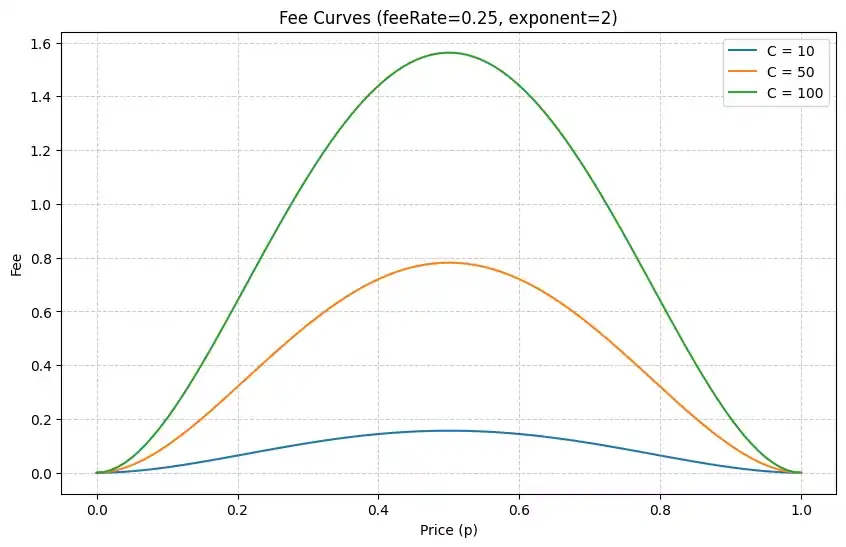
Therefore, the platform introduced a fee mechanism, with the highest fees specifically applied when the odds are 50:50 (as shown in the image). This directly makes the arbitrage cost for many bots higher than their potential profit, so these bots naturally shut down.

Why Subsidize Market Makers?

As mentioned earlier, market makers had too much capital extracted from them previously. To retain market makers, the platform distributes the collected fees to those placing limit orders (market makers).

So why was the rebate reduced from 100% to 20%?

The detail is in this phrase: "From the 12th to the 18th, 20% of fees are rebated." This tells us that the rebate percentage after the 18th is to be determined.

When fees were first introduced, market makers were actually uncertain—they didn't know if the fees would effectively block the bots. The platform initially rebated 100% of the fees to market makers to cover their risks and retain liquidity.

Why only 20% now? Let's look at the data first:
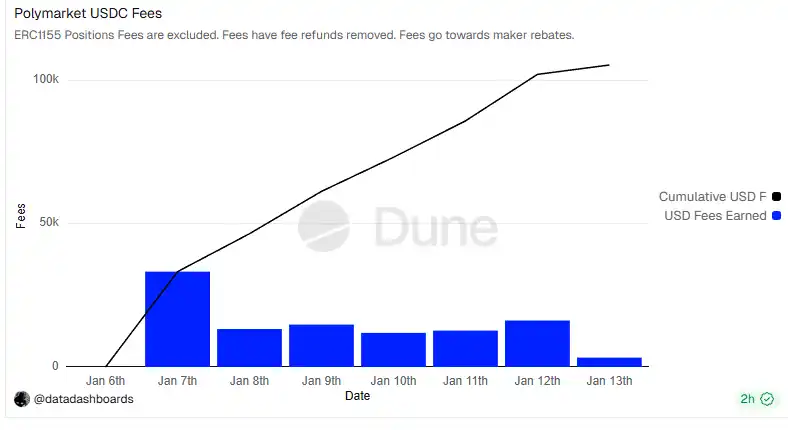
After fees were enabled, the total fee volume halved. What does this indicate? It confirms that many high-frequency bots indeed shut down.

Seeing that the bots are gone and the risk for market makers has decreased, the platform likely concluded that a 100% fee rebate is no longer necessary. They are trying 20% first to see the data performance.

This is why they are trialing a 20% fee rebate for one week first, to observe the data before deciding on the subsequent rebate ratio.

Ultimately, all this is about balancing the interests of market makers, bots, and regular traders.

The "Money Printer" Bots

There are many "money printer" entities present across various markets on Polymarket. Very few people in the market truly understand how they operate.

A very popular example is a post by X user: @the_smart_ape:
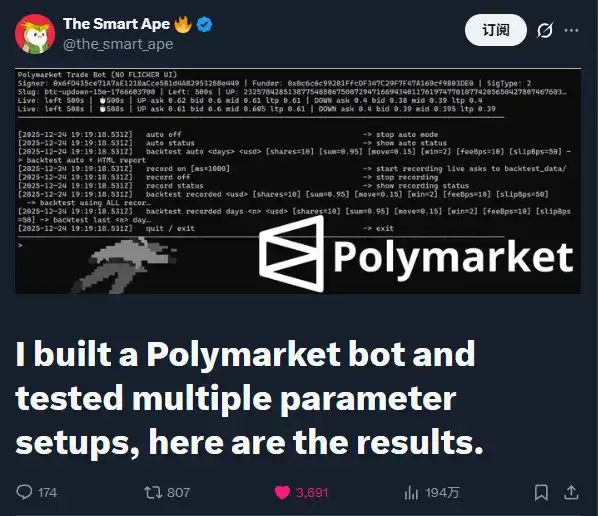
This post has nearly 2 million views. Many friends have tried the strategy described in the article, and indeed some have made profits.

But just a few days later, the fees were introduced, and many friends could no longer profit...

So have the "money printers" disappeared? Not entirely. Interested friends can check out these "money printers":

https://polymarket.com/@gabagool22?via=dfarm

https://polymarket.com/@distinct-baguette?via=dfarm

https://polymarket.com/@livebreathevolatility?via=dfarm

If you can decipher their strategies, your "money printer" isn't far away. But remember, don't tell anyone else—though you can secretly tell me.

Finally

Actually, on Polymarket, since there are no third-party commissions or fees, we are essentially betting against each other. Therefore, the platform's responsibility is to provide a fair playing field for both sides.

Players who enjoy PVP games also know that absolute fairness doesn't exist; it can only be approached through iterative version updates, striving for relative fairness.

This situation also shows us that "money printers" do exist on Polymarket, and it's all about competing on technology and strategy.

If this article was helpful to you, please help share it. Thank you.

If you are a newbie to Polymarket, be sure to check out this article → 《Beginner's Tutorial: Hand-Holding Guide to Getting Started with Polymarket from Scratch (Includes Anti-Ban + Low-Friction Deposit/Withdrawal Strategies)》

Пов'язані питання

QWhy did Polymarket introduce fees specifically for the 15-minute cryptocurrency price prediction markets?

APolymarket introduced fees to combat 'latency arbitrage' bots that exploited millisecond delays in price updates to profit at the expense of market makers, which was degrading liquidity in these short-term markets.

QWhat was the initial fee rebate policy, and how did it change?

AInitially, Polymarket implemented a 100% fee rebate to market makers (those placing limit orders). This was later reduced to a 20% rebate for a trial period from the 12th to the 18th.

QWhat effect did the introduction of fees have on the trading activity of arbitrage bots?

AThe total amount of fees collected dropped by half after their introduction, indicating that a significant number of high-frequency arbitrage bots were no longer profitable and stopped operating.

QWhat is the purpose of the fee rebate given to market makers?

AThe rebate is an incentive to compensate market makers for the risks they faced from arbitrage bots and to encourage them to continue providing liquidity (placing limit orders) on the platform.

QAccording to the article, what is the ultimate goal of Polymarket's fee policy adjustments?

AThe goal is to balance the interests of market makers, arbitrage bots, and regular traders to create a fairer trading environment, akin to how game developers balance PVP games through iterative updates.

Пов'язані матеріали

Frenzy Surrounding Unitree's Humanoid Robots Exceeds Hyperliquid Traders' Expectations

The Chinese robotics company Unitree Robotics made a highly anticipated debut on the Shanghai Stock Exchange on August 19, 2026. Its shares soared 629% above their IPO price, valuing the company at approximately $66 billion at the start of trading. This represents one of the most significant investor frenzies around physical AI—systems combining AI with robots. Prior to the listing, crypto traders on the Hyperliquid platform had already been speculating on the company's value through a perpetual futures contract, pegging its valuation at around $38 billion. The actual debut massively exceeded these crypto market predictions by about 75%. The contract's trading volume reached $64 million. Unitree, specializing in humanoid and quadruped robots, is now mainland China's first publicly listed humanoid robot company. It shipped over 5,500 humanoid units in 2025, leading global sales. The company's 2025 revenue surged to 1.7 billion yuan from 393 million yuan a year earlier, with a net profit of 278 million yuan and gross margins exceeding 60%. The IPO, which raised about 6.1 billion yuan ($905 million), reflects intense investor interest in the physical AI sector. JPMorgan estimates the humanoid robot market could grow from $2 billion in 2025 to $300 billion by 2035, with China holding about 75% of the global market share due to lower production costs. However, analysts warn of potential overvaluation, noting the stock's price far exceeds traditional financial metrics and is driven by retail speculation. The company faces the challenge of translating pilot projects and demonstrations into widespread commercial adoption. Strategic investors in the IPO included AI firm DeepSeek, Tencent, and units of major state-owned companies.

cryptonews.ru4 хв тому

Frenzy Surrounding Unitree's Humanoid Robots Exceeds Hyperliquid Traders' Expectations

cryptonews.ru4 хв тому

Why Didn't Oil Prices Stabilize Above $100 as Traffic Through the Strait of Hormuz Plunged Again?

Despite a significant drop in daily oil tanker traffic through the critical Strait of Hormuz in August, Brent crude oil prices have failed to stabilize above $100 per barrel, instead hovering around $90. This contrasts with traditional market logic, where a threat to a chokepoint handling roughly 20 million barrels per day (27% of global seaborne oil) should trigger a sustained supply risk premium. The article explains that the market is pricing in increased transit costs rather than an imminent, complete supply cutoff. Investors currently believe multiple buffers can absorb the shock: strategic and commercial inventories, the potential for coordinated stock releases, available OPEC+ spare capacity, and alternative export routes from the Gulf. Furthermore, workarounds like ship-to-ship transfers outside the Strait and route adjustments by buyers and shippers add resilience, though at a higher cost for insurance, financing, and longer voyages. The underlying U.S.-Iran tensions frame this reassessment as a problem of cost allocation across the supply chain. The price action suggests traders are awaiting clearer signals—such as a military escalation, sustained Iranian attacks, or stricter enforcement of secondary sanctions on buyers—before pricing in a worst-case, long-term disruption scenario. In the longer term, the episode is accelerating investments to reduce dependency on the Strait, such as expanded storage and pipeline infrastructure, which will embed higher costs into the energy system. While Brent may remain range-bound for now, the real-time impact of the Hormuz risk is likely appearing first in freight rates, insurance premiums, and regional product spreads like diesel crack margins. The stability of current prices depends on how much longer these existing buffers can effectively absorb the mounting transit costs and logistical friction.

marsbit54 хв тому

Why Didn't Oil Prices Stabilize Above $100 as Traffic Through the Strait of Hormuz Plunged Again?

marsbit54 хв тому

BONK Crypto Treasury Company Has Only $2.14 Million Cash Left, 70% of Revenue Comes from Founder's Own Platform

BONK Inc. (BNKK), the NASDAQ-listed company associated with the Solana meme coin BONK, reported stark financials for the first half of the year. While revenue skyrocketed 6,218% year-over-year to $5.5 million, the company posted a net loss of $7.88 million and its cash reserves plummeted to just $214,000. Its auditors issued a "going concern" warning, citing cumulative losses of $191.4 million, negative operating cash flow, and critically low liquidity. A critical detail is that $3.92 million, or 71%, of its revenue came from an "affiliate revenue share" with LetsBonk.fun, a meme coin launchpad. This platform is linked to founder Mitchell Rudy, whose entity, Lucky Dog Holdings, beneficially owns approximately 40.2% of common stock and all C Series preferred shares. These preferred shares grant the holder the right to elect half of the company's board. The company's financial structure is further intertwined with Rudy; it sold $50 million worth of stock to his entities, accepting payment in BONK tokens. Fluctuations in the value of these and other held digital assets led to an $8.17 million unrealized loss, the primary driver of the net loss. With operating cash outflows of $4.17 million for the half-year, the remaining cash covers roughly nine days of operations at the current burn rate, highlighting severe financial strain despite top-line growth.

marsbit1 год тому

BONK Crypto Treasury Company Has Only $2.14 Million Cash Left, 70% of Revenue Comes from Founder's Own Platform

marsbit1 год тому

Торгівля

Спот
活动图片