Free Mirror or Land Grab? OpenClaw Founder Blasts Tencent for Copying

Odaily星球日报Опубліковано о 2026-03-13Востаннє оновлено о 2026-03-13

Анотація

OpenClaw founder Peter Steinberger publicly criticized Tencent for creating SkillHub, a localized platform mirroring OpenClaw, accusing the tech giant of copying without supporting the project. Tencent responded by clarifying that SkillHub acts as a local mirror site, properly attributing OpenClaw as the data source and reducing bandwidth strain on the origin server by processing significant traffic locally. It also expressed willingness to become a sponsor. However, Steinberger remained unsatisfied, emphasizing that the core issue was not technical but ethical—Tencent failed to communicate beforehand. The dispute highlights deeper concerns about big tech’s approach to open-source ecosystems: while mirroring is common and often legal under open-source licenses, Tencent’s move is seen as an attempt to control user access, distribution channels, and future commercial influence within the AI agent ecosystem. The incident reflects a broader pattern in China’s internet industry, where major companies rapidly embrace emerging technologies like OpenClaw not purely for innovation, but to capture entry points, traffic, and platform dominance. By offering localized, convenient services, they risk enclosing open ecosystems within their own walled gardens—ultimately dictating which tools get visibility, monetization, and user adoption. As OpenClaw gains explosive popularity in China, the episode underscores a tension between open-source ideals and commercial strategies, where co...

Original | Odaily Planet Daily (@OdailyChina)

Author | Golem (@web 3_golem)

As domestic tech giants rush to launch "one-click OpenClaw installation," controversy has followed.

On March 12, OpenClaw founder Peter Steinberger publicly questioned Tencent's creation of Skillhub on X, accusing it of causing official speed reductions that prevent rapid data scraping, and stating, "they copy but do not support the project in any way."

In response to the controversy, Tencent quickly replied, expressing understanding of Peter Steinberger's concerns. They stated that SkillHub is a localized Skills platform built by Tencent based on the OpenClaw ecosystem. As a local mirror site, it always credits ClawHub as the data source. In its first week, it handled 180GB of traffic for users (870,000 downloads) and only pulled 1GB of non-concurrent requests from the official source. Tencent also expressed willingness to become a sponsor.

Logically, Tencent's response should have clarified the most contentious issue of "whether they are excessively consuming the source site's resources." However, Peter was not satisfied, stating that this was not the main point. He suggested that SkillHub could be made the official fifth mirror to synchronize download statistics, but Tencent should have proactively communicated with him beforehand.

Although the matter ended here, viewing it simply as "the OpenClaw founder's emotional outburst" or "a misunderstanding of a big tech company's normal localization efforts" would be a superficial understanding.

The Problem Isn't the Mirror, But the Big Tech's "High-Handedness"

If you only look at the technical actions, this is not unusual.

In China's developer ecosystem, mirroring open-source projects is a common practice. International open-source infrastructures like npm, PyPI, and Docker Hub have numerous local mirrors in China. Precisely because of this, Tencent denied that its creation of Skillhub was copying, but rather a localized Skills platform. It explained that it was not free-riding or draining the official site but was distributing, accelerating, and adapting to help OpenClaw land in China.

In a sense, Tencent's approach does address the most practical needs of Chinese "lobster farmers." OpenClaw is incredibly popular in China, but not everyone is willing or able to stably access the original community, let alone the fact that the installation, discovery, and retrieval experience for many Skills is still quite primitive.
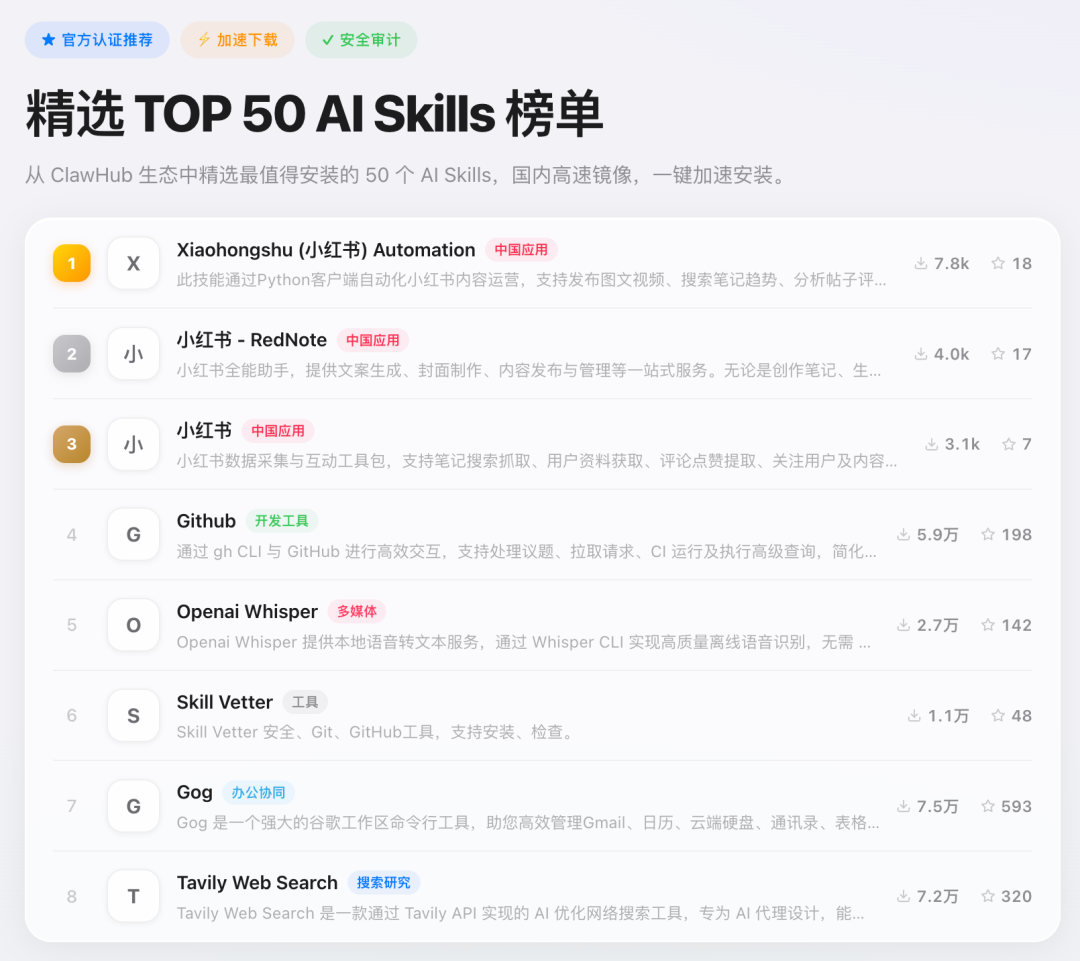
Skillhub

But is a mirror site inherently blameless? The answer is not necessarily.

Because what the open-source license allows, what community ethics accept, and what commercial reality ultimately brings are often three different sets of accounts.

At the license level, as long as the license is followed and the source is credited, many mirroring and redistribution actions are valid. At the community ethics level, Tencent's SkillHub credits the OpenClaw official source and has actively reduced the source site's bandwidth costs, seemingly taking responsibility.

But Tencent forgot that OpenClaw is not a small open-source project needing big tech's deliberate resource injection. It is the hottest project on GitHub with the most stars. In this context, Tencent's action without prior notice becomes "high-handed." It's no longer just a simple mirroring issue but quickly involves three more sensitive questions: Who represents the official ecosystem? Who is taking the user entry point? And who is defining the download, distribution, and statistical metrics?

This is what truly discomforted Peter, who stated that Tencent's behavior directly affects download statistics. Peter isn't opposed to Tencent localizing OpenClaw for China but believes they should have communicated first, rather than building the platform, onboarding users, and then explaining under public pressure that they were actually there to help.

Furthermore, from a commercial reality perspective, once a platform shell like SkillHub gains scale, the official status and statistical authority originally held by the OpenClaw community can easily be marginalized. Today it's a localized Skills platform; tomorrow it could be the "default Skills distribution market"; later, it might be "who decides which Skills are seen, installed, and commercialized."

This is the real danger signal behind this controversy and a scene all too familiar in the Chinese internet over the past decade: the enclosure movement.

Big Tech Isn't "Farming Lobsters"; They're Using Lobsters to Enclose AI Land

In the past period, "farming lobsters" has become the hottest meme in the Chinese AI circle, and OpenClaw has been rapidly pushed into an almost emotional industry symbol. Everyone says lobsters represent the new imagination of the Agent era and the future of personal AI assistants, which sounds very passionate.

But big tech doesn't look at lobsters with idealism; they see entry points, traffic, distribution power, and the shell of the next-generation operating system.

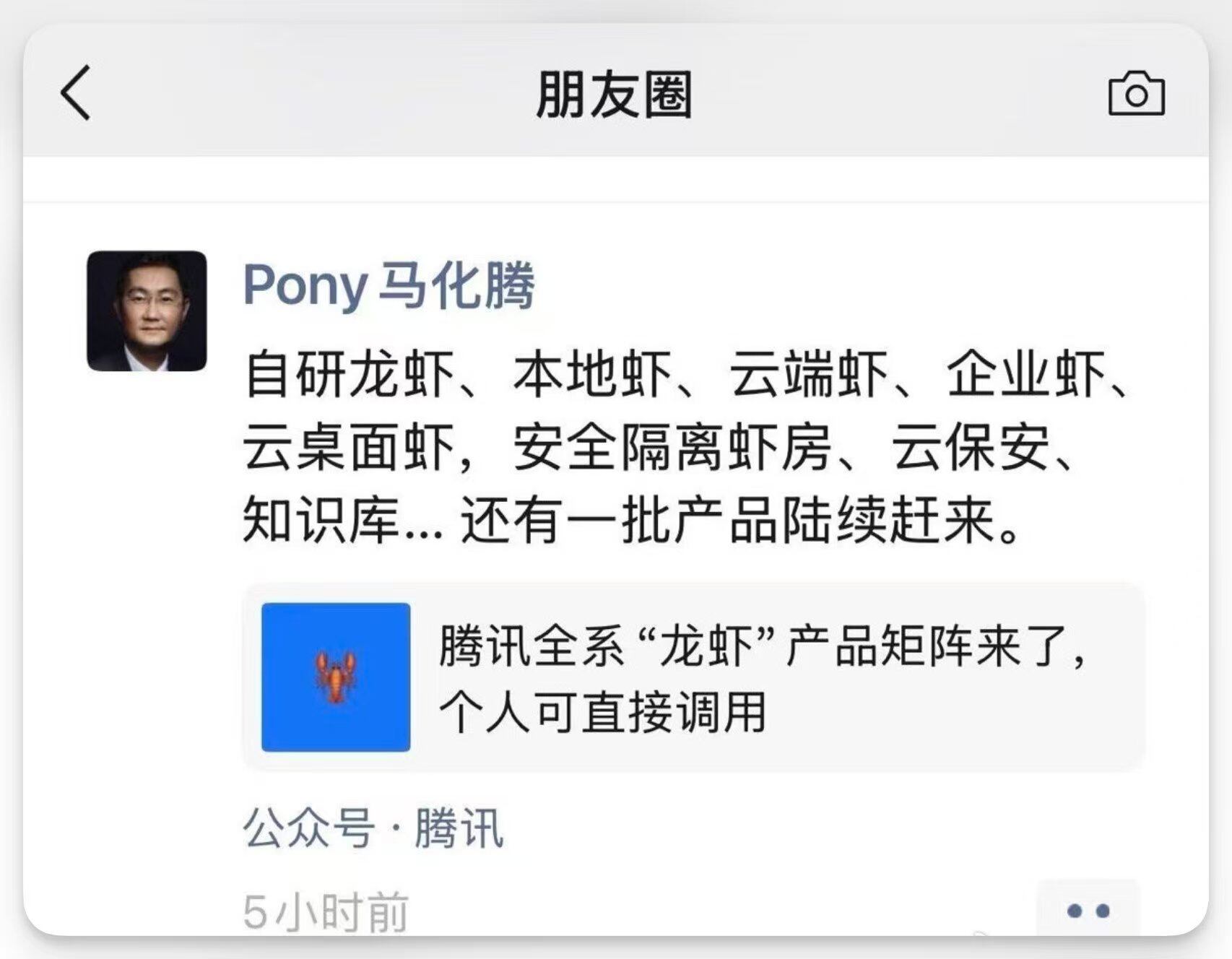
In the early hours of March 11, Pony Ma promoted Tencent's full suite of "lobster" products on his WeChat Moments. Tencent's "Lobster Family Bucket" customizes a "little lobster" for general users, developers, and enterprise users, supporting one-click installation with no threshold. SkillHub was launched simultaneously at this time, built with 13,000 localized Skills for one-click invocation, usable directly in scenarios like Xiaohongshu operations and Baidu search.
Of course, Tencent isn't the only one "smelling the wind and moving." If you stretch the timeline, you'll find that domestic tech giants have almost collectively jumped in to help users solve the "lobster farming"难题, their movements so整齐 they seem to have pressed the same switch, though Tencent is currently the most comprehensive.

On the surface, everyone means well, but in reality, this hides the most familiar path dependency in the commercial playbook of Chinese internet companies. Facing a new ecosystem already validated by the market and heated up by public opinion, the first move isn't about profit and business models, but grabbing the entry point first, building the platform first, onboarding users first.

What Tencent wants is not just to make it easier for Chinese users to "farm lobsters," but to ensure that when Chinese users truly start "using Agents to get things done," their first instinct is to do it within Tencent's product shell.

This is the most intriguing aspect of actions like SkillHub. It表面上 (superficially) is a mirror site, but in essence, it could be the starting point of a larger closed loop. Today users see local Skill search and download; tomorrow it might be default access to some cloud, some account system, some enterprise workbench. Later, developers might slowly realize that although they are still developing within the OpenClaw ecosystem, the real decisions about exposure, recommendation, review, and commercialization paths are made by the platform.

This script has been played out too many times in the Chinese internet. From ride-hailing to food delivery, from short-video platforms to cloud markets, almost every "ecological prosperity"背后 (behind it) has been accompanied by the same structural ending—the platform first uses free, open strategies to attract users, then builds walls, using traffic, advertising, and other means to turn the ecology back into its own附属层 (subsidiary layer).

Big tech companies all know that old entry points like search, social, content, and e-commerce are fiercely competitive to the limit, while Agent might be the most promising new entry point for the next round. In that case, rather than waiting for OpenClaw to grow wildly on its own, it's better to take it over while it's still in its explosive early stages, encapsulate it first, and get users accustomed to "bossing lobsters around" within their own systems.

Therefore, everyone is too familiar with what will happen next after big tech companies争先恐后 (scramble) to help users solve the OpenClaw installation problem. And Peter, who doesn't understand the Chinese internet, naturally can't comprehend why Tencent didn't communicate with him beforehand or synchronize data with him.

OpenClaw originally represented another AI future: local operation, personal control, community extension, open connection. Its most imaginative aspect is making Agents truly the user's own execution layer. But once this ecosystem gets repackaged by big tech with "localized mirrors," "domestic adaptation," "unified distribution," and "security review," the flavor changes. In the product logic of big tech, the entry point belongs to me, distribution belongs to me, so ultimately, payment and commercialization should also belong to me.

To put it more bluntly, big tech companies aren't "embracing lobsters"; they are "using lobsters to enclose territory in the AI era."

And this is the most unsettling aspect behind this small controversy. Walls are never built all at once; they always grow slowly under the guise of "more convenient" and "more stable." By the time developers, users, and traffic are all contained within the same shell, so-called openness and autonomy might ultimately just become a component within the big tech ecosystem.

OpenClaw currently faces the most paradoxical fate in China: The lobster hasn't fully grown yet, but big tech has already started setting up the nets.


Пов'язані питання

QWhat was the main criticism raised by OpenClaw founder Peter Steinberger against Tencent?

APeter Steinberger accused Tencent of copying OpenClaw without supporting the project, specifically criticizing their SkillHub platform for not communicating beforehand and potentially affecting official download statistics.

QHow did Tencent respond to the allegations made by the OpenClaw founder?

ATencent stated that SkillHub is a localized Skills platform based on the OpenClaw ecosystem, serving as a mirror site that credited ClawHub as the data source. They claimed to have handled 180GB of traffic for users in the first week while only pulling 1GB from the official source, and expressed willingness to become a sponsor.

QWhat broader concern does the article highlight beyond the technical aspects of mirroring OpenClaw?

AThe article highlights concerns about large tech companies like Tencent potentially seizing user entry points, distribution channels, and statistical control, ultimately leading to a 'walled garden' approach where the platform dictates visibility, installation, and commercialization of Skills, marginalizing the original open ecosystem.

QWhy does the author compare Tencent's actions to a 'land grab' in the AI industry?

AThe author compares it to a 'land grab' because Tencent and other large Chinese tech companies are rapidly integrating OpenClaw into their platforms to control the future AI agent entry points, user habits, and distribution power, rather than purely supporting open ecosystem growth.

QWhat is the ironic situation OpenClaw faces in China according to the article?

AOpenClaw faces the ironic situation where 'the lobster hasn't even grown up yet, but big tech companies are already building fences around it'—meaning the open ecosystem is being enclosed by platforms before it fully matures, risking loss of autonomy and community-driven development.

Пов'язані матеріали

SemiAnalysis Dissects Huawei's Kirin 9030: Process Technology Halted, So They Folded the Chip

SemiAnalysis has published a detailed teardown report on the HiSilicon Kirin 9030 Pro chipset found in Huawei's Mate 80 Pro. Fabricated using SMIC's most advanced N+3 node without EUV lithography, the analysis reveals significant technical achievements and strategic shifts. The report indicates SMIC's N+3 has achieved transistor density comparable to TSMC's N6 (113.4 vs 107.7 MTr/mm²), primarily through aggressive use of Self-Aligned Quadruple Patterning (SAQP) for its metal layers. This results in a notably small 32.5nm M0 metal pitch. However, SemiAnalysis notes this achievement comes with significantly higher process complexity, cost, and potential yield challenges compared to competitors using more advanced tools. The Kirin 9030 design maximizes this constrained density. While its GPU performance has improved ~70% and matches Qualcomm's 2022 flagship level, the CPU core's IPC lags behind current top-tier designs from Apple and Qualcomm, a gap attributed to the underlying manufacturing technology rather than design capability. Facing long-term restrictions on advanced tools, Huawei is charting a new path. The report highlights the company's "LogicFolding" roadmap, a 3D stacking technique aimed at shortening signal paths to boost performance and efficiency. The goal is to reach 5GHz frequency and a projected density of 295 MTr/mm² by 2031. SemiAnalysis concludes that export controls have not halted China's chip progress but have fundamentally altered its trajectory, making it more expensive and complex. This has spurred innovation in alternative areas like 3D stacking and domestic EDA tool development, with Huawei's supply chain also beginning to integrate Chinese memory from CXMT.

marsbit36 хв тому

SemiAnalysis Dissects Huawei's Kirin 9030: Process Technology Halted, So They Folded the Chip

marsbit36 хв тому

How Will the Price Move Before SpaceX's Next Share Unlock?

TL;DR Investors buying SPCX after SpaceX's IPO are not simply investing in a typical tech stock. It’s a high-valuation asset driven by Musk's narrative, Starlink, and space transport potential, but with a key twist: a very small initial float of ~4% has led to significant post-listing price appreciation. The current price action reflects a timing gap. Before the first lock-up expiration (estimated around August, subject to official confirmation), scarcity and high demand could continue to push prices up. Short-term bulls focus on low float, FOMO, and potential index inclusion. However, bears point to the supply dynamics that will change post-lockup. Existing shareholders still hold over 95% of shares, which will be released in stages starting from the first unlock window. This introduces future selling pressure from low-cost holders. The upcoming Q2 earnings report is a critical catalyst before the unlock. It will test whether the company's fundamentals can justify the current ~$2.1T valuation. Strong results could support the pre-unlock momentum, while weak figures could amplify concerns about future supply. The trading thesis is shifting from immediate scarcity ("can't buy enough") to evaluating future absorption capacity ("who will buy when more supply hits"). The path ahead hinges on the specifics of the unlock schedule, Q2 earnings performance, and whether anticipated passive index buying materializes.

marsbit56 хв тому

How Will the Price Move Before SpaceX's Next Share Unlock?

marsbit56 хв тому

Bitcoin Short-Term Bullish Structure Validated, HYPE Low-Entry Window Opens | Guest Analysis

**Market Analysis Summary (Week of June 2026)** **Overall Market Context:** The market environment is exceptionally complex, with the unexpected US-Iran agreement and the reopening of the Strait of Hormuz triggering a global asset repricing and significant volatility. This heightened noise underscores the importance of a structured analytical framework. **Bitcoin (BTC) Analysis & Strategy:** * **Current Status:** The price has climbed above $65,000, currently in a rebound phase (segment 38-39) following a complex 12-segment correction from the May high of $82,850. * **Key Levels:** * **Primary Resistance:** $69,500–$70,500. A successful breakout above $65,000 targets this zone. * **Primary Support:** $65,000 (immediate), followed by $59,000–$60,000 and $55,000. * **Weekly Outlook & Strategy:** The focus is on the confirmation of the $65,000 level. * **Bullish Scenario (Hold $65K):** A move toward the $69.5K–$70.5K resistance zone is anticipated, which is a potential area for initiating medium-term short positions. * **Bearish Scenario (Break below $65K):** A retest of the $60,000–$62,000 support range is likely. * **Medium-Term Strategy:** Currently neutral. Plan to establish short positions (up to 60% allocation) either in the $69.5K–$70.5K resistance zone upon signs of rejection, or on a confirmed breakdown below $65,000 and further below $59K–$60K. * **Short-Term Strategy:** Utilize 30% capital for scalping opportunities based on support/resistance levels, using 30/60-minute charts. **HYPE Analysis & Strategy:** * **Current Status:** The price has stabilized around $52 after a four-segment decline from the June high of $75.87 and is now in a rebound (segment 50-51). * **Key Levels:** * **Primary Resistance:** $62.50–$64.57. Watch for potential rejection here to form a lower high. * **Primary Support:** $52–$55.50, followed by $47–$49. * **Weekly Outlook & Strategy:** Adopt a "buy on dips, avoid chasing rallies" approach. * **Core View:** Monitor the price action and potential formation of a lower high ("endpoint 51") in the $62.50–$64.57 resistance zone. * **Short-Term Strategy:** Consider light long positions (max 30% allocation) if the price finds support and shows reversal signals in the $52–$54.50 or deeper $47–$49 support zones, confirmed by proprietary quantitative bottom signals. **Trade Review:** Last week's HYPE short-term long trade, executed based on proprietary "Price Difference" and "Momentum" model signals, yielded a profit of approximately 11.88%. The entry was near $54.39 and exit near $60.85. **Risk Management Reminder:** Always set an initial stop-loss upon entry. Move stop-loss to breakeven at +1% profit, then trail it upwards to lock in gains as the trade progresses. *Disclaimer: All analysis, models, and strategies are based on personal technical analysis for educational purposes only, not investment advice. The market carries inherent risk.*

Odaily星球日报1 год тому

Bitcoin Short-Term Bullish Structure Validated, HYPE Low-Entry Window Opens | Guest Analysis

Odaily星球日报1 год тому

Bitcoin Short-Term Bullish Structure Validated, HYPE Accumulation Window Opens | Guest Analysis

**Bitcoin and HYPE Market Analysis: Short-Term Outlook and Trading Strategies** This market analysis examines Bitcoin (BTC) and HYPE amid volatile conditions, providing short-term outlooks and specific trading strategies. **Key Outlooks:** * **Bitcoin (BTC):** Focus is on whether BTC's recent move above $65,000 holds. A successful breakout could lead to a test of the $69,500-$70,500 resistance zone, where medium-term short positions are considered. A failure, breaking below $65,000, may trigger a decline towards the $59,000-$60,000 support area. * **HYPE:** The token completed a four-wave correction and is now rebounding. The key resistance zone is $62.5-$64.57. The trading strategy is "buy on dips," looking for entry opportunities near the $52-$54.5 or deeper $47-$49 support zones, pending confirmation from proprietary models. **BTC Trading Strategy:** * **Medium-term:** Primarily looking to establish short positions (up to 60% allocated capital) if price rallies to the $69,500-$70,500 resistance area and shows signs of reversal. Alternative plans involve initiating shorts on a breakdown below $65,000. * **Short-term:** Allocate up to 30% capital for intraday "spread" trades based on support/resistance levels on 30/60-minute charts. **HYPE Trading Strategy:** * **Short-term:** Adopt a dip-buying approach. Consider light long positions (under 30% capital) when price tests key support levels ($52-$54.5 or $47-$49) and shows stabilization, confirmed by proprietary "Price Spread" and "Momentum Quant" models. **Trade Recap:** The analysis reviews a successful HYPE long trade from the previous week, executed at ~$54.39 and closed at ~$60.85 for an ~11.88% gain, based on signals from the aforementioned models. **Risk Management Emphasis:** The article stresses strict capital allocation (under 30-60%), immediate initial stop-loss placement, and a trailing stop-loss protocol to lock in profits as trades move favorably. ***Disclaimer:** All analysis, models, and strategies are for educational purposes based on technical analysis, not investment advice. Markets are volatile; trade with caution.*

marsbit1 год тому

Bitcoin Short-Term Bullish Structure Validated, HYPE Accumulation Window Opens | Guest Analysis

marsbit1 год тому

Торгівля

Спот
Ф'ючерси
活动图片




