Fragmentation drains up to $1.3B a year from tokenized assets: Report

cointelegraphОпубліковано о 2025-12-19Востаннє оновлено о 2025-12-19

Анотація

Fragmentation across blockchain networks is causing significant economic drain in the tokenized asset market, with inefficiencies costing up to $1.3 billion annually, according to a report from RWA.io. The lack of interoperability traps liquidity and prevents capital from moving freely, causing identical or economically equivalent real-world assets (RWAs) to trade at price differences of 1% to 3% across different chains. These inefficiencies hinder arbitrage and price discovery. Additionally, moving capital between chains results in transaction losses of 2% to 5% due to fees, slippage, and operational risks. If unresolved, these issues could escalate to $30–75 billion in annual losses as the tokenized RWA market grows to an estimated $16–30 trillion by 2030. Despite these challenges, tokenized assets continue gaining adoption, with recent moves by companies like Securitize and Coinbase to launch onchain stock trading.

Fragmentation across blockchain networks is already imposing a measurable economic cost on the tokenized asset market, with inefficiencies translating into up to $1.3 billion in annual value drag.

In a report sent to Cointelegraph, real-world asset (RWA) data provider RWA.io argued that while blockchains accelerated innovation, they also created walls that trap liquidity and prevent capital from moving freely across networks.

As a result, tokenized RWAs have increasingly behaved like disconnected markets rather than a single, unified financial system. The research found that identical or economically equivalent assets routinely trade at different prices across chains, while moving capital between networks remained costly and complex.

Researchers stated that these inefficiencies hinder the market’s ability to self-correct through arbitrage, a mechanism that facilitates efficient price discovery.

“This fragmentation is the single greatest impediment to the market realizing its multi-trillion-dollar potential,” said Marko Vidrih, co-founder and chief operating officer at RWA.io.

“In traditional finance, the EU-wide SEPA Instant mandate shows how value can move across accounts in seconds. Tokenized assets should be just as frictionless,” Vidrih added.
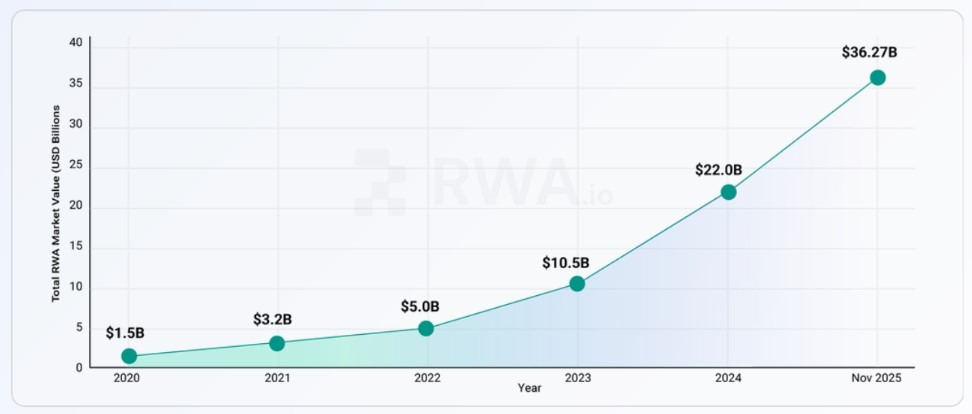
RWA market growth from 2020 to 2025. Source: RWA.io

Price inefficiencies and capital friction across chains

The report states that one of the most obvious consequences of fragmentation is the persistent price divergence for identical assets issued on different blockchains.

According to the report, economically identical tokenized assets often trade at spreads of 1% to 3% across major networks, despite representing claims on the same underlying assets. In traditional finance, arbitrage would quickly eliminate such market gaps.

However, crosschain arbitrage remains unviable due to technical hurdles, fees, delays and operational risks, the report claims. It states that the costs to relocate assets often exceed the price discrepancy, allowing inefficiencies to persist.

Beyond price discovery, RWA.io estimated that moving capital between non-interoperable chains results in losses of 2% to 5% per transaction. This is because of exchange fees, slippage, transfer costs, gas fees and timing risks. In aggregate, the report models an average loss of about 3.5% per capital reallocation.

Should these fragmentation patterns persist, RWA.io estimated that the friction costs could drain between $600 million $1.3 billion from the market annually.
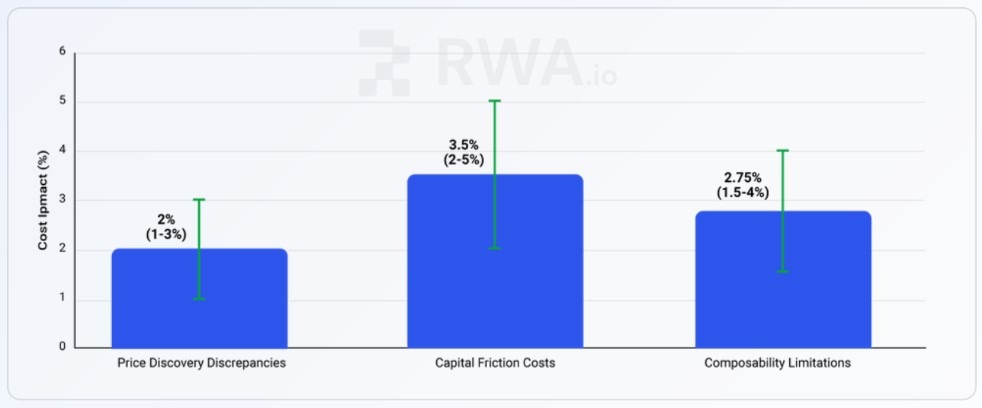
Economic costs of market fragmentation. Source: RWA.io

RWA.io projects that tokenized real-world assets could grow into a $16 trillion to $30 trillion market by 2030, and warns that if current inefficiencies persist, the associated value drag would scale with it.

Applying today’s fragmentation-related frictions to a market of that size implies potential annual losses of $30 billion to $75 billion, turning infrastructure shortcomings into a material constraint on long-term growth.

Related: Tokenized stocks may be onchain, but the SEC still wants the keys

Tokenized assets gain traction despite inefficiencies

Despite claims of inefficiency, tokenized assets continue to gain traction across both crypto-native platforms and traditional financial institutions. Just this week, companies have made moves to tokenize equities.

On Tuesday, RWA-focused company Securitize announced plans to launch compliant, onchain stock trading.

On Thursday, crypto exchange Coinbase launched a stock trading feature, allowing users to invest directly in stocks through its application.

Magazine: Koreans ‘pump’ alts after Upbit hack, China BTC mining surge: Asia Express

Трендові криптовалюти

Пов'язані питання

QWhat is the estimated annual economic cost of fragmentation on the tokenized asset market according to the RWA.io report?

AThe report estimates that fragmentation drains between $600 million and $1.3 billion from the tokenized asset market annually.

QWhat is identified as the 'single greatest impediment' to the tokenized asset market reaching its multi-trillion-dollar potential?

AFragmentation across blockchain networks is identified as the single greatest impediment to the market realizing its multi-trillion-dollar potential.

QWhat is the typical price spread for identical tokenized assets trading on different blockchains?

AEconomically identical tokenized assets often trade at spreads of 1% to 3% across major blockchain networks.

QWhy does cross-chain arbitrage fail to correct price inefficiencies in the tokenized asset market?

ACross-chain arbitrage remains unviable due to technical hurdles, fees, delays, operational risks, and the fact that the costs to relocate assets often exceed the price discrepancy.

QWhat is the projected size of the tokenized real-world asset market by 2030, and what could the associated losses be if fragmentation persists?

ARWA.io projects the market could grow to $16 trillion to $30 trillion by 2030. If current inefficiencies persist, the associated annual losses could scale to $30 billion to $75 billion.

Пов'язані матеріали

7 Months After the Collapse of Huiwang, Southeast Asia's Escrow Platforms Undergo a Major Reshuffle

Following the collapse of Huione Pay—dubbed the "Alipay of Southeast Asia"—seven months ago, the region's underground financial guarantee platform sector is undergoing a significant reshuffle. This power vacuum has been swiftly filled by emerging platforms such as XinBi, Tiger/Navigator, JinBei (renamed JinBo), Dali/Tiancheng, and FullyLight. These platforms, operating largely via Telegram and offering services like escrow for illicit transactions, have absorbed the vast user base and markets left behind by Huione. While positioning themselves as "trust intermediaries," their primary clientele consists of networks involved in online scams, money laundering, illegal gambling, and even human trafficking. For instance, the Tiger/Navigator platform explicitly provides "escrow" services for kidnapping-for-ransom operations ("强押车交易"). Data underscores the immense scale: Huione alone processed over $103 billion in cryptocurrency payments and facilitated over $31 billion through its escrow market before its downfall, linking it to Cambodia's notorious Prince Group. Since its collapse, competitors have seen explosive growth. For example, the XinBi platform has accumulated over $1.6 billion in total USDT revenue, while platforms like NewPay, OkPay (under Dali), and FullyLight Wallet collectively processed over $4.8 billion in USDT in a single year. This ecosystem thrives in regions like Cambodia and Myanmar, where regulatory gaps allow these platforms to act as critical financial infrastructure for sprawling cybercrime industries, from scam compounds to online casinos. The article concludes that the moniker "Southeast Asian Alipay" is a misnomer, obscuring the platforms' fundamental role in enabling serious criminal enterprises rather than representing legitimate financial innovation.

Odaily星球日报39 хв тому

7 Months After the Collapse of Huiwang, Southeast Asia's Escrow Platforms Undergo a Major Reshuffle

Odaily星球日报39 хв тому

The Changing Landscape: What Are Crypto VCs Experiencing?

Title: The Shifting Landscape of Crypto Venture Capital The era of dedicated crypto venture capital funds is undergoing a significant transformation. Once essential for navigating the sector's complexity and high risk, these specialized funds are now facing an identity crisis as the market matures. This shift mirrors historical patterns in other specialized investment classes like cleantech and SPACs, where initial information advantages dissipate as technologies become mainstream and integrated into existing industry frameworks. The article argues that crypto is reaching a critical inflection point, transitioning from a "building phase" to an "integration phase." Major players like Stripe, BlackRock, and Visa now engage with crypto not for its novel mechanics but as a foundational financial infrastructure. Their needs—regulatory compliance, banking partnerships, distribution channels—align with traditional fintech, a domain easily understood by large, generalist funds like Sequoia and Founders Fund. This evolution creates a "barbell effect" within the VC landscape. On one end are massive, diversified platforms that can incorporate crypto as one vertical among many. On the other are small, nimble funds focused on niche, experimental projects. The middle ground—medium-sized dedicated crypto funds—is being squeezed out. Their typical fund size makes it impossible to generate sufficient returns solely from early-stage crypto bets, yet they cannot compete with giants for later-stage deals. Consequently, leading crypto-native firms like Paradigm and Framework Ventures are expanding into AI, robotics, and other sectors, driven partly by LP pressure for better returns amid a broader VC DPI crisis. Others, like Dragonfly and a16z, have narrowed their crypto focus predominantly to financial infrastructure like stablecoins, reframing the sector's core narrative. For crypto entrepreneurs, this consolidation presents challenges. While generalist funds offer larger checks and broader resources, crypto projects now compete fiercely with AI for attention and capital within these firms. Furthermore, the long-term, non-commercial foundational work that built the ecosystem—funded by dedicated crypto VCs—is less likely to attract generalist capital focused on direct returns. The conclusion is that "crypto investor" as a standalone category is becoming obsolete, akin to "internet investor." Crypto is becoming a baseline infrastructure layer. The future will see a barbell structure: large-scale growth financing handled by generalist funds, while pioneering, speculative projects are funded by small, specialized vehicles. The dedicated crypto funds of the 2017-2021 boom, which incubated core infrastructure, are giving way to this new, bifurcated reality.

Foresight News56 хв тому

The Changing Landscape: What Are Crypto VCs Experiencing?

Foresight News56 хв тому

As Consensus Accelerates, What Are Young Investors Betting On?

Title: As Consensus Forms Faster, What Are Young Investors Betting On? In the rapid evolution of tech investment, a new generation of young investors is navigating a landscape where AI, robotics, commercial aerospace, and quantum computing are advancing simultaneously. Traditional investment logic based on financial models is giving way to a need for deep technical understanding and the ability to act before industry consensus forms. An analysis of trends from the "WAIC FUTURE TECH" list of young investment leaders reveals key shifts in focus. The first major trend is the movement of AI from the digital screen into the physical world. Investment is shifting from large language models and chatbots towards embodied AI, robotics, AI hardware, and edge computing. While demonstrations generate excitement, the real challenge lies in achieving scalable, reliable, and cost-effective delivery in complex real-world environments like factories and logistics. Success depends not just on algorithms but on the integration of sensors, actuators, and control systems. Second, the competitive focus for large models is moving beyond raw capability toward building an "intelligence flywheel." The goal is to create self-reinforcing systems where user interaction generates data, improving the model, which in turn enhances the user experience and attracts more engagement. Companies that successfully embed AI into workflows to create these closed-loop systems can build lasting value that isn't easily erased by the next model upgrade. Third, facing a potential bottleneck in high-quality human-generated data, investors are looking at new underlying technologies. Reinforcement learning and self-play, as demonstrated by AlphaGo Zero, offer paths for AI to generate its own experience. Scientific foundation models, which aim to build general AI capabilities for fields like life sciences and materials discovery, represent a non-consensus direction that could unlock new frontiers of knowledge and data. Finally, in deep-tech areas like quantum computing, commercial aerospace, and space-based infrastructure, patient capital is essential. These fields have long, uncertain development and validation cycles involving complex engineering, supply chains, and regulations. Investment here requires a long-term view, focusing on foundational team capabilities and the eventual emergence of market demand, even if commercial returns are distant. Collectively, these trends illustrate how young investors are adapting to a new era. They are learning to make earlier, technically-informed judgments, balance hype with real-world viability, and provide the patient capital needed to build the deep-tech foundations of the future.

marsbit1 год тому

As Consensus Accelerates, What Are Young Investors Betting On?

marsbit1 год тому

Торгівля

Спот

Популярні статті

Як купити O

Ласкаво просимо до HTX.com! Ми зробили покупку O1 exchange (O) простою та зручною. Дотримуйтесь нашої покрокової інструкції, щоб розпочати свою криптовалютну подорож.Крок 1: Створіть обліковий запис на HTXВикористовуйте свою електронну пошту або номер телефону, щоб зареєструвати обліковий запис на HTX безплатно. Пройдіть безпроблемну реєстрацію й отримайте доступ до всіх функцій.ЗареєструватисьКрок 2: Перейдіть до розділу Купити крипту і виберіть спосіб оплатиКредитна/дебетова картка: використовуйте вашу картку Visa або Mastercard, щоб миттєво купити O1 exchange (O).Баланс: використовуйте кошти з балансу вашого рахунку HTX для безперешкодної торгівлі.Треті особи: ми додали популярні способи оплати, такі як Google Pay та Apple Pay, щоб підвищити зручність.P2P: Торгуйте безпосередньо з іншими користувачами на HTX.Позабіржова торгівля (OTC): ми пропонуємо індивідуальні послуги та конкурентні обмінні курси для трейдерів.Крок 3: Зберігайте свої O1 exchange (O)Після придбання O1 exchange (O) збережіть його у своєму обліковому записі на HTX. Крім того, ви можете відправити його в інше місце за допомогою блокчейн-переказу або використовувати його для торгівлі іншими криптовалютами.Крок 4: Торгівля O1 exchange (O)Легко торгуйте O1 exchange (O) на спотовому ринку HTX. Просто увійдіть до свого облікового запису, виберіть торгову пару, укладайте угоди та спостерігайте за ними в режимі реального часу. Ми пропонуємо зручний досвід як для початківців, так і для досвідчених трейдерів.

155 переглядів усьогоОпубліковано 2026.06.19Оновлено 2026.06.19

Як купити O

Як купити PROS

Ласкаво просимо до HTX.com! Ми зробили покупку Pharos (PROS) простою та зручною. Дотримуйтесь нашої покрокової інструкції, щоб розпочати свою криптовалютну подорож.Крок 1: Створіть обліковий запис на HTXВикористовуйте свою електронну пошту або номер телефону, щоб зареєструвати обліковий запис на HTX безплатно. Пройдіть безпроблемну реєстрацію й отримайте доступ до всіх функцій.ЗареєструватисьКрок 2: Перейдіть до розділу Купити крипту і виберіть спосіб оплатиКредитна/дебетова картка: використовуйте вашу картку Visa або Mastercard, щоб миттєво купити Pharos (PROS).Баланс: використовуйте кошти з балансу вашого рахунку HTX для безперешкодної торгівлі.Треті особи: ми додали популярні способи оплати, такі як Google Pay та Apple Pay, щоб підвищити зручність.P2P: Торгуйте безпосередньо з іншими користувачами на HTX.Позабіржова торгівля (OTC): ми пропонуємо індивідуальні послуги та конкурентні обмінні курси для трейдерів.Крок 3: Зберігайте свої Pharos (PROS)Після придбання Pharos (PROS) збережіть його у своєму обліковому записі на HTX. Крім того, ви можете відправити його в інше місце за допомогою блокчейн-переказу або використовувати його для торгівлі іншими криптовалютами.Крок 4: Торгівля Pharos (PROS)Легко торгуйте Pharos (PROS) на спотовому ринку HTX. Просто увійдіть до свого облікового запису, виберіть торгову пару, укладайте угоди та спостерігайте за ними в режимі реального часу. Ми пропонуємо зручний досвід як для початківців, так і для досвідчених трейдерів.

205 переглядів усьогоОпубліковано 2026.06.22Оновлено 2026.06.22

Як купити PROS

Що таке VERONA

I. Вступ до проекту VERONA - це блокчейн, створений для всіх, скрізь, через абстракцію ланцюга. Використовуючи свій загальний шар абстракції, VERONA вирізняється інтеграцією складних функцій блокчейну, таких як рахунки, підписи та взаємодія, безпосередньо на рівні протоколу. Цей підхід дозволяє взаємодіяти з блокчейн-додатками без необхідності розуміти основні технології.1) Основна інформація Назва: VERONA (VERONA)III. Пов'язані посилання Офіційне посилання на сайт: https://xion.burnt.com/ Біла книга: https://xion.burnt.com/whitepaper.pdf Експлорери: https://explorer.burnt.com/ Соціальні мережі: https://x.com/burnt_xion Примітка: Вступ до проекту взято з матеріалів, опублікованих або наданих офіційною командою проекту, які є лише для довідки і не є інвестиційною порадою. HTX не несе відповідальності за будь-які прямі або непрямі збитки, що виникають внаслідок цього.

137 переглядів усьогоОпубліковано 2026.06.22Оновлено 2026.06.22

Що таке VERONA

Обговорення

Ласкаво просимо до спільноти HTX. Тут ви можете бути в курсі останніх подій розвитку платформи та отримати доступ до професійної ринкової інформації. Нижче представлені думки користувачів щодо ціни A (A).

活动图片














