Four Months to Ring the Bell: Crypto Custody Pioneer BitGo Showcases Financial Engineering in IPO

marsbitОпубліковано о 2026-01-24Востаннє оновлено о 2026-01-24

Анотація

BitGo, a leading cryptocurrency custody provider, has successfully completed its initial public offering (IPO) on January 22, 2026, marking the first major crypto IPO of the year. The listing was celebrated with a high-profile lights show in Manhattan and the donation of a framed Bitcoin whitepaper to the NYSE. The company priced its shares at $18, above the initial target range, raising approximately $213 million. Despite an initial 35% surge on the first trading day, the stock later fell below the offering price, with a market cap briefly exceeding $2.8 billion. BitGo also introduced tokenized shares in partnership with Ondo Global Markets, enabling trading on multiple blockchains. Founded in 2013 by Mike Belshe, BitGo pioneered multi-signature wallets and regulated custody services. It has since expanded into a comprehensive financial platform offering trading, lending, and prime brokerage services. The company currently safeguards over $82 billion in assets for more than 5,100 institutional clients globally. While BitGo reported substantial revenue growth—$10 billion in the first nine months of 2025, up from $1.9 billion a year earlier—its net profit margin remained thin at just 0.35%. Critics, including Primitive Ventures’ Dovey Wan, argue that the revenue is largely inflated by GAAP accounting from client trading volume, with real earnings being significantly lower. Key risks include high client concentration in its lending book. Despite mixed analyst views, BitGo’s...

Author: Nancy, PANews

"This morning, we took over Wall Street; tonight, we take over the sky." On January 22, crypto custody giant BitGo officially listed, firing the first shot of the 2026 crypto IPO wave.

To commemorate this milestone, BitGo donated a framed copy of the Bitcoin whitepaper to the NYSE, which was hung on the trading floor wall. That evening, a light show featuring the BitGo logo lit up the sky over Manhattan, New York, showcasing its prominence.
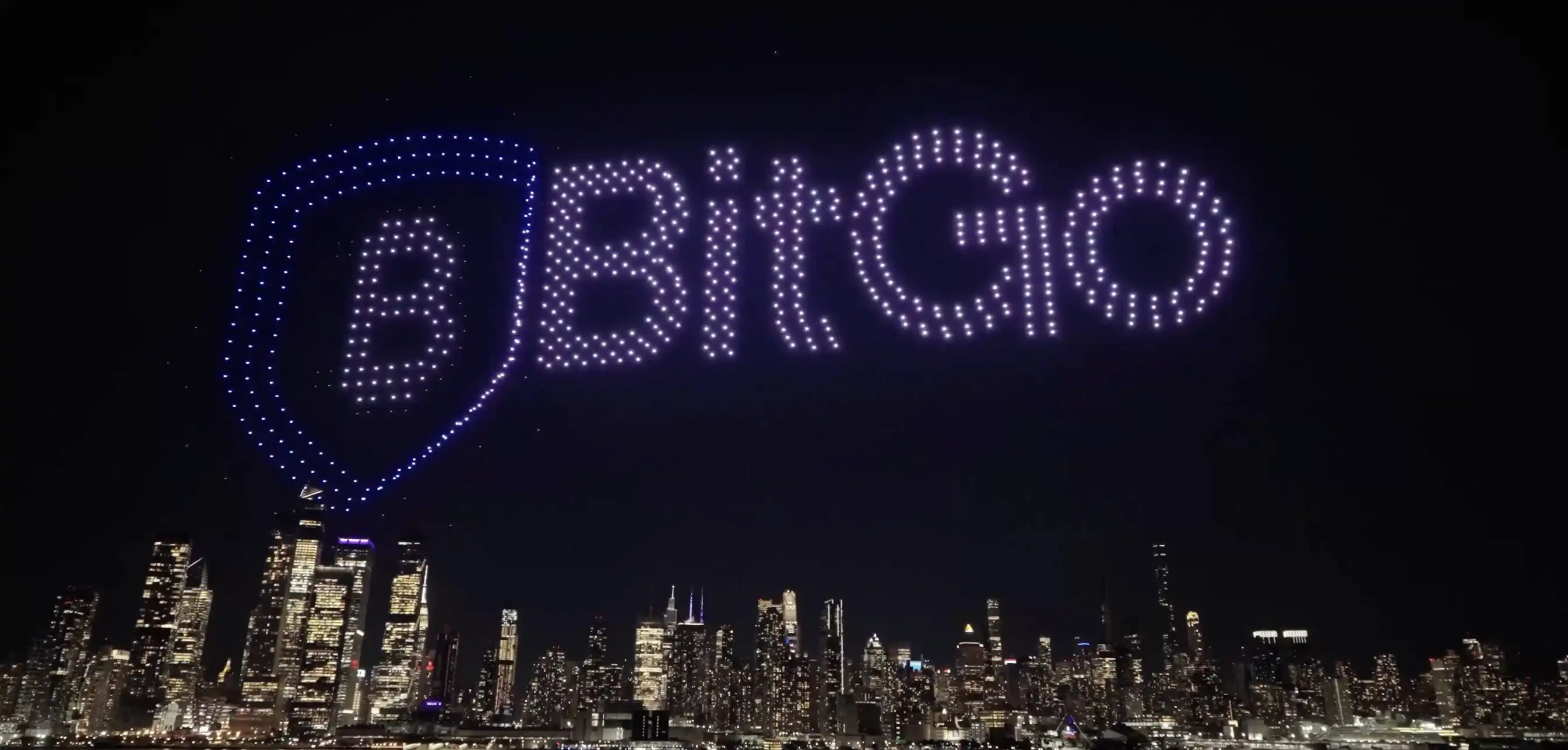
Ringing the Bell in Four Months, Limited Returns for Subscribing Institutions

It took BitGo just four months from filing its prospectus with the U.S. SEC to complete the sprint from application to bell-ringing.

Looking at its performance on the first day of trading, January 22, BitGo's stock price rose by about 35% at one point, with an intraday high corresponding to a market cap of over $2.8 billion, before giving back some of those gains. The next day, BitGo fell below its issue price, closing at $14.5. Compared to other crypto companies that have gone public in the past year, this valuation is not particularly high.

Additionally, as a crypto-native company, BitGo introduced an innovative tokenized play after its listing. Through a partnership with Ondo Global Markets, it tokenized its stock, allowing investors to trade it on Ethereum, Solana, and BNB Chain.

In fact, as early as February of last year, BitGo was rumored to be considering an IPO. It then submitted its IPO application to the U.S. SEC in September, planning to issue 11.8 million shares at a price range of $15 to $17 per share, aiming to raise up to approximately $200 million, with Goldman Sachs Group and Citigroup acting as joint lead underwriters. Ultimately, BitGo set the issue price at $18 per share, higher than the previously indicated range, raising about $213 million.

According to informed sources, BitGo's IPO issuance was several times oversubscribed. For example, YZi Labs announced its participation as a strategic investor. Based on the current market cap, the returns for these subscribing parties are limited for now.

In terms of shareholding structure, after the IPO completion, BitGo's founder and CEO Mike Belshe will retain control of the company, holding about 56% of the voting rights; Valor Equity Partners and Redpoint Ventures hold 4.6% and 3.9% of the voting rights, respectively.

Among them, Redpoint Ventures led BitGo's $12 million Series A funding round in 2014 and continued to invest subsequently; Valor Equity Partners led the approximately $42.5 million Series B round in 2017. Its founder, Antonio Gracias (a board member of Tesla and SpaceX), is also a member of BitGo's board.

In addition, BitGo's investors include Craft Ventures (founded by the first U.S. "AI and Crypto Czar" David Sacks), Goldman Sachs, Galaxy Digital, DRW, and many other institutions. However, as most funding rounds did not disclose specific valuations, the return rates for these institutions are difficult to calculate. Only in 2023, when BitGo completed its $100 million Series C funding round, its valuation was approximately $1.75 billion. Compared to the current listed market cap, the premium space is not substantial.

$10 Billion Revenue Accused of "Financial Engineering"

Having been established for over a decade, BitGo can be considered the "founding father" of the crypto custody business.

As early as 2013, Mike Belshe, an early member of the Google Chrome team and one of the main contributors to the HTTP/2 specification, co-founded BitGo. At its inception, the company launched the industry's first commercially viable multi-signature wallet, requiring users to complete at least two to three confirmations when initiating transactions, significantly improving the security standard for Bitcoin asset storage. Since then, BitGo has continuously iterated its wallet technology and API interfaces and was among the first to enter the compliant custody track, becoming one of the earliest crypto companies to offer regulated qualified custody services.

In 2020, BitGo launched the BitGo Prime platform, beginning its transformation from a single custody provider to a comprehensive institutional financial platform, offering trading, lending, custody, and financing liquidity services to institutional clients. In the following years, BitGo also obtained a trust license from the New York State Department of Financial Services (NYDFS) and several international regulatory approvals, and in 2025, it was approved to transform into a banking institution, further deepening its compliance layout.

It is worth mentioning that Galaxy Digital once planned to acquire BitGo for $1.2 billion, a deal that was poised to become the largest M&A transaction in the crypto industry at the time. However, due to failure to meet closing conditions, Galaxy Digital unilaterally terminated the agreement, leading to litigation between the two parties. BitGo sought $100 million in compensation, but the court ultimately ruled in favor of Galaxy Digital, and the deal fell through.

To date, BitGo's assets under management exceed $82 billion, serving over 5,100 institutional clients in more than 100 countries, including hedge funds, exchanges, mining companies, and traditional financial institutions.

The continuous expansion of its business scale has driven BitGo's rapid revenue growth, making it one of the few crypto companies able to maintain stable profitability. According to its prospectus, in the first nine months of 2025, BitGo achieved revenue of approximately $10 billion, a significant increase from $1.9 billion in the same period of 2024. This growth primarily came from the development of businesses such as digital asset sales, staking, subscription fees, settlement services, and high-frequency trading. However, despite the huge revenue, the net profit was extremely low. The net profit for the first three quarters of last year was about $35.3 million, which, although an increase from the same period in 2024 ($5.1 million), accounted for only about 0.35% of the total revenue.

Behind the rapid numerical growth is BitGo's transformation from a pure custodian to a broker. As a broker, the amount of client trading can be included in revenue, while the actual profit is only the fees paid by clients.

In this regard, Dovey Wan, founding partner of Primitive Ventures, analyzed that, judging from the quality and growth structure of its income, BitGo is not a high-quality target. Its disclosed core revenue is almost entirely GAAP rev (Generally Accepted Accounting Principles revenue), with the real revenue being pitifully small.

She stated that, based on real revenue performance, it was $146.4 million in 2023, dropped to $131.9 million in 2024, and was $100.5 million in the first half of 2025. Considering that data is often inflated before an IPO, this figure still needs to be viewed with caution. The client trading business, which contributes the majority of GAAP revenue, actually has a gross margin of only about 0.3%. In the first half of 2025, this part of the revenue was as high as $58.8 million, compared to only $500,000 in the same period last year. Staking revenue is accounting-type revenue and can be considered zero. The only segment that reflects growth potential—subscription and service business—has instead seen a significant decline. This revenue was $136.8 million in 2023, dropped to $71.7 million in 2024; and was $40.1 million in the first half of 2025, only a slight increase from $38.3 million in the same period last year. Moreover, BitGo's lending book risk is highly concentrated, with the top three clients accounting for over 50%.

Dovey also revealed that last October, investment banks had hinted that BitGo's IPO valuation was expected to be between $2.75 billion and $3 billion, planning to raise about $300 million, but low market interest led to the fundraising target being lowered to about $200 million.

However, Matthew Sigel, Head of Digital Assets Research at VanEck, is optimistic about BitGo's upside potential. He stated that BitGo is the first listed company to provide investors with pure crypto custody business and is one of the few listed crypto companies expected to achieve revenue growth of over 50% in 2025. Benefiting from the growth of tokenization business and the institutionalization of digital assets, as well as a relaxing regulatory environment, BitGo, as a quality custodian with zero hacking incidents, has huge upside potential.

Furthermore, BitGo has demonstrated strong operational momentum. According to Matthew Sigel's predictions, BitGo is expected to maintain a 26% revenue growth before 2028, achieving over $400 million in revenue and more than $120 million in EBITDA, corresponding to a reasonable market cap of over $3 billion.

BitGo has rung the bell for this year's crypto institution listings. After it, many other crypto institutions are waiting to go public. Industry giants such as Kraken, ConsenSys, Ledger, Animoca Brands, Upbit, and Bithumb have plans or have already submitted applications.

Although the market sentiment is somewhat tepid, the crypto bells on Wall Street are destined to ring continuously this year.


Пов'язані питання

QWhat was the significance of BitGo's IPO in the context of the 2026 crypto market?

ABitGo's IPO on January 22, 2026, marked the first crypto IPO of the year, signaling a new wave of public listings for crypto companies.

QHow did BitGo's stock perform on its first day of trading and what was its subsequent price movement?

AOn its first day, BitGo's stock price rose by about 35%, reaching a market cap of over $2.8 billion, but it later gave back some of those gains. The following day, it fell below its IPO price, closing at $14.5 per share.

QWhat innovative method did BitGo use to make its stock available to a broader range of investors after going public?

ABitGo partnered with Ondo Global Markets to tokenize its stock, allowing it to trade on the Ethereum, Solana, and BNB Chain blockchains.

QAccording to the analysis by Dovey Wan, what were the main criticisms regarding the quality of BitGo's reported revenue?

ADovey Wan criticized that BitGo's massive GAAP revenue was largely from principal trading (acting as a broker), which has a very low gross margin of about 0.3%, while its more sustainable subscription and service revenue had actually declined significantly.

QWhich major acquisition deal involving BitGo fell through and what was the outcome?

AGalaxy Digital had planned to acquire BitGo for $1.2 billion, but the deal was terminated by Galaxy Digital for failure to meet closing conditions. BitGo sued for a $100 million termination fee, but the court ruled in Galaxy Digital's favor.

Пов'язані матеріали

Borrowing Money from a Hundred Years Later, Building Incomprehensible AI

Tech giants like Alphabet, Amazon, Meta, and Microsoft are undergoing a radical financial transformation due to AI. Their traditional "light-asset, high-free-cash-flow" model is being dismantled by staggering capital expenditures on AI infrastructure—data centers, GPUs, and power. Combined 2026 guidance exceeds $700 billion, a 4.5x increase from 2022, causing free cash flow to plummet (e.g., Amazon's fell 95%). To fund this, they are borrowing unprecedented sums through long-dated, multi-currency bonds (e.g., Alphabet's 100-year bond). The world's most conservative capital—pensions, insurers—is now funding Silicon Valley's most speculative bet. This shift makes these companies resemble heavy-asset industrials (railroads, utilities) rather than software firms, threatening their premium valuations. Historically, such infrastructure booms (railroads, fiber optics) followed a pattern: genuine technology, overbuilding fueled by competitive frenzy, aggressive debt financing, and a crash triggered by financial conditions—not technology failure. The infrastructure remained, but many original builders and financiers did not survive. The core gamble is a "time arbitrage": using cheap debt today to build scale and lock in customers before AI capabilities commoditize. They are betting that AI revenue will materialize before debt comes due. Their positions vary: Amazon is under immediate cash pressure; Meta's path to monetization is unclear; Alphabet has a robust core business buffer; Microsoft has the shortest path from infrastructure to revenue. The contract is set: the most risk-averse global capital has lent its time to Silicon Valley, awaiting a future that is promised but uncertain.

marsbit9 хв тому

Borrowing Money from a Hundred Years Later, Building Incomprehensible AI

marsbit9 хв тому

The 'VVV' Concept Soars 9x in Half a Year, The New AI Narrative on Base Chain

"The article explores the 'VVV' concept as the new AI-focused narrative within the Base ecosystem, centered around the token $VVV of the privacy-focused, uncensored generative AI platform Venice, led by crypto veteran Erik Voorhees. Venice has seen significant growth in 2026, with its API users surging, partly attributed to exposure from OpenClaw. The platform now boasts over 2 million total users and 55,000 paid subscribers. Correspondingly, the $VVV token price has risen over 9x this year. Key to its performance are tokenomics designed for value accrual: reduced annual emissions, subscription revenue used for buyback-and-burn, and a unique staking mechanism. Staking $VVV yields $sVVV, which can be used to mint $DIEM tokens. Each staked $DIEM provides a daily $1 credit for using Venice's API services, creating tangible utility. The article also highlights other tokens associated with the 'VVV' narrative. $POD, the token of distributed AI network Dolphin (which co-developed Venice's default AI model), saw a massive price surge. $cyb3rwr3n, a project for a Venice credit auction market, gained attention due to perceived connections to Venice's team despite official denials. Finally, $SR of robotics platform STRIKEROBOT.AI rose after announcing a partnership with Venice for robot vision-language model development. Overall, the 'VVV' ecosystem combines AI platform growth, deflationary tokenomics, and innovative utility mechanisms, driving significant investor interest and price action in related tokens."

marsbit18 хв тому

The 'VVV' Concept Soars 9x in Half a Year, The New AI Narrative on Base Chain

marsbit18 хв тому

Anthropic and OpenAI Have Single-Handedly Severed the Logic of Pre-IPO Stock Tokenization

The pre-IPO stock token market is experiencing significant turmoil following strong statements from AI giants Anthropic and OpenAI. Both companies have updated their official policies, declaring that any transfer of their company shares—including sales, transfers, or assignments of share interests—without prior board approval is "invalid" and will not be recognized in their corporate records. This means buyers in such unauthorized transactions would not be recognized as shareholders and would have no shareholder rights. A major point of contention is the use of Special Purpose Vehicles (SPVs), which are legal entities commonly used by pre-IPO token platforms to pool investor funds and indirectly acquire shares from employees or early investors. The companies explicitly state they do not permit SPVs to acquire their shares, and any such transfer violates their restrictions. They warn that third parties selling shares through SPVs, direct sales, forward contracts, or stock tokens are likely engaged in fraud or are offering worthless investments due to these transfer limits. This stance directly threatens the core model of many pre-IPO token platforms, which rely on SPV structures. The announcement revealed additional risks within this model, such as complex "SPV-within-SPV" layering that obscures legal transparency, increases management fees, and creates a chain reaction risk of invalidation. Following the news, tokens like ANTHROPIC and OPENAI on platforms like PreStocks fell sharply (over 20%). The market reaction highlights a divergence: while asset-backed pre-IPO tokens plummeted, purely speculative pre-IPO futures contracts, which are bilateral bets on future IPO prices with no claim to actual shares, remained relatively stable as they are unaffected by the transfer restrictions. The industry is split on the implications. Some believe the fundamental logic of pre-IPO token trading is broken if leading companies reject SPV-held shares, potentially causing a domino effect. Others, like Rivet founder Nick Abouzeid, argue that buyers of such unofficial tokens always knowingly accepted the risk of non-recognition by the company. The statements serve as a stark risk warning and a corrective measure for a market where valuations for some AI-related pre-IPO tokens had soared to irrational levels, far exceeding recent funding round valuations.

marsbit1 год тому

Anthropic and OpenAI Have Single-Handedly Severed the Logic of Pre-IPO Stock Tokenization

marsbit1 год тому

Anthropic and OpenAI Personally Sever the Logic of Pre-IPO Crypto-Stocks

The pre-IPO token market has been rocked by strong statements from Anthropic and OpenAI. Both AI giants have updated official warnings, declaring that any sale or transfer of their company shares without explicit board approval is "invalid" and will not be recognized on their corporate records. This directly targets Special Purpose Vehicles (SPVs), the common legal structure used by pre-IPO token platforms. These platforms typically use an SPV to acquire shares from employees or early investors, then issue blockchain-based tokens representing a claim on the SPV's economic benefits. Anthropic and OpenAI's position means that if an SPV's share purchase lacked authorization, the underlying asset could be deemed worthless, nullifying the token's value. Anthropic explicitly warned that any third party selling its shares—via direct sales, forwards, or tokens—is likely fraudulent or offering a valueless investment. The crackdown highlights risks in the popular SPV model, including complex multi-layered "Russian doll" SPV structures that obscure legal ownership, add fees, and concentrate risk. If one layer is invalidated, the entire chain could collapse. Following the announcements, tokens like ANTHROPIC and OPENAI on platforms like PreStocks fell sharply (over 20%). In contrast, purely speculative pre-IPO prediction contracts remained stable, as they involve no actual share ownership. The move is seen as a corrective measure amid a market frenzy where some pre-IPO token valuations (e.g., Anthropic's token hitting a $1.4 trillion implied valuation) far exceeded recent official funding rounds. Opinions are split: some believe this undermines the core logic of pre-IPO token trading if top companies reject SPVs, while others argue buyers always assumed this legal risk when accessing unofficial channels. The statements serve as a stark warning and a potential catalyst for market de-leveraging and clearer boundaries.

Odaily星球日报1 год тому

Anthropic and OpenAI Personally Sever the Logic of Pre-IPO Crypto-Stocks

Odaily星球日报1 год тому

The Waged Worker Driven to Poverty by AI Subscriptions

"AI Membership: The Hidden Cost Pushing Workers Toward 'Poverty'" The widespread corporate push for AI adoption is creating a hidden financial burden for employees. Companies, from giants like Alibaba to small firms, are mandating AI use, often tying token consumption to KPIs, but frequently refuse to cover the costs. Workers are forced to pay for subscriptions out of pocket to stay competitive and avoid being replaced. Front-end developer Long Shen spends up to 2000 RMB monthly on tools like Cursor and ChatGPT Plus, seeing it as a necessary 3% salary investment to handle 90% of his coding tasks. While it boosted his performance and led to promotions, he now faces idle time at work, pretending to be busy. Designer Peng Peng navigates strict company firewalls by using personal devices and accounts for AI image generation tools like Midjourney, spending hundreds monthly without reimbursement, while her boss demands faster, more numerous revisions. The pressure creates workplace anxiety and suspicion. Programmer Li Huahua, after a friend's experience of raised KPIs following AI success, fears being branded a "traitor" for using it yet worries about falling behind if she doesn't. The dynamic allows management to demand results without understanding the tools or covering expenses, treating employees like AI "agents." While some, like entrepreneur Jin Tu, find high value in paid AI, building entire systems and winning competitions, for most, it's a trap. Free tools like Kimi and Doubao are introducing fees, closing off alternatives. The initial efficiency gains individual advantage, but as AI becomes ubiquitous, the personal edge disappears, workloads increase, and a cycle of dependency begins. Workers like Long Shen realize they cannot maintain AI-generated code without AI, making stopping harder than continuing to pay. The tool promising liberation is instead becoming a compulsory, costly chain in the modern workplace.

marsbit2 год тому

The Waged Worker Driven to Poverty by AI Subscriptions

marsbit2 год тому

Торгівля

Спот
Ф'ючерси
活动图片