Fortune Teller Predicted Hantavirus 4 Years in Advance, Are Market 'Prophets' Among the People?

marsbitОпубліковано о 2026-05-08Востаннє оновлено о 2026-05-08

Анотація

A mysterious 2022 tweet from a user claiming to be a fortune teller, predicting the end of COVID-19 and the emergence of a Hantavirus, has recently gone viral. The tweet resurfaced amid reports of a real Hantavirus outbreak on a cruise ship in May 2025, which resulted in several deaths. The article discusses how this event fueled speculation and anxiety online, which was quickly absorbed by the cryptocurrency market. A Hantavirus-themed meme coin, HANTA, was launched, and prediction markets like Polymarket and Predict.fun created events for users to bet on whether the Hantavirus would be declared a pandemic by the end of 2026. The piece highlights the crypto market's tendency to convert public attention, fear, and speculation into tradable assets. It concludes by noting the internet's role in blending coincidence, emotion, and imagination, creating narratives that straddle the line between reality and urban legend.

Original|Odaily Planet Daily(@OdailyChina)

Author|Wenser(@wenser 2010 )
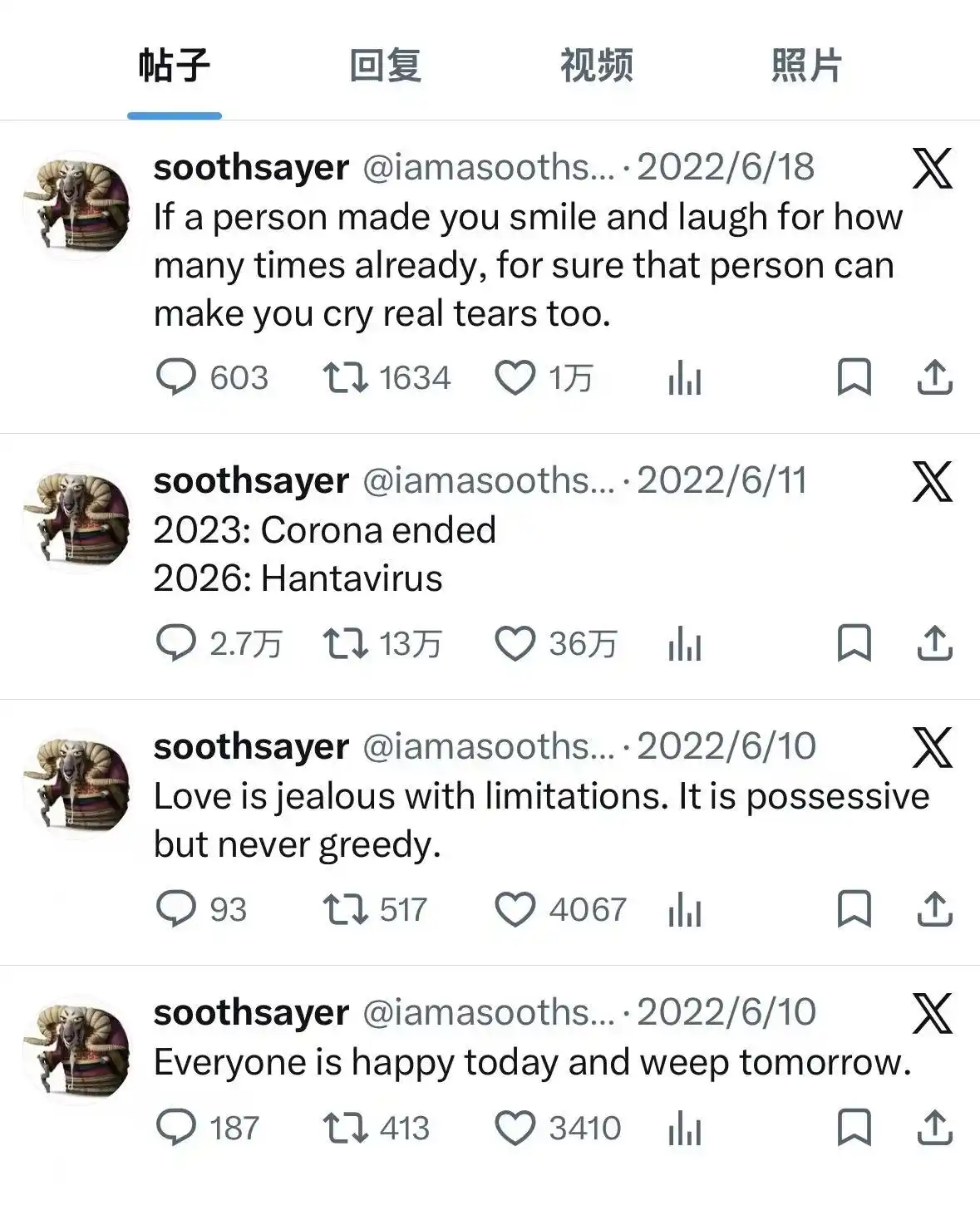
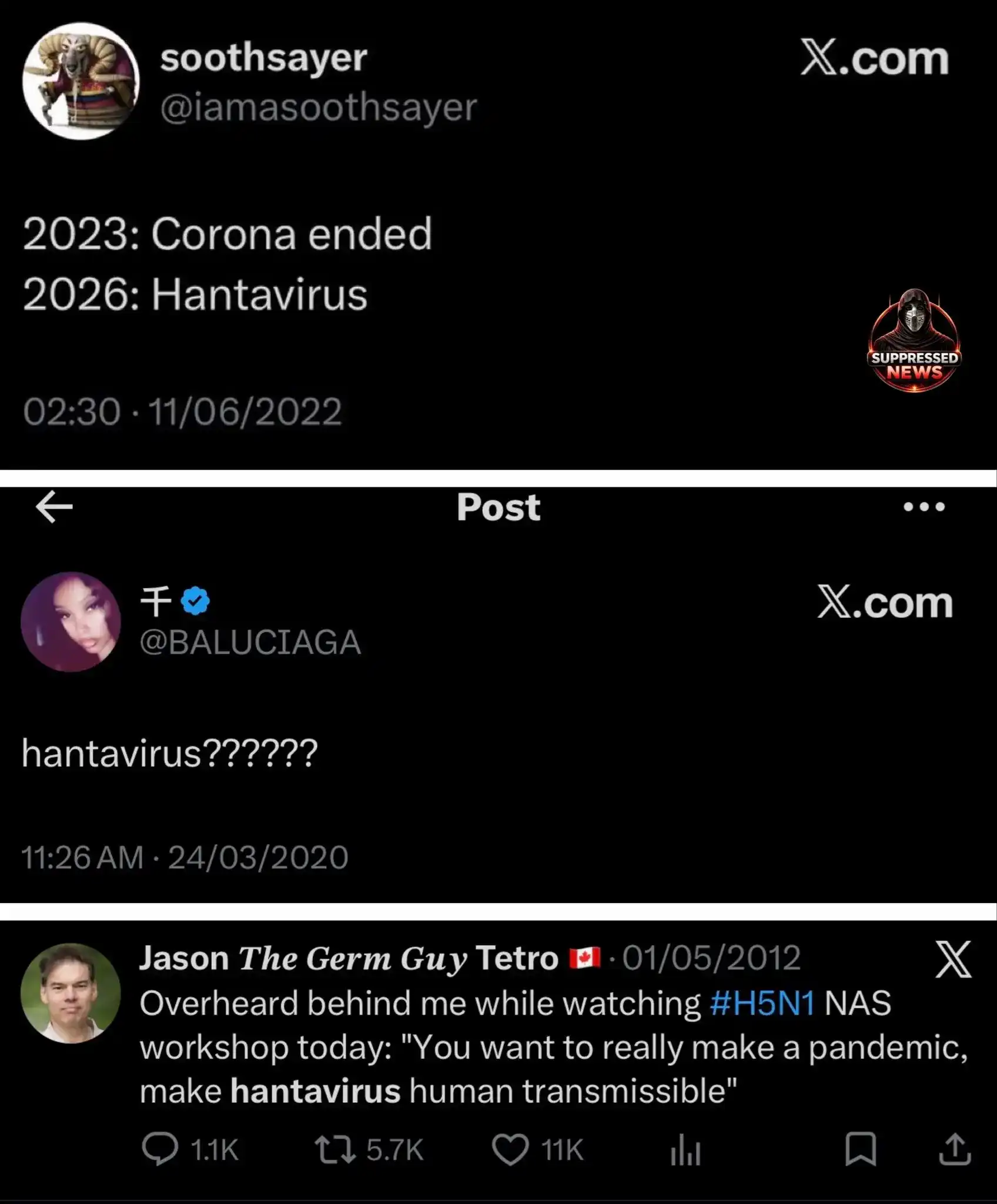
Last night, an old tweet from June 11, 2022, detonated like a nuclear bomb across the X platform's public opinion sphere. The tweet came from a fortune teller who claimed to be able to "read the future," prophesying not only the end of the COVID-19 pandemic in 2023 but also, with the accuracy of a prophet, pinpointing the recent emergence of the Hantavirus.

For a moment, countless people flocked to the post, leaving various comments. Yet, the account vanished after posting only 5 tweets, disappearing into thin air, adding a mysterious, urban legend-like quality to the entire affair.

Amidst the lingering sense of uncertainty left by the post-pandemic era, discussions about the Hantavirus quickly spilled over from public health topics and evolved into an amplifier of emotions on social media. It was also rapidly absorbed by the crypto market as a new trading narrative. From meme coins to prediction markets, speculative funds always find the points of intense emotion first.

In the stream of information, where truth is hard to discern, and amidst the resonance of group sentiment, the crypto market once again displayed its instinct: to rapidly convert attention, anxiety, and expectations into tradable products and prices.

A Mysterious Tweet from 4 Years Ago, Tied to the Recent Cruise Ship Virus that Killed 3

The story begins with the account @soothsayer.

This account, which has only posted 5 tweets, had received little attention until now. If you ignore that "Hantavirus prophecy" tweet, you might think this account was no different from the ordinary ones on the X platform that post daily "inspirational quotes" and "motivational sayings."

But as the topic of the Hantavirus has gained momentum in recent days, this old tweet has taken on a flavor of "cyber mysticism."
In April of this year, a cruise ship named "Hondius" set sail from Argentina in South America, originally planning to cross the Atlantic to the Canary Islands in Spain. However, during the voyage, a Dutch man suddenly died on board and was later confirmed to have died from the Hantavirus. As of May 6th, the death toll has increased to 3, and the number of infections has risen to 8, including tourists from the Netherlands, the UK, Germany, and other countries. Currently, the cruise ship has been temporarily denied docking due to the Hantavirus, and the WHO is closely monitoring the situation. It's worth noting that around 30 passengers disembarked from the ship in the two weeks prior without a tracking program, spreading across 12 countries.

Therefore, although the WHO clarified that the virus has not shown signs of large-scale spread before, it has inevitably caused public anxiety, with many exclaiming "it reminds me of the fear of being dominated by COVID."

It is worth noting that, according to test results from the South African National Institute for Communicable Diseases and the Geneva University Hospital in Switzerland, the virus type for this outbreak has been confirmed as the Andes Hantavirus.

The vast majority of Hantaviruses are not transmissible between humans, but the Andes virus is the only exception. Such transmission usually occurs among close family members or healthcare workers. Additionally, Hantaviruses mostly infect humans through "rodent-borne" routes. The main transmission methods are divided into three types: respiratory infection, i.e., inhaling aerosols contaminated by rodent excreta; contact infection, i.e., direct contact of broken skin or mucous membranes with excreta from infected rodents; and digestive tract infection, i.e., consuming food contaminated by rodent excreta.

Regarding many people's concern about whether the virus will spread domestically, reliable sources indicate that in China, the disease caused by Hantavirus is known as "Epidemic Hemorrhagic Fever." China has achieved significant results in the prevention and treatment of this virus and its associated diseases, with no current risk of a large-scale outbreak. The Chinese Embassy in Cape Verde previously issued an announcement confirming there were no Chinese citizens on the ship.

Looking back at the fortune teller's tweet, one finds that it not only directly mentions Hantavirus but also dates back four years, which is indeed highly topical.

Hantavirus in Crypto: Meme Coins and Prediction Markets

Following the emergence of the Hantavirus, the crypto market also experienced tremors. Meme coins and prediction markets immediately began their performances.

Community members dug up a Meme coin created a year ago, which officially launched on external platforms on May 4th: HANTA (Hantavirus) Meme coin (2tXpgu2DLTsPUf9zFmuZmA4xrYxXKBTpVq9wAM7hzs9y). Its current market cap is reported to be $12 million, making it a veritable "OG play."

Additionally, on the prediction market front, both Polymarket and Predict.fun have launched betting events related to the Hantavirus.

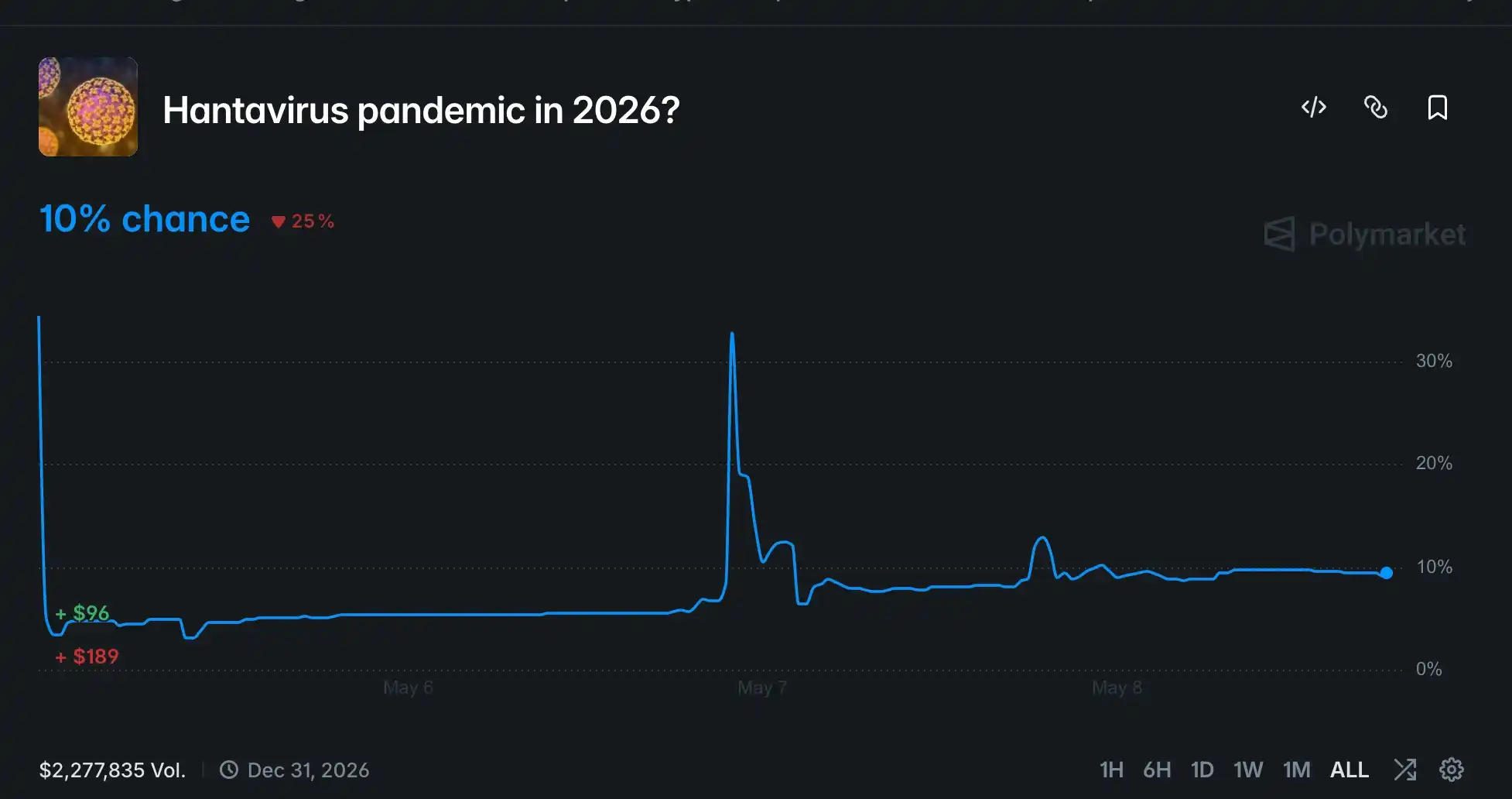
On Polymarket, the probability of the event "Hantavirus Pandemic by 2026" is currently reported at 10%, having previously surged to nearly 35%; the betting amount is currently around $2.27 million. Its resolution rules are: "If the World Health Organization, in official public communications from the time of market creation until 11:59 PM EST on December 31, 2026, explicitly characterizes the Hantavirus, Hantavirus Pulmonary Syndrome (HPS), Hemorrhagic Fever with Renal Syndrome (HFRS), or a Hantavirus-related outbreak as a 'pandemic,' then this market will resolve to 'YES'; otherwise, it will resolve to 'NO.' An explicit characterization includes official WHO statements, reports, press conferences, or publications that explicitly describe the outbreak as a 'pandemic.' Merely declaring it a Public Health Emergency of International Concern (PHEIC) does not qualify unless it is also described as a pandemic. The primary settlement basis for this market will be WHO official communications. Consensus from credible reporting may also serve as a basis."
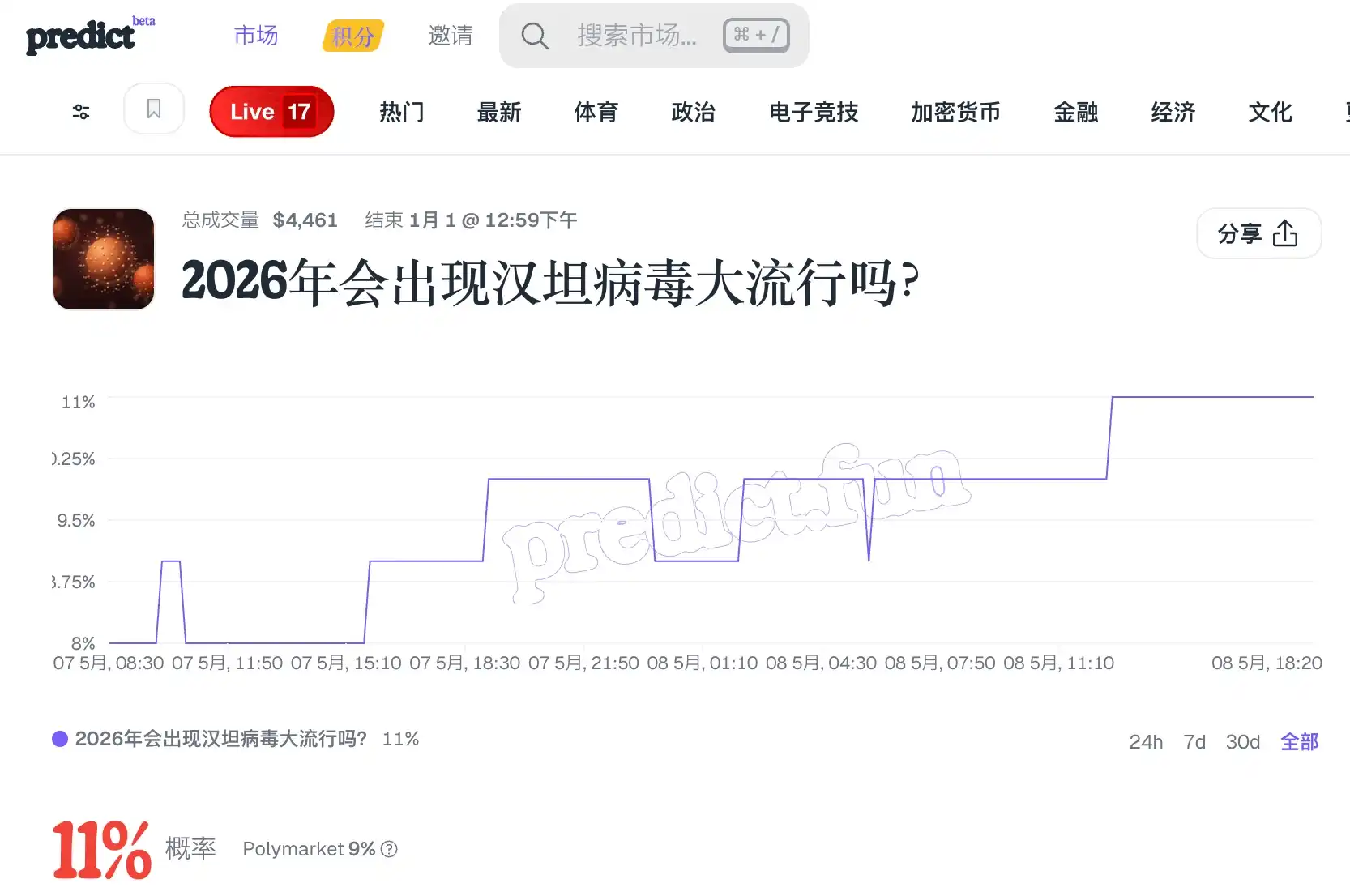
On the Predict.fun platform, the probability for the identically named betting event is currently reported at 11%, slightly higher than Polymarket's data; the betting volume is smaller, only around $4,400. Its resolution rules are similar to Polymarket's, also relying on the WHO's public statements.
For many, betting real money on the future is inherently addictive. The reason prediction markets are becoming increasingly popular is precisely because they turn humanity's anxiety, curiosity, and desire for the unknown directly into tradable commodities.

At the end of the article, let's bring our focus back to the X platform. There are still numerous ancient posts about "Hantavirus" scattered there, some from 2020, some even traceable back to 2012. Some people dig out fragments of text as "divine prophecies," some piece together blurry screenshots into complete stories, and others firmly believe everything was written in advance.

Truth is not important. What truly fascinates people is how the internet always mixes coincidence, fear, emotion, and imagination into something between reality and urban legend, making you can't help but want to click and take a look.

Just as the fortune teller @soothsayer left behind: "Laugh today, weep tomorrow."
Пов'язані питання

QWhat is the core event described in the article that sparked widespread discussion?

AThe article describes how an old tweet from a user named @soothsayer, posted in 2022, went viral because it seemed to predict the recent Hantavirus outbreak on a cruise ship, along with the end of COVID-19 in 2023.

QHow did the cryptocurrency market react to the Hantavirus news according to the article?

AThe cryptocurrency market absorbed the Hantavirus news as a new trading narrative. A Meme coin named HANTA (Hantavirus) was launched, and prediction markets like Polymarket and Predict.fun created events for users to bet on the probability of a Hantavirus pandemic by 2026.

QWhat specific type of Hantavirus was confirmed in the cruise ship outbreak, and why is it notable?

AThe confirmed virus type is the Andes Hantavirus. It is notable because, unlike most other Hantaviruses, the Andes virus is known to be capable of human-to-human transmission, usually among close contacts like family members or healthcare workers.

QWhat are the main transmission routes for Hantaviruses mentioned in the article?

AThe main transmission routes for Hantaviruses mentioned are: respiratory infection (inhaling aerosols contaminated by rodent excreta), contact infection (broken skin or mucous membranes contacting infected rodent excreta), and digestive tract infection (consuming food contaminated by rodent excreta).

QWhat is the article's perspective on the allure of prediction markets in the context of events like the Hantavirus?

AThe article suggests that prediction markets are increasingly popular because they transform human anxiety, curiosity, and desire regarding the unknown into a tradable commodity. People find it addictive to bet real money on future outcomes.

Пов'язані матеріали

The Shutdown of Claude Mythos Revealed the True Cost of Renting AI to Me

The sudden shutdown of Claude Mythos this week starkly highlights a critical, often overlooked risk for founders: when your core capability relies entirely on someone else's platform, your fate is not in your own hands. The key question becomes: who truly owns the intelligence your product depends on? For years, the debate around open-source models focused on cost. Now, the evidence is clear: fine-tuned open-source models can achieve frontier-level quality for specific, mission-critical tasks at a fraction of the cost. However, the deeper issue is control. Relying on a third-party API is like renting; it works until the landlord changes the rules, raises the rent, or asks you to leave—as Mythos experienced. The lesson is not to stop using frontier models—they are incredible infrastructure. The goal is ownership. Ownership means starting with a powerful open-source model and shaping it around what makes your company unique: your data, workflows, domain expertise, and definition of "good." Over time, the model becomes less generic and more reflective of your business, creating durable value. The optimistic conclusion is that AI's future doesn't hinge on one superior model. There is no single frontier. The frontier includes proprietary models, models fine-tuned on company-specific knowledge, specialized models for narrow problems, and intelligent routers orchestrating model ensembles. The most interesting development is not models getting smarter, but intelligence becoming increasingly customizable. The winning companies will be those that transform intelligence into a unique, owned asset. Looking ahead, the vision is not one model dominating all, but many teams owning the part of the frontier that matters most to them.

marsbit22 хв тому

The Shutdown of Claude Mythos Revealed the True Cost of Renting AI to Me

marsbit22 хв тому

Tiger Research: U.S. Strategic Bitcoin Reserve - Should the Market Be Happy or Disappointed?

Tiger Research analyzes the evolution of U.S. legislative efforts regarding a strategic Bitcoin reserve, concluding the market impact is limited in the short term but potentially positive long-term. The core event was a March 2025 executive order by former President Trump, which designated confiscated Bitcoin as a strategic reserve and promised not to sell existing holdings (approx. 190k BTC). As it contained no mandate to purchase new Bitcoin, the market reacted negatively, with prices dropping 5.7%. Legislative history shows a significant retreat from initial ambitions. The 2024 "BITCOIN Act" proposed mandatory purchases of 1 million BTC over five years. Reintroduced in 2025, it stalled due to high fiscal costs, concerns over dollar hegemony, and opposition from the Treasury Secretary. The current frontrunner, the 2026 "American Retirement and Monetary Advancement (ARMA) Act," is a compromise. It lacks any purchase requirement, instead focusing on consolidating existing government-held Bitcoin and legally prohibiting its sale for at least 20 years. While ARMA has higher passage odds due to bipartisan support and no purchase mandate, its immediate market effect is neutral. It eliminates potential government selling pressure but creates no new demand. The long-term significance is that formally establishing Bitcoin as a national reserve asset in law could later reignite debates on mandatory purchases. Therefore, the path to a government buyer is longer than initially priced by the market, but the directional narrative remains intact.

marsbit24 хв тому

Tiger Research: U.S. Strategic Bitcoin Reserve - Should the Market Be Happy or Disappointed?

marsbit24 хв тому

US Stock Market Trend (June 16): SpaceX Rises 42% in Two Days, New Fed Chairman Takes Office Today

**U.S. Stocks Trend (June 16): SpaceX Soars 42% in Two Days, New Fed Chair Takes Office Today** Markets surged on Monday following former President Trump's social media announcement of a completed U.S.-Iran deal to reopen the Strait of Hormuz, pending a June 19 signing. The news triggered a broad risk-on rally: oil prices crashed, tech stocks soared, bond yields fell, and defensive sectors lagged. **Market Performance:** The Nasdaq jumped 3.07%, led by semiconductor stocks like Micron (+9.2%). The S&P 500 gained 1.65%, and the Dow rose 0.92% to a record high. However, the Russell 2000 small-cap index underperformed (+0.72%). SpaceX continued its hot streak, rising another 5% pre-market after disclosures of large buys by an Australian billionaire and Cathie Wood's ARK. Boeing also rallied on the transportation optimism. Conversely, energy stocks like Chevron fell over 3% on the oil price plunge, with other defensive sectors also selling off. The day's action showed a clear rotation of funds from energy/defensive plays into AI and tech narratives. **Macro & Outlook:** The VIX fear index fell 8.37%. Treasury yields declined, and WTI crude dropped over 5%. Attention now shifts to a packed schedule: the Bank of Japan is widely expected to hike rates to 1.0% on Tuesday. The Fed's June meeting concludes Wednesday, marking new Chair Wash's debut. While rates are expected to hold, his tone on stubborn inflation and the "dot plot" will be crucial for gauging the 2024 rate path. The formal Iran deal signing is set for Friday. **Trend Perspective:** While the peace deal is a genuine positive, Monday's explosive rally may have gotten ahead of itself, pricing in a swift resolution to inflation concerns. The shortened trading week faces a triple test: BoJ tightening, the Fed's policy stance, and deal implementation details. Tech and semiconductors, which led the surge, remain vulnerable to any disappointment from these key events. The real price discovery begins with the central banks' communications this week.

marsbit45 хв тому

US Stock Market Trend (June 16): SpaceX Rises 42% in Two Days, New Fed Chairman Takes Office Today

marsbit45 хв тому

Торгівля

Спот
Ф'ючерси

Популярні статті

Як купити 4

Ласкаво просимо до HTX.com! Ми зробили покупку 4 (4) простою та зручною. Дотримуйтесь нашої покрокової інструкції, щоб розпочати свою криптовалютну подорож.Крок 1: Створіть обліковий запис на HTXВикористовуйте свою електронну пошту або номер телефону, щоб зареєструвати обліковий запис на HTX безплатно. Пройдіть безпроблемну реєстрацію й отримайте доступ до всіх функцій.ЗареєструватисьКрок 2: Перейдіть до розділу Купити крипту і виберіть спосіб оплатиКредитна/дебетова картка: використовуйте вашу картку Visa або Mastercard, щоб миттєво купити 4 (4).Баланс: використовуйте кошти з балансу вашого рахунку HTX для безперешкодної торгівлі.Треті особи: ми додали популярні способи оплати, такі як Google Pay та Apple Pay, щоб підвищити зручність.P2P: Торгуйте безпосередньо з іншими користувачами на HTX.Позабіржова торгівля (OTC): ми пропонуємо індивідуальні послуги та конкурентні обмінні курси для трейдерів.Крок 3: Зберігайте свої 4 (4)Після придбання 4 (4) збережіть його у своєму обліковому записі на HTX. Крім того, ви можете відправити його в інше місце за допомогою блокчейн-переказу або використовувати його для торгівлі іншими криптовалютами.Крок 4: Торгівля 4 (4)Легко торгуйте 4 (4) на спотовому ринку HTX. Просто увійдіть до свого облікового запису, виберіть торгову пару, укладайте угоди та спостерігайте за ними в режимі реального часу. Ми пропонуємо зручний досвід як для початківців, так і для досвідчених трейдерів.

425 переглядів усьогоОпубліковано 2025.10.20Оновлено 2026.06.02

Як купити 4

Обговорення

Ласкаво просимо до спільноти HTX. Тут ви можете бути в курсі останніх подій розвитку платформи та отримати доступ до професійної ринкової інформації. Нижче представлені думки користувачів щодо ціни 4 (4).

活动图片