Original|Odaily Planet Daily(@OdailyChina)
Author|Wenser(@wenser 2010 )
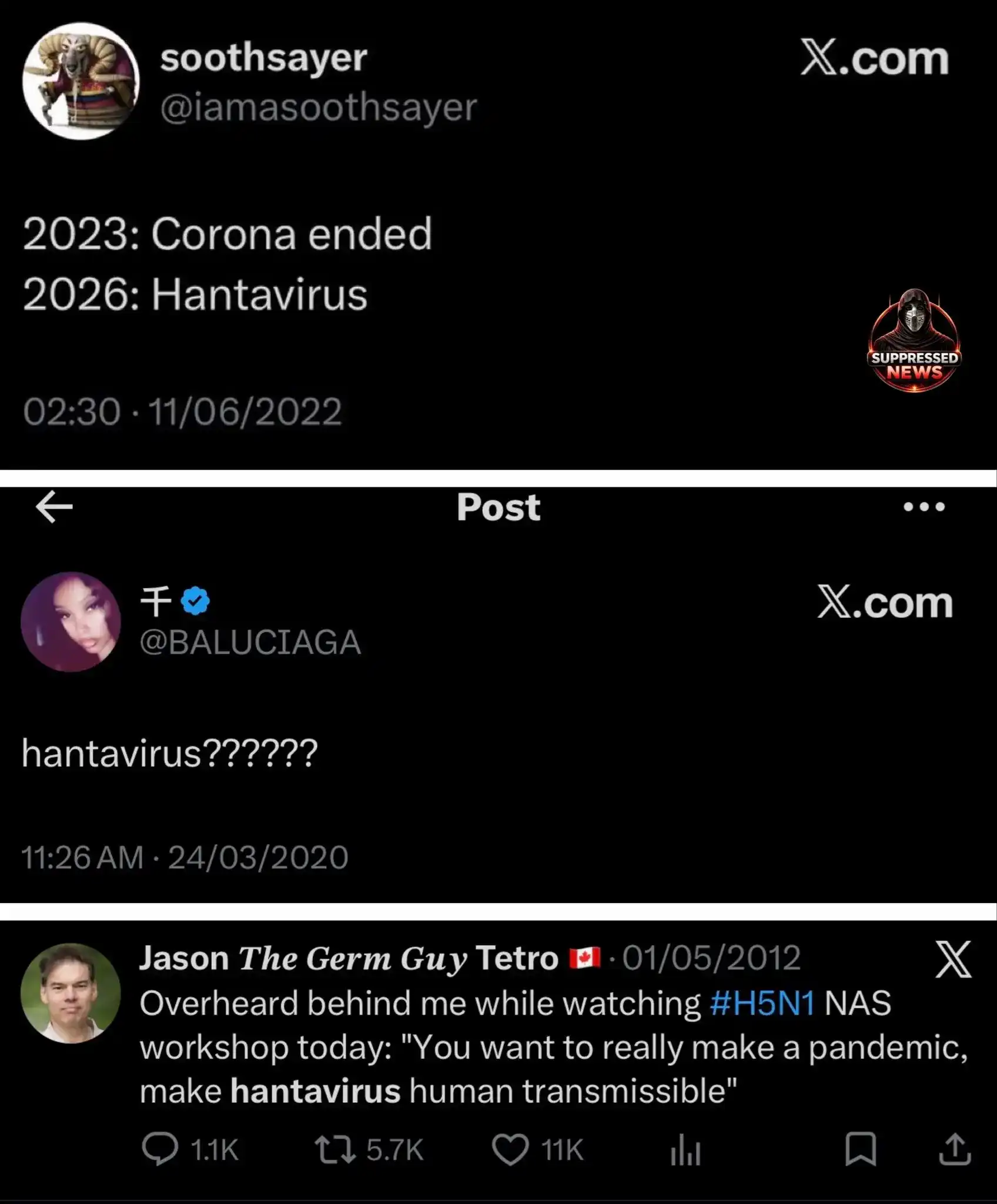
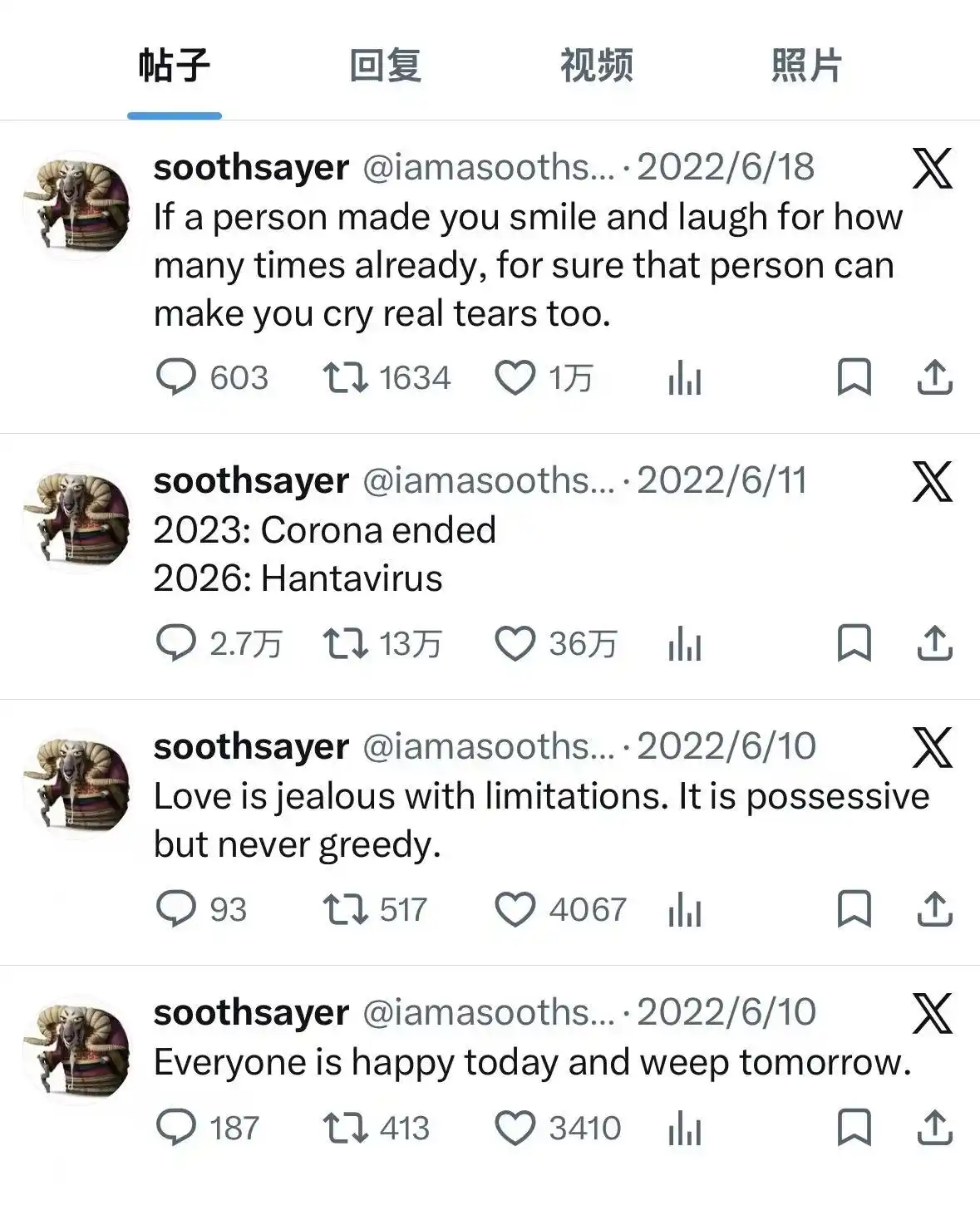
Last night, an old tweet from June 11, 2022, detonated like a nuclear bomb across the X platform's public opinion sphere. The tweet came from a fortune teller who claimed to be able to "read the future," prophesying not only the end of the COVID-19 pandemic in 2023 but also, with the accuracy of a prophet, pinpointing the recent emergence of the Hantavirus.
For a moment, countless people flocked to the post, leaving various comments. Yet, the account vanished after posting only 5 tweets, disappearing into thin air, adding a mysterious, urban legend-like quality to the entire affair.
Amidst the lingering sense of uncertainty left by the post-pandemic era, discussions about the Hantavirus quickly spilled over from public health topics and evolved into an amplifier of emotions on social media. It was also rapidly absorbed by the crypto market as a new trading narrative. From meme coins to prediction markets, speculative funds always find the points of intense emotion first.
In the stream of information, where truth is hard to discern, and amidst the resonance of group sentiment, the crypto market once again displayed its instinct: to rapidly convert attention, anxiety, and expectations into tradable products and prices.
A Mysterious Tweet from 4 Years Ago, Tied to the Recent Cruise Ship Virus that Killed 3
The story begins with the account @soothsayer.
This account, which has only posted 5 tweets, had received little attention until now. If you ignore that "Hantavirus prophecy" tweet, you might think this account was no different from the ordinary ones on the X platform that post daily "inspirational quotes" and "motivational sayings."
But as the topic of the Hantavirus has gained momentum in recent days, this old tweet has taken on a flavor of "cyber mysticism."
In April of this year, a cruise ship named "Hondius" set sail from Argentina in South America, originally planning to cross the Atlantic to the Canary Islands in Spain. However, during the voyage, a Dutch man suddenly died on board and was later confirmed to have died from the Hantavirus. As of May 6th, the death toll has increased to 3, and the number of infections has risen to 8, including tourists from the Netherlands, the UK, Germany, and other countries. Currently, the cruise ship has been temporarily denied docking due to the Hantavirus, and the WHO is closely monitoring the situation. It's worth noting that around 30 passengers disembarked from the ship in the two weeks prior without a tracking program, spreading across 12 countries.
Therefore, although the WHO clarified that the virus has not shown signs of large-scale spread before, it has inevitably caused public anxiety, with many exclaiming "it reminds me of the fear of being dominated by COVID."

It is worth noting that, according to test results from the South African National Institute for Communicable Diseases and the Geneva University Hospital in Switzerland, the virus type for this outbreak has been confirmed as the Andes Hantavirus.
The vast majority of Hantaviruses are not transmissible between humans, but the Andes virus is the only exception. Such transmission usually occurs among close family members or healthcare workers. Additionally, Hantaviruses mostly infect humans through "rodent-borne" routes. The main transmission methods are divided into three types: respiratory infection, i.e., inhaling aerosols contaminated by rodent excreta; contact infection, i.e., direct contact of broken skin or mucous membranes with excreta from infected rodents; and digestive tract infection, i.e., consuming food contaminated by rodent excreta.
Regarding many people's concern about whether the virus will spread domestically, reliable sources indicate that in China, the disease caused by Hantavirus is known as "Epidemic Hemorrhagic Fever." China has achieved significant results in the prevention and treatment of this virus and its associated diseases, with no current risk of a large-scale outbreak. The Chinese Embassy in Cape Verde previously issued an announcement confirming there were no Chinese citizens on the ship.
Looking back at the fortune teller's tweet, one finds that it not only directly mentions Hantavirus but also dates back four years, which is indeed highly topical.
Hantavirus in Crypto: Meme Coins and Prediction Markets
Following the emergence of the Hantavirus, the crypto market also experienced tremors. Meme coins and prediction markets immediately began their performances.
Community members dug up a Meme coin created a year ago, which officially launched on external platforms on May 4th: HANTA (Hantavirus) Meme coin (2tXpgu2DLTsPUf9zFmuZmA4xrYxXKBTpVq9wAM7hzs9y). Its current market cap is reported to be $12 million, making it a veritable "OG play."
Additionally, on the prediction market front, both Polymarket and Predict.fun have launched betting events related to the Hantavirus.
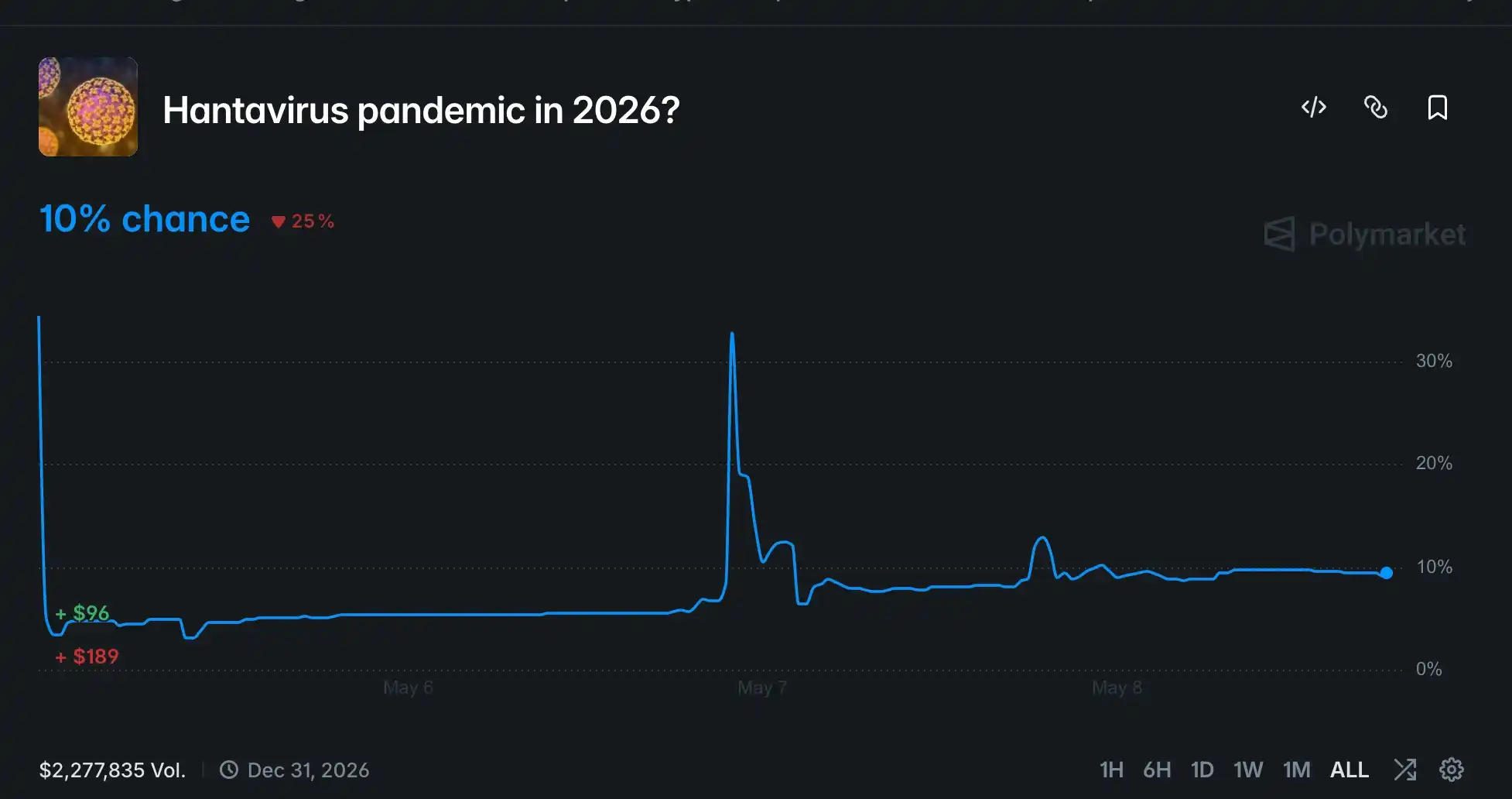
On Polymarket, the probability of the event "Hantavirus Pandemic by 2026" is currently reported at 10%, having previously surged to nearly 35%; the betting amount is currently around $2.27 million. Its resolution rules are: "If the World Health Organization, in official public communications from the time of market creation until 11:59 PM EST on December 31, 2026, explicitly characterizes the Hantavirus, Hantavirus Pulmonary Syndrome (HPS), Hemorrhagic Fever with Renal Syndrome (HFRS), or a Hantavirus-related outbreak as a 'pandemic,' then this market will resolve to 'YES'; otherwise, it will resolve to 'NO.' An explicit characterization includes official WHO statements, reports, press conferences, or publications that explicitly describe the outbreak as a 'pandemic.' Merely declaring it a Public Health Emergency of International Concern (PHEIC) does not qualify unless it is also described as a pandemic. The primary settlement basis for this market will be WHO official communications. Consensus from credible reporting may also serve as a basis."
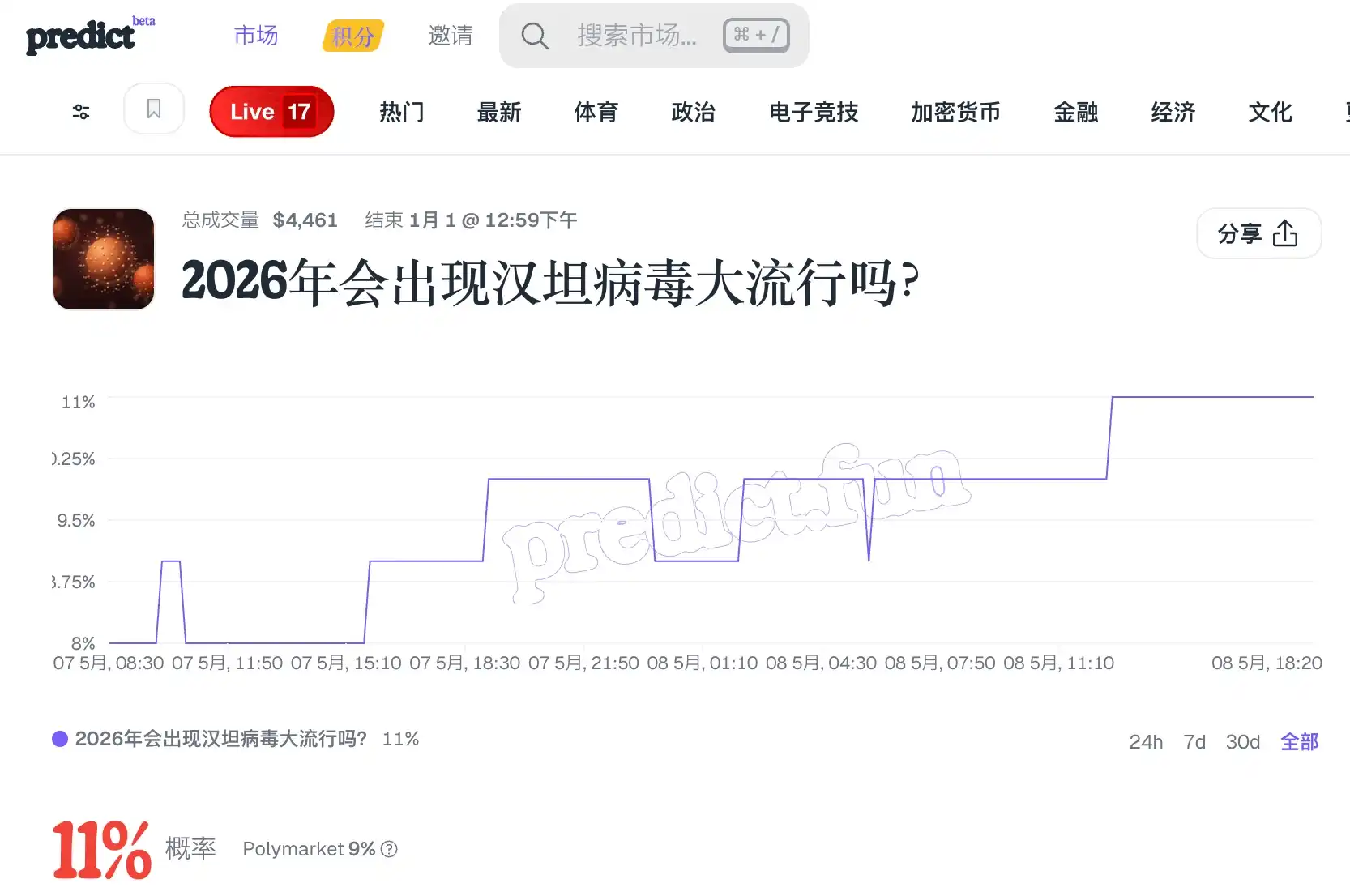
On the Predict.fun platform, the probability for the identically named betting event is currently reported at 11%, slightly higher than Polymarket's data; the betting volume is smaller, only around $4,400. Its resolution rules are similar to Polymarket's, also relying on the WHO's public statements.
For many, betting real money on the future is inherently addictive. The reason prediction markets are becoming increasingly popular is precisely because they turn humanity's anxiety, curiosity, and desire for the unknown directly into tradable commodities.
At the end of the article, let's bring our focus back to the X platform. There are still numerous ancient posts about "Hantavirus" scattered there, some from 2020, some even traceable back to 2012. Some people dig out fragments of text as "divine prophecies," some piece together blurry screenshots into complete stories, and others firmly believe everything was written in advance.
Truth is not important. What truly fascinates people is how the internet always mixes coincidence, fear, emotion, and imagination into something between reality and urban legend, making you can't help but want to click and take a look.
Just as the fortune teller @soothsayer left behind: "Laugh today, weep tomorrow."