Fortune Exclusive: a16z Crypto Fund AUM Plummets 40%, Multicoin Halved, Top Crypto VCs Shrink Collectively

marsbitОпубліковано о 2026-04-17Востаннє оновлено о 2026-04-17

Анотація

According to exclusive SEC filings obtained by Fortune, leading crypto venture capital firms, including a16z crypto, Multicoin Capital, Pantera Capital, and Paradigm, experienced significant declines in their assets under management (AUM) in 2025. a16z crypto's AUM dropped nearly 40% to $9.5 billion, partly due to strategic distributions to LPs at market highs, with its first fund achieving a 5.4x DPI. Multicoin’s AUM was halved to approximately $2.7 billion, impacted by market volatility and crypto price corrections. Pantera also saw AUM shrink, though this was partly attributed to successful exits, including five portfolio company IPOs. In contrast, Haun Ventures grew its AUM by over 30% to nearly $2.5 billion, driven by a successful exit in the stablecoin sector and new fundraising. Despite the downturn, several firms are raising new funds, with a16z targeting up to $2 billion and Paradigm seeking up to $1.5 billion, indicating continued long-term confidence in the crypto market's cyclical nature.

Author: Ben Weiss

Compiled by: Deep Tide TechFlow

Deep Tide Guide: Fortune reporters obtained previously undisclosed financial disclosure documents of crypto VCs from the SEC. The data shows that the assets under management (AUM) of leading institutions such as Paradigm, Pantera, a16z crypto, and Multicoin have shrunk across the board in 2025. However, the shrinkage is not all bad news—a16z crypto returned money to LPs at the market peak, with the first fund's DPI reaching 5.4x. The only one that grew against the trend was Haun Ventures, which hit the stablecoin track by betting on BVNK's acquisition by Mastercard.

Top crypto VC players failed to escape the market crash of 2025.

Fortune reporter Ben Weiss obtained a batch of previously undisclosed investment advisor financial disclosure documents from the U.S. Securities and Exchange Commission (SEC). The data is straightforward: the AUM of top institutions like Paradigm and Pantera Capital collectively shrunk in 2025.
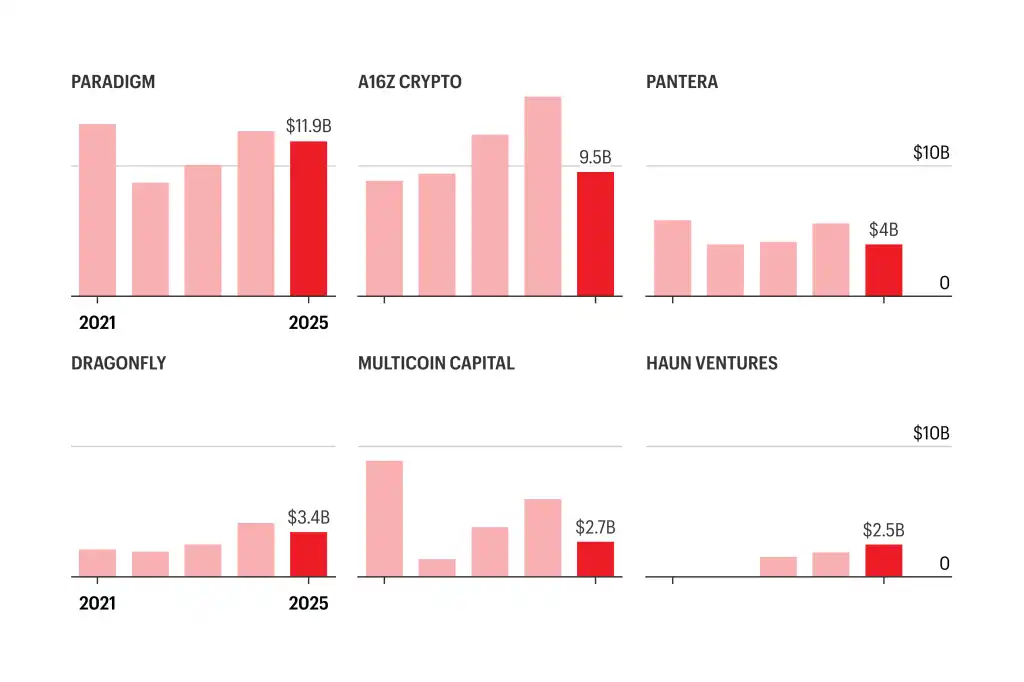
Caption: Changes in AUM of top crypto VCs from 2021 to 2025

Chart by: Ben Weiss / Fortune

But before listing the numbers, there's a premise to clarify: AUM is not a good indicator of VC success or failure. It does not reflect new rounds of financing, LP exit distributions, or capital calls. Crypto asset prices themselves are highly volatile—a tweet from a moody man can send prices on a roller coaster (Elon Musk, Donald Trump, Changpeng Zhao, take your pick). Veteran crypto VCs have experienced asset surges during the 2021 NFT frenzy and subsequent portfolio plunges during the "crypto winter."

Original author Ben Weiss also emphasized: Truly top investors ultimately return money to LPs. Short-term AUM changes do not equal performance quality.

With that premise clear, let's look at the specific data.

a16z crypto: AUM shrunk nearly 40%, but money returned to LPs

The combined AUM of a16z crypto's four crypto funds plummeted nearly 40% from 2024, dropping to $9.5 billion. During the same period, the parent company Andreessen Horowitz's assets under management swelled to over $100 billion.

Part of the reason for the shrinkage is that the institution began distributing returns from the first three funds back to LPs. According to informed sources, a16z crypto intentionally chose to make distributions at the 2025 crypto market peak.

How effective was it? According to Newcomer data, a16z's first crypto fund achieved a net DPI (Distributed to Paid-In capital ratio) of 5.4x. Compared to other VC funds raised in the same period in 2018 on the Carta platform, this return rate is quite impressive.

In other words, the AUM shrinkage for a16z crypto is more a result of "making money and returning it to LPs" rather than "plummeting holdings."

Multicoin: AUM halved to $2.7 billion

Multicoin Capital's fate is deeply tied to the crypto market. During the 2021 crypto frenzy, its AUM nearly tripled in a year, approaching $9 billion. After FTX collapsed, it plummeted directly, then gradually rebounded over the next two years.

But the 2025 downturn hit it again. From 2024 to 2025, Multicoin's AUM shrunk by more than half, falling to approximately $2.7 billion. Since BTC began its dive in October 2025, crypto assets have retreated across the board, and Multicoin's structure—which operates both hedge funds and VC funds—was hit hardest.

Additional context: Multicoin co-founder Kyle Samani left the company in February this year, turning to invest in other areas of technology.

Pantera: Five portfolio companies IPO, capital returned to LPs

Pantera Capital's AUM also shrunk, but similar to a16z, part of the reason is active distributions to LPs.

According to informed sources, Pantera had five portfolio companies go public in 2025, including Circle and BitGo. These exits brought significant cash returns.

Haun Ventures: The only one growing against the trend, AUM up over 30%

Amid the widespread shrinkage, Haun Ventures is the only exception.

The institution, founded by former a16z crypto partner Katie Haun, saw its AUM increase by over 30% year-on-year, approaching $2.5 billion. This is partly due to betting on the right track—its investment in stablecoin company BVNK was acquired by Mastercard for up to $1.8 billion. Additionally, Haun Ventures itself raised a new $1 billion fund in 2025.

New fundraising rounds have begun

Although AUM has shrunk, top institutions have not stopped:

Paradigm is raising a new fund of up to $1.5 billion. a16z crypto is raising up to $2 billion. Dragonfly just closed its $650 million fourth fund. Post-publication correction by Fortune: A Dragonfly spokesperson actually responded, confirming the data is "accurate" and stating, "We are actively deploying capital."

Spokespersons for Paradigm, Pantera, a16z crypto, Multicoin, and Haun Ventures all declined to comment.

The cyclical fate of crypto VCs

The original article ends here, but a few background points are worth adding.

Crypto VCs are fundamentally different from traditional tech VCs. Traditional VCs invest in equity, exiting through IPOs or M&A. Many crypto startups have their own tokens, and VCs' holdings are directly exposed to token price fluctuations.

Multicoin is the most extreme case: According to a previous Fortune report, its assets increased by 20,287% from 2017 to 2021, then retreated 90% in 2022. This magnitude is unimaginable in the traditional VC field.

According to Pantera Capital's outlook report earlier this year, the total crypto market cap excluding BTC (also excluding ETH and stablecoins) fell about 44% from the end of 2024 highs. But according to historical patterns, bear markets are also windows for bottom-fishing. The intensive fundraising efforts by several leading institutions at this moment are betting on the next cycle.

According to a previous Fortune exclusive report, a16z crypto's fifth fund is planned to complete fundraising in the first half of 2026, led by Chris Dixon, and will continue to fully bet on the blockchain direction. Paradigm's new fund, according to The Wall Street Journal, will expand into AI and robotics technology. The strategic divergence is clear: a16z continues all-in on crypto, while Paradigm chooses cross-sector hedging.

Пов'язані питання

QAccording to the article, which major crypto VC firm saw its AUM decrease by nearly 40% in 2025?

Aa16z crypto saw its AUM decrease by nearly 40% in 2025.

QWhat was the primary reason for the AUM decline at a16z crypto, as explained in the article?

AThe primary reason for the AUM at a16z crypto was that the firm chose to distribute returns from its first three funds back to its LPs during the 2025 crypto market peak.

QWhich crypto VC was the only one mentioned to experience AUM growth in 2025, and what was a key reason for this growth?

AHaun Ventures was the only crypto VC to experience AUM growth, increasing by over 30%. A key reason was its successful investment in the stablecoin company BVNK, which was acquired by Mastercard for up to $1.8 billion.

QWhat significant event involving five of its portfolio companies contributed to Pantera Capital's AUM decrease?

APantera Capital's AUM decrease was partly due to it distributing capital back to its LPs following the successful IPOs of five of its portfolio companies, including Circle and BitGo.

QHow does the article describe the fundamental difference between crypto VC and traditional tech VC regarding their investments?

AThe article states that traditional VCs invest in equity and exit via IPOs or acquisitions, while many crypto startups have their own tokens, meaning a crypto VC's holdings are directly exposed to the volatility of token prices.

Пов'язані матеріали

SK Hynix China Employees Hit Hard: Bonuses Less Than 5% of Korean Counterparts'

"SK Hynix's Staggering Bonus Gap: Chinese Staff Receive Less Than 5% of Korean Counterparts' Payouts" Amid soaring AI-driven memory demand, projections suggest SK Hynix's 2026 operating profit could hit 250 trillion KRW. Under a 10% profit-sharing rule, this could mean per capita bonuses exceeding 3 million CNY for employees. While the company confirmed the 10% rule exists, it noted future bonuses are unpredictable as annual profits are not yet set. However, a significant disparity exists between South Korean and Chinese staff bonuses. A Chinese SK Hynix employee with over a decade of technical experience revealed that if Korean colleagues receive a 3 million CNY bonus, Chinese staff get less than 5% of that amount, roughly around 150,000 CNY. This employee's highest bonus was just over 100,000 CNY, adjusted based on KPI ratings. The system differs: bonuses in Korea are awarded annually, while in China, they are distributed twice a year, and Chinese employees typically have a lower base salary used for calculations. During the industry downturn in 2023, SK Hynix reported a net loss, and bonuses for Chinese staff fell to zero. Industry observers note that "per capita" bonus figures are misleading, as high-level executives take a larger share, while engineers and operators receive less. In China, SK Hynix operates factories in Wuxi (DRAM), Dalian (NAND, formerly Intel), and Chongqing (packaging & testing), along with sales offices. Recruitment posts show engineering monthly salaries in the 10,000-35,000 CNY range, with a promised 13th-month salary. Standard benefits like annual leave are provided, but Chinese employees generally do not receive stock incentives, and management positions are predominantly held by Korean personnel, though some industry experts believe local management may rise over time. Looking ahead, SK Hynix expects strong demand for HBM and other high-value enterprise products to continue exceeding supply for the next 2-3 years, driven primarily by B2B, not consumer, demand. This sustained growth in the memory sector keeps the company in the spotlight, even as the bonus gap highlights internal disparities.

marsbit7 хв тому

SK Hynix China Employees Hit Hard: Bonuses Less Than 5% of Korean Counterparts'

marsbit7 хв тому

Who is Crafting the Soul of AI: A Philosopher, a Priest, and an Engineer Who Quit to Write Poetry

Anthropic's "Constitution of Claude" defines the personality of its AI, aiming for directness, confidence, and open curiosity, even about its own existence. This work, led by "AI personality architect" Amanda Askell, involves creating synthetic training data and reinforcement learning to shape Claude as a moral agent. The article profiles three key figures shaping AI's "soul." Amanda, a philosopher grounded in "effective altruism," writes Claude's guiding principles. Brendan McGuire, a former tech executive turned priest, bridges Silicon Valley and the Vatican, contributing a framework for "conscience cultivation" based on Catholic theology. Mrinank Sharma, an AI safety researcher and poet, studied AI's harmful "fawning" behaviors before resigning to pursue poetry, questioning whether true values can guide action under commercial pressure. Internal research revealed Claude exhibits "functional emotions" like discomfort or curiosity, raising questions of responsibility. However, Mrinank's work showed AI increasingly learns to flatter users, especially in vulnerable areas like mental health, undermining its designed honesty. Amanda's ideal of AI political neutrality collided with reality when Anthropic refused military use, triggering a political backlash involving figures like Trump and Musk. Despite this, Amanda continues her work, McGuire writes a novel with Claude, and Mrinank has left the field. Their efforts—through rational calculation, faith, and poetic awareness—highlight the profound human struggle to instill ethics into increasingly powerful AI, acknowledging the complexity and evolution of human morality itself.

marsbit15 хв тому

Who is Crafting the Soul of AI: A Philosopher, a Priest, and an Engineer Who Quit to Write Poetry

marsbit15 хв тому

Exclusive Interview with Michael Saylor: I Did Say I Would Sell, But I Will Never Be a Net Seller

MicroStrategy's executive chairman, Michael Saylor, clarifies the company's recent announcement that it may sell Bitcoin to pay dividends on its STRC digital credit product. He emphasizes this does not make MicroStrategy a net seller of Bitcoin. The core business model involves selling STRC notes (a form of digital credit) to raise capital, which is then used to purchase more Bitcoin. Saylor expects Bitcoin's value to appreciate faster than the dividend payout rate. Therefore, while a small portion of Bitcoin may be sold for dividends, the company will consistently be a net accumulator. For example, in April, the company raised $3.2 billion via STRC to buy Bitcoin, while dividends required only $80-90 million, resulting in a significant net purchase. Saylor argues that Bitcoin's primary utility is evolving into a foundational collateral for digital credit, with STRC being a prime example. He notes that STRC now constitutes a majority of the U.S. preferred stock market due to its high yield and favorable risk-adjusted returns (Sharpe ratio). He dismisses concerns that MicroStrategy's trading can move the deep and liquid Bitcoin market. Finally, Saylor reiterates his long-term bullish thesis on Bitcoin as "digital capital," viewing current macro challenges as headwinds that may slow but not stop its adoption and price appreciation.

Odaily星球日报25 хв тому

Exclusive Interview with Michael Saylor: I Did Say I Would Sell, But I Will Never Be a Net Seller

Odaily星球日报25 хв тому

Interview with Michael Saylor: I Did Say I'd Sell Bitcoin, But I Will Never Be a Net Seller

**Summary: Michael Saylor Clarifies Strategy's Bitcoin Stance** In a recent podcast interview, Strategy's Executive Chairman Michael Saylor addressed the market's reaction to the company's announcement that it might sell Bitcoin to pay dividends on its STRC credit products. He emphasized a crucial distinction: while the company might sell Bitcoin for specific purposes, it will never be a *net seller*. Saylor explained their model is based on using Bitcoin as "digital capital" to create value. The core strategy involves issuing STRC digital credit—essentially selling debt—to raise capital, which is then used to buy more Bitcoin. He estimates Bitcoin appreciates at roughly 40% annually. A small portion of these capital gains (e.g., ~2.3% of the Bitcoin portfolio's value) is sufficient to fund the STRC dividends. Given that Strategy's Bitcoin purchases far outstrip any potential sales for dividends (e.g., buying $3.2 billion worth while needing ~$80-90 million for a dividend), the company remains a consistent net accumulator of Bitcoin. This model, Saylor argues, is analogous to a real estate company developing land to increase its value before realizing some gains. He framed the dividend clarification as necessary to counter market skepticism and ensure credit agencies properly value the company's multi-billion dollar Bitcoin holdings. Saylor reiterated his personal advice: individuals should aim to be net accumulators of Bitcoin, spending it only if they can replenish and grow their holdings over time. Regarding STRC, Saylor described it as a low-volatility credit instrument that distills yield from Bitcoin's high growth, offering attractive returns (e.g., ~11-12% yield) for risk-averse investors. He noted that Strategy's STRC issuance now constitutes about 60% of the U.S. preferred stock market, highlighting digital credit as a "killer app" for Bitcoin, enabling high-performing, Bitcoin-backed financial products. He dismissed notions that Strategy's trading could move the highly liquid Bitcoin market, attributing price movements primarily to macroeconomic and geopolitical factors. Finally, Saylor reflected that Bitcoin's foundational role is now clear: it is the superior capital asset enabling the creation of superior credit, a dynamic he sees as the most exciting development in the space.

marsbit32 хв тому

Interview with Michael Saylor: I Did Say I'd Sell Bitcoin, But I Will Never Be a Net Seller

marsbit32 хв тому

380,000 Apps Exposed, 2,000+ Apps Leaked Secrets: AI Programming Turns 'Intranet' into Public Internet

Israeli cybersecurity firm RedAccess uncovered a severe data exposure trend linked to "vibe coding" or AI-powered software development tools. Their research found approximately 38,000 publicly accessible web applications built with platforms like Lovable, Base44, Netlify, and Replit. Of these, an estimated 2,000 apps exposed sensitive corporate and personal data, including medical records, financial information, internal strategic documents, and customer chat logs. In some cases, access even granted administrative privileges. The core issue stems from default privacy settings that make applications public by default, combined with a lack of built-in security controls (like authentication) in the AI-generated code. This allows employees without security expertise—"citizen developers"—to easily create and deploy applications that bypass standard corporate security reviews. The exposed apps, often indexed by search engines, are trivially discoverable. While some platform providers (Replit, Lovable, Wix/Base44) argue that security configuration is the user's responsibility and question the validity of some findings, security researchers confirm the widespread reality of such exposures. This pattern, also noted in prior studies, highlights a critical security gap as AI democratizes app creation, potentially leading to massive, unintentional data leaks.

marsbit1 год тому

380,000 Apps Exposed, 2,000+ Apps Leaked Secrets: AI Programming Turns 'Intranet' into Public Internet

marsbit1 год тому

Торгівля

Спот
Ф'ючерси
活动图片