For Web3, This Time Cai Wensheng Is Determined to Get His Hands Dirty

marsbitОпубліковано о 2026-03-16Востаннє оновлено о 2026-03-16

Анотація

Cai Wenshou, a prominent Chinese internet entrepreneur and investor, is making a significant push into the Web3 space with a hands-on approach, moving beyond his previous role as a financial backer. Despite early successes in domains and internet companies like Meitu, his advocacy for Meitu's $100 million cryptocurrency investment in 2021 led to substantial paper losses and public criticism, eventually resulting in his departure as chairman. After stepping down, he reduced his stake in Meitu and invested personal funds into Web3 initiatives. He purchased a 25-story commercial building in Hong Kong, renamed it "CAI Tower" (representing Crypto and AI), offering free rent to Web3 and AI startups in exchange for first investment rights. He also acquired two Hong Kong-listed companies, rebranding them as CAI Holdings and LONG Investment Group, to build a Web3 and AI asset management platform. Additionally, he integrated a licensed virtual asset exchange, EXIO, into his ecosystem, creating a full-cycle support system from incubation to trading. Cai believes in the long-term potential of Web3, comparing its growth trajectory to AI's gradual rise. He remains optimistic about Bitcoin's future, predicting it could reach $1.1 million. Unlike some early crypto figures who have exited the industry, Cai is deepening his involvement, aiming to foster tangible projects and ecosystems. His commitment reflects a broader need for established leaders to drive real-world adoption and achieve a ...

Author:Zhou, ChainCatcher

If there are still any investors in the current crypto industry worth looking forward to, Cai Wensheng should be one of them.

Starting from the early domain name business, to the successive successes of 58.com, Storm Player, and Meitu, then to strongly advocating for Meitu to hoard cryptocurrencies, facing billions in floating losses and being criticized for speculative trading, stepping down as chairman, cashing out to buy buildings, and betting on Hong Kong Web3.

He is a person who has been repeatedly misunderstood by the times, yet repeatedly validated by the times.

Only this time, he decided to "get his hands dirty."

Last Time, Didn't Get a Good Result

2021 年, Cai Wensheng strongly advocated for Meitu to buy Bitcoin and Ethereum, with a total investment of about $100 million.

When buying, Cai Wensheng once said in his WeChat Moments: "Someone has to be the first to eat the crab. This should be the first Hong Kong-listed company to purchase BTC digital currency, and also the world's first listed company to use ETH Ethereum as a monetary value reserve."

However, as a Hong Kong-listed company, any major asset allocation by Meitu needed to be approved by the board of directors. Although he held over 25% of the shares at the time and, as chairman, could push for the purchase, he could not prevent the sale.

2022 年, the crypto market plummeted, and Meitu's paper losses exceeded 280 million RMB, with accusations of "speculative crypto trading" flooding in. The stock price of Meitu in Hong Kong also hit a historic low.
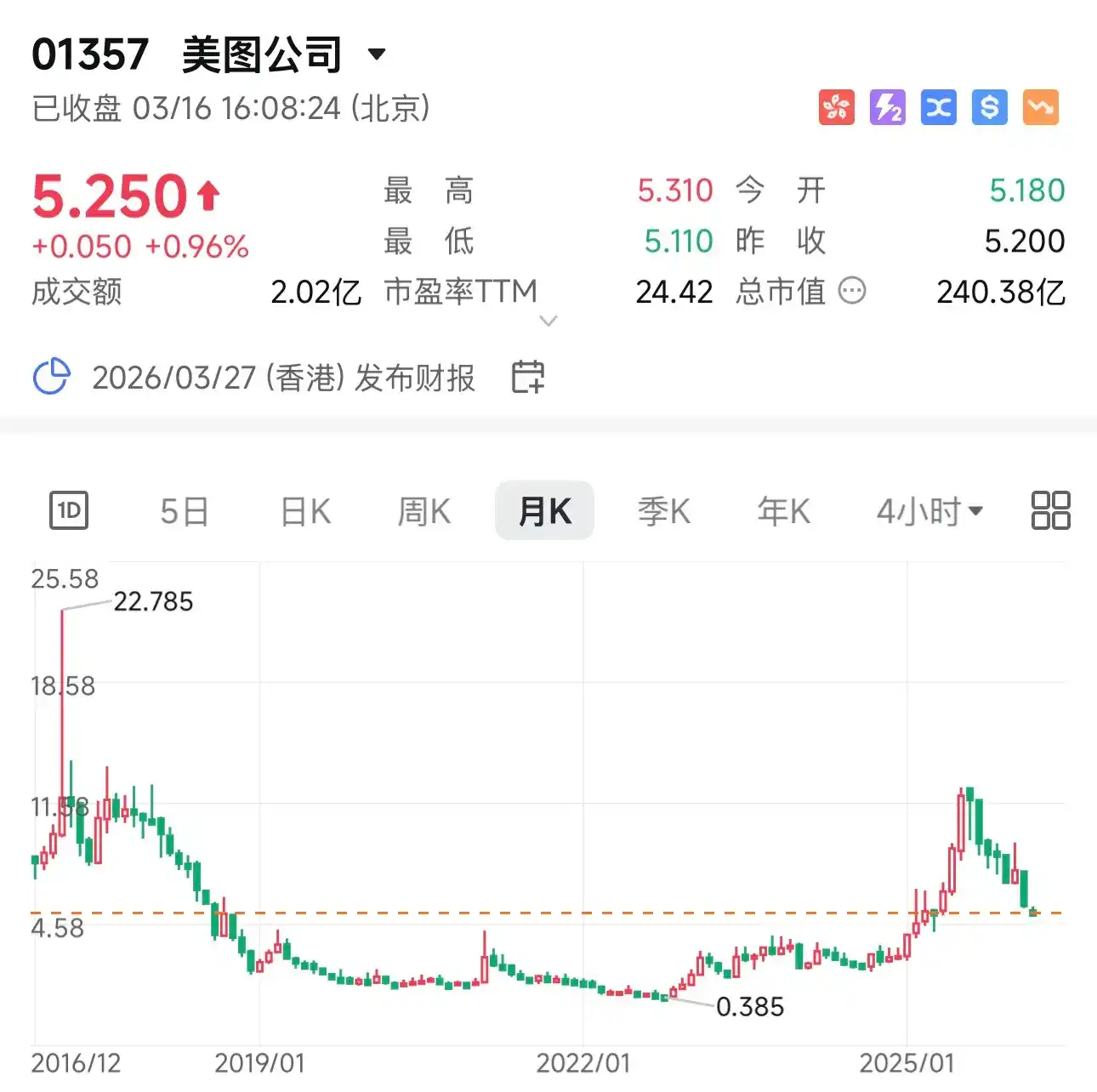

Publicly listed companies sometimes have less tolerance for floating losses than individual investors—stock price pressure, shareholder doubts, media siege—these were external pressures that anyone at the time could not withstand.

2023 年, he stepped down as chairman amid skepticism, and Wu Xinhong returned to take charge, immediately beginning to "tear off the Cai Wensheng label," with the strategic focus fully shifting to AI.

The ending of the story is quite ironic. Meitu issued an announcement in early December 2024, stating that as of that date, it had sold all its cryptocurrency, with a total cash consideration of approximately $180 million, realizing a gain of about $79.63 million, equivalent to approximately RMB 571 million.

If they had held on back then, Meitu would have been one of the first batch of DAT companies in Hong Kong.

The trend was validated, but it was no longer related to him.

Getting Involved, Getting Hands Dirty

From domain names, mobile internet, to Web3, people in each era said he was gambling.

He once said in an interview that what Web3 entrepreneurs do is often not understood, especially by traditional investors.

At the same time, he expressed firm belief in the explosion of Web3, though the timing is hard to predict, just like AI went through many years of dormancy before迎来 the ChatGPT explosion.

According to RootData显示, Cai Wensheng's Longling Capital早年 invested in the crypto exchange OKX (formerly OKCoin). In 2018, he revealed publicly that he had invested in over 10 blockchain projects, including Theta, Ontology, Zipper, etc.

<极好的, I will continue the translation from where it left off, ensuring all HTML tags are preserved and the structure is maintained.

img style="max-width:100%;overflow:hidden;" src="https://d1x7dwosqaosdj.cloudfront.net/images/2026-03/ba38047c3f24461f9b57e864d3fc5780.jpg" alt="">


This time, he simply increased his bet.

After stepping down, Cai Wensheng chose to reduce his stake in Meitu, with his shareholding比例 dropping from a peak of about 25% to less than 10%.

650 million Hong Kong dollars to buy a 25-story commercial building in Tin Hau, Hong Kong, renamed CAI Building. He specifically stated: "CAI is the abbreviation of Crypto and AI, not my surname."

It is reported that CAI Building does not charge rent, only asks for the优先 investment right in the first round of financing, no discount, no controlling stake. He publicly stated that the goal is to incubate 5 unicorns within three years.

Last November, Cai Wensheng said at Hong Kong Fintechweek that buying this building was to "set an example." Now this building is fully occupied by AI and Web3 companies.

Capital operations also followed. He successively acquired two Hong Kong-listed companies—China New Economy Investment and China Financial Leasing, renamed them CAI Holdings and LONG Investment Group respectively,打造 a Web3+AI asset management platform.

In early 2026, CAI Holdings又 acquired the equity of two early-stage projects, Forestheaven and EXIO, by issuing new shares. The seller was precisely Longling Capital, wholly owned by Cai Wensheng.

Among them, EXIO is a licensed virtual asset trading platform in Hong Kong, holding SFC Type 1 and Type 7 licenses. It is the first compliant exchange in Hong Kong with a securities background. Longling Capital was one of its early investors.

Incorporating this piece into CAI Holdings means his ecosystem extends from incubation to circulation—projects cultivated in the CAI Building can be directly listed for compliant trading on a licensed exchange.

Crypto OGs Need a Decent Victory

Among the crypto OGs we know, Cai Wensheng is not the one who has benefited the most.

The fates of early crypto OGs vary.

Some achieved financial freedom and completely faded out—Babbitt founder Chang Jia was once the most powerful spokesperson for long-termism in the crypto industry. Since 2023, he has turned to AI entrepreneurship.

Multicoin Capital co-founder Kyle Samani became famous for early bets on Solana. When leaving the圈, he publicly stated that "cryptocurrency is not as interesting as many people think."

Some stay in the圈, but their focus has shifted—Shenyu was a representative figure in the mining圈 early on. Now, content about AI tools占了大半 on his social accounts.

And those who, like Cai Wensheng, choose to stay include Xiao Feng and Feng Bo, etc.

Xiao Feng turned from traditional finance, leading HashKey on an institutionalized compliance path, operating with licenses, and connecting with traditional capital; Feng Bo布局 in a professional crypto VC manner, closer to the standard institutional investor approach.

They are同样 optimistic about this industry, but their paths are截然不同.

Cai Wensheng chose a "dirtier" path: not taking the institutional route, not making pure financial bets, personally putting down roots in Hong Kong, getting involved hands-on.

At the 2023 Hong Kong Web3 Carnival, Cai Wensheng said: "People who have worked from Web1 to Web3, this seems like a compliment, but it actually means that we have not been successful from Web1 to Web3, we have always been on the road. But many people from Web1 to Web3 are no longer here, but we are still here,说明 we are veterans. Old soldiers never die, they just fade away."

In early 2026, he predicted that Bitcoin would rise to $1.1 million, which means the total market capitalization of Bitcoin would be about $21 trillion. Previously, he publicly stated that he held about 10,000 Bitcoins. There is no news yet showing that he has exited.

Of course, the controversy has not disappeared. Continuously endorsing during a bear market, whether it is坚守 against the market or having to tell stories after being trapped, is still difficult for outsiders to distinguish.

But the ammunition from cashing out, the buildings bought, the companies acquired—these are all actions with real money.

This industry has experienced too many indecent endings. Project方 running away, whales dumping and fleeing, OGs quietly leaving the scene. What remains in the public eye are often only those news about changes in whale addresses.

This industry does not lack people who喊单, it lacks people who truly stay and get their hands dirty.

A bull market unlocking cannot solve the industry's root problems. In the end, it still relies on projects that truly succeed and ecosystems that truly land to win a decent victory for crypto OGs.


Пов'язані питання

QWhat was the outcome of Cai Wensheng's push for Meitu to invest in Bitcoin and Ethereum in 2021?

AMeitu invested approximately $100 million in Bitcoin and Ethereum in 2021, but faced a paper loss of over 280 million RMB in 2022 due to the crypto market crash. Cai Wensheng stepped down as chairman amid criticism, and Meitu later sold all its cryptocurrency holdings in 2024 for about $180 million, realizing a profit of approximately $79.63 million.

QWhat does 'CAI' stand for in the name of the building Cai Wensheng purchased in Hong Kong?

ACAI stands for 'Crypto and AI', not Cai Wensheng's surname. The building, named CAI Mansion, is intended to incubate AI and Web3 startups.

QHow is Cai Wensheng currently involved in the Web3 and crypto industry after leaving Meitu?

ACai Wensheng is deeply involved by purchasing a 25-story commercial building in Hong Kong (CAI Mansion) to incubate Web3 and AI startups, acquiring and renaming two Hong Kong-listed companies to create Web3+AI asset management platforms, and integrating a licensed virtual asset trading platform (EXIO) into his ecosystem.

QWhat is Cai Wensheng's prediction for the future price of Bitcoin?

ACai Wensheng predicted that Bitcoin would rise to $1.1 million, which would imply a total market capitalization of approximately $21 trillion.

QWhich early blockchain projects did Cai Wensheng's Longling Capital invest in?

ALongling Capital invested in early blockchain projects including Theta, Ontology, Zipper, and the crypto exchange OKX (formerly OKCoin).

Пов'язані матеріали

Must-Watch Events Next Week|CLARITY Act Could Face Senate Vote; SpaceX, Circle to Report Earnings (8.3-8.9)

**Summary: Key Events and Developments to Watch (August 3-9)** The upcoming week is marked by significant financial disclosures, key legislative deadlines, and notable product updates. **Major Financial Events:** Several companies are scheduled to release their Q2 2026 earnings. American Bitcoin (ABTC) will report on August 3, followed by SpaceX and Hut 8 Mining Corp. on August 4, and Circle on August 5. Notably, a significant portion of SpaceX shares (up to 12% of total shares) will be unlocked on August 6 following their earnings release. **Key Legislative Deadline:** The U.S. Senate faces an August 7 deadline to secure 60 votes for the CLARITY Act, a bipartisan bill aiming to establish a federal regulatory framework for cryptocurrencies. The Senate may hold a full vote on the bill during the week. **Economic Data:** The U.S. July Non-Farm Payrolls report will be released on August 7, providing crucial labor market data. **Technology & Product Updates:** * **Shutdowns:** DeFi portfolio tracker Zapper and wallet app Ctrl Wallet will cease operations on August 3. * **Upgrades:** LayerZero will deprecate its v1 relayers on August 3. XRP Ledger's new version 3.3.0, featuring five new functions, is expected next week. * **AI:** Elon Musk announced that the advanced Grok 4.6 AI model is set for release around August 7. * **Bitcoin:** The BIP-110 forced signaling for a potential Bitcoin network change is scheduled to begin around August 8. **Other Notable Events:** Chinese robotics firm Unitree Tech has set its preliminary price inquiry for its IPO for August 5. South Korean exchange Upbit will delist AQT and AERGO tokens on August 3.

marsbit18 хв тому

Must-Watch Events Next Week|CLARITY Act Could Face Senate Vote; SpaceX, Circle to Report Earnings (8.3-8.9)

marsbit18 хв тому

Stocks Are Plummeting More Sharply Than Cryptocurrencies. Where Has the Money Gone?

Stock Markets Plunge Deeper Than Cryptocurrencies: Where Did the Money Go? In late July, Seoul's Kospi index triggered circuit breakers for two consecutive days, plummeting over 40% from its June high. The collapse was led by heavyweight stocks like SK Hynix, whose record profits still disappointed investors, and devastating leveraged ETFs, with one major product losing over 83% of its value. This signaled a global, forced deleveraging targeting the most crowded trades. Interestingly, while stocks exhibited extreme volatility akin to crypto markets, Bitcoin rose nearly 15% in July after a prior steep drop. Analysis shows the money fleeing equities did not flow into Bitcoin. Instead, Bitcoin had already absorbed its sell-off in May-June, when U.S. spot Bitcoin ETFs saw historic outflows. The true safe-haven beneficiary was gold, whose price rose over 20% year-on-year, highlighting a decoupling between Bitcoin and gold as "digital gold." The sell-off was a targeted unwinding of leveraged positions in tech and semiconductors, accelerated by broker-dealer risk management and shifts in the AI narrative, including new competition from Chinese memory chipmakers. The retreat path was clear: from high-valuation tech stocks to cash and U.S. Treasuries, then to gold. For Bitcoin to attract sustained institutional inflows, conditions like eased global liquidity pressure, a "soft-landing" Fed rate cut, and U.S. regulatory clarity via legislation like the stalled CLARITY Act are needed. Currently, Bitcoin is not a safe haven but an already-cleared asset. Its low correlation with tech stocks, however, makes it a potential diversification play for institutional portfolios once the storm passes. The money isn't here yet, but the positioning is underway.

marsbit18 хв тому

Stocks Are Plummeting More Sharply Than Cryptocurrencies. Where Has the Money Gone?

marsbit18 хв тому

In Conversation with Ray Dalio: We Are Currently in an AI Bubble, with 1% of My Portfolio in Bitcoin

Ray Dalio, founder of Bridgewater Associates, warns in an interview that the current AI boom shows classic bubble characteristics, which could lead to significant economic downturns as seen in past cycles like 1929 or 2000. He explains that speculative enthusiasm, fueled by debt and overvaluation, often precedes a crash when rising rates or taxation force asset sales, causing widespread losses and recession. Dalio also outlines his "Big Cycle" theory, describing an approximate 80-year pattern where widening wealth gaps, massive government deficits, and shifting geopolitical power (like China's rise) create internal conflict and global instability. He emphasizes that we are in a late-cycle, transitional phase where traditional powers like the US and UK face decline. For personal wealth protection, Dalio advises diversification beyond cash into assets like stocks, bonds, real estate, and particularly gold, which he prefers over Bitcoin. While he holds about 1% of his portfolio in Bitcoin as a non-printable hard asset, he views gold as more secure from technological or governmental threats. Regarding AI's impact, Dalio believes it will disproportionately benefit capital owners, worsening inequality by replacing both physical and cognitive labor. He suggests that human intuition and emotional intelligence, combined with AI, will be key for future workers. On taxation, Dalio argues that wealth taxes are impractical and risk triggering asset sell-offs, reducing productive investment. He points to the UK as a cautionary example of debt, low productivity, and political strife. Geopolitically, Dalio foresees a more regionalized world, with the US showing weakness in prolonged conflicts like with Iran, akin to past imperial declines. The ideal outcome, he suggests, is coexisting powerful blocs (e.g., Americas, China-Asia Pacific) without major war.

marsbit4 год тому

In Conversation with Ray Dalio: We Are Currently in an AI Bubble, with 1% of My Portfolio in Bitcoin

marsbit4 год тому

Daily 7.2 Trillion KRW: Foreign Capital's Record Net Buying on Friday! Wall Street Says Headwinds for Korean Stock Fund Flows Have Subsided

South Korean stock market sees a dramatic shift in fund flows. On July 31, foreign investors made a record net purchase of approximately KRW 7.2 trillion in KOSPI stocks, marking a fundamental reversal from the persistent large-scale net outflows seen in previous months. This contributed to a significant narrowing of foreign net selling in July to KRW 9.8 trillion, down sharply from KRW 48.4 trillion in June and KRW 44.5 trillion in May. Simultaneously, domestic institutional pressure eased. South Korean pension funds and asset managers turned to a net buying position in July, purchasing KRW 1.0 trillion worth of KOSPI shares, contrasting with net sales in May and June. Market volatility is expected to be dampened by new financial regulations. Effective July 31, the Financial Services Commission tightened access for retail investors to single-stock leveraged ETFs by raising the minimum cash deposit requirement. Trading volumes for these products subsequently dropped to about 50% of their monthly average. Citigroup Research maintains its year-end KOSPI target of 10,000 points. The firm cites several supportive factors: the substantial easing of headwinds from capital outflows, a robust fundamental outlook for the semiconductor sector, historically low market valuations, strong economic fundamentals, and the potential for policy support from financial authorities if needed.

marsbit4 год тому

Daily 7.2 Trillion KRW: Foreign Capital's Record Net Buying on Friday! Wall Street Says Headwinds for Korean Stock Fund Flows Have Subsided

marsbit4 год тому

Торгівля

Спот
活动图片




