Flow Foundation Fights Korean Delisting After Binance Clears Crypto Security Fears

bitcoinistОпубліковано о 2026-03-10Востаннє оновлено о 2026-03-10

Анотація

Flow Foundation and Dapper Labs have filed a motion with the Seoul Central District Court to halt the planned delisting of FLOW on major South Korean exchanges Upbit, Bithumb, and Coinone. The delisting followed a December protocol-level exploit that allowed the minting of duplicate tokens, though no user funds were lost. While global exchanges like Binance, Coinbase, and Kraken have since reviewed and fully restored FLOW trading—with Binance removing its monitoring tag—Korean platforms maintained heightened scrutiny. Flow expressed gratitude for the Korean community’s support and emphasized its commitment to the market through legal action, potential new listings, and ecosystem development. Despite regulatory challenges, Flow’s network continues to attract major partners like Disney and the NBA, with strong consumer adoption and NFT distribution.

Flow Foundation is asking a Seoul court to halt the delisting of FLOW on South Korea’s biggest crypto exchanges.

FLOW Fights Back

In an announcement made on March 8, Flow Foundation and Dapper Labs (a venture‐backed Web3 company best known for creating CryptoKitties, NBA Top Shot and other major NFT products) have revealed that they filed a motion with the Seoul Central District Court to suspend the planned termination of FLOW trading on Upbit, Bithumb and Coinone.

Crypto Security Fears

On Dec. 27, Flow suffered a protocol‐level exploit that allowed an attacker to mint roughly 3.9 million duplicate tokens, triggering an emergency halt. Initial recovery proposals included a full chain rollback, which drew pushback from partners over double balances and bridge losses; the team pivoted to an “isolated recovery” that targeted and destroyed only the counterfeit tokens.

Despite no user funds on exchanges were ultimately lost, Korean platforms kept FLOW under heightened scrutiny. Upbit, Bithumb and Coinone announced on Feb. 12 that they would end trading support for FLOW on March 16, citing the December protocol-level exploit.

Security Concerns Are Now Resolved

However, every major global venue, including Binance, Coinbase, Kraken and HTX, have now independently reviewed the incident and fully restored FLOW trading, with Binance even removing its monitoring tag after a joint resolution on March 6. This confirms, according to Flow Foundation and Binance itself, that “all issues related to the security incident have been resolved”.

“A Commitment To Korea”

In Korea, Korbit (one of South Korea’s oldest regulated cryptocurrency exchanges, focused on KRW spot trading for major coins and retail users) conducted its own review, Korbit removed a trading-caution label on Feb. 27, and continues to support unrestricted FLOW trading. Flow Foundation expressed its special gratitude towards his Korean community continued support:

The Foundation recognizes the uncertainty the Korean community has faced since February, and is grateful for the patience and support of Korean holders through this process

The filing of the motion with the Seoul Central District Court is a step that “reflects the responsibility of the Foundation to advocate for the Korean community using every available pathway”, Flow Foundation claims. The Foundation has also assured that it “remains open to constructive conversation with all parties involved”.

Alongside this, The Foundation is pursuing new listings and expands self-custody options for local users while pushing ahead with its consumer DeFi roadmap, including on-chain automation, EVM‐equivalent infrastructure and an enshrined lending protocol, betting that long‐term adoption will outlast short‐term regulatory frictions in one market.

The Growth Of The Flow Ecosystem

While Korea wrestles over FLOW’s listing status, the underlying network is quietly behaving like a top‐tier consumer chain. Disney, the NBA, the NFL and Ticketmaster all continue to build on Flow, together distributing over 100 million NFTs to more than 13 million fans and generating billions in primary and secondary sales.

As Flow’s ecosystem momentum continues to build, the real question for investors watching the Korean injunction drama is whether a localized delisting can truly derail it.
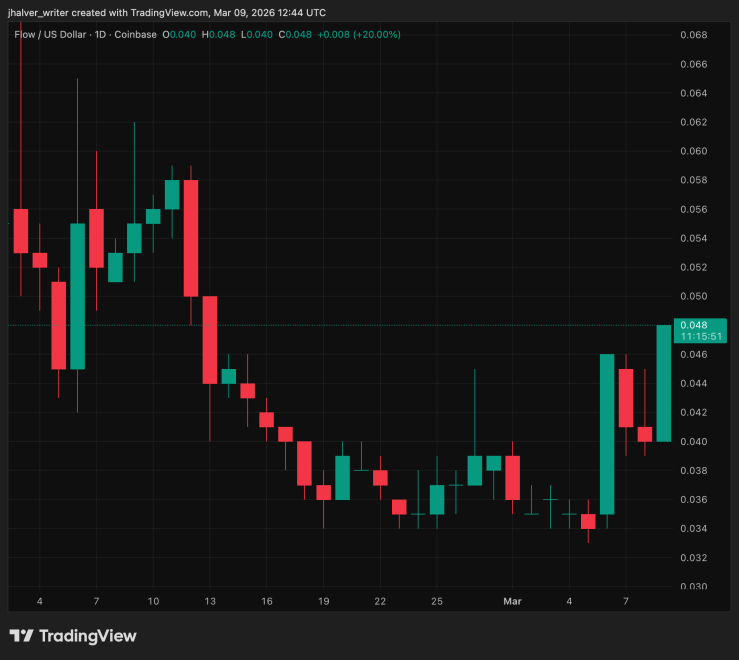
FLOW's price trends to the upside on the daily chart. Source: FLOWUSD on Tradingview

Cover image from ChatGPT, FLOWUSD chart from Tradingview

Трендові криптовалюти

Пов'язані питання

QWhat action did Flow Foundation take in response to the planned delisting of FLOW on major South Korean exchanges?

AFlow Foundation filed a motion with the Seoul Central District Court to suspend the planned termination of FLOW trading on Upbit, Bithumb, and Coinone.

QWhat was the primary reason cited by the Korean exchanges for their decision to delist FLOW token?

AThe exchanges cited the December protocol-level exploit that allowed an attacker to mint approximately 3.9 million duplicate tokens as the reason for the delisting.

QWhich major global cryptocurrency exchange removed its monitoring tag for FLOW after a joint resolution on March 6?

ABinance removed its monitoring tag for FLOW after the joint resolution on March 6, confirming that all security issues were resolved.

QWhich South Korean exchange conducted its own review and continued to support unrestricted FLOW trading, removing its trading-caution label?

AKorbit conducted its own review, removed a trading-caution label on February 27, and continues to support unrestricted FLOW trading.

QWhat major corporations are mentioned as continuing to build on the Flow network, contributing to its ecosystem growth?

ADisney, the NBA, the NFL, and Ticketmaster are all mentioned as continuing to build on Flow, having distributed over 100 million NFTs to more than 13 million fans.

Пов'язані матеріали

Michael Saylor: 110 Reasons to Oppose BIP-110

Michael Saylor presents 110 arguments against Bitcoin Improvement Proposal (BIP) 110, a soft fork aimed at restricting certain non-monetary data storage uses (like inscriptions) on the Bitcoin blockchain. He acknowledges the proponents' valid concerns—such as node costs, fee pressure, and preserving Bitcoin's monetary focus—but fundamentally disagrees with the proposed solution. Saylor argues that BIP 110 represents a dangerous precedent of using consensus rules to enforce value judgments on transaction validity, moving away from Bitcoin's core principles of neutrality and permissionless innovation. His key objections are organized into eleven categories: 1) It violates neutrality and hard consensus by banning currently valid transactions. 2) It fails to meet the high burden of proof required for a consensus change, lacking concrete data on the alleged crisis. 3) Its seven bundled technical restrictions are overly broad, targeting generic script functionalities and blocking future upgrade paths. 4) It sacrifices compatibility and future optionality by closing off designed upgrade hooks. 5) Its temporary rules add significant complexity (grandfathering, expiry states) without sufficient justification. 6) The economic and security impacts, particularly on miner revenue and fee markets, are uncertain and unmodeled. 7) Superior, market-based tools (fee markets, relay/mining policies) already exist to manage blockchain load. 8) It stifles innovation by creating a chilling effect for developers. 9) Its modified activation mechanism (55% threshold, forced signaling) is aggressive and risks network splits. 10) The precedent it sets—using consensus to suppress disliked but legal uses—is more dangerous than the problem it aims to solve. 11) A better path exists: improving measurements, refining resource-based policies, and allowing market forces to work. Saylor concludes that Bitcoin's strength lies in its neutral rules, open markets, and hard consensus. Changing these foundational elements to target specific use cases is an unnecessary and risky "iatrogenic" intervention. He advocates for guarding Bitcoin's neutrality rather than acting as its redeemer.

marsbit6 хв тому

Michael Saylor: 110 Reasons to Oppose BIP-110

marsbit6 хв тому

Торгівля

Спот

Популярні статті

Як купити FLOW

Ласкаво просимо до HTX.com! Ми зробили покупку Flow (FLOW) простою та зручною. Дотримуйтесь нашої покрокової інструкції, щоб розпочати свою криптовалютну подорож.Крок 1: Створіть обліковий запис на HTXВикористовуйте свою електронну пошту або номер телефону, щоб зареєструвати обліковий запис на HTX безплатно. Пройдіть безпроблемну реєстрацію й отримайте доступ до всіх функцій.ЗареєструватисьКрок 2: Перейдіть до розділу Купити крипту і виберіть спосіб оплатиКредитна/дебетова картка: використовуйте вашу картку Visa або Mastercard, щоб миттєво купити Flow (FLOW).Баланс: використовуйте кошти з балансу вашого рахунку HTX для безперешкодної торгівлі.Треті особи: ми додали популярні способи оплати, такі як Google Pay та Apple Pay, щоб підвищити зручність.P2P: Торгуйте безпосередньо з іншими користувачами на HTX.Позабіржова торгівля (OTC): ми пропонуємо індивідуальні послуги та конкурентні обмінні курси для трейдерів.Крок 3: Зберігайте свої Flow (FLOW)Після придбання Flow (FLOW) збережіть його у своєму обліковому записі на HTX. Крім того, ви можете відправити його в інше місце за допомогою блокчейн-переказу або використовувати його для торгівлі іншими криптовалютами.Крок 4: Торгівля Flow (FLOW)Легко торгуйте Flow (FLOW) на спотовому ринку HTX. Просто увійдіть до свого облікового запису, виберіть торгову пару, укладайте угоди та спостерігайте за ними в режимі реального часу. Ми пропонуємо зручний досвід як для початківців, так і для досвідчених трейдерів.

295 переглядів усьогоОпубліковано 2024.12.10Оновлено 2026.06.02

Як купити FLOW

Обговорення

Ласкаво просимо до спільноти HTX. Тут ви можете бути в курсі останніх подій розвитку платформи та отримати доступ до професійної ринкової інформації. Нижче представлені думки користувачів щодо ціни FLOW (FLOW).

活动图片










