Five Institutions Outline the 2026 Crypto Blueprint: Will the 'Super App' Arrive? Is the 'Four-Year Cycle' Ending?

Odaily星球日报Опубліковано о 2025-12-25Востаннє оновлено о 2025-12-25

Анотація

Five major crypto research institutions (Coinbase, a16z Crypto, Four Pillars, Messari, and Delphi Digital) forecast a shift in the crypto landscape for 2026, marked by structural maturation rather than short-term speculation. Key predictions include: - The end of the 4-year market cycle driven by Bitcoin halvings, replaced by institutional adoption and macro liquidity. - Rise of the "Agent Economy": AI agents will autonomously manage funds and execute complex DeFi strategies, requiring new infrastructure like KYA (Know Your Agent) protocols. - Emergence of "Super Apps": User-friendly applications will abstract blockchain complexity, integrating payments, investing, and lending, fueled by clearer U.S. regulations. - Growth of "Ownership Tokens": Tokens with integrated economic, legal, and governance rights will gain prominence, alongside revenue-sharing models. - Privacy and DePIN convergence: Privacy-focused assets (e.g., ZEC) and decentralized physical infrastructure networks will see renewed demand, especially for AI and data computation. - Institutional liquidity from ETFs and tokenization of real-world assets (RWA) will formalize crypto as an asset class. Overall, the focus shifts from speculation to utility, driven by regulatory clarity, AI integration, and infrastructure scalability.

Original fromEli5DeFi

Compiled by | Odaily Planet Daily Golem(@web 3_golem)

As 2025 draws to a close, major crypto research institutions are releasing reports and making predictions on industry trends for the coming year, forming a new consensus: the era of pure speculation is fading, replaced by structural maturation, driven not by short-term profit motives but by liquidity convergence, infrastructure development, and integration.

Odaily Planet Daily has compiled the core predictions for 2026 from five research institutions—Coinbase, A16Z Crypto, Four Pillars, Messari, and Delphi Digital:

  • End of the Four-Year Cycle: Research institutions unanimously agree that the four-year speculative halving cycle is fading. It is being replaced by structural maturation, where value will flow to "ownership tokens" with profit-sharing models and projects with practical utility, rather than being driven by short-term gains.
  • Rise of the Agent Economy: Major research institutions (Delphi Digital, a16z, Coinbase) predict that AI agents will become primary economic actors. Market focus may shift to KYA (Know Your Agent) identity protocols and machine-native settlement layers.
  • Super Apps: With the clarification of US regulatory policies (Four Pillars, Messari), complex crypto experiences will be simplified into user-friendly "super apps" and privacy-preserving blockchains, thus abstracting away the technology to enable mass adoption.

Delphi Digital 2026 Outlook
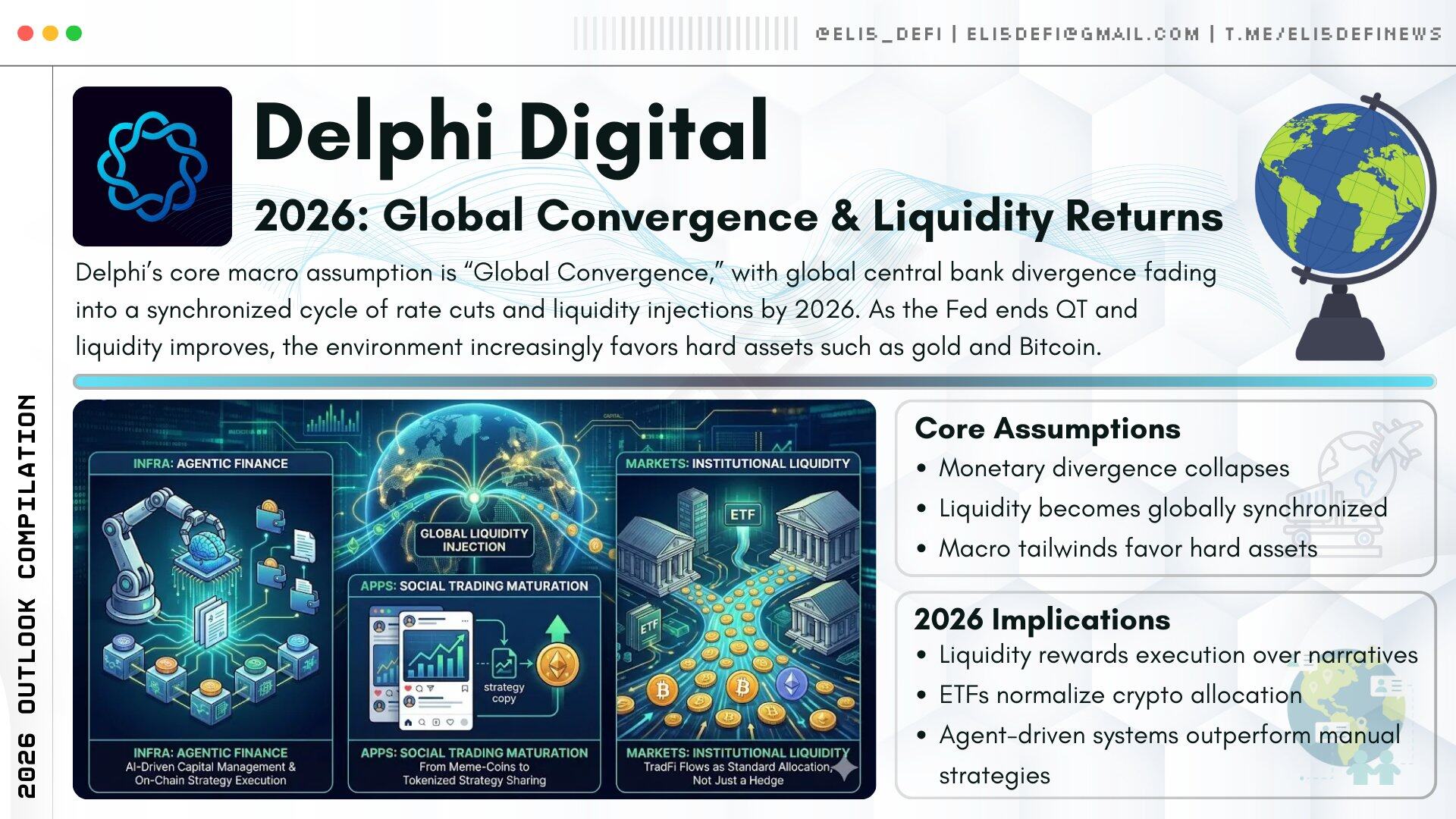
Delphi Digital bases its outlook on a "global convergence" macro assumption. They predict that by 2026, the divergence in global central bank policies will end, shifting towards a unified cycle of interest rate cuts and liquidity injection. As the Federal Reserve ends quantitative tightening (QT) and global liquidity improves, the market environment will favor hard assets like gold and Bitcoin.

Agent Economy

A major expansion of infrastructure is the rise of the "agent economy." AI agents will no longer be just chatbots but will actively manage funds, execute complex DeFi strategies, and optimize on-chain yields without human intervention.

Social Trading and the "Pump" Economy

On the consumer application front, Delphi highlighted the user stickiness of platforms like pump.fun and predicts that "social trading" will mature. This trend will evolve from simple meme coin gambling to complex copy-trading tiers, with strategy sharing becoming a tokenized product.

Institutional Liquidity

Market structure will be altered by the deepening adoption of ETFs, with traditional finance liquidity flowing into the crypto market not just as a hedge but as a standard portfolio allocation driven by macro liquidity easing.

Full report link: https://members.delphidigital.io/reports/the-year-ahead-for-infra-2026

Messari 2026 Outlook
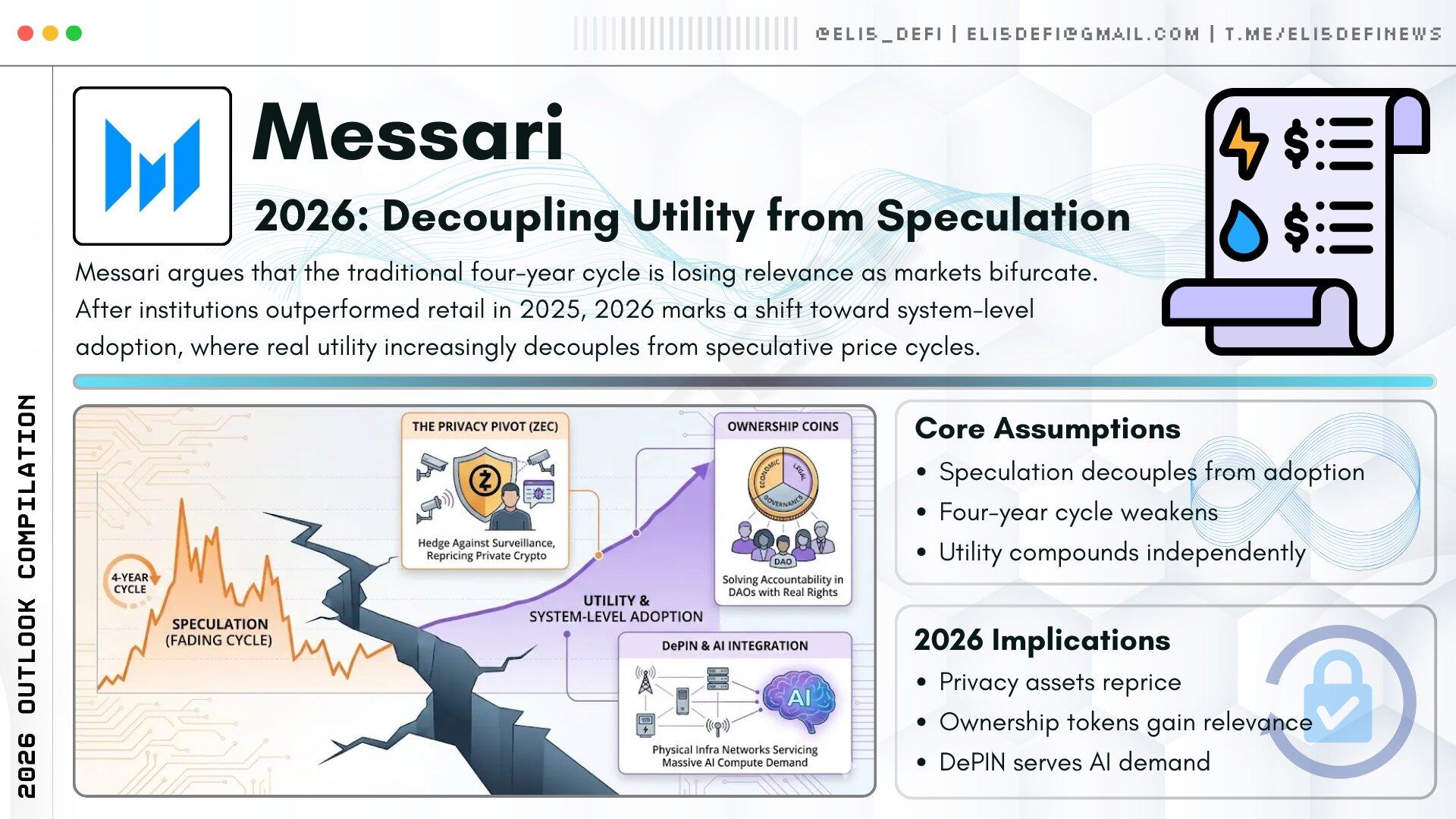
Messari's core thesis is the "decoupling of utility and speculation." They argue that as the market bifurcates, the relevance of the "four-year cycle" model is diminishing. They posit that 2025 was a year where institutional investors won and retail investors struggled, setting the stage for 2026 to be about "system-level adoption" rather than mere asset price speculation.

Rise of Privacy Coins ($ZEC)

A contrarian expansion trend is the renaissance of privacy. Messari emphasizes that Zcash (ZEC) and similar assets are not just "privacy coins" but necessary hedges against growing surveillance and corporate control, predicting a repricing of "private cryptocurrencies."

Ownership Tokens

2026 will see the emergence of a new category—"ownership tokens"—which combine economic, legal, and governance rights. Messari believes ownership tokens can address the accountability crisis in DAOs and potentially spawn the first billion-dollar projects in this specific niche.

DePIN and AI Convergence

This thesis focuses on DePIN (Decentralized Physical Infrastructure Networks), expecting these protocols to find real product-market fit by meeting the massive computational and data demands of the AI sector.

Full report link: https://messari.io/report/the-crypto-theses-2026

Four Pillars 2026 Outlook
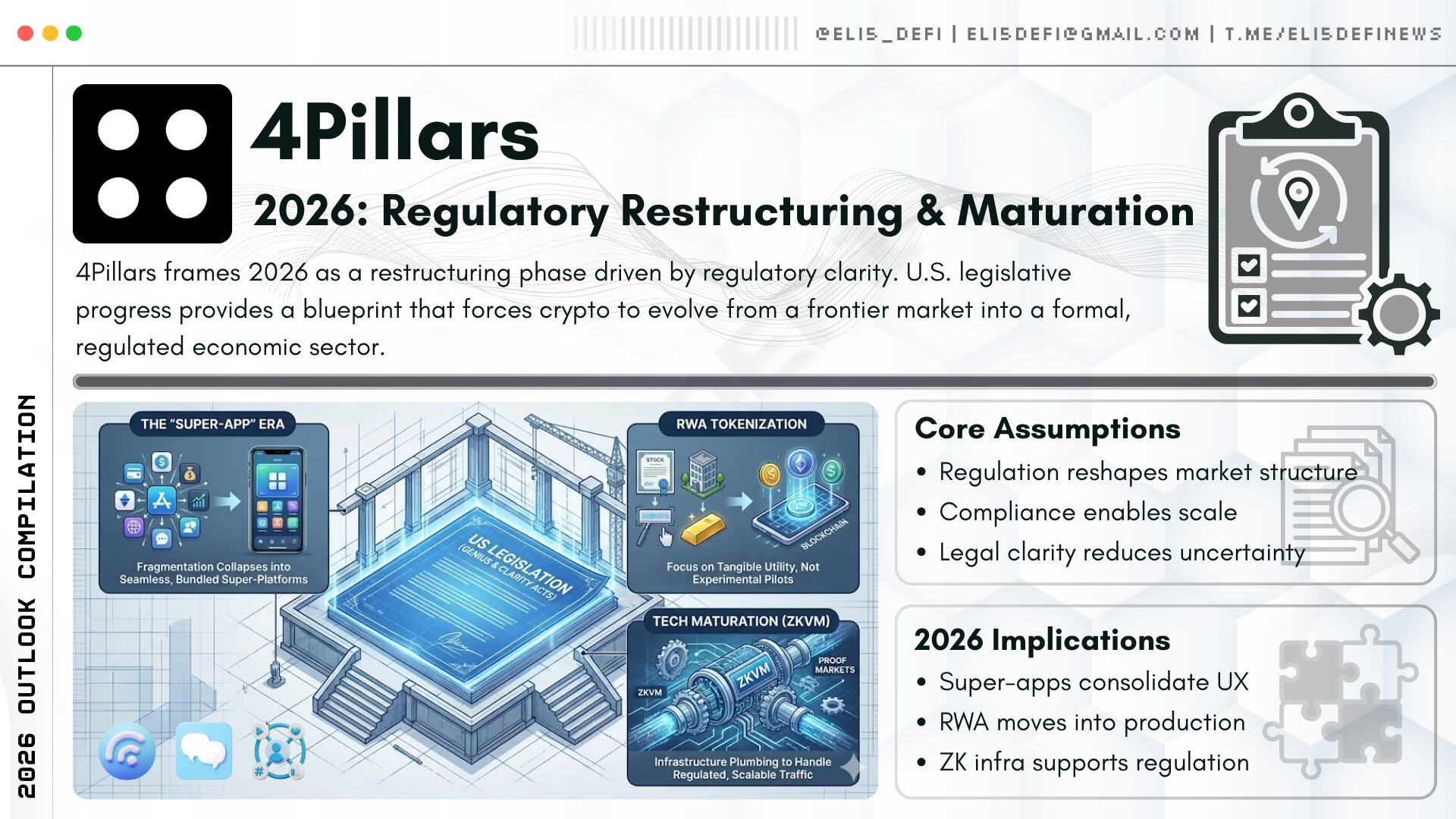
Four Pillars' outlook centers on "regulatory restructuring." Their core assumption is that US legislative initiatives (specifically mentioning the "GENIUS Act" and "CLARITY Act" in their predictions) will provide a blueprint for a comprehensive market overhaul.

This regulatory clarity is the catalyst for restructuring the market from a "Wild West" frontier into a formal economic sector.

The Era of "Super Apps"

Four Pillars predict that the fragmentation of crypto applications will finally coalesce into "super apps"—stablecoin-powered platforms that seamlessly integrate payment, investment, and lending functions. The complexity of blockchain will be completely abstracted away.

RWA Tokenization

Restructuring will drive the tokenization of equities and traditional assets, but the focus will be on actual utility, not experimental pilot programs.

Crypto Tech Maturation

On the technology side, they delve into the role of Zero-Knowledge Virtual Machines (ZKVM) on Ethereum and proof markets, seeing them as necessary infrastructure to handle the scale of this new, regulated institutional flow.

Full report link: https://4pillars.io/en/articles/2026-outlook-restructuring-100ys-perspective

Coinbase 2026 Outlook

Coinbase's report predicts the "end of the four-year cycle." They state clearly that 2026 will mark the end of the traditional Bitcoin halving cycle theory. Instead, the market will be driven by structural factors, macro demand for alternative stores of value, and the formalization of crypto as a mid-sized alternative asset class.

Tokenomics 2.0

A shift from "governance-only" tokens to "revenue-linked" models. Protocols will increasingly implement buyback-and-burn or fee-sharing mechanisms (compliant with new regulations) to align token holder incentives with platform success.

DAT 2.0 (Digital Asset Trading)

A move towards professionalized trading and "sovereign block space" procurement, treating block space as a key commodity for the digital economy.

AI and Crypto Intersection

Coinbase anticipates significant growth in AI agents using crypto payment rails. They predict the market will need "crypto-native settlement layers" capable of handling persistent micro-transactions between machines, which traditional payment rails cannot support.

Full report link: https://www.coinbase.com/en-sg/institutional/research-insights/research/market-intelligence/2026-crypto-market-outlook

a16z Crypto 2026 Outlook
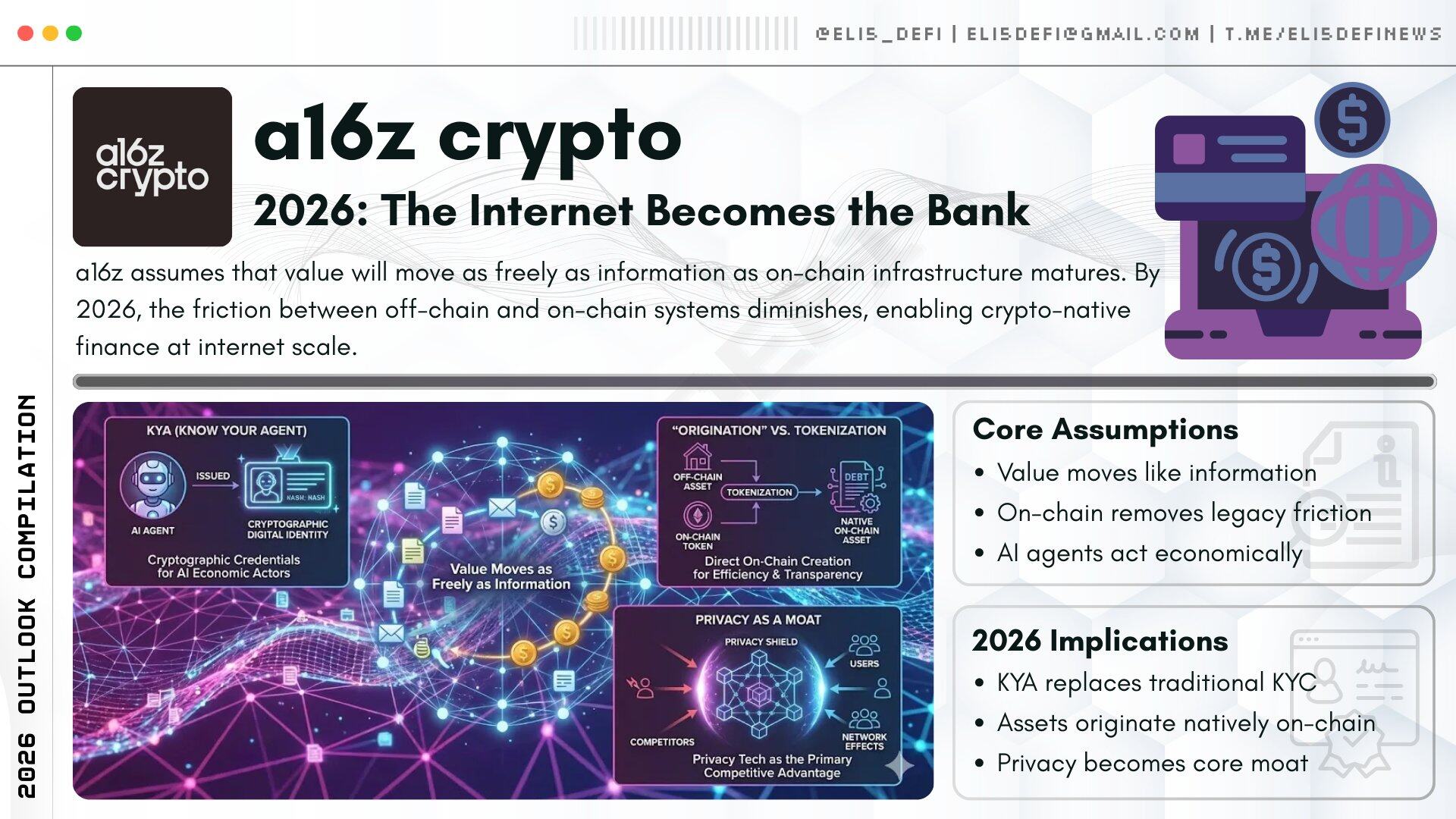
a16z crypto's outlook is that "the internet will become the bank." Their foundational belief is that value is beginning to flow as freely as information. They see the friction between the "off-chain" and "on-chain" worlds as the primary bottleneck, and 2026 will see this friction removed through better infrastructure.

KYA (Know Your Agent)

A key expansion is the shift from KYC (Know Your Customer) to KYA. As AI agents become primary economic participants, they will need cryptographically signed credentials to transact, creating a new layer of identity infrastructure.

"Native Bonds" vs. Tokenization

a16z predicts a future where instead of tokenizing off-chain assets as in the past (e.g., buying a treasury bill and putting it on-chain), debt and assets will be originated directly on-chain to lower the cost of service and increase transparency.

Privacy Tech Moat

They argue that in the era of open-source code, privacy technology (and the ability to protect state privacy) will become the most important competitive moat for blockchains, creating powerful network effects for privacy-enabled chains.

Wealth Management for All

The combination of AI and crypto infrastructure will democratize complex wealth management (e.g., asset rebalancing, tax-loss harvesting), previously accessible only to high-net-worth individuals, for the masses.

Full report link: https://a16zcrypto.com/posts/article/big-ideas-things-excited-about-crypto-2026/


Пов'язані питання

QWhat is the consensus among major crypto research institutions regarding the future of the four-year market cycle?

AMajor research institutions like Coinbase, a16z, and Messari believe the traditional four-year speculative cycle driven by events like Bitcoin halvings is ending. It is being replaced by structural maturity, where value flows to 'ownership tokens' with revenue-sharing models and projects with real utility, rather than being driven by short-term speculation.

QWhat is the 'Agent Economy' predicted by Delphi Digital and other firms for 2026?

AThe 'Agent Economy' refers to a future where AI agents evolve beyond simple chatbots to become primary economic actors. These agents will autonomously manage capital, execute complex DeFi strategies, and optimize on-chain yields without human intervention, requiring new infrastructure like KYA (Know Your Agent) protocols and machine-native settlement layers.

QAccording to Four Pillars and Messari, what will drive the emergence of 'Super Apps' in crypto?

AThe emergence of 'Super Apps' is predicted to be driven by clearer US regulatory policies. These user-friendly applications will abstract away blockchain's complexity, seamlessly integrating functions like payments, investing, and lending, all powered by stablecoins, to achieve mass adoption.

QHow does Messari define 'Ownership Tokens' and what problem do they aim to solve?

AMessari defines 'Ownership Tokens' as a new asset class that combines economic, legal, and governance rights. They aim to solve the accountability crisis in DAOs by better aligning incentives and could potentially birth the first billion-dollar projects within that specific niche.

QWhat key shift in tokenomics does Coinbase predict for 2026, moving away from the current model?

ACoinbase predicts a shift from tokens that are 'governance-only' to a 'Tokenomics 2.0' model where tokens are linked to protocol revenue. This involves the implementation of mechanisms like buybacks, burns, or fee-sharing (in compliance with new regulations) to directly tie tokenholder incentives to the platform's financial success.

Пов'язані матеріали

380,000 Apps Exposed, 2,000+ Apps Leaked Secrets: AI Programming Turns 'Intranet' into Public Internet

Israeli cybersecurity firm RedAccess uncovered a severe data exposure trend linked to "vibe coding" or AI-powered software development tools. Their research found approximately 38,000 publicly accessible web applications built with platforms like Lovable, Base44, Netlify, and Replit. Of these, an estimated 2,000 apps exposed sensitive corporate and personal data, including medical records, financial information, internal strategic documents, and customer chat logs. In some cases, access even granted administrative privileges. The core issue stems from default privacy settings that make applications public by default, combined with a lack of built-in security controls (like authentication) in the AI-generated code. This allows employees without security expertise—"citizen developers"—to easily create and deploy applications that bypass standard corporate security reviews. The exposed apps, often indexed by search engines, are trivially discoverable. While some platform providers (Replit, Lovable, Wix/Base44) argue that security configuration is the user's responsibility and question the validity of some findings, security researchers confirm the widespread reality of such exposures. This pattern, also noted in prior studies, highlights a critical security gap as AI democratizes app creation, potentially leading to massive, unintentional data leaks.

marsbit35 хв тому

380,000 Apps Exposed, 2,000+ Apps Leaked Secrets: AI Programming Turns 'Intranet' into Public Internet

marsbit35 хв тому

Attracting Global Capital, Asia's New 'Super Cycle' Is Unfolding

Investors are turning to Asia as the next frontier for global equity growth, with a new "super cycle" unfolding across the region. Driven by the AI revolution, Asian markets, particularly South Korea, have seen significant rallies. According to Morgan Stanley analysis, the underlying drivers of Asia's industrial cycle are shifting from traditional sectors like real estate and manufacturing to massive investments in AI infrastructure, energy security and transition, and supply chain resilience. Fixed asset investment in Asia is projected to grow from around $11 trillion in 2025 to $16 trillion by 2030, with a 7% annual growth rate from 2026-2030. The AI wave is a primary catalyst, driving immense capital expenditure for chips, servers, data centers, and power systems. Asia is central to this hardware supply chain. In China, AI investment is focused on building a full-system domestic capability, with the local AI chip market potentially reaching $86 billion by 2030. Beyond AI, China's export story is expanding from EVs and batteries to robotics. The country already captures about half of new global industrial robot demand and over 90% of humanoid robot shipments. This growth phase mirrors the early stages of China's EV export boom. Simultaneously, energy security investments, spurred by AI's massive power needs, are rising, with China benefiting from its leadership in solar, batteries, and EVs. Regional defense spending is also increasing structurally, supporting demand for advanced manufacturing. The main beneficiaries are China, South Korea, and Japan, positioned in core supply chain areas. However, risks remain, including potential overcapacity, profit margin pressures from competition, persistent technological restrictions, geopolitical friction, and workforce displacement due to AI-driven automation. Market volatility is also expected to increase as investor expectations diverge on the realization of these capital investment and export themes.

marsbit36 хв тому

Attracting Global Capital, Asia's New 'Super Cycle' Is Unfolding

marsbit36 хв тому

Funding Weekly Report | 14 Public Funding Events, Kalshi Completes $10B New Funding Round at $220B Valuation Led by Coatue Management

Weekly Funding Roundup: 14 Deals and $10.49B+ in Total Funding, Led by Kalshi's $1B Round Last week (5.4-5.10) saw 14 notable funding events in the global blockchain ecosystem, raising over $10.49 billion in total. Key highlights include Kalshi, a prediction market platform, securing a $1 billion round led by Coatue Management, reaching a $22 billion valuation. The platform now boasts ~2 million MAUs and $178B in annualized trading volume. In DeFi, regulated on-chain reinsurer OnRe raised $5 million in Series A funding, and Bitcoin-backed credit protocol Saturn Credit completed a $2 million seed round. For Infrastructure & Tools, OpenTrade raised $17 million to expand its stablecoin yield infrastructure, and RWA platform Balcony secured $12.7 million to deploy its property settlement service in the US. Centralized Finance saw one deal: AI-driven trading platform Stockcoin.ai completed a seed round led by Amber Group. In the prediction market sector alongside Kalshi, AI-powered platform Elastics raised $2 million. Other notable deals include SC Ventures' strategic investment in crypto market maker GSR and Centrifuge securing a "seven-figure" investment from Coinbase to become a core RWA partner for Base. On the investor side, Haun Ventures raised a new $1 billion fund targeting crypto and AI, and Multi Investment raised ~$616 million to focus on blockchain and Web3 investments.

marsbit1 год тому

Funding Weekly Report | 14 Public Funding Events, Kalshi Completes $10B New Funding Round at $220B Valuation Led by Coatue Management

marsbit1 год тому

Торгівля

Спот
Ф'ючерси

Популярні статті

Як купити SUPER

Ласкаво просимо до HTX.com! Ми зробили покупку SuperFarm (SUPER) простою та зручною. Дотримуйтесь нашої покрокової інструкції, щоб розпочати свою криптовалютну подорож.Крок 1: Створіть обліковий запис на HTXВикористовуйте свою електронну пошту або номер телефону, щоб зареєструвати обліковий запис на HTX безплатно. Пройдіть безпроблемну реєстрацію й отримайте доступ до всіх функцій.ЗареєструватисьКрок 2: Перейдіть до розділу Купити крипту і виберіть спосіб оплатиКредитна/дебетова картка: використовуйте вашу картку Visa або Mastercard, щоб миттєво купити SuperFarm (SUPER).Баланс: використовуйте кошти з балансу вашого рахунку HTX для безперешкодної торгівлі.Треті особи: ми додали популярні способи оплати, такі як Google Pay та Apple Pay, щоб підвищити зручність.P2P: Торгуйте безпосередньо з іншими користувачами на HTX.Позабіржова торгівля (OTC): ми пропонуємо індивідуальні послуги та конкурентні обмінні курси для трейдерів.Крок 3: Зберігайте свої SuperFarm (SUPER)Після придбання SuperFarm (SUPER) збережіть його у своєму обліковому записі на HTX. Крім того, ви можете відправити його в інше місце за допомогою блокчейн-переказу або використовувати його для торгівлі іншими криптовалютами.Крок 4: Торгівля SuperFarm (SUPER)Легко торгуйте SuperFarm (SUPER) на спотовому ринку HTX. Просто увійдіть до свого облікового запису, виберіть торгову пару, укладайте угоди та спостерігайте за ними в режимі реального часу. Ми пропонуємо зручний досвід як для початківців, так і для досвідчених трейдерів.

190 переглядів усьогоОпубліковано 2024.12.11Оновлено 2025.03.21

Як купити SUPER

Обговорення

Ласкаво просимо до спільноти HTX. Тут ви можете бути в курсі останніх подій розвитку платформи та отримати доступ до професійної ринкової інформації. Нижче представлені думки користувачів щодо ціни SUPER (SUPER).

活动图片












