Financing Weekly Report | 11 Public Financing Events, Latin American Financial App ARQ Focused on Stablecoins Completes $70 Million Financing

marsbitОпубліковано о 2026-03-09Востаннє оновлено о 2026-03-09

Анотація

PANews Weekly Funding Roundup (Mar 2-8): 11 Funding Deals, Totaling Over $184M This week saw 11 disclosed funding events in the blockchain sector. Key highlights include: **DeFi:** - OmniPact, a decentralized protocol for P2P transactions, secured $50M in private funding. - QFEX raised $9.5M in a seed round for its 24/7 high-leverage RWA trading platform. - Sats Terminal received a strategic investment from Gate Ventures. **Web3 & AI:** - AI Agent yield protocol Superpower completed an undisclosed pre-seed round. **Infrastructure & Tools:** - Cyclops raised $8M to develop stablecoin payment infrastructure. - Decentralized cloud storage provider Akave secured $6.65M. - Bitcoin USDT infrastructure project Utexo completed a $7.5M round. - Pre-confirmation network Interstate raised $1.5M. **CeFi:** - Latin American stablecoin-focused app ARQ (formerly DolarApp) raised $70M with participation from Sequoia and Founders Fund. - Digital asset trading firm Crossover raised $31M in a Series B round led by Tradeweb. *Note: Two major funding rounds for AI procurement firm Lio ($30M) and robotics company Neura Robotics (~$1B) were reported but excluded from the official count.*

Highlights of This Issue

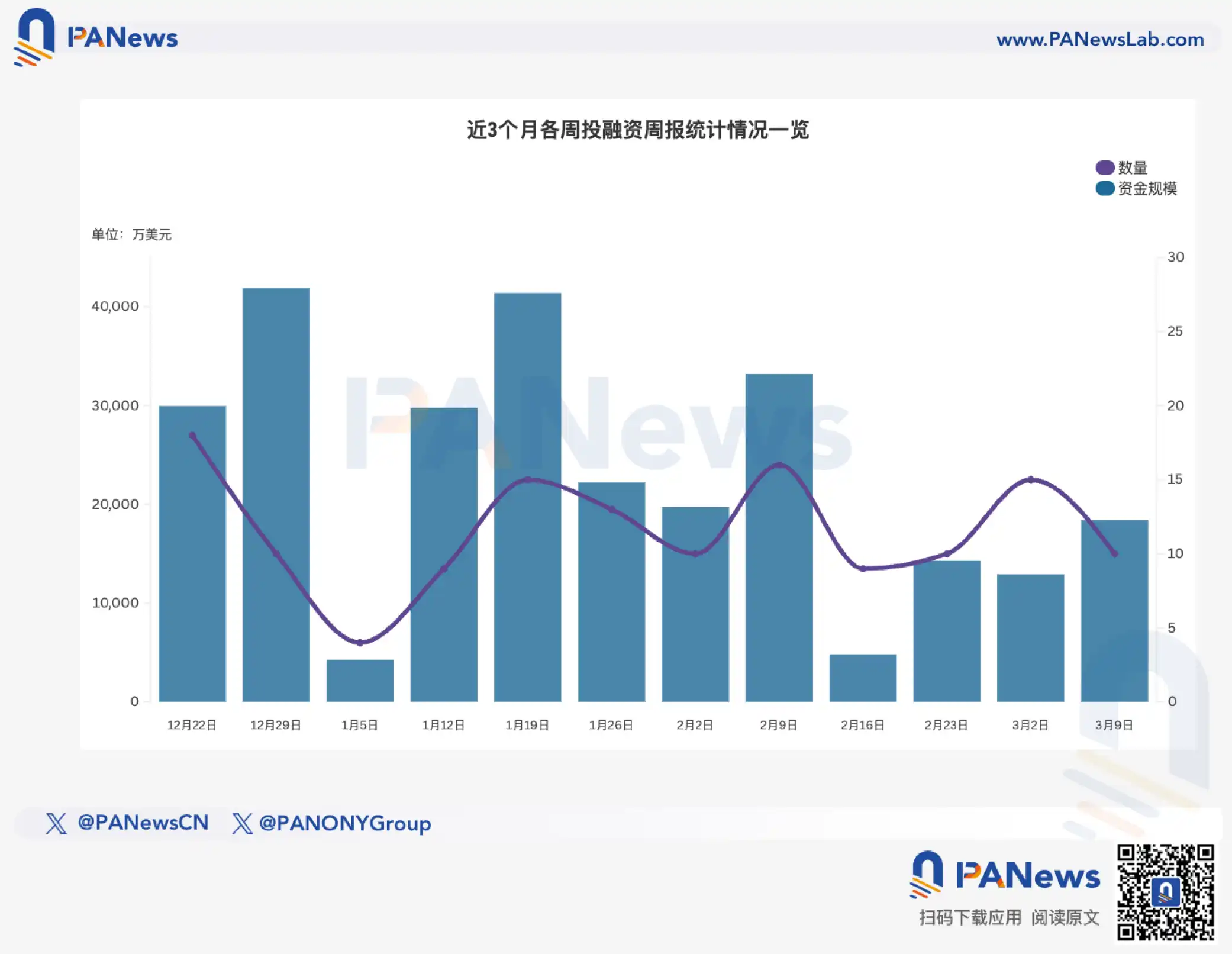
According to incomplete statistics from PANews, there were 11 investment and financing events in the global blockchain sector last week (3.2-3.8), with a total funding scale exceeding $184 million. The overview is as follows:

  • DeFi announced 3 investment and financing events, among which QFEX completed a $9.5 million seed round financing;
  • Web3+AI announced 1 investment and financing event, AI Agent revenue protocol Superpower completed Pre-Seed round financing, with participation from Taisu Ventures and others;
  • Infrastructure & Tools announced 5 investment and financing events, among which Cyclops completed $8 million financing, with investors including Castle Island Ventures, etc.;
  • Centralized Finance announced 2 investment and financing events, among which digital asset trading company Crossover completed a $31 million Series B financing, led by Tradeweb;
DeFi

On-chain escrow decentralized protocol OmniPact completes $50 million private financing

The decentralized protocol OmniPact, which builds a trust layer for peer-to-peer transactions of physical and digital assets, announced the completion of $50 million in private financing. The investors are a consortium of institutional investors and family offices that requested anonymity. The protocol uses smart contracts as on-chain escrow to solve the "trust problem" in peer-to-peer transactions. The new funds will support the development of its core contracts and multi-chain infrastructure, as well as related security audits, while promoting the launch of its testnet in Q1 2026.

QFEX completes $9.5 million seed round financing and launches 24/7 high-leverage RWA trading platform

QFEX announced the completion of a $9.5 million seed round financing. This round was led by General Catalyst partner Yuri Sagalov, with participation from Paul Graham, Y Combinator, and multiple institutions and angels. Investors include NexusVP, Moonfire VC, Goodwater Capital, Liquid2V, 468 Capital, RitualVC, etc. QFEX claims to be the first high-leverage exchange led by a traditional finance team that allows 24/7 trading of traditional assets (RWA), offering investors up to 50x leverage for trading US stocks, commodities, and foreign exchange. The team members come from Citadel, Jump Trading, Optiver, Jane Street, Tower Research Capital, and Flow Traders.

Sats Terminal receives strategic investment from Gate Ventures

Gate Ventures, the venture capital arm of Gate.com, announced a strategic investment in the Bitcoin-native financial platform Sats Terminal. The latter focuses on providing self-custody trading, lending, and yield services for BTC holders, aiming to integrate the fragmented Bitcoin DeFi infrastructure into a more user-friendly unified entry point, lowering the barrier to entry for retail and institutional use.

AI

AI Agent revenue protocol Superpower completes Pre-Seed round financing, with participation from Taisu Ventures and others

The AI Agent revenue protocol Superpower announced on platform X the completion of a Pre-Seed round financing, with the amount undisclosed. Taisu Ventures, 280 Capital, Paper Ventures, and CatcherVC participated.

AI procurement agent company Lio completes $30 million Series A financing, led by a16z

AI procurement agent startup Lio announced the completion of a $30 million Series A financing, led by Andreessen Horowitz. Lio builds virtual procurement teams for large enterprises, taking over the entire process from demand submission, inquiry and price comparison, supplier negotiation, supplier onboarding, to placing orders in ERP, email, and contract systems through natural language requests. a16z stated that the current procurement processes of large global enterprises still heavily rely on emails, PDFs, and manual coordination, with procurement transaction volumes linearly tied to the scale of human resources, and enterprises spending approximately hundreds of billions of dollars annually on procurement manpower. Lio attempts to break this linear relationship through scalable AI agents, automating traditional back-office procurement work.

(This financing event is not included in this week's report statistics)

Infrastructure & Tools

Cyclops secures $8 million financing to advance stablecoin payment infrastructure

US stablecoin infrastructure startup Cyclops completed $8 million in financing. Investors include Castle Island Ventures, F-Prime, and payment company Shift4 Payments. The valuation was not disclosed. Cyclops provides underlying stablecoin settlement technology for merchants and payment companies in industries such as aviation and hotels. It currently cooperates with helicopter travel company Blade and merchants using Shift4 like Blue Origin, providing a "technical pipeline" when they complete 24/7 settlements via stablecoins. The company was founded by Alex Wilson and two others, currently has about 20 employees, profits from transaction fees, and plans to further expand cooperation with payment and card organizations such as Fiserv, Adyen, Global Payments, and Visa, Mastercard, American Express.

Decentralized cloud storage service provider Akave completes $6.65 million seed round financing

Decentralized cloud storage service provider Akave announced the completion of $6.65 million in financing. Participants include Protocol Labs, No Limit Holdings, Blockchange, Lightshift, Blockchain Builders Fund, Big Brain Holdings, Avalanche Foundation, and Filecoin Foundation, among others. Akave Cloud is an S3-compatible decentralized storage platform built on a dedicated Avalanche Layer 1 blockchain, aiming to provide enterprises with an alternative to traditional cloud storage, supporting AI applications to run without being locked into specific cloud service providers.

Utexo completes $7.5 million financing, with participation from Tether, Gate Ventures, etc.

The Bitcoin USDT infrastructure project Utexo completed $7.5 million in financing. Investors include Tether, BigBrainVC, Portal Ventures, Gate Ventures, etc. Utexo stated it will promote the native deployment of USDT on the Bitcoin network, claiming "USDT is finally coming home after more than a decade." This round also attracted follow-on investments from multiple institutions including Alchemy, FTI Global, Maven11 Capital, KuCoin Ventures, and early participants of projects like Ledger.

Utexo is a Bitcoin-native settlement infrastructure that integrates the RGB protocol and the Lightning Network, supporting private, instant, and non-custodial stablecoin transactions on the Bitcoin network, directly introducing stablecoin liquidity into the Bitcoin ecosystem and expanding decentralized financial application scenarios.

Five Bells, founded by former NYDIG executives, completes seed round financing, building a "native Bitcoin DvP settlement layer"

Five Bells, co-founded by former NYDIG and Two Sigma executives, has completed a seed round financing. Ego Death Capital led the round, with Epoch VC, Timechain, and Fulgur Ventures participating.

Five Bells is building what it calls the "first native Bitcoin DvP settlement layer," aiming to address counterparty risks in large-scale Bitcoin transactions for institutions. Its solution allows both parties to a transaction to pre-lock settlement terms on-chain, lock BTC in a mechanism similar to escrow, and automatically complete delivery upon confirmation of fiat wire transfer or stablecoin payment, thereby eliminating operational friction and settlement costs. The solution is based on Taproot FROST contracts, utilizing the Bitcoin network as a neutral and shared trust anchor. The company plans to officially launch the service to customers after completing final testing and audits.

Ethereum-based pre-confirmation network Interstate completes $1.5 million financing

The Ethereum-based pre-confirmation network Interstate completed $1.5 million in financing. Participants include Marshland Capital, Taisu Ventures, Bloccelerate, Alpen Labs, GD1, MH Ventures, Alchemy Ventures, Legends Group, Waikit Lau, and Sergey Gorbunov. According to the introduction, Interstate is a company focused on cryptocurrency R&D, committed to improving the Ethereum user experience by shortening transaction confirmation times. Their pre-confirmation network allows users to receive transaction confirmation in about 100 milliseconds, faster than Ethereum's standard 12-second block time.

Centralized Finance

Financial app ARQ focused on stablecoins completes $70 million financing, with participation from Sequoia Capital and Founders Fund

The Latin American financial application ARQ, focused on stablecoins, completed $70 million in financing, with participation from Sequoia Capital and Founders Fund. This round of financing will be used for rebranding, hiring new employees, and expanding services beyond US dollar-denominated transfers, including wealth management, local currency high-yield accounts, and credit business.

ARQ, formerly known as DolarApp, provides multi-currency accounts, digital wallets, foreign exchange, and debit card services, helping users store and transfer funds across borders. It has over 2 million customers in Latin America, with annualized transaction volume exceeding $10 billion. ARQ stated that it has built infrastructure connecting traditional banking networks and stablecoin-based payment systems, enabling users to hold and transact in foreign currencies.

Digital asset trading company Crossover completes $31 million Series B financing, led by Tradeweb

Fixed income trading giant Tradeweb Markets led a $31 million Series B investment in digital asset trading company Crossover Markets Group. DRW Venture Capital, Ripple, Virtu Financial, Wintermute Ventures, XTX Markets, and Illuminate Financial participated. The deal values Crossover at approximately $200 million. As part of the transaction, Tradeweb will utilize its algorithmic technology to route institutional clients' crypto orders through the platform, providing a direct channel for their entry into the digital asset space.

Crossover was founded in 2022 by foreign exchange market veterans from Jefferies and Euronext FX. Its CROSSx platform adopts an ECN model, separating trade execution from custody and credit. Since its launch, it has matched over $50 billion in notional trading volume.

Others

Robotics company Neura Robotics secures approximately €1 billion financing led by Tether, valuation reaches €4 billion

German humanoid robot startup Neura Robotics is raising approximately €1 billion in financing. This round involves participation from stablecoin issuer Tether Holdings, with a post-money valuation of about €4 billion. Informed sources said the company may continue to raise funds after this round. Neura Robotics focuses on AI-driven humanoid robots. Its website showcases its use in automotive assembly lines and household scenarios. The company currently sells factory transport robots and home robotic arm devices. CEO David Reger previously stated that the company's order size last year was close to $1 billion, with customers including Japan's Kawasaki Heavy Industries and Omron.

(This financing event is not included in this week's report statistics)

Пов'язані питання

QHow many investment and financing events were recorded in the blockchain sector last week, and what was the total funding amount?

AThere were 11 investment and financing events in the blockchain sector last week, with a total funding amount exceeding $184 million.

QWhich company in the DeFi sector raised $95 million in a seed round, and what is its primary business focus?

AQFEX raised $95 million in a seed round. It is a high-leverage RWA trading platform offering 24/7 trading of traditional assets like stocks, commodities, and forex with up to 50x leverage.

QWhat is the core innovation of the OmniPact protocol, and how much did it raise in its private funding round?

AOmniPact is a decentralized protocol that uses smart contracts as on-chain escrow to solve the 'trust problem' in peer-to-peer transactions for physical and digital assets. It raised $50 million in a private funding round.

QWhich Latin American financial application focused on stablecoins raised $70 million, and which major venture capital firms participated?

AARQ, a financial application focused on stablecoins in Latin America, raised $70 million. The round saw participation from Sequoia Capital and Founders Fund.

QWhat infrastructure did the company Cyclops build, and how much funding did it secure to advance it?

ACyclops built stablecoin payment infrastructure for merchants and payment companies, providing the underlying technology for 24/7 settlements. It secured $8 million in funding to advance this.

Пов'язані матеріали

Has the 'Digital Gold' Narrative for BTC Failed?

**Title: Has the "Digital Gold" Narrative for Bitcoin Failed?** The article argues that Bitcoin's "digital gold" narrative remains valid despite a recent sharp price decline (from a peak near $126k in Oct 2025 to briefly under $61k in Feb 2026). It presents a long-term investment framework based on three core points: **1. Viewing Bitcoin as an Asset:** Bitcoin is presented as a superior potential store of value compared to gold. Key arguments are its absolute scarcity (21 million cap), superior portability, and transparent auditability via its public ledger. While acknowledging its current use in early, volatile stages (~3-4% global adoption), the author draws parallels to the early, disruptive phases of the internet and e-commerce. **2. Understanding the Recent Downturn:** The current ~50% correction is framed as a predictable, consensus-driven cycle following its post-halving peak (the 2024 halving preceded the Oct 2025 high). A crucial factor is a historic "changing of hands": the influx of new institutional buyers via ETFs allowed early, low-cost holders (miners, OG believers) to take profits. The author notes that while severe, Bitcoin's historical drawdowns (e.g., 93% in 2011, 77% in 2021-22) have been progressively smaller, suggesting maturing holder structure and decreasing volatility over time. **3. The Long-Term Perspective:** The long-term thesis hinges on Bitcoin capturing a portion of gold's market value. With Bitcoin's market cap at ~$1.4 trillion (at $70k) versus gold's ~$20 trillion, significant upside potential exists if the "digital gold" narrative is partially realized. However, the author strongly cautions that short-term risks remain, the bottom is unpredictable, and high volatility is inherent. The real risk is not Bitcoin failing but poor personal position management (over-leverage, wrong capital) and a lack of deep understanding, which can force investors out during severe downturns. The conclusion uses Amazon's 95% crash post-2000 dot-com bubble and subsequent 42x recovery as an analogy. The ultimate question is not if Bitcoin's price will rise, but if an investor's strategy and conviction can withstand the volatility to see the long-term play out. The recent divergence (gold up, Bitcoin down) is posed not as a narrative failure, but as potential evidence of this ongoing, painful transition from a speculative asset to a mainstream allocation.

marsbit1 год тому

Has the 'Digital Gold' Narrative for BTC Failed?

marsbit1 год тому

Has BTC's 'Digital Gold' Narrative Failed?

The article discusses Bitcoin's "digital gold" narrative, its recent price drop, and long-term outlook through the perspective of "Jason". It argues the narrative is not a failure but that Bitcoin represents a superior, new asset class due to its fixed supply (21 million), portability, and auditability. The piece compares its current ~3-4% global adoption rate to early internet/e-commerce, suggesting significant growth potential. Regarding the 2025-2026 price decline (from ~$126k to briefly under $61k), the author views it as a predictable, consensus-driven sell-off within Bitcoin's ~4-year cycle post-halving, exacerbated by a major "handover" from early, low-cost holders to new institutional buyers via ETFs. A key observation is that historical peak-to-trough drawdowns have lessened over time (e.g., 93% in 2011 to ~50% in 2026), indicating maturing volatility as holder structure changes. For the long term, the author uses a simple framework: Bitcoin's total market cap (~$1.4T at $70k) is only about 7% of gold's (~$20T). Even capturing 30-50% of gold's value would imply substantial upside. However, the article strongly cautions against viewing this as investment advice, emphasizing extreme volatility and the critical importance of risk management, position sizing, and deep fundamental understanding to survive severe drawdowns. It concludes by drawing a parallel to Amazon's 95% crash in 2000 and subsequent 42x recovery, stressing that the key is surviving market cycles to realize long-term potential.

链捕手1 год тому

Has BTC's 'Digital Gold' Narrative Failed?

链捕手1 год тому

From Code to Cognition: A Ten-Thousand-Word Guide to the Evolution of the Robot Brain

"From Code to Cognition: The Evolution of Robot Brains" The journey of robotic intelligence has shifted dramatically from manually coded systems to AI-driven brains. For decades, robots relied on layered software stacks—perception, state estimation, planning, control—each handcrafted. While predictable, they lacked adaptability. The 2010s saw deep learning revolutionize perception (e.g., object detection) and control (via reinforcement learning), but learned skills remained narrow. The arrival of Large Language Models (LLMs) marked a turning point. LLMs acted as high-level planners, interpreting natural language instructions and generating sequences of actions for traditional robotic systems to execute. However, true integration came with Visual-Language-Action (VLA) models, which fused vision, language, and motion prediction into a single network. Pioneered by models like RT-2 and open-source projects like OpenVLA, VLAs enable robots to reason and act directly from visual input and commands. The most advanced humanoid robots now employ a "dual-brain" architecture: a slow-thinking, large VLA (System 2) for reasoning and planning, and a fast-reacting, small network (System 1) for high-frequency motion control, sometimes with an even lower-level System 0 for balance. This split balances cognition with the physics of real-time movement. Computation is split between onboard hardware (e.g., NVIDIA Jetson) for safety-critical control loops and cloud/edge servers for non-critical tasks like learning and interfaces. A crucial driver is the open-source ecosystem—models like GR00T and OpenVLA allow startups to build upon pre-trained brains and fine-tune them with their own data, accelerating development. Despite progress, current systems struggle with recovery from errors, sample inefficiency, and long-horizon tasks. This has spurred the rise of **World Models**—neural networks that predict the consequences of actions. By simulating possible futures before acting (like NVIDIA Cosmos or Meta V-JEPA), robots can plan, recover, and generalize better. This represents the next frontier: shifting intelligence from learned reactions to an internal model of physics and cause-and-effect. The field is rapidly evolving. While not yet at its "ChatGPT moment," the convergence of cheaper hardware, scalable simulation, and world models points toward robots that are increasingly capable, adaptive, and useful. The question is shifting from "what can robots do?" to "what *should* they do?"

marsbit2 год тому

From Code to Cognition: A Ten-Thousand-Word Guide to the Evolution of the Robot Brain

marsbit2 год тому

AI Bubble Is Bursting

The AI Bubble is Bursting: A Necessary Purge on the Path to Ubiquitous Intelligence Market volatility has reignited debates about an AI bubble, with figures like Ray Dalio pointing to high valuations. However, this parallels the dot-com bubble, which, despite its crash, laid the physical infrastructure for today's internet era. The current AI investment frenzy, with tech giants planning trillions in infrastructure spending far outstripping current AI application revenues, appears similarly imbalanced. This 'bubble' is seen as an inevitable phase for a disruptive technology, paying the "innovation tax." Critically, AI inference costs have plummeted over 99.7% since 2023, making intelligence nearly free at the margin. This hasn't reduced spending but has instead unlocked massive new demand, as seen in enterprise AI cloud expenditure tripling. This follows the Jevons Paradox: efficiency gains lead to greater total consumption. The market is now entering a cleansing phase, weeding out speculative ventures lacking real moats. The deeper shift is a move from capital expenditure (CapEx) on hardware to value creation in operational expenditure (OpEx) through AI applications that solve real industry problems. While infrastructure valuations are high, rapid earnings growth from widespread AI adoption across sectors—from manufacturing and finance to law and healthcare—may digest these valuations over time. Ultimately, this creative destruction will leave behind robust infrastructure and optimized models, cheaply powering an AI-augmented future for all industries, much as the internet became indispensable after its own bubble burst. The core productive potential remains undiminished.

链捕手2 год тому

AI Bubble Is Bursting

链捕手2 год тому

Торгівля

Спот
Ф'ючерси

Популярні статті

Що таке USDC(WORMHOLE)

USD Coin (Wormhole): Всеосяжний огляд Вступ У швидко мінливому світі криптовалют USD Coin (Wormhole), що називається $USDC(Wormhole), вирізняється як піонерське рішення у сфері DeFi (децентралізовані фінанси). Функціонує на кількох блокчейн-платформах, включаючи Solana, USD Coin (Wormhole) є більше ніж просто цифрове представлення американського долара. Він втілює інноваційний дух сучасних фінансів, що дозволяє безшовні трансакції між різними ланцюгами та підвищує взаємодію між різними блокчейн-екосистемами завдяки передовому протоколу Wormhole. Що таке USD Coin (Wormhole)? USD Coin (Wormhole) — це токенізована версія американського долара, розроблена для полегшення безперешкодних трансакцій між різними блокчейн-мережами. Його основна мета — зміцнити ліквідність і поліпшити функціональність екосистеми DeFi. Використовуючи протокол Wormhole, який встановлює надійну мережу міжланцюгового зв'язку, користувачі можуть без зусиль передавати токени USDC між різними платформами. Ця можливість міжланцюгових трансакцій є суттєвим досягненням у використанні криптовалюти, сприяючи більш взаємопов'язаній та ефективній екосистемі, де активи можуть вільно пересуватися між різними блокчейнами. Цінність USD Coin (Wormhole) полягає не тільки в його стабільності, оскільки він закріплений за американським доларом, але й у його здатності заповнювати прогалини між різними блокчейн-середовищами. Цей інноваційний підхід сприяє більшій участі серед користувачів і розробників, прокладаючи шлях для нових і захоплюючих застосувань у сфері децентралізованих фінансів. Хто є творцем USD Coin (Wormhole)? Походження USD Coin (Wormhole) тісно пов'язане з мережею Wormhole, яка була розроблена Jump Crypto. Хоча конкретні індивідуальні творці не документуються, Jump Crypto відзначається своєю участю в просуванні блокчейн-технологій та підтримці їх застосувань у фінансах. Створивши мережу Wormhole, Jump Crypto зіграв життєво важливу роль у просуванні міжланцюгових передач активів, підвищуючи ефективність і різноманітність використання криптовалюти. Хто є інвесторами USD Coin (Wormhole)? Успіх USD Coin (Wormhole) підтримується інвестиціями з кількох значних фондів та організацій у світі криптовалют. Ключовими інвесторами є: Coinbase Ventures: Значна венчурна компанія, яка підтримується однією з провідних криптовалютних бірж у галузі, Coinbase Ventures надає важливий капітал і стратегічну підтримку багатообіцяючим блокчейн-проєктам. Arrington XRP Capital: Спеціалізуючись на цифрових активах, Arrington XRP Capital визнає потенціал інноваційних проектів, таких як USD Coin (Wormhole), і відповідно інвестував для підтримки його розвитку. Jump Trading: Як материнська організація Jump Crypto, Jump Trading приносить не тільки інвестиції, але й багатий досвід у торгових технологіях і динаміці ринку для підтримки проєкту Wormhole. Як працює USD Coin (Wormhole)? Операційна структура USD Coin (Wormhole) ретельно розроблена для забезпечення ефективних міжланцюгових трансакцій, максимізуючи безпеку та ефективність. Ось спрощений огляд того, як він працює: Блокування активів: Коли користувач хоче передати USDC з одного блокчейну на інший, спочатку він блокує свої токени на вихідному блокчейні. Цей процес забезпечує безпеку активів, які будуть знищені або переміщені пізніше. Мінтинг токенів: Після блокування токенів, на цільовому блокчейні випускається еквівалентна кількість USDC. Це надає користувачеві доступ до своїх коштів на новій платформі, що відображає гнучкість, якою володіє протокол Wormhole. Міжланцюговий переказ: Протокол Wormhole ефективно сприяє всьому процесу переказу. Він забезпечує, що після того, як USDC випущений на цільовому ланцюзі, еквівалентні токени знищуються на вихідному ланцюзі. Результатом є безшовний переказ вартості між двома різними блокчейн-середовищами. Ця методологія міжланцюгових трансакцій забезпечує безпеку та прозорість, значно підвищуючи ліквідність у різних екосистемах DeFi. Хронологія USD Coin (Wormhole) Розуміння еволюції USD Coin (Wormhole) надає важливий контекст для його значення у світі криптовалют. Ось хронологія, що підкреслює важливі віхи в історії проєкту: 2021: Запущено проєкт Wormhole, який встановлює рамки для міжланцюгових передач активів і створює передумови для розвитку USD Coin (Wormhole). 2022: Мережею Wormhole відбулося суттєве випробування внаслідок порушення безпеки, що призвело до крадіжки на суму 325 мільйонів доларів. Однак цей інцидент пізніше був вирішений і відшкодований Jump Crypto, що підкреслює прихильність проєкту до безпеки та прозорості. 2023: USD Coin (Wormhole) інтегрується з протоколом міжланцюгового переказу Circle (CCTP), що підвищує його можливості для міжланцюгових переказів і ще більше зміцнює його позицію в екосистемі DeFi. 2024: Продовжується розвиток і розширення мережі Wormhole, спрямоване на збільшення корисності та досяжності USD Coin (Wormhole) та покращення його операційної структури. Ключові особливості Успіх USD Coin (Wormhole) можна віднести до кількох ключових особливостей, які відрізняють його від інших криптовалютних пропозицій: Міжланцюгова взаємодія У центрі USD Coin (Wormhole) знаходиться здатність забезпечувати безшовні перекази між кількома блокчейн-мережами. Ця взаємодія служить основою для децентралізованих фінансів, дозволяючи різним платформам взаємодіяти одна з одною, прискорюючи еволюцію фінансових послуг. Безпека Wormhole використовує добре спроектовану мережу Гвардіанів, що складається з валідаторів вузлів, які забезпечують безпечні міжланцюгові транзакції. Цей колективний нагляд зменшує ризик шахрайства і дає користувачам впевненість у тому, що їхні активи захищені під час міжланцюгових переказів. Підвищення ліквідності Дозволяючи USDC вільно використовуватися між різними блокчейнами, USD Coin (Wormhole) підвищує ліквідність у екосистемі DeFi. Це збільшене ліквідність може сприяти більш ефективному трейдингу, поліпшити цінові стратегії та поліпшити загальну динаміку ринку, що охоплює різні цифрові активи. Висновок USD Coin (Wormhole) є ключовою інновацією в блокчейн-просторі, зміцнюючи можливості децентралізованих фінансів (DeFi) та встановлюючи більш зв'язану фінансову екосистему. Завдяки своїй надійній структурі для міжланцюгових транзакцій, функціям безпеки та потужній підтримці з боку авторитетних інвесторів, USD Coin (Wormhole) має гарні перспективи для відігравання ключової ролі у майбутньому криптовалюти. Оскільки ландшафт цифрових фінансів продовжує розвиватися, USD Coin (Wormhole) не тільки схвалює майбутнє взаємозв'язку між блокчейн-мережами, але й підтверджує силу токенізації та блокчейн-технологій у трансформації нашого сприйняття та використання цінності у цифровому світі. Орієнтуючись на складнощі міжланцюгової функціональності, він демонструє досконалий підхід до забезпечення фінансової інклюзії та інновацій у світі криптовалют.

151 переглядів усьогоОпубліковано 2024.04.03Оновлено 2024.12.03

Що таке USDC(WORMHOLE)

Що таке W$C

World$tateCoin ($W$C): Всеосяжне дослідження нової криптовалютної ініціативи Вступ У постійно змінюваному ландшафті криптовалют World$tateCoin ($W$C) з’явився як проект, що прагне використати потенціал технологій web3 для створення унікальної цифрової екосистеми. Коли традиційні моделі онлайн-взаємодії зазнають значних змін, World$tateCoin намагається закріпитися в цьому зароджуючомуся третьому поколінні інтернету. У цій статті ми поглибимося у тонкощі World$tateCoin, надаючи огляд проекту, його цілей та потенційного впливу на простір web3. Що таке World$tateCoin ($W$C)? World$tateCoin ($W$C) розроблений як криптовалюта, що полегшує безперешкдні транзакції в середовищі web3. Націлений на створення децентралізованої платформи, де користувачі можуть взаємодіяти з різними веб3-додатками, $W$C має на меті спростити досвід користувача та підвищити доступність цифрових послуг. Хоча проект прагне стати невід’ємною частиною ландшафту web3, детальні відомості щодо його конкретних цілей та випадків використання залишаються обмеженими, викликаючи питання щодо його потенційної ролі та корисності в швидко розвиваючомуся цифровому контексті. Суть web3 полягає в децентралізації та розширенні повноважень користувачів над їх онлайн-взаємодіями. World$tateCoin має намір відповідати цим принципам, хоча конкретні застосування та функціональні можливості валюти все ще обговорюються в спільноті. Хто є творцем World$tateCoin ($W$C)? Досліджуючи походження World$tateCoin, інформація про його творця залишається невловимою. Станом на сьогодні немає публічно доступних даних, що ідентифікують осіб або організації, які стоять за проектом. Ця невизначеність може кинути тінь сумніву на кредибільність проекту, але прагнення до інновацій у рамках криптовалют може бути рушійною силою для його прийняття в майбутньому. Відсутність впізнаваного керівництва може стати причиною труднощів, пов'язаних з довірою та прозорістю — елементами, які є критично важливими для формування сильної спільноти в криптопросторі. Хто є інвесторами World$tateCoin ($W$C)? Поточні дослідження не розкривають жодних конкретних інвесторів або організацій, які підтримують World$tateCoin. Це не є чимось незвичайним для нових криптовалютних проектів — отримувати дискретні інвестиції або працювати у мінімалістичній фінансовій структурі протягом початкової фази. Невизначеність, що оточує інвестиційну підтримку та фінансування, може впливати на стійкість та перспективи зростання проекту. Оцінюючи нові проекти в криптовалютному домені, інвестори зазвичай шукають прозорість щодо фінансової підтримки та підтримки з боку зак established entities. Відсутність цієї інформації може вимагати обережного підходу для потенційних користувачів та зацікавлених сторін, які цікавляться майбутнім World$tateCoin. Як працює World$tateCoin ($W$C)? Операційна механіка World$tateCoin грунтується на принципах децентралізації, які є характерними для технологій web3. Завдяки можливості здійснення транзакцій безпосередньо між користувачами без втручання посередників $W$C має на меті підвищити довіру та ефективність. Проте всебічна документація, що детально описує унікальні особливості та операційні механізми, які відрізняють World$tateCoin від інших криптовалют, помітно брак. Відсутність інформації ускладнює розуміння того, як $W$C функціонує в ширшій екосистемі web3 і які унікальні пропозиції він приносить користувачам і розробникам. Однак базова мета дозволити децентралізовані транзакції обіцяє більш вільний фінансовий ландшафт, якщо проект зможе здійснити свої амбіції щодо впровадження потужних механізмів та зручних інтерфейсів. Хронологія World$tateCoin ($W$C) Скласти хронологію, що узагальнює історичний прогрес World$tateCoin, є складним завданням через відсутність значної документації про ключові події та етапи. Проте можна уявити приблизну послідовність гіпотетичних фаз, які можуть скласти шлях вперед для проекту: Початкова концепція (Дата невідома): Концептуалізація структури World$tateCoin у ширшому контексті технологій web3. Фаза розвитку (Дата невідома): Початок технічної розробки та кодування. Залучення громади (Дата невідома): Встановлення контактів з потенційними користувачами та зацікавленими сторонами для формування інтересу громадськості до проекту. Цільова дата запуску (Дата невідома): Оголошення очікуваної дати запуску, залежно від прогресу в етапах розробки та тестування. Через брак підтверджених дат та деталей стосовно цих фаз зацікавленим сторонам слід залишатися пильними і залученими до комунікацій проекту для отримання оновлень щодо його траєкторії. Ключові теми про World$tateCoin ($W$C) У міру розвитку проекту постають певні ключові теми, які втілюють потенціал та прагнення World$tateCoin: Децентралізація: Основна філософія, що лежить в основі проекту, спрямована на сприяння безпосереднім взаємодіям між користувачами. Інтеграція web3: Мета відображення принципів web3 та забезпечення безперешкодного доступу користувачів до різноманітних цифрових послуг. Цифрова валюта: Позиціонується як валюта для полегшення інтернет-транзакцій, World$tateCoin прагне ввести додаткову ліквідність на ринок web3. Виклик нестачі інформації: Помітна відсутність детальної інформації про основи проекту, творців та методи операцій, що вимагає підвищеної прозорості від розробників для створення довіри з боку спільноти. Висновок World$tateCoin ($W$C) розташований у захоплюючій, але невизначеній сфері інтеграції криптовалют і web3. Хоча він прагне культивувати децентралізоване середовище, обмежена доступність інформації про своїх творців, інвесторів і конкретні функції створює труднощі для потенційних учасників та користувачів. У динамічному світі криптовалют прозорість, залученість та добре структуроване спілкування є важливими для успіху таких проектів, як World$tateCoin. Оскільки ландшафт продовжує змінюватися, учасники з нетерпінням очікують, як проект зможе закріпити своє місце в наративі web3 і внести свій вклад у триваючу трансформацію цифрової екосистеми.

126 переглядів усьогоОпубліковано 2024.04.05Оновлено 2024.12.03

Що таке W$C

Як купити W

Ласкаво просимо до HTX.com! Ми зробили покупку Wormhole (W) простою та зручною. Дотримуйтесь нашої покрокової інструкції, щоб розпочати свою криптовалютну подорож.Крок 1: Створіть обліковий запис на HTXВикористовуйте свою електронну пошту або номер телефону, щоб зареєструвати обліковий запис на HTX безплатно. Пройдіть безпроблемну реєстрацію й отримайте доступ до всіх функцій.ЗареєструватисьКрок 2: Перейдіть до розділу Купити крипту і виберіть спосіб оплатиКредитна/дебетова картка: використовуйте вашу картку Visa або Mastercard, щоб миттєво купити Wormhole (W).Баланс: використовуйте кошти з балансу вашого рахунку HTX для безперешкодної торгівлі.Треті особи: ми додали популярні способи оплати, такі як Google Pay та Apple Pay, щоб підвищити зручність.P2P: Торгуйте безпосередньо з іншими користувачами на HTX.Позабіржова торгівля (OTC): ми пропонуємо індивідуальні послуги та конкурентні обмінні курси для трейдерів.Крок 3: Зберігайте свої Wormhole (W)Після придбання Wormhole (W) збережіть його у своєму обліковому записі на HTX. Крім того, ви можете відправити його в інше місце за допомогою блокчейн-переказу або використовувати його для торгівлі іншими криптовалютами.Крок 4: Торгівля Wormhole (W)Легко торгуйте Wormhole (W) на спотовому ринку HTX. Просто увійдіть до свого облікового запису, виберіть торгову пару, укладайте угоди та спостерігайте за ними в режимі реального часу. Ми пропонуємо зручний досвід як для початківців, так і для досвідчених трейдерів.

200 переглядів усьогоОпубліковано 2024.12.10Оновлено 2026.06.02

Як купити W

Обговорення

Ласкаво просимо до спільноти HTX. Тут ви можете бути в курсі останніх подій розвитку платформи та отримати доступ до професійної ринкової інформації. Нижче представлені думки користувачів щодо ціни W (W).

活动图片