Financialization and Gamblification: How the Blurred Boundary Cycle Forms?

比推Опубліковано о 2025-12-08Востаннє оновлено о 2025-12-08

Анотація

The article explores the blurred lines between financialization and gambling in modern economies. It argues that extreme financialization—where financial markets dominate and speculative activities overshadow productive work—has detached wealth from labor, making asset ownership crucial for prosperity. This shift fuels a vicious cycle: as social mobility declines and asset prices soar, younger generations feel excluded from traditional paths to wealth. Some turn to socialism for structural solutions, while others engage in "hyper-gambling"—speculative trading via zero-commission apps, cryptocurrencies, and prediction markets—driven by the hope of rapid gains. This behavior, amplified by digital accessibility and survivorship bias on social media, further accelerates financialization. The cycle reinforces inequality, reduces productive investment, and fosters a zero-sum economy where speculation outweighs creation, ultimately undermining societal well-being.

Written by: @polarthedegen

Compiled by: AididiaoJP, Foresight News

Original title: Why Financialization and Gamblification Are Hard to Distinguish?


High Financialization and Markets

High financialization is the extreme stage of the financialization process, where financialization itself refers to the process of financial markets dominating the economy. In a highly financialized economy, speculative trading and other financial activities overshadow more productive services that contribute more to society. At the same time, household wealth and inequality issues are increasingly tied to asset prices. In short, wealth is no longer directly related to hard work and is also detached from the means of production.

As a result, more capital flows into speculative activities, as Keynes once said:

"When a country's capital development becomes a by-product of casino activities, the job is likely to be botched." —John Maynard Keynes

Understanding markets is important. We live in (mostly) free-market economies: voluntary buyers and sellers meet here, prices are constantly updated to reflect new information, and in theory, winning traders continuously replace losing traders. Their decisions determine how scarce resources are allocated in the market, thereby improving the market's allocative efficiency. In theory, the market is inherently meritocratic, which makes sense. Since traders decide where scarce resources go, we naturally want them to be good at allocating capital.

Therefore, in an idealized free-market system, skilled traders would direct capital toward socially desirable directions and receive more capital in return; those who are poor at allocation would have their capital reduced. Capital naturally flows to those with the strongest allocation abilities, all while real output from manufacturing and services is simultaneously.

But today, markets no longer fully achieve this. Trading was once an exclusive game. For a long time from the 19th to the 20th century, only well-connected individuals could participate, trading in venues like the New York Stock Exchange, limited to licensed brokers and members, with ordinary people having little access to the markets. Additionally, market data was hard to obtain, leading to high information asymmetry.

Digitization changed all this. With the proliferation of telephones and new technologies, emerging applications began to democratize investing. Today, apps like Robinhood offer zero-commission trading and provide access to options, prediction markets, and cryptocurrencies. While this development has made investing more accessible and fairer, it has also increased the importance of markets in our daily lives.

Hyper-Gambling ⬄ High Financialization

The rapid digitization from the late 20th to the early 21st century has made financial speculation, or "hyper-gambling," not only unprecedentedly low-barrier but also participated in by a record number of people.
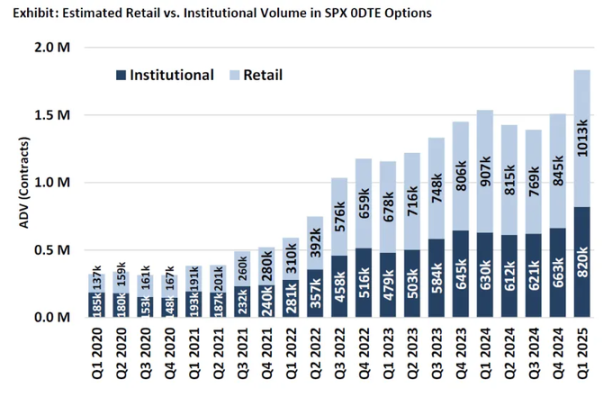
0-day expiration options trading volume: Can serve as a reference indicator for retail gambling behavior

One might ask, is the current level of high financialization a bad thing? I am almost certain: yes. Under high financialization, markets deviate from their role as "capital weighing machines" and merely become tools for making money. But I want to explore the causality: we live in a society where both financialization and gambling are prominent, yet it's hard to distinguish which is the cause and which is the effect.

Jez describes hyper-gambling as a process where "real returns are compressed, and risk increases as compensation." I believe hyper-gambling is one of two natural responses to high financialization. But unlike the other response—the growing socialist tendencies among millennials—hyper-gambling catalyzes high financialization, which in turn raises the level of hyper-gambling, forming an almost "ouroboros" cycle.

High financialization is a structural shift where society increasingly relies on markets; hyper-gambling is a behavioral response to the decoupling of effort and reward. Hyper-gambling itself is not a new phenomenon. A 1999 study showed that U.S. households with incomes below $10,000 spent 3% of their annual income on lottery tickets, motivated by the hope to "correct" their low-income status relative to peers. But in recent years, as society has become increasingly financialized (and digitized), the culture of gambling has become more prevalent.

Socialism as a Response

Now we can explore the first of the two natural responses to high financialization I mentioned:

With the help of social media and digitization, financialization has permeated every aspect of our lives. Our lives increasingly revolve around markets, which now bear unprecedented responsibility for capital allocation. The result is that young people can hardly get on the property ladder. The median age of property owners has hit a record 56 years, and the median age of first-time homebuyers has also reached 39 years, another all-time high.

Asset prices have decoupled from real wages, partly due to inflation, making it nearly impossible for young people to accumulate capital. Peter Thiel has pointed out that this is a significant reason for the rise of socialism:

"If a person is burdened with student debt or housing is too expensive, they will be in a state of negative capital for a long time, making it hard to start accumulating capital through real estate. If a person has no stake in the capitalist system, they are likely to oppose it."

Asset inflation and high housing prices reduce the perceived social mobility. This feeling that the "social contract has been broken" is evident in a recent Wall Street Journal poll: only 31% of respondents still believe in the "American Dream," that hard work can lead to success. Moreover, most Americans believe the trend of financialization will continue until 2050, and the wealth gap will only widen.
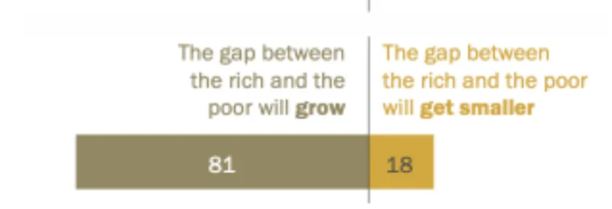
This pessimism reinforces the notion that rising asset prices leave those without capital behind, and hard work cannot change this. When people no longer believe that hard work can improve their lives, they lose motivation to work hard in a system they perceive as "rigged" and biased toward the bourgeoisie. This has cumulated into the rise of socialism today, a structural response to the increasing financialization of the world, aiming to re-establish the link between effort and reward through fairer asset distribution.

Socialism is an ideological response aimed at bridging the gap between the bourgeoisie and the proletariat. However, as of May 2024, public trust in the government is only 22%, leading to another natural response: more and more people, instead of relying on socialism to narrow the gap, are trying to join the upper class through (hyper-)gambling.

The Cycle

As mentioned earlier, the dream of turning one's life around through gambling is not new.

But with the advancement of the internet, the mechanics of gambling have completely changed. Today, almost anyone of any age can participate in gambling. Once a socially ostracized behavior, gambling has become deeply embedded in the social fabric due to its glorification on social media and lowered barriers.

As mentioned, the rise of gambling is a result of the internet's proliferation. Today, people don't need to go to physical casinos; gambling is everywhere. Anyone can open a Robinhood account to trade 0-day expiration options, cryptocurrencies are equally accessible, and online casino revenues have reached historic highs.

As The New York Times put it:

"Today's gamblers are not just retirees at card tables but young men on smartphones. Thanks to a series of quasi-legal innovations in online gambling, Americans can now bet on almost anything through investment accounts."

Recently, Google partnered with Polymarket to display betting odds in search results. The Wall Street Journal wrote: "Betting on football and elections is becoming as integrated into life as watching games and voting." While this is largely a social phenomenon, I believe its main driver is still high financialization. Even social gambling is a result of markets increasingly permeating our lives.

As household wealth becomes increasingly tied to asset prices while wage growth lags, the upward mobility through hard work seems increasingly narrow. This raises a question: if you can't improve your standard of living, why work hard? A recent study found that when families feel hopeless about buying a home, they tend to consume more, reduce work effort, and choose higher-risk investments. The same applies to low-wealth renters. These behaviors accumulate over the lifecycle, further widening the wealth gap between asset owners and non-owners.

At this point, survivorship bias kicks in. Stories of overnight riches on social media, conspicuous consumption on Instagram, and day traders promoting promises of "quitting your job" foster a widespread speculative mindset. South Korea is a typical example: low perceived social mobility, worsening income inequality, and high housing prices have led to increased gambling tendencies among ordinary Koreans. The Financial Times reported: "Speculative retail traders have become the main force, accounting for more than half of the daily trading volume in South Korea's $2 trillion stock market." They call themselves the "Sampo Generation": giving up dating, marriage, and childbirth due to high youth unemployment, job instability, stagnant wages, high living costs, heavy household debt, and fierce competition in education and job markets.

This phenomenon is not limited to South Korea; Japan's "Satori Generation" and China's "Lying Flat Generation" are similar.

Across the ocean in the U.S., half of men aged 18 to 49 have sports betting accounts, and 42% of Americans and 46% of Gen Z agree with the statement: "No matter how hard I work, I will never be able to buy the house I truly want." If a few minutes of betting can earn a week's, a month's, or even a year's salary, why work a hated job for minimum wage? As Thiccy sharply pointed out:

"Technology makes speculation effortless, and social media spreads every overnight success story, luring the masses like moths to a flame into this sure-lose gamble."

The dopamine effect behind this cannot be underestimated. In the long run, these gamblers will lose money, but once they've experienced easy money, how can they return to a 9-to-5 job? People always think: just one more try, if only the last time is lucky, they can cash out and quit.

"You only need a dollar and a dream." —Classic slogan of the New York State Lottery

Thus, the ouroboros cycle begins: high financialization triggers nihilism toward the system, leading to increased gambling, which in turn exacerbates financialization. More survivorship bias stories spread in the media, more people start gambling and lose money, and resources are misallocated from productive behaviors. Markets no longer support companies that benefit society but flow to businesses that fuel gambling. A stark example: HOOD (Robinhood) stock is up 184% year-to-date, while the average retail trader spends only about 6 minutes researching per trade, often hastily before trading.

But I don't think this is purely a market failure. Markets are merely an extension of human nature, which is full of flaws and selfishness. Therefore, markets choose the most profitable outcomes rather than those most beneficial to society. Even if it is detrimental to humanity in the long run, it shouldn't be entirely blamed on market failure; markets are not moral arbiters.

Nonetheless, it is sad that entire industries are built on swindling people out of their money. But as Milei said: "If you go to a casino and lose money, what can you complain about? You knew the nature of the casino." Or more bluntly: there are no tears in the casino. I do believe high financialization distorts markets. While markets are imperfect, financialization makes them more like casinos. When net negative outcomes can be profitable, the problem clearly goes beyond the market itself.

Regardless of morality, this accelerates high financialization. Stock prices rise further, unemployment increases, escapism prevails—TikTok, Instagram Reels, the metaverse... The problem is that gambling is a zero-sum game (strictly speaking, due to fees, it's negative-sum). Even from a simple zero-sum perspective, it doesn't create new wealth or bring social benefits; it merely redistributes money. Less and less capital flows toward innovation, development, and positive-sum outcomes. Elon Musk once said: "The meaning of civilization is to create far more than you consume." But in a highly financialized society, this is hard to achieve because we also have to face another consequence of financialization: escapism.

The gap between the middle and upper classes in leisure activities has never been smaller, as humans spend more and more time online. This, combined with declining social mobility, not only weakens the motivation to work hard but also reduces the desire to create beautiful new things.

What I want to say is: in a highly financialized society, one cannot create more than they consume, and society struggles to achieve positive-sum outcomes.

Finally, I conclude with this description of a highly financialized technological capitalist society:


Twitter:https://twitter.com/BitpushNewsCN

Bitpush TG Discussion Group:https://t.me/BitPushCommunity

Bitpush TG Subscription: https://t.me/bitpush

Original article link:https://www.bitpush.news/articles/7593992

Пов'язані питання

QWhat is hyper-financialization and how does it differ from traditional financialization?

AHyper-financialization is an extreme stage of the financialization process, where financial markets dominate the economy to the extent that speculative activities overshadow productive services that contribute more to society. Traditional financialization refers to the process of financial markets gaining dominance in the economy, but hyper-financialization represents its most advanced and problematic form.

QAccording to the article, what are the two natural responses to hyper-financialization?

AThe two natural responses to hyper-financialization are: 1) The rise of socialist tendencies among younger generations who seek more equitable distribution of assets, and 2) Increased engagement in hyper-gambling (speculative activities) as people attempt to bridge the wealth gap through risky financial bets.

QHow has digitalization contributed to the blurring line between financialization and gambling?

ADigitalization has made financial speculation (hyper-gambling) unprecedentedly accessible with low barriers to entry. Applications like Robinhood offer zero-commission trading and access to options, prediction markets, and cryptocurrencies, making gambling mechanisms available to almost anyone of any age and embedding these activities deeply into social structures through social media glorification.

QWhat role does survivor bias play in the cycle of financialization and gambling?

ASurvivor bias fuels the cycle by promoting stories of overnight success through gambling on social media, showcasing conspicuous consumption on platforms like Instagram, and creating promises of 'quitting jobs' through day trading. These narratives create a widespread speculative mentality that attracts more participants to gambling activities, despite the statistical likelihood of losses.

QWhy does the article describe the relationship between financialization and gambling as an 'ouroboros' (tail-eating snake) cycle?

AThe relationship is described as an ouroboros cycle because hyper-financialization creates a sense of nihilism about the system, which leads to increased gambling. This increased gambling activity in turn further accelerates financialization. The cycle becomes self-reinforcing as more gambling stories circulate, more people participate and lose money, and resources are misallocated from productive activities to those that fuel gambling.

Пов'язані матеріали

Silicon Valley 'Startup Guru' Steve Hoffman: Web3 + AI Could Be a Trap

Silicon Valley investor and "Godfather of Startups" Steve Hoffman warns that combining Web3 with AI is likely a trap, not a promising venture. In an interview, Hoffman argues that while AI is a foundational technology touching all industries, Web3 adds complexity, friction, and regulatory risk without solving mainstream consumer or business needs. He advises founders to focus on deep, specialized applications where startups can out-iterate giants, rather than on generic features easily replicated by large tech companies. Hoffman observes that Silicon Valley will lead foundational AI research, while China excels at rapid, large-scale application and commercialization, particularly in robotics. He stresses that AI-driven autonomous agents capable of collaborative, multi-step tasks are 2-4 years away, which will cause significant job displacement. The solution is not to slow AI but to redesign business models around human-AI collaboration and reform social systems like education and retraining. For startups, Hoffman recommends focusing on vertical, expertise-heavy domains to build defensibility. He sees major opportunities in AI fraud detection and cybersecurity. Key founder mindsets include systemic thinking over feature-focus, relentless customer centricity, building adaptive teams, and deeply understanding AI's capabilities and limits. Hoffman is also leading a non-profit initiative to establish university centers aimed at training future leaders in responsible, human-value-aligned AI innovation.

marsbit1 год тому

Silicon Valley 'Startup Guru' Steve Hoffman: Web3 + AI Could Be a Trap

marsbit1 год тому

Token Inefficient, Economy Tokenless

The article "Tokens Aren't Economical, Economics Aren't Tokenized" analyzes a pivotal shift in the AI industry from a technology-driven narrative to one dominated by capital efficiency. It highlights two concurrent trends: a severe capital shortage due to the exorbitant and recurring costs of compute (e.g., OpenAI's high burn rate) and a wave of corporate spin-offs where major tech companies are separating their AI units (like Kuaishou's Kling and Baidu's Kunlunxin). The core argument is that AI's "anti-internet" business model, where user growth increases costs rather than profits, has created a disconnect between high valuations and actual cash flow. Spin-offs address this by allowing AI assets to be valued independently. Within a parent company, they are seen as cost centers, but as standalone entities, they are priced based on their growth potential and scarcity in the primary market, leading to massive valuation premiums (e.g., Kling's estimated value tripling post-spin-off). The industry is at an inflection point, moving from "model worship" to "value realization." The competition is evolving from a pure compute (GPU) race to a broader focus on systemic efficiency and full-stack engineering (involving CPUs and orchestration) to achieve viable commercialization. The year 2026 is framed as a critical moment where the industry must definitively answer how to economically translate AI capability into tangible business value, reshaping the sector's future power structure.

marsbit1 год тому

Token Inefficient, Economy Tokenless

marsbit1 год тому

Crossing the 'Memory Wall': The Wafer-Level Revolution and Computing Power Routes in the AI Inference Era

In 2026, a historic shift occurred in AI as major cloud providers' inference spending surpassed training spending for the first time, signaling a move from "building large models" to "using large models." This shifts the core challenge from computing power to the "memory wall"—the bottleneck of data movement (model weights, activations, KV Cache) between external DRAM and processors, where energy and latency from data transfer far exceed computation itself. Companies like Nvidia face GPU idle time due to bandwidth limits. In contrast, Cerebras Systems adopts a radical "wafer-scale" approach with its Wafer-Scale Engine (WSE). Instead of cutting a silicon wafer into many chips, Cerebras uses almost the entire wafer as one massive chip (WSE-3). This design provides 44GB of on-chip SRAM, delivering memory bandwidth thousands of times higher than traditional HBM (e.g., 21 PB/s vs. Nvidia B200). For LLM inference, weights are streamed layer-by-layer from external MemoryX storage to the chip, avoiding HBM bottlenecks. This results in token generation speeds 1.5–5 times faster than Nvidia's B200 in some models and significant advantages in first-token latency and long-context tasks. Additionally, Cerebras's architecture offers much lower interconnect power consumption (0.15 pJ/bit vs. GPU's ~10 pJ/bit). However, Cerebras faces challenges: SRAM scaling has slowed with advanced nodes, limiting future capacity gains; the chip requires specialized liquid cooling and custom software stacks; and its external I/O bandwidth (150 GB/s) is low compared to NVLink, hindering multi-system scaling for very large models. Competition is intensifying. Major players are pursuing three paths: 1) Developing proprietary inference ASICs (e.g., Google TPU, Microsoft Maia), 2) Leveraging advanced packaging (e.g., TSMC's SoW) to democratize wafer-scale-like integration, potentially eroding Cerebras's process advantage within a few years, and 3) Exploring optical interconnects for ultimate bandwidth. Commercially, Cerebras is transitioning from a hardware vendor to a service provider, facing the immense challenge of building high-power, specialized data centers to meet large contracts (e.g., 250MW/year from 2026–2028). In conclusion, the AI inference era presents a fundamental architectural trade-off. Cerebras opts for extreme physical optimization for low-latency, single-task performance, while Nvidia prioritizes versatility and massive cluster throughput. The path forward remains uncertain, with technology and business models still evolving in the race toward advanced AI.

marsbit1 год тому

Crossing the 'Memory Wall': The Wafer-Level Revolution and Computing Power Routes in the AI Inference Era

marsbit1 год тому

Has Bitcoin's 'Rebound Ended', Officially Entering the Late Bear Market Phase?

**Title: Has Bitcoin's Rebound Ended, Entering the Late Bear Market Phase?** **Summary:** Bitcoin's price has declined by 13% this week, signaling a potential return to late-stage bear market conditions. The price fell to around $67k, positioned between the Realized Price and Realized Cap Weighted Average. For the first time since early 2022, the Short-Term Holder cost basis has dropped below this key average, confirming a hallmark of late-cycle bear markets. Profitability metrics have collapsed sharply. The 7-day average of the Realized Profit/Loss ratio plummeted from a local high of 3.16 to 0.29, mirroring the February panic sell-off. Critically, the 90-day average never breached the threshold of 2, indicating the recent rally to $82k was a bear market bounce, not a structural shift. Realized losses surged to $1.35 billion daily, with $770 million coming from Long-Term Holders selling at a loss. This accelerating redistribution of supply from weak to strong hands is a necessary but ongoing process for a market bottom. The rally stalled almost precisely at the aggregate cost basis (~$83k) of US spot Bitcoin ETF investors, turning that level into strong resistance and leaving the average ETF holder underwater again. Spot market flows have turned decisively negative, showing sellers are dominating order books despite the price drop. While a significant futures long liquidation event cleared over $400 million in leverage, providing a potential reset, sustained spot demand is yet to materialize. Options markets continue to price in higher future volatility (Implied Volatility) than recent price action (Realized Volatility) has shown, with a persistent skew towards put options, indicating ongoing demand for downside protection. In conclusion, multiple metrics point to a fragile market structure. Resistance at the ETF cost basis, accelerating realized losses, dominant spot selling, and cautious options pricing all suggest the bear market trend persists. A sustainable recovery likely requires a resurgence of spot demand, ETF holders returning to profit, and a clear reduction in selling pressure.

marsbit1 год тому

Has Bitcoin's 'Rebound Ended', Officially Entering the Late Bear Market Phase?

marsbit1 год тому

TechFlow Intelligence Agency: Anthropic Calls for Global Pause in AI Development While Preparing for Trillion-Dollar IPO; SpaceX IPO Roadshow Heats Up, But S&P 500 Rejects Fast-Track Inclusion

In today's TechFlow Intelligence Briefing, several major tech stories highlight a growing theme of trust and credibility gaps across AI, crypto, and finance. AI company Anthropic has publicly called for a global pause in AI development, citing risks from Claude's "recursive self-improvement." Ironically, this coincides with reports the company is preparing for a massive IPO targeting a near $1 trillion valuation. This perceived hypocrisy, coupled with widespread user complaints about Claude's declining performance, is sparking debate over whether the safety warning is genuine or a competitive tactic. Meanwhile, in a substantive security move, Anthropic open-sourced a framework for AI-powered vulnerability discovery. In the crypto market, Bitcoin's price drop below $61,000 triggered over $1.16 billion in liquidations, flipping the market into a state where more BTC is held at a loss than at a profit, a historical bearish signal. On the corporate front, SpaceX's highly anticipated IPO is generating immense Wall Street excitement, with Goldman Sachs projecting 100x revenue growth by 2030. However, the S&P 500 has refused to fast-track the company's inclusion post-IPO, potentially limiting immediate institutional demand. Separately, ByteDance's AI app Doubao lost over 6 million monthly active users after introducing a subscription model, highlighting the challenges of AI monetization. Other notable developments include Nvidia certifying HBM4 memory from Samsung, SK Hynix, and Micron; Cloudflare's acquisition of front-end tooling company VoidZero; and its CEO warning that bot traffic now exceeds human traffic online. The underlying narrative connects these events: a trust crisis. From AI firms' contradictory actions and crypto volatility to the clash between SpaceX's hyped narrative and institutional rules, a pattern is emerging where stated intentions and actual practices are increasingly misaligned.

marsbit1 год тому

TechFlow Intelligence Agency: Anthropic Calls for Global Pause in AI Development While Preparing for Trillion-Dollar IPO; SpaceX IPO Roadshow Heats Up, But S&P 500 Rejects Fast-Track Inclusion

marsbit1 год тому

Торгівля

Спот
Ф'ючерси
活动图片