Federal Reserve Withdraws Crypto Rules, Banks Get More Freedom

bitcoinistОпубліковано о 2025-12-18Востаннє оновлено о 2025-12-18

The Federal Reserve announced on April 24, 2025, that it is pulling back previous rules for banks handling crypto and dollar tokens. From now on, banks will be supervised the usual way, instead of through separate crypto-focused requirements.

Banks Can Now Move Faster With Crypto

The rules being withdrawn included a 2022 letter that told state member banks to notify the Fed before dealing with crypto, and a 2023 letter that required approval before handling dollar tokens. These rules had kept some smaller banks, especially uninsured crypto-focused ones, from accessing Fed accounts or payment systems.
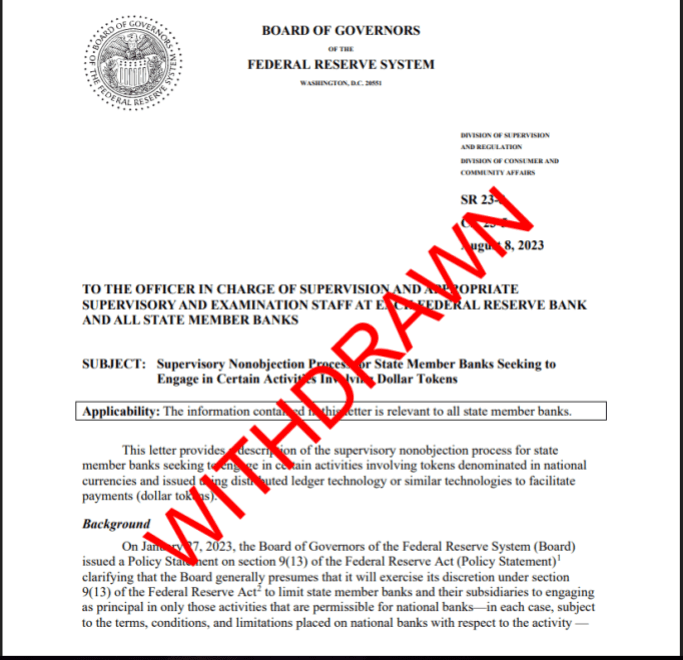
Other regulators moved at the same time. The FDIC and the OCC also withdrew two 2023 statements about crypto risks. Those statements had flagged issues like liquidity and governance risks in crypto banking. By pulling them back, banks now face fewer formal roadblocks when offering crypto services.

Fed’s New Guidance

On Dec. 17, 2025, the Fed introduced new guidance to give both insured and uninsured state member banks a clear path to explore activities like cryptocurrencies, as long as they meet the Fed’s risk-management standards, the central bank said.


Supervision Now Part Of Normal Oversight

The Fed said it will continue watching banks’ crypto work, but through regular supervisory processes. Banks don’t need to send extra notifications or get prior approval for crypto activities anymore. That includes things like custody, trading, or settlement of digital assets. There aren’t new rules being added — it’s just now part of normal oversight.

Total crypto market cap currently at $2.9 trillion. Chart: TradingView

Key Dates And Actions

The important date is April 24, 2025. On this day, the Fed withdrew letters from 2022 and 2023, along with the two joint interagency statements from 2023. These had previously told banks how to report and get approval for crypto work. The withdrawal simply moves crypto activities into regular bank supervision.
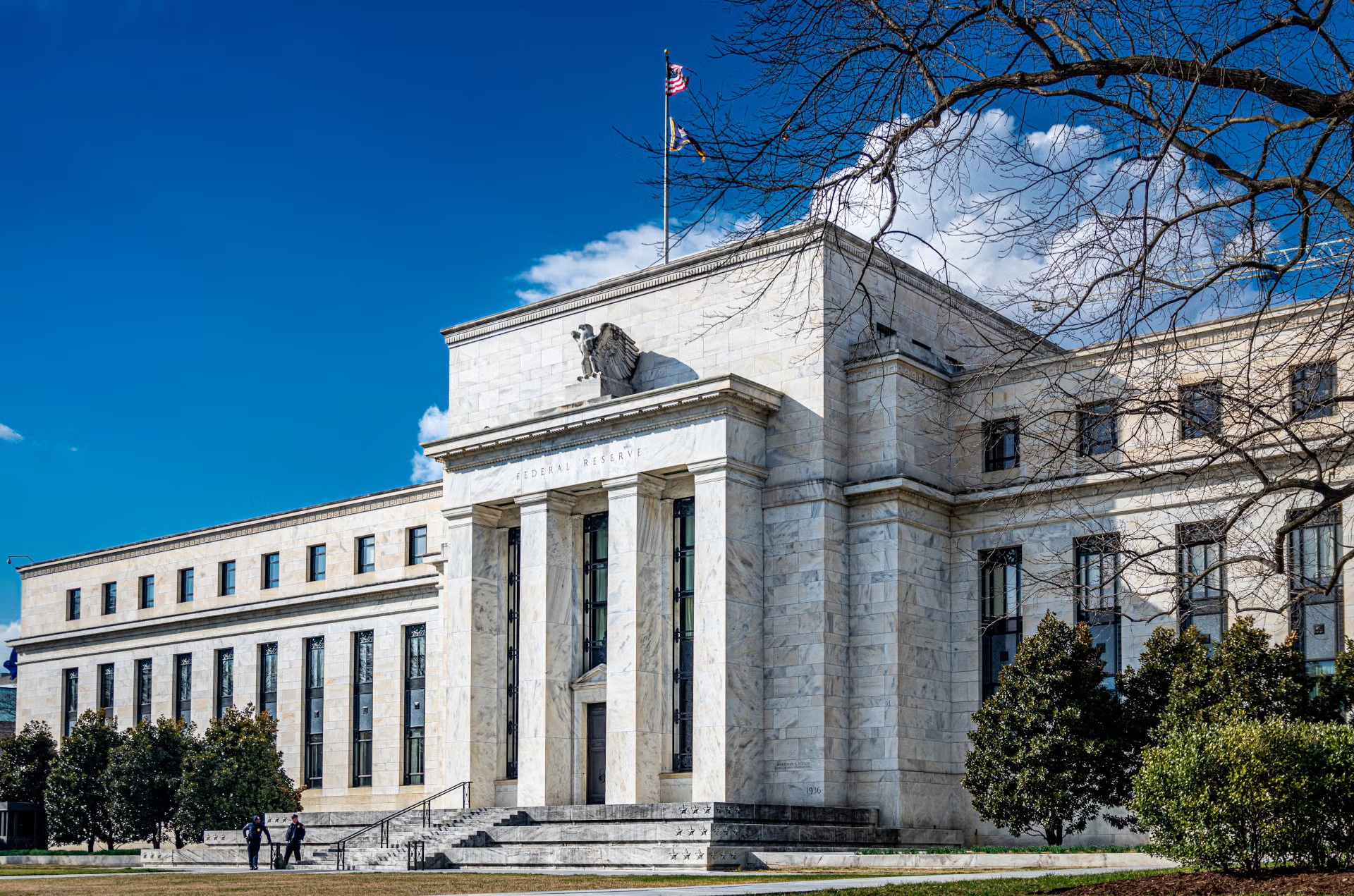
The US Federal Reserve. Image: TuftsNow

What This Means For Banks And Markets

Banks have more leeway to provide crypto services because they no longer have to follow the old regulations. They’ve gained the ability to quickly develop, test, and manage digital assets. However, the Fed continues to keep an eye on how banks manage their risks.

While this change does not eliminate all regulatory requirements, it eliminates much of the extra duplication of paperwork and approvals that acted as barriers and impeded progress in the past.

Featured image from Unsplash, chart from TradingView

Пов'язані питання

QWhat did the Federal Reserve announce on April 24, 2025, regarding banks and crypto?

AThe Federal Reserve announced that it is pulling back previous rules for banks handling crypto and dollar tokens, and that banks will now be supervised through the usual way instead of separate crypto-focused requirements.

QWhich specific regulatory documents were withdrawn by the Fed?

AThe Fed withdrew a 2022 letter that required state member banks to notify the Fed before dealing with crypto, a 2023 letter that required approval before handling dollar tokens, and two joint interagency statements from 2023 about crypto risks.

QHow does the new Fed guidance change the process for banks engaging in crypto activities?

ABanks no longer need to send extra notifications or get prior approval for crypto activities like custody, trading, or settlement of digital assets. These activities are now supervised through regular oversight processes instead of separate requirements.

QWhat was the significance of the 2023 policy statements that were withdrawn?

AThe 2023 statements had flagged issues like liquidity and governance risks in crypto banking and acted as formal roadblocks, which kept some smaller and uninsured crypto-focused banks from accessing Fed accounts or payment systems.

QWhat are the implications of this regulatory change for banks and the crypto market?

ABanks now have more freedom to quickly develop, test, and manage digital asset services without the extra duplication of paperwork and approvals. However, the Fed will continue to oversee risk management, and the change integrates crypto into normal bank supervision rather than eliminating all regulations.

Пов'язані матеріали

OpenAI Post-Training Engineer Weng Jiayi Proposes a New Paradigm Hypothesis for Agentic AI

OpenAI engineer Weng Jiayi's "Heuristic Learning" experiments propose a new paradigm for Agentic AI, suggesting that intelligent agents can improve not just by training neural networks, but also by autonomously writing and refining code based on environmental feedback. In the experiment, a coding agent (powered by Codex) was tasked with developing and maintaining a programmatic strategy for the Atari game Breakout. Starting from a basic prompt, the agent iteratively wrote code, ran the game, analyzed logs and video replays to identify failures, and then modified the code. Through this engineering loop of "code-run-debug-update," it evolved a pure Python heuristic strategy that achieved a perfect score of 864 in Breakout and performed competitively with deep reinforcement learning (RL) algorithms in MuJoCo control tasks like Ant and HalfCheetah. This approach, termed Heuristic Learning (HL), contrasts with Deep RL. In HL, experience is captured in readable, modifiable code, tests, logs, and configurations—a software system—rather than being encoded solely into opaque neural network weights. This offers potential advantages in explainability, auditability for safety-critical applications, easier integration of regression tests to combat catastrophic forgetting, and more efficient sample use in early learning stages, as demonstrated in broader tests on 57 Atari games. However, the blog acknowledges clear limitations. Programmatic strategies struggle with tasks requiring long-horizon planning or complex perception (e.g., Montezuma's Revenge), areas where neural networks excel. The future vision is a hybrid architecture: specialized neural networks for fast perception (System 1), HL systems for rules, safety, and local recovery (also System 1), and LLM agents providing high-level feedback and learning from the HL system's data (System 2). The core proposition is that in the era of capable coding agents, a significant portion of an AI's learned experience could be maintained as an auditable, evolving software system.

marsbit32 хв тому

OpenAI Post-Training Engineer Weng Jiayi Proposes a New Paradigm Hypothesis for Agentic AI

marsbit32 хв тому

Your Claude Will Dream Tonight, Don't Disturb It

This article explores the recent phenomenon of AI companies increasingly using anthropomorphic language—like "thinking," "memory," "hallucination," and now "dreaming"—to describe machine learning processes. Focusing on Anthropic's newly announced "Dreaming" feature for its Claude Agent platform, the piece explains that this function is essentially an automated, offline batch processing of an agent's operational logs. It analyzes past task sessions to identify patterns, optimize future actions, and consolidate learnings into a persistent memory system, akin to a form of reinforcement learning and self-correction. The article draws parallels to similar features in other AI agent systems like Hermes Agent and OpenClaw, which also implement mechanisms for reviewing historical data, extracting reusable "skills," and strengthening long-term memory. It notes a key difference from human dreaming: these AI "dreams" still consume computational resources and user tokens. Further context is provided by discussing the technical challenges of managing AI "memory" or context, highlighting the computational expense of large context windows and innovations like Subquadratic's new model claiming drastically longer contexts. The core critique argues that this strategic use of human-centric vocabulary does more than market products; it subtly reshapes user perception. By framing algorithms with terms associated with consciousness, companies blur the line between tool and autonomous entity. This linguistic shift can influence user expectations, tolerance for errors, and even perceptions of responsibility when systems fail, potentially diverting scrutiny from the companies and engineers behind the technology. The article concludes by speculating that terms like "daydreaming" for predictive task simulation might be next, continuing this trend of embedding the idea of an "inner life" into computational processes.

marsbit34 хв тому

Your Claude Will Dream Tonight, Don't Disturb It

marsbit34 хв тому

Торгівля

Спот
Ф'ючерси
活动图片





