Author: Godot
The two hottest sectors in AI are storage and photonics. Previously, I wrote a framework on storage (Understanding the Profit Pools and Industry Landscape of AI Storage Tiers). This article focuses on photonics.
Silicon photonics (Silicon Photonics) is used for communication between computing chips, replacing traditional copper wires, as clearly shown in the diagram below.
Terms you might come across but find confusing, such as LPO (Linear-drive Pluggable Optics), CPO (Co-packaged Optics), OCS (Optical Circuit Switching), and Optical I/O (Optical Input/Output), represent different technical approaches to implementing silicon photonics.
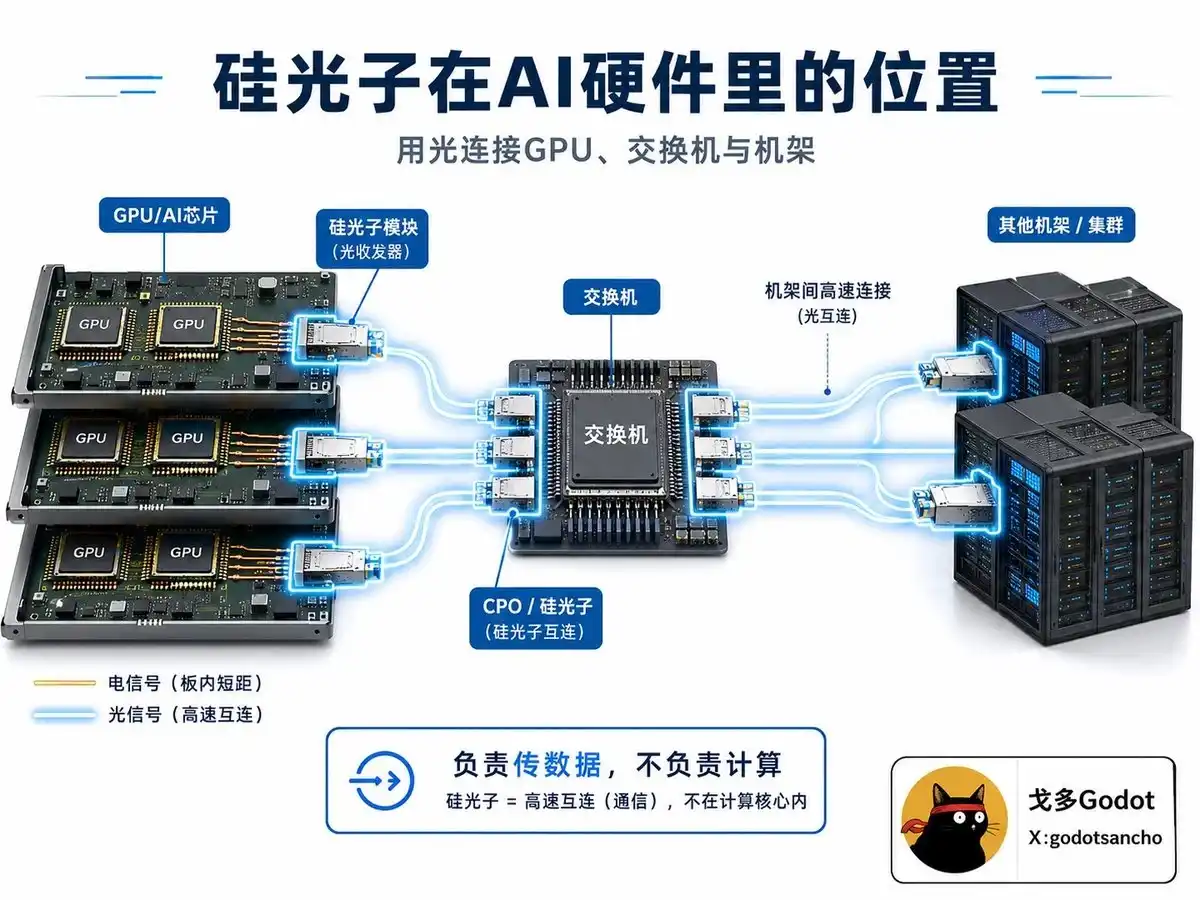
Typically, chips communicate using copper wires. Silicon photonic chips integrate components like lasers (which generate light), modulators (which "modulate" light), and *detectors* (which "receive" light) directly onto silicon wafers, enabling communication via photons.
So, why replace copper? And why use silicon photonics instead of other alternatives?
First, copper wires nearly reach their physical limits when transmitting signals above 1.6T, leading to signal degradation. Switching materials becomes imperative. This is the most critical issue and a necessary change. The technical term is the "bandwidth wall."
Second, copper is a tangible physical entity. As GPU clusters expand, there simply isn't enough space for all the copper wiring. This is another compelling reason to replace copper. Photonics are different; optical interfaces can be soldered directly next to switch chips, eliminating the need for extensive cabling. The term for this is the "scale wall."
Third, copper consumes too much power. In facilities consuming hundreds of megawatts, silicon photonics can save tens of thousands of kilowatt-hours daily—energy otherwise wasted on copper wire communication. After switching to photonics, this power can be redirected to GPUs for actual computation. This is termed the "power wall."
More interestingly, silicon photonics can leverage the mature CMOS manufacturing processes of the existing semiconductor industry, eliminating the need to build entirely new factories from scratch, thus enabling low-cost, high-volume production.
Of course, silicon photonics also has a drawback: silicon itself cannot emit light efficiently and must rely on Indium Phosphide (InP) materials. This has become the most critical bottleneck in the entire supply chain.
The Evolution of Silicon Photonics Technology
The most significant watershed moment was in March 2025 when NVIDIA, at its GTC conference, launched the Quantum-X and Spectrum-X photonic switches. Jensen Huang announced that starting from the next-generation Rubin architecture, "optical interconnect is not an option, it's a requirement."
A week later, NVIDIA announced a combined $4 billion investment in Coherent and Lumentum to secure key supply chains.
The paper on the silicon-based photoelectric effect was published in the 1980s. From 2004 to 2014, Intel and IBM manufactured silicon-based optical modulators.
In the previous decade, hyperscale cloud service providers like AWS, Google, and Meta adopted silicon photonics, though at the time it was only a part of fiber optic communication.
Current Industry Landscape
1) The Foundation: Foundries
They manufacture photonic chips. TSMC $TSM leads with its COUPE process. Tower Semiconductor $TSEM specializes in silicon photonics foundry services, with its silicon photonics revenue growing 70% year-over-year in 2025. GlobalFoundries $GFS, through its acquisition of Singapore's AMF, has become the world's largest dedicated silicon photonics foundry.
2) The Second Tier: Core Component Suppliers
They provide components like lasers and modulators, primarily Indium Phosphide (InP) lasers. Globally, fewer than five companies can manufacture high-speed EML lasers.
Lumentum $LITE is the only manufacturer capable of mass-producing 200G/lane EML lasers, a core component for 1.6T optical modules. To lock in its capacity, NVIDIA has secured orders extending beyond 2027.
3) The Third Tier: Module and System Manufacturers
They assemble components into finished products. Coherent holds about 25% of the global optical transceiver market share. Chinese companies like InnoLight, Eoptolink, and Accelink are significant contenders in terms of manufacturing scale and cost competitiveness.
4) The Top Tier: System Integrators
This layer includes NVIDIA, Cisco, Broadcom $AVGO, and Marvell $MRVL.
In summary,
NVIDIA $NVDA
Holds a dominant position, deciding the interconnect standards for AI data centers and securing supply chains through strategic investments.
Broadcom $AVGO
The absolute leader in networking switch chips, commanding nearly 80% market share in Ethernet switches. The Tomahawk 6-Davisson is the world's first 102.4 Tbps CPO switch.
Marvell $MRVL
Broadcom's strongest challenger, dominating the PAM4 optical DSP market with a 60-70% share. Recently acquired Celestial AI to enter the chip-to-chip optical interconnect space.
Lumentum $LITE
The most critical supplier of EML lasers. The world's only manufacturer capable of mass-producing 200G/lane EML lasers. NVIDIA has locked in orders until after 2027.
Coherent $COHR
An integrated player across the entire supply chain, with a presence from materials and lasers to modules. FY2025 revenue was $5.8 billion, making it the market leader in optical transceiver share.
TSMC $TSM
The process standard-setter. Its 65nm silicon photonics process is in mass production. The COUPE platform is currently the most advanced 3D heterogeneous integration solution, and NVIDIA's CPO roadmap is deeply tied to it.
Tower Semiconductor $TSEM
The purest beneficiary of the silicon photonics foundry trend. Its silicon photonics revenue grew 70% year-over-year in 2025. It is investing $650 million to triple its capacity. It has the highest potential for valuation elasticity among all the mentioned players.
Lightmatter / Ayar Labs (Unlisted · IPO Candidates)
Lightmatter, valued at $4.4 billion, focuses on 3D photonic interconnects. Ayar Labs has received investments from AMD, Intel, and NVIDIA, working on optical I/O chiplets. Both are potential major IPO candidates.
Valuation Logic Shift Driven by the Silicon Photonics Boom
Take an example. Previously, Wall Street valued Tower Semiconductor as a regular analog foundry, with a Price-to-Sales (P/S) ratio of around 2-3x.
But when its silicon photonics business grew from 5% to 30%-40% of total revenue, the market began to revalue it as a scarce asset within AI infrastructure, potentially lifting its P/S ratio to 6-10x.
Lumentum and Coherent, once viewed as telecom component suppliers, are now being redefined as indispensable providers of AI interconnect components. BofA analyst Vivek Arya raised Marvell's target price to $200, underpinned by valuing Marvell as an AI infrastructure platform rather than a communications chipmaker.
Evercore ISI's assessment of Cisco is similar. As silicon photonics products penetrate hyperscale data centers, Cisco's core AI-related revenue could potentially explode from $3 billion to $12-$15 billion over the next 3-4 years.
The Moat of the Silicon Photonics Industry
The silicon photonics industry exhibits clear winner-take-most characteristics, as every single process has been refined over a long period *before* the AI boom.
InP lasers: Globally, fewer than five companies can mass-produce high-end EML lasers, with a capacity expansion cycle of 3-5 years. This is the most critical bottleneck in the entire supply chain.
TSMC's COUPE process: The technological barrier of 3D heterogeneous integration puts competitors at least two generations behind, requiring years of yield experience accumulation.
Foundry PDK ecosystem: Once a customer designs with a specific foundry's Process Design Kit (PDK), the switching cost is extremely high—redesigning and recertification can take 12-18 months.
Thermal management and packaging: CPO requires managing the coupling of electrical, thermal, and optical domains within a few millimeters of space, which cannot be achieved without years of system integration experience.
The supplier certification process for giants like AWS and Google typically takes 12-24 months. Once certified, customer stickiness is extremely strong.
Risks and Cold-headed Considerations
The growth of the entire industry chain is highly dependent on the capital expenditures of the five hyperscale cloud giants: Microsoft, Google, Meta, Amazon, and Oracle.
There is substitutability among technical paths like LPO, CPO, OCS, and Optical I/O. If one route is disrupted by another, previously invested capital may face depreciation or write-downs.
Research firms like LightCounting judge that truly large-scale CPO deployment will not arrive until after 2028. Before that, transitional solutions like LPO will dominate volumes.
Therefore, betting on the success of the *industry* is safer than betting on the success of a *single company*.


















