Farewell to Buying Houses and Stocks: The Younger Generation Embraces Cryptocurrency as the Main Battlefield for Wealth

深潮Опубліковано о 2025-12-17Востаннє оновлено о 2025-12-17

Анотація

A new report by Coinbase reveals a significant generational shift in wealth-building strategies in the U.S. Younger investors, including Gen Z and millennials, are increasingly moving away from traditional paths like buying real estate and investing in stocks. Instead, they are turning to alternative assets, particularly cryptocurrencies, as a core component of their financial future. The study, conducted with Ipsos, found that 73% of young investors believe it's harder for their generation to build wealth through conventional means compared to their parents' generation. In response, they are actively diversifying their portfolios, allocating 25% to non-traditional assets like crypto, derivatives, and NFTs—three times the allocation of older investors. Nearly half (45%) of young investors already hold cryptocurrency, viewing it not as a speculative side investment but as a vital tool for catching up financially. They express strong optimism about crypto’s future, with 80% believing it offers financial opportunities outside the traditional system and will play a major role in the future of finance. This shift is driving demand for more innovative, internet-native financial products—such as crypto derivatives, DeFi, and 24/7 trading platforms—and reflects a broader move toward more active, risk-tolerant investment behavior among younger generations.

Written by: Coinbase

Compiled by: Chopper, Foresight News

For decades, the path to wealth accumulation for Americans has remained almost unchanged: find a good job, buy property, invest in stocks, and wait for the power of compound interest to yield returns. However, our latest "Cryptocurrency Industry Report" shows that the younger generation of investors no longer believes in this traditional path and is adjusting their investment behavior accordingly.

To understand how different generations respond to the market and the role cryptocurrency plays in their investment portfolios, Coinbase partnered with Ipsos to conduct a specialized survey. A total of 4,350 American adults were interviewed, including 2,005 investors with investment accounts. The core findings of the survey are as follows: younger investors, such as Gen Z and Millennials, are more inclined to actively manage their investments, more open to non-traditional assets, and more likely to view cryptocurrency as a core component of their financial future than any previous generation.
A Generation Shut Out of the Traditional Wealth Ladder

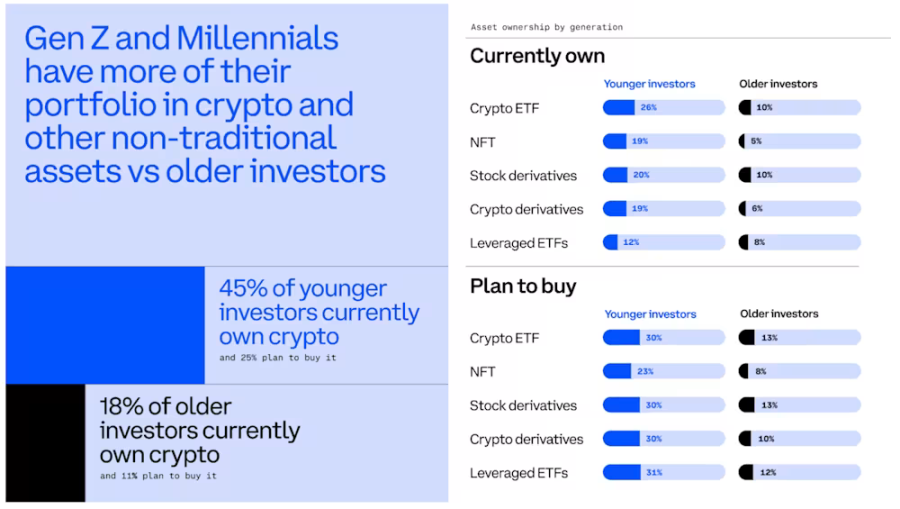
Younger investors are far more optimistic about the economy than older generations, but they believe the existing financial system is not designed for them. Survey data shows that nearly seven out of ten (73%) young people believe it is more difficult for their generation to accumulate wealth through traditional means compared to their parents' generation. In contrast, only 57% of older generations share this view.

They have witnessed soaring housing costs, overwhelming student debt, and sluggish wage growth. In this context, more and more young people are seeking alternative ways to accumulate wealth beyond the traditional model of "home equity + stock portfolio."

Non-Traditional Asset Allocation Three Times Higher Than Older Generations

This anxiety is directly reflected in their asset allocation strategies. The survey shows that younger investors allocate 25% of their portfolios to non-traditional asset classes such as cryptocurrencies, financial derivatives, non-fungible tokens (NFTs), and other emerging products. This is three times the proportion allocated by older investors, who only allocate 8% to non-traditional assets.

The proportion of stock holdings is roughly similar across generations, but the key difference lies in the fact that younger investors diversify their portfolios beyond stocks. They are more actively seeking opportunities for returns beyond traditional stock dividends and are more willing to experiment with new investment tools and emerging markets to narrow the wealth gap.

Cryptocurrency Is Not a Side Investment but a Core Allocation

This generational shift in investment philosophy is most evident in the acceptance of cryptocurrency. The report shows that 45% of younger investors already hold cryptocurrency, compared to only 18% of older investors. Additionally, nearly half (47%) of younger investors want to gain exposure to new crypto assets before the general market, while only 16% of older investors share this desire.

In the eyes of the younger generation, cryptocurrency is not merely a form of speculative trading but an important tool to help them catch up in wealth accumulation. Eighty percent of young people believe that cryptocurrency provides their generation with more financial opportunities outside the traditional financial system. At the same time, another 80% are convinced that cryptocurrency will play a significantly larger role in the future financial system. Among older investors, only about 60% share this view.

The younger generation's enthusiasm for exploring emerging markets extends beyond spot cryptocurrencies; they are also eager to engage with more non-traditional assets. Data shows that 80% of younger investors are willing to try new investment opportunities ahead of others, while less than half of older generations share this attitude. Younger investors consistently show strong interest in emerging non-traditional products such as cryptocurrency derivatives, prediction markets, 24/7 stock trading, early token offerings, altcoins, and decentralized finance lending.

The Impact of This Trend on Future Markets

The younger generation of investors has already demonstrated distinct characteristics: they trade more frequently, are willing to take greater risks for higher returns, and are shifting a significant portion of their portfolios to non-traditional assets, with cryptocurrency at the core. At the same time, they are driving the entire financial industry toward a transformation that better meets the needs of the internet-native generation, creating platforms that operate around the clock and support diverse asset trading.

Пов'язані питання

QAccording to the Coinbase report, what percentage of young investors have allocated their portfolios to non-traditional assets?

AYoung investors have allocated 25% of their portfolios to non-traditional assets like cryptocurrency, derivatives, and NFTs.

QHow does the view on the difficulty of building wealth through traditional pathways differ between younger and older generations?

A73% of young investors believe it is harder for their generation to build wealth through traditional pathways, compared to only 57% of older investors who share this view.

QWhat proportion of young investors already hold cryptocurrency, and how does this compare to older investors?

A45% of young investors hold cryptocurrency, whereas only 18% of older investors do.

QWhat is the prevailing belief among young investors regarding the future role of cryptocurrency in the financial system?

A80% of young investors believe that cryptocurrency will play a significantly larger role in the future financial system.

QBeyond spot crypto, what types of emerging, non-traditional products are young investors interested in?

AYoung investors are highly interested in emerging products like crypto derivatives, prediction markets, 24/7 stock trading, early token sales, altcoins, and DeFi lending.

Пов'язані матеріали

CRCL 暴涨暴跌,COIN 跟着跳水:CLARITY Act 背后真正的利益战争

A recent draft of the CLARITY Act sparked market volatility, with Circle (CRCL) and Coinbase (COIN) stocks plunging. The core issue is Section 404 of the draft, which proposes prohibiting digital asset service providers from paying interest or rewards *solely* for holding payment stablecoins. The article argues this is not merely a technical debate over rewards, but a fundamental battle over the future role of stablecoins: Will they remain purely payment/transaction tools, or evolve into on-chain savings accounts that compete with bank deposits? US banks, fearing deposit outflow, have lobbied heavily for such restrictions. While Circle and Coinbase were both hit, their exposures differ. Circle's direct revenue primarily comes from reserve earnings, so the draft impacts its future growth narrative. Coinbase, however, relies heavily on USDC rewards and balances as part of its "Everything Exchange" platform strategy, making its growth engine more directly vulnerable. The analysis identifies three deeper layers often missed: 1) The political economy of preventing stablecoins from becoming savings substitutes. 2) The distinct impact on issuers (Circle) versus distributors/platforms (Coinbase). 3) The migration of yield demand to other tokenized securities (like MMFs) regulated under existing frameworks, as hinted in Section 505 of the same draft. In essence, three major battles are underway: banks defending their deposit base, Coinbase fighting for user entry and distribution rights, and Wall Street aiming to control the compliant path for tokenization. While a short-term headwind for crypto-native platforms, the article suggests this regulatory push could force the industry to build more sustainable value in real payment and B2B infrastructure.

marsbit14 хв тому

CRCL 暴涨暴跌,COIN 跟着跳水:CLARITY Act 背后真正的利益战争

marsbit14 хв тому

Tom Lee充值信仰:加密春天已至,ETH会涨到25万美元

Tom Lee, Chairman of BitMine (NYSE: BMNR), asserts that "Crypto Spring" has arrived and predicts ETH could reach $250,000. In his speech at "Proof of Talk 2026," he outlines five macro catalysts: the end of the Iran war reducing oil-price inflation, the likely passing of pro-crypto US legislation (the Clarity Act), a supportive White House, a crypto-friendly new Fed Chair (Kevin Warsh), and strong demographic-driven equity market growth. Lee argues that two key trends will drive ETH's value: Agentic AI/robotics, which will require blockchain for control and payments, and the massive tokenization of real-world assets (potentially a $300 trillion market). He believes Ethereum is poised to become a future monetary unit, with its price closely linked to software stocks that are already benefiting from AI. He notes the evolving role of the Ethereum Foundation, whose ETH holdings have shrunk to 0.1% of supply. He positions public treasury companies like BitMine—which holds 4.47% of ETH's circulating supply—as the new key ecosystem funders and validators. Finally, Lee promotes BitMine as a leveraged play on ETH's rise. He highlights BitMine's investments in AI/identity (via Eightco/ORBS), its massive ETH staking operation generating ~$1M daily, its stake in content creator MrBeast, and its upcoming inclusion in the Russell 1000 index, which could drive significant institutional buying. He concludes that if ETH reaches $25,000, BitMine's stock could rise dramatically from its current ~$18 price.

Odaily星球日报32 хв тому

Tom Lee充值信仰:加密春天已至,ETH会涨到25万美元

Odaily星球日报32 хв тому

Торгівля

Спот
Ф'ючерси
活动图片