Farewell to Building Castles: The Transformation Moment for Crypto VCs

marsbitОпубліковано о 2025-12-18Востаннє оновлено о 2025-12-18

Анотація

The crypto VC industry is undergoing a painful but necessary transformation, marked by the collapse of once-prominent firms like Shima Capital. Its founder, Yida Gao, faced SEC charges for fraudulent fundraising and misrepresentation, leading to the fund’s shutdown. This signals a broader shift toward accountability and transparency in the sector. The era of easy profits through speculative investments and “pump-and-dump” models is ending. With declining liquidity and retail participation, many VCs face prolonged losses and difficult exits. Data shows only 2% of altcoins are in profit, highlighting severe market strain. Investors now prioritize projects with real traction and data, not just narratives. VC strategies are evolving: funding is becoming more concentrated, with larger sums flowing into fewer, later-stage deals. There’s also a growing focus on infrastructure—such as payment rails and privacy tools—rather than premature application-layer projects. Some crypto-native funds are even diversifying into AI, biotech, and other non-crypto sectors. This period of recalibration, though challenging, is pushing the industry toward sustainable growth. By building stronger foundations, the market may eventually support more resilient and valuable applications in the next cycle.

Author: Nancy, PANews

From the former "investment风向标" to the current "fear of VCs," crypto venture capital is undergoing a necessary process of demystification and clearing.

The darkest moment is also the moment of rebirth. This brutal process of defoaming is forcing the crypto market to establish healthier and more sustainable valuation logic, while also driving the industry back to rational construction and maturity.

The Fall of Star VCs: The Demystification Moment of Elite Glory

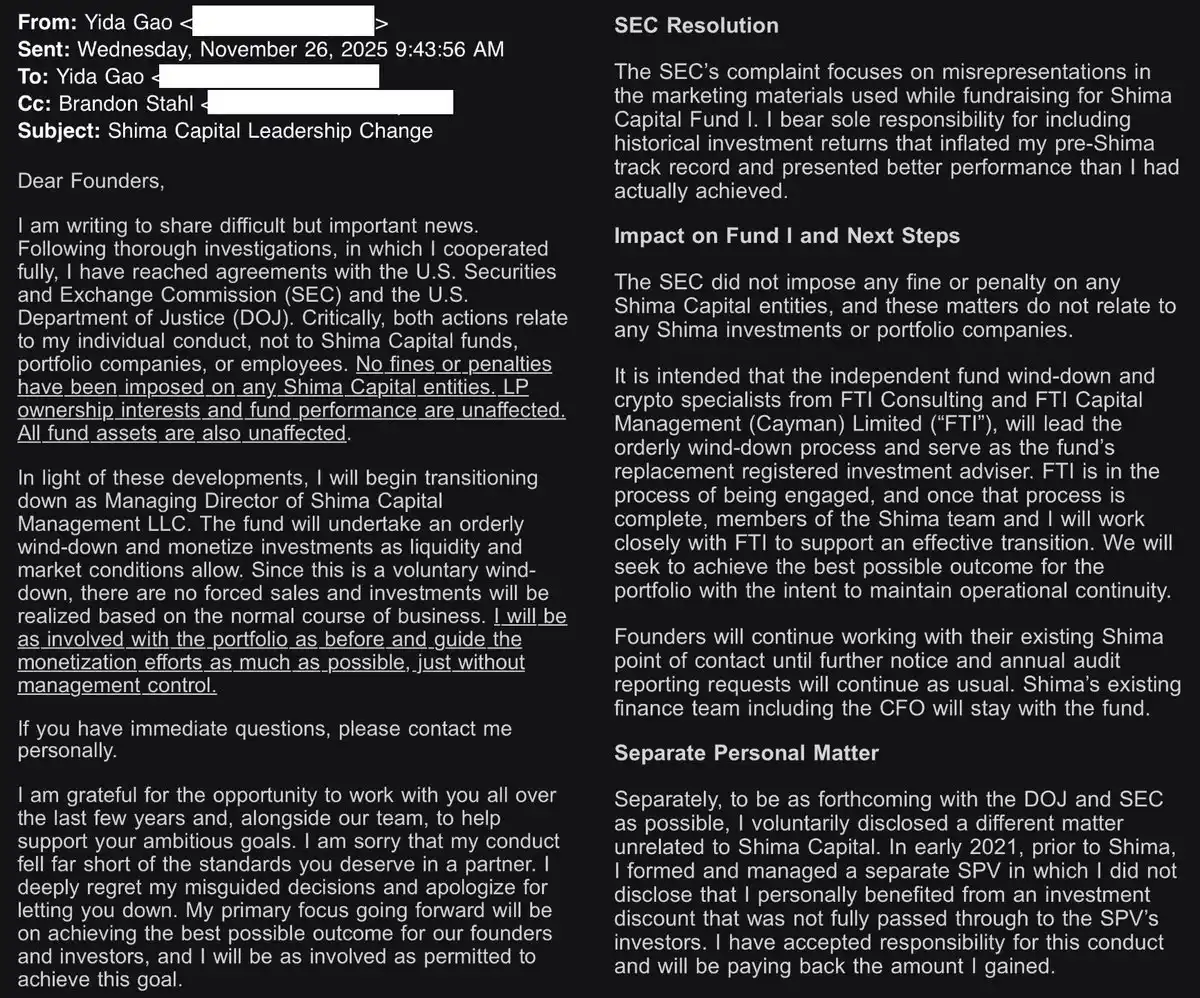
Another crypto venture capital firm has fallen. On December 17, Shima Capital was exposed to be quietly winding down its operations.

In this brutal crypto cycle, the exit of VCs is not uncommon, but Shima Capital's departure is not dignified. Unlike other VCs that died from liquidity drying up or were dragged down by poor investment portfolios, Shima Capital's downfall stemmed more from internal moral hazards and management chaos.

The direct trigger for this decision was the lawsuit filed by the U.S. SEC against the institution and its founder Yida Gao three weeks ago. The charges alleged that they violated multiple securities laws and illegally raised over $169.9 million from investors through fraudulent means.

Under regulatory pressure, Yida Gao quickly chose to settle with the SEC and the U.S. Department of Justice. While paying a fine of approximately $4 million, he decided to close the fund and announced his resignation from all positions, expressing deep regret for his "misleading decisions." The foundation will enter a liquidation process and will gradually liquidate assets to repay investors as the market allows.
As a once high-frequency star venture capital in the crypto field, Shima Capital's rise relied more on the founder's elite光环. American-Chinese Yida Gao was a Wall Street top student with a background from MIT. He even took over the crypto course taught by former SEC Chairman Gary Gensler at MIT. His resume also includes well-known institutions like Morgan Stanley and New Enterprise Associates.

With this background, Shima easily raised $200 million for its first fund, with backers including Dragonfly, hedge fund billionaire Bill Ackman, Animoca, OKX, Republic Capital, Digital Currency Group, and Mirana Ventures.

Holding huge funds, Shima became one of the most active hunters in the last cycle, betting on over 200 crypto projects, including hot projects like Monad, Puddy Penguins, Solv, Berachain, 1inch, Coin98, etc. Despite the vast investment portfolio, Shima and its team were evaluated by investors as young and lacking experience, not truly understanding the industry, and merely following the speculative wave of cryptocurrency.

More seriously, all this was built on lies. According to the SEC's lawsuit documents, when raising $158 million for Shima Capital Fund I, he fabricated past performance, claiming that one of his investments had achieved a 90x return, while the actual data was only 2.8x. When the lie was at risk of being exposed, he even tried to brush it off as a "typo" to investors.

Not only that, Yida Gao raised funds from investors through an SPV to purchase BitClout tokens, promising discounts and principal protection. However, in reality, although he bought the tokens at a low price, he did not offer them to investors at the original price but instead resold them to his own SPV at a markup, secretly profiting $1.9 million without disclosure.

From a long-term perspective, Shima's exit also sends a positive signal to the market: crypto wrongdoing is no longer outside the law, and the industry's transparency and ethical standards will be better improved.

Related reading: Unveiling the Founder of Shima Capital Suspected of Misappropriating Assets: From Fujian Immigrant to Wall Street Financial Elite

The Era of Easy Money is Over, VCs Enter an Evolution Period

The so-called failure of the VC model is essentially the market forcing the industry to evolve.

Currently, the assembly-line model of "VCs forming a syndicate, retail investors taking the bag" has been broken, and funds are rapidly withdrawing from air projects. For example, not long ago, Monad, with its豪华 investment lineup, still couldn't escape price difficulties after launch, which also made a group of VCs "break defense," and venture capital firms like Dragonfly engaged in fierce debates around value valuation.

The industry's rules of the game have changed. Whether it's the success of projects without VC funding (like Hyperliquid) or the community's resistance to high-valuation projects, they are actually pushing venture capital institutions out of their arrogant ivory towers. Only when the path of making quick money simply by "issuing and selling tokens" is blocked will VCs truly settle down to find projects with造血能力 that can solve practical problems.

This阵痛 is obvious. As retail investors exit leading to liquidity drying up, the traditional exit channels for VCs are blocked. Valuation adjustments not only lengthen the return cycle but also leave a large number of investments facing serious paper losses.

Not long ago, Akshat Vaidya, co-founder of Arthur Hayes' family office Maelstrom, publicly complained that the principal of his investment in a certain Pantera fund four years ago had nearly halved, while Bitcoin had risen about twofold during the same period.

Another VC confided to PANews that they were overwhelmed by exits. Even though they participated in the seed round, the current token price they hold is lower than the cost price. Even if a project is listed on a top exchange like Binance, years later they only recovered one-fifth of the principal. Many projects choose to随便 list on a small exchange to give investors an交代, but there is simply no liquidity to exit. Some projects even choose to lie flat, and when asked, the answer is always to wait for the right time.

Glassnode data shows that currently only about 2% of the altcoin supply is in a profitable state, showing an unprecedented market differentiation. During Bitcoin bull markets, it is historically uncommon for altcoins to consistently underperform.
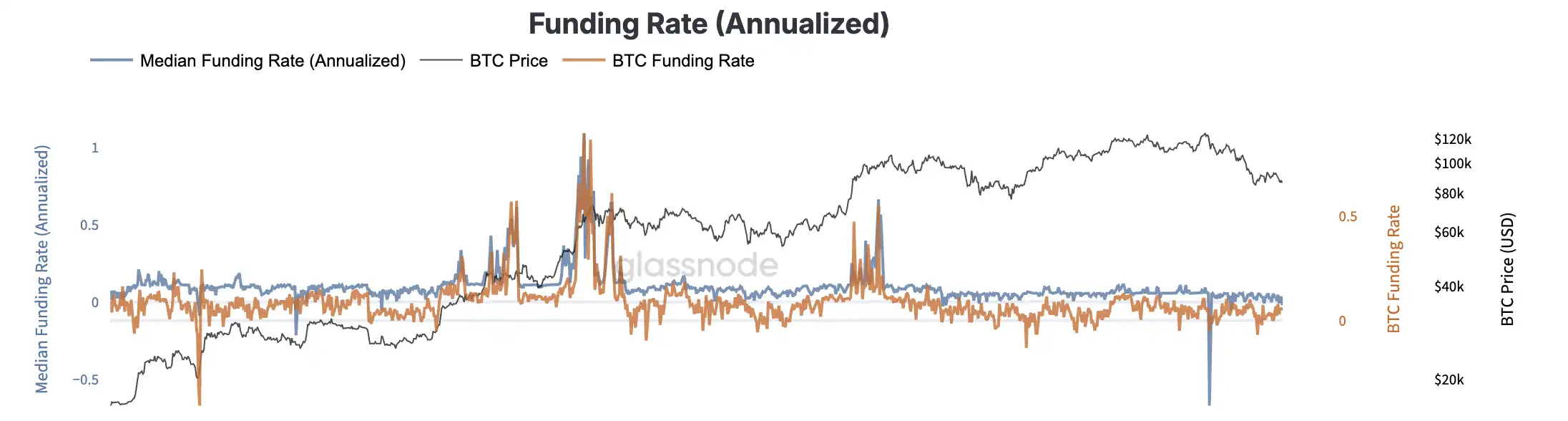
The data confirms that the era of making money with eyes closed is彻底 over.

The end of one era means the beginning of another. Rui from HashKey Ventures pointed out on social media that VCs are not afraid of熬, they are afraid of快, which is also why bear markets are more suitable for VCs. To truly succeed, one must survive until the next dead period. Unlike project parties, VCs are quite good at enduring. At the same time, most crypto VCs essentially arbitrage information asymmetry, coupled with some path dependence, earning some hard money and channel fees. More importantly, many of these people have now turned into market agents or market makers, which is essentially not much different.

Build Roads Before Buildings, Seeking Certain Opportunities

Facing the receding hot money, VCs are not all "fleeing" but are making strategic contractions and adjustments to their battle lines.

"If a project doesn't have a data dashboard, we won't invest in it." Recent participants at a Dubai crypto event revealed that VCs now pay more attention to actual business data rather than单纯 stories. Facing the bleak reality, VCs have significantly raised investment thresholds or even completely abandoned new investments.

Dovey Wan, founder of Primitive Ventures,坦言 that for investors, the ratio at which strength and luck can be exchanged (at present) is becoming increasingly苛刻, especially in the post-GPT era. This is true for all industries: choice is more important than effort, but choice is much harder than effort.

Pantera Capital revealed a positive trend in a recent video. According to its disclosure, although the total financing amount in the crypto field reached $34 billion this year, exceeding the records of 2021 and 2022, the number of transactions decreased by nearly 50%. This phenomenon has several main reasons: First, the investor structure has changed. Family offices and individual investors active during 2021-2022 have become more cautious after experiencing bear market losses, with some even choosing to exit the market. Second, the investment strategies of existing VCs have become more concentrated. These VCs prefer to put funds into a few high-quality projects rather than casting a wide net as before, because the capital, time, and resource costs required to launch new projects are higher now. On the other hand, some funds have shifted to relatively safer assets, which also explains why大量资金 is highly concentrated in Bitcoin and a few mainline assets in this cycle. Third, funds are ample but deployment节奏 has slowed. Many venture capital funds raised large amounts of money in 2021 and 2022 and are currently holding sufficient "ammunition," mainly used to support existing investment portfolios and are in no hurry to invest in new projects. From a longer-term perspective, this change is not a negative signal but rather a sign of the market maturing.

Galaxy Research's recent analysis of Q3 investment reports also pointed out that crypto VC investment额 in the quarter increased but was concentrated. Meanwhile, nearly 60% of investment funds flowed to late-stage companies, the second-highest level since Q1 2021. Compared to 2022, venture capital fundraising data also shows a significant decline in investor interest. This data also shows that VCs are more willing to heavily bet on certain opportunities.
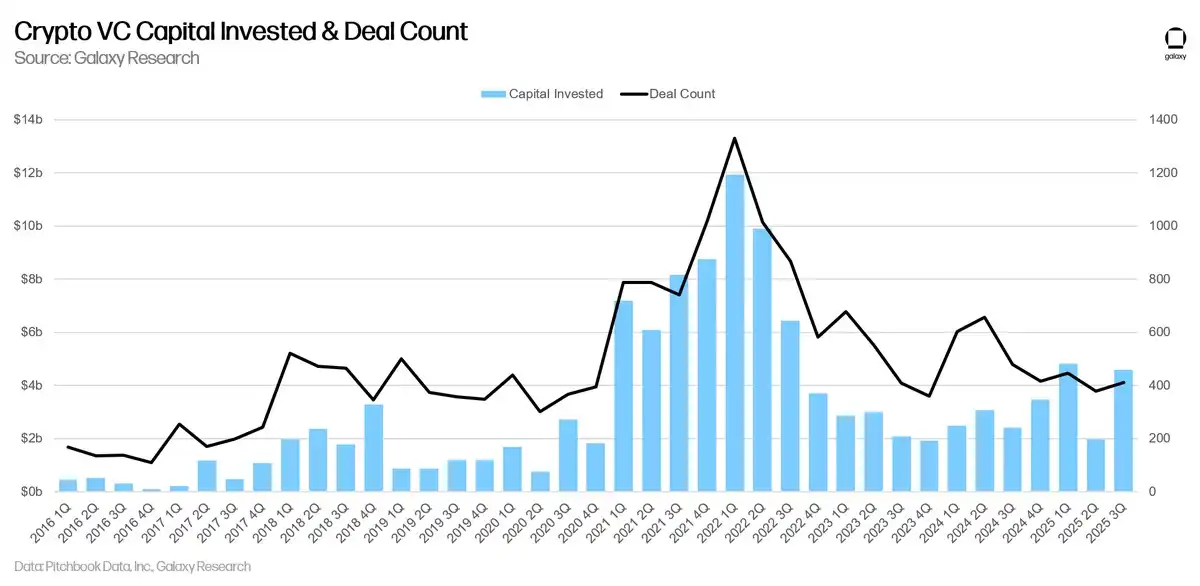
To hedge against the risks of a single market, some crypto VCs have started to "not focus on their main business,"瞄准 markets outside of crypto-native. For example, the recent investment list of YZi Labs shows that its gaze has turned to biotech, robotics, and other圈外 sectors. Some crypto-native funds have long started investing in AI projects. Although they don't have significant pricing advantages compared to tech funds, it's an attempt at transformation.

Pantera also reflected on the investments of the last cycle. "In the last cycle, a large amount of capital flowed into speculative areas like NFTs and the metaverse. These projects tried to skip infrastructure and directly build the 'cultural top layer.' But it's like building a castle on sand: the underlying infrastructure wasn't ready, payment rails were not mature, the regulatory environment was unclear, and the user experience was far from mainstream level. The industry was too eager to seek killer apps and invested resources in the application layer where the soil wasn't ready."

Pantera believes that this crypto cycle is undergoing a necessary "correction." Now more funds are flowing into infrastructure construction, such as more efficient payment chains, more mature privacy tools, and stablecoin systems. This path is the correct sequence, and the applications of the next cycle will have the conditions to truly explode.

Lay the foundation first, then build the building.

The brutal clearing of crypto VCs at present is both a阵痛 and a reshaping.

Пов'язані питання

QWhat led to the downfall of Shima Capital, and what does it signify for the crypto VC industry?

AShima Capital's downfall was primarily due to internal moral hazards and management chaos, including fraudulent fundraising and misrepresentation of investment returns, as charged by the SEC. This signifies a necessary cleansing and demystification in the crypto VC space, highlighting that unethical practices are no longer tolerated and promoting higher transparency and ethical standards.

QHow has the crypto VC investment strategy evolved in the current market cycle according to the article?

AVCs have shifted towards more cautious and data-driven investments, focusing on actual business metrics rather than speculative stories. They are concentrating funds on fewer high-quality projects, with increased investment in later-stage companies and infrastructure, rather than broad, early-stage bets, reflecting a move towards maturity and risk mitigation.

QWhat example does the article provide to illustrate the failure of the 'VC assembly line' model where retail investors bear the losses?

AThe article cites the example of Monad, which had a豪华 investment lineup but still faced price struggles after launch, leading to debates among VCs like Dragonfly about value valuation. This shows the breakdown of the model where VCs set up projects and retail investors end up absorbing the losses.

QAccording to Pantera Capital, what is the positive trend in the current crypto funding environment despite a drop in deal count?

APantera Capital notes that while the total crypto funding reached $34 billion, deal count dropped by nearly 50%. This is due to more concentrated investments by VCs in high-quality projects, increased costs for launching new ventures, and a shift towards safer assets like Bitcoin, indicating market maturation rather than a negative signal.

QWhat strategic shift are some crypto VCs making to hedge risks, as mentioned in the article?

ASome crypto VCs are diversifying into non-crypto native markets, such as biotech and robotics, to hedge against single-market risks. Others are investing in AI projects, attempting to transition beyond the crypto space despite lacking significant pricing advantages compared to tech funds.

Пов'язані матеріали

Those Pre-Bitcoin PoW Protocols Have Recently Been Reimplemented

This article details a recent surge in replicating pre-Bitcoin Proof-of-Work (PoW) protocols, specifically focusing on Hal Finney's 2004 RPOW (Reusable Proofs of Work). Within five days in May 2026, multiple independent builders in the Bitcoin/cypherpunk community launched projects inspired by this early electronic cash proposal. The initiative began with Fred Krueger's `rpow2.com`, a centralized but auditable system that replaced RPOW's original IBM 4758 hardware with Ed25519 signatures. Initially a faithful replica, it later adopted Bitcoin-like features (21M supply cap, difficulty adjustment) and a controversial 5.24% founder allocation. This sparked rapid forks, including `rpow4.com` which incorporated full Bitcoin parameters, a prediction market (`rpowmarket.com`), and a DEX (`rpow2swap.com`). Concurrently, Mike In Space created a prototype of Wei Dai's 1998 b-money proposal (`b-money.replit.app`), pushing the historical exploration even further back. The article contrasts these centralized, server-dependent experiments with Bitcoin's core innovation of decentralized, trustless consensus. It also highlights a parallel development: the `HASH` project on Ethereum, which uses smart contract hooks to enable a purely fair-launch, browser-mineable PoW token with 0% allocations to team or VCs. The collective activity is framed as a meme-driven, educational exploration of cypherpunk history rather than a serious financial movement, with all projects heavily disclaiming any investment value.

marsbit6 хв тому

Those Pre-Bitcoin PoW Protocols Have Recently Been Reimplemented

marsbit6 хв тому

South Korean Exchanges 'Battle' Regulators, Challenging the Boundaries of Enforcement and Legislation

South Korea's cryptocurrency industry is engaged in a rare, direct confrontation with regulators. The Financial Intelligence Unit (FIU), the primary anti-money laundering (AML) watchdog, has recently imposed heavy penalties on major exchanges like Upbit and Bithumb for alleged violations involving unregistered overseas VASPs and AML procedures. However, exchanges are now actively challenging these actions in court and through industry associations. In a significant shift, the Seoul Administrative Court ruled in favor of Upbit's operator, Dunamu, overturning part of an FIU-ordered business suspension. The court found the FIU's penalty criteria and justification insufficiently clear. Similarly, the court suspended the enforcement of a six-month business suspension against Bithumb pending a final ruling, citing potential irreversible harm to the exchange. Beyond legal battles, the industry is contesting proposed legislative amendments. The Digital Asset eXchange Alliance (DAXA) strongly opposes a draft rule that would mandate Suspicious Transaction Reports (STRs) for all crypto transfers over 10 million KRW (~$6,800). DAXA argues this "poison pill" clause violates legal principles and would overwhelm the STR system, increasing reports from 63,000 to an estimated 5.45 million annually for major exchanges, thereby crippling effective AML monitoring. This conflict highlights a structural tension in South Korea's crypto governance: comprehensive digital asset laws are still developing, while regulators rely heavily on AML enforcement. The industry's move from passive compliance to active legal and legislative challenges signifies a new phase, pressing for clearer rules and more proportionate enforcement. While short-term disputes may intensify, this clash could ultimately lead to a more mature and sustainable regulatory framework for South Korea's vibrant crypto market.

marsbit59 хв тому

South Korean Exchanges 'Battle' Regulators, Challenging the Boundaries of Enforcement and Legislation

marsbit59 хв тому

After 50x Storage Surge, Justin Sun Always Looks to the Next Decade

Sun Yuchen, known for his controversial stunts like a $30 million lunch with Warren Buffett (canceled due to a kidney stone) and eating a $6.2 million duct-taped banana, is often overshadowed by a significant fact: his decade-long track record of spotting major investment trends. In 2016, he famously advised young people to invest in Bitcoin, Nvidia, Tesla, and Tencent instead of buying property. A hypothetical $20,000 investment in Nvidia and Tesla from that list would now be worth over 50 million RMB. His latest major call was on November 6, 2025, predicting a "50x storage opportunity" tied to the AI boom, which materialized with Sandisk's stock surging nearly 50-fold by 2026. Looking ahead, Sun now focuses on the next frontier: Physical AI. He identifies four key areas: 1. **Embodied AI/Robotics**: He sees this reaching its "iPhone moment," with companies like UBTech and Galaxy General leading in commercialization. 2. **Drones**: Viewed as the first commercially viable form of Physical AI, revolutionizing sectors from warfare (e.g., AeroVironment's Switchblade) to logistics. 3. **Spatial Computing**: Beyond VR, it's about AI understanding physical space, a foundational technology for robotics and autonomous systems, exemplified by Apple's Vision Pro. 4. **Space Exploration**: After a 2025 suborbital flight with Blue Origin, Sun advocates for space as the ultimate frontier, discussing blockchain's potential role in space asset management and data transactions. His investment philosophy involves betting on entire, inevitable trends rather than single companies. For robotics, he sees Tesla (the body/manufacturer) and Nvidia (the brain/AI platform) as complementary plays. In defense drones, he highlights companies making tanks obsolete (AeroVironment) and those augmenting fighter jets (Kratos). For space, he participated in Blue Origin's flight and anticipates SpaceX's potential IPO to redefine the sector's valuation. Sun Yuchen's vision frames the next two decades not as a revolution in information flow (like the internet), but in the fundamental operation of the physical world through AI-powered robots, autonomous systems, and spatial intelligence, ultimately extending human and AI activity into space. While many still focus on conventional assets, he continues to look toward the next technological horizon.

marsbit1 год тому

After 50x Storage Surge, Justin Sun Always Looks to the Next Decade

marsbit1 год тому

The Billionaires Behind the Most Expensive Midterm Election in History

"The Most Expensive Midterm Elections and Their Billionaire Backers" This analysis details the unprecedented scale of spending in the 2026 midterm elections, highlighting the key billionaire donors shaping the political landscape. Jeff Yass, founder of Susquehanna International Group, has contributed over $81 million, ranking third among individual donors behind George Soros ($102.6M) and Elon Musk ($84.8M). Yass is a major donor to Trump's MAGA Inc. and supports school choice and various candidates. Overall, federal committees have raised over $4.7 billion this cycle, with political ad spending projected to reach $10.8 billion. Republican-aligned groups are significantly out-raising their Democratic counterparts. "Dark money" from undisclosed sources continues to grow. The core stakes involve control of Congress and policy direction for Trump's final term. Donors are also motivated by specific issues: Sergey Brin and Chris Larsen are funding opposition to a proposed California wealth tax and supporting crypto-friendly policies. Other top donors include OpenAI's Greg Brockman and his wife Anna ($50M total to MAGA Inc. and an AI-focused PAC), Richard Uihlein ($45.3M to conservative causes), venture capitalists Marc Andreessen and Ben Horowitz (each over $44M to crypto/AI PACs and MAGA Inc.), Miriam Adelson ($42.6M to GOP leadership PACs), Paul Singer ($33.9M), and Diane Hendricks ($25.8M to MAGA Inc.). The article notes that the peak fundraising period is still ahead, with major primaries approaching.

marsbit1 год тому

The Billionaires Behind the Most Expensive Midterm Election in History

marsbit1 год тому

Торгівля

Спот
Ф'ючерси
活动图片