Exposing $74 Billion Government Corruption, He 'Incidentally' Earned Millions on X Platform

比推Опубліковано о 2026-02-04Востаннє оновлено о 2026-02-04

Анотація

An anonymous X user known as Beaver won a $1 million creator competition on the platform by publishing an investigative article exposing a massive corruption scandal involving the consulting firm Deloitte and the U.S. government. The article, titled "Deloitte, a $74 Billion Cancer Metastasized Across America," revealed that Deloitte had received $40 billion in government contracts over two decades but caused approximately $34 billion in losses due to systemic failures, fraud, and deeply entrenched conflicts of interest, including frequent employee exchanges between the firm and government agencies. Beaver, who operates a data transparency website called SomaliScan, used public records to document the misuse of public funds. Although not primarily involved in cryptocurrency, Beaver had previously launched a memecoin called SS, which saw a temporary price surge following the article’s viral success—garnering 45 million views. The author pledged to use the prize money to purchase SS. The top three articles in the competition aligned with perennial popular themes: political exposure (winner), financial strategy (runner-up), and self-improvement advice (third place). The outcome underscores that high-impact content on X often revolves around uncovering hidden truths, offering practical guidance, or resonating with broad public sentiment.

Written by: Eric, Foresight News

Original Title: The Creator Who Took $1 Million from X Once Launched a Memecoin


At 00:00 Beijing time on February 4, 2025, X announced the results of its $1 million creator competition launched two weeks ago. The event was open only to U.S. participants, who were required to write an original article of at least 1,000 words. The article with the highest number of reads on the "Home Timeline" of X's paid users would win the exclusive million-dollar prize.

Given the precedent of "How to Completely Change Your Life in One Day" with 170 million views, many speculated that the winning article would likely be a similar "inspirational piece." However, the result was both unexpected and yet made sense.

Writing Articles Is More Profitable Than Trading Cryptocurrency

The creator who became a millionaire with a single article goes by the X username Beaver. His article, "Deloitte, a $74 Billion Cancer Metastasized Across America," garnered 45 million views.
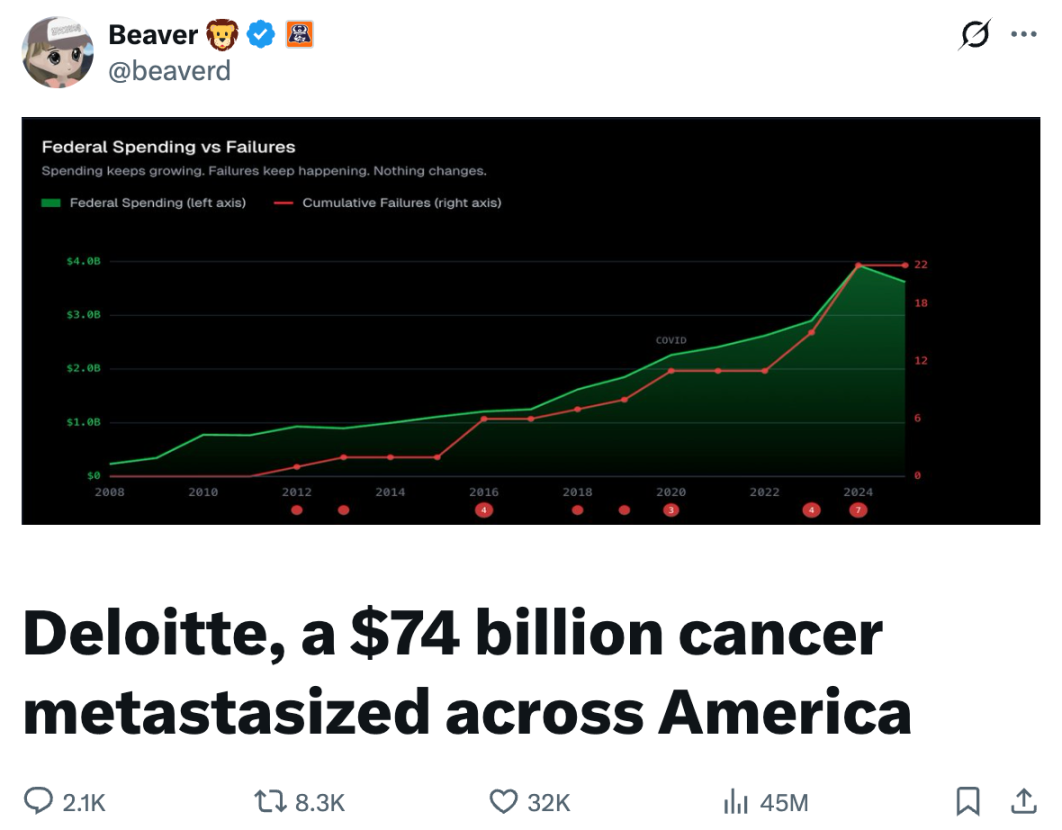
The winning article is an in-depth investigative report exposing a U.S. government scandal. The author, through analyzing public documents such as federal contracts, state contracts, recorded defaults, lawsuits, and audits, uncovered a history of "collusion between officials and businesses" involving tens of billions of dollars: Over the past 20 years, Deloitte has secured a total of $40 billion in contracts from federal and state governments. However, the various systems it developed, including unemployment benefit application systems, either suffered from vulnerabilities that led to billions in fraudulent claims or were abandoned after budgets were multiplied without results.

In summary, the government spent $40 billion on systems that ultimately caused $34 billion in losses. Even more alarming, there is frequent employee movement between Deloitte and the U.S. government, allowing Deloitte to infiltrate every aspect of the government, "like cancer cells spreading through the bloodstream," continuously siphoning taxpayers' money with no clear source or way to eradicate it.

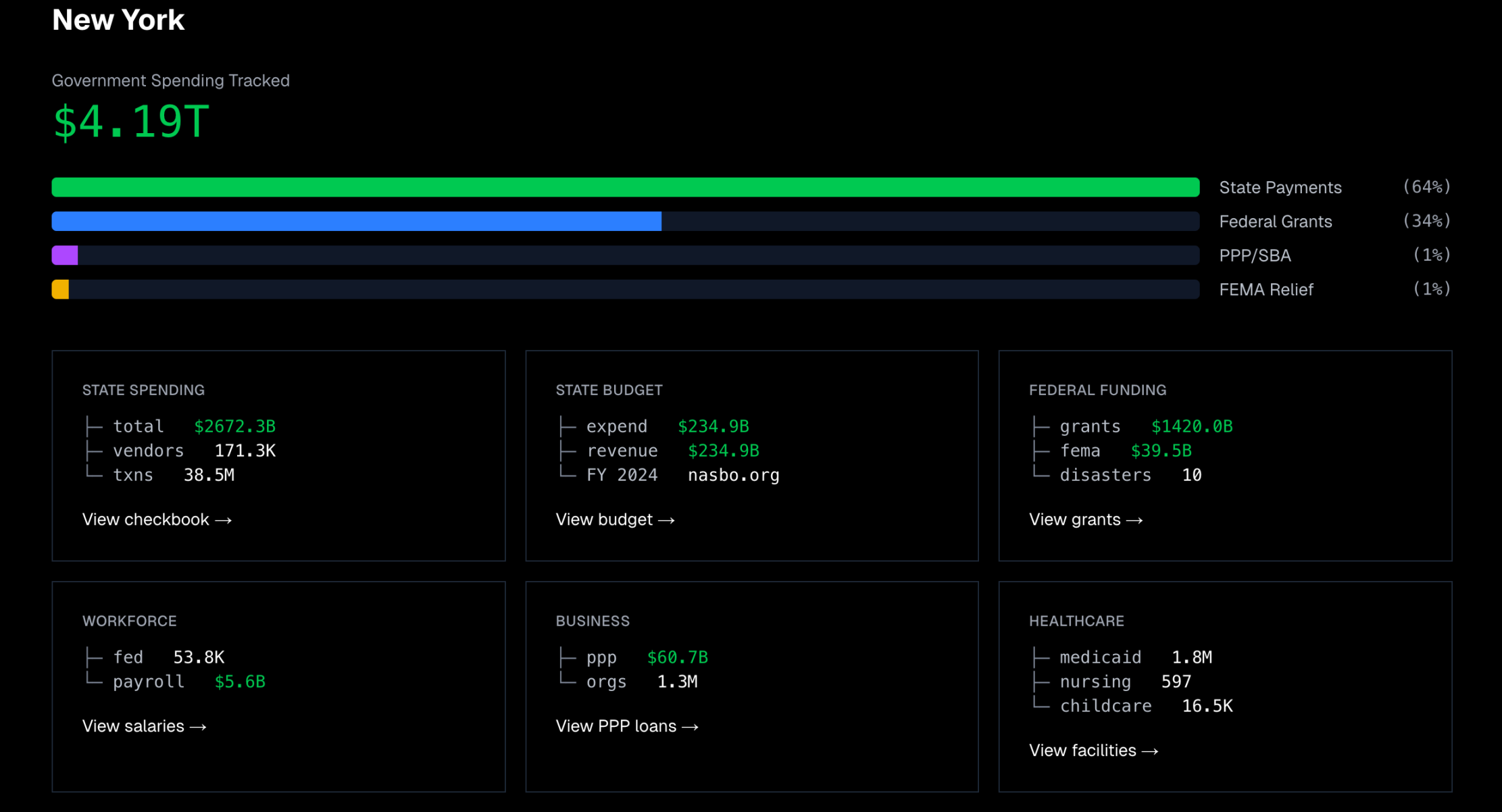
Looking through Beaver's account, you'll find that its main theme is "concern for the country and its people," with topics almost always related to government, politics, and public welfare. Additionally, Beaver launched a website called SomaliScan, which compiles public data on government budgets, expenditures, federal grants, labor statistics, and includes information on political donations and other politically related data. The corrupt relationship between Deloitte and the government was uncovered by analyzing this data.
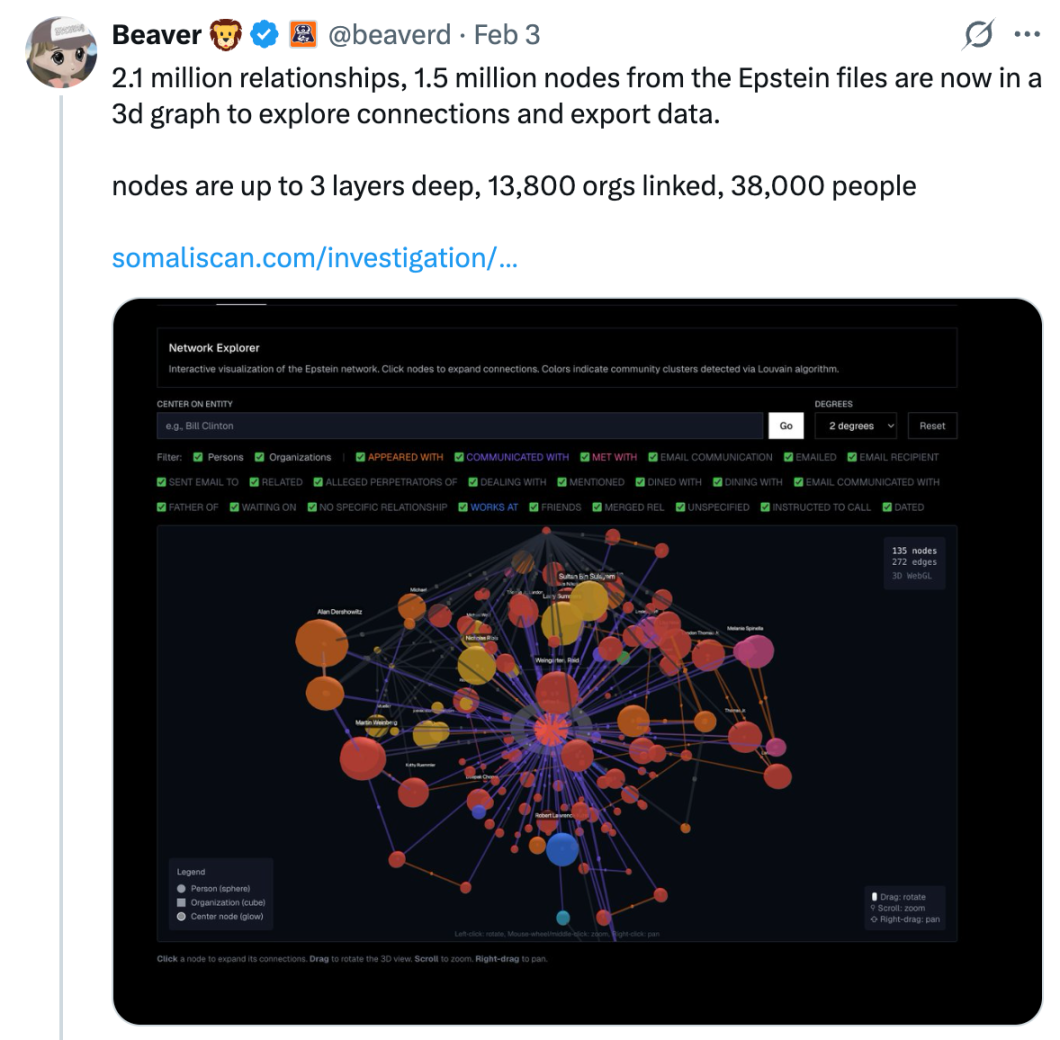
On February 3, Beaver also organized the massive "Epstein Files" released to the public into complex relationship diagrams on the website.
Interestingly, this political commentator launched a meme token called SS (9NrkmoqwF1rBjsfKZvn7ngCy6zqvb8A6A5RfTvR2pump) for the website on January 2 of this year. The token performed poorly initially but surged to a阶段性 high on January 28 after Beaver's article gained tens of millions of views, and spiked again when the winner was announced today. Compared to SS's dismal performance and the $1 million prize, this might be a rare case where "writing articles is more profitable than trading cryptocurrency."
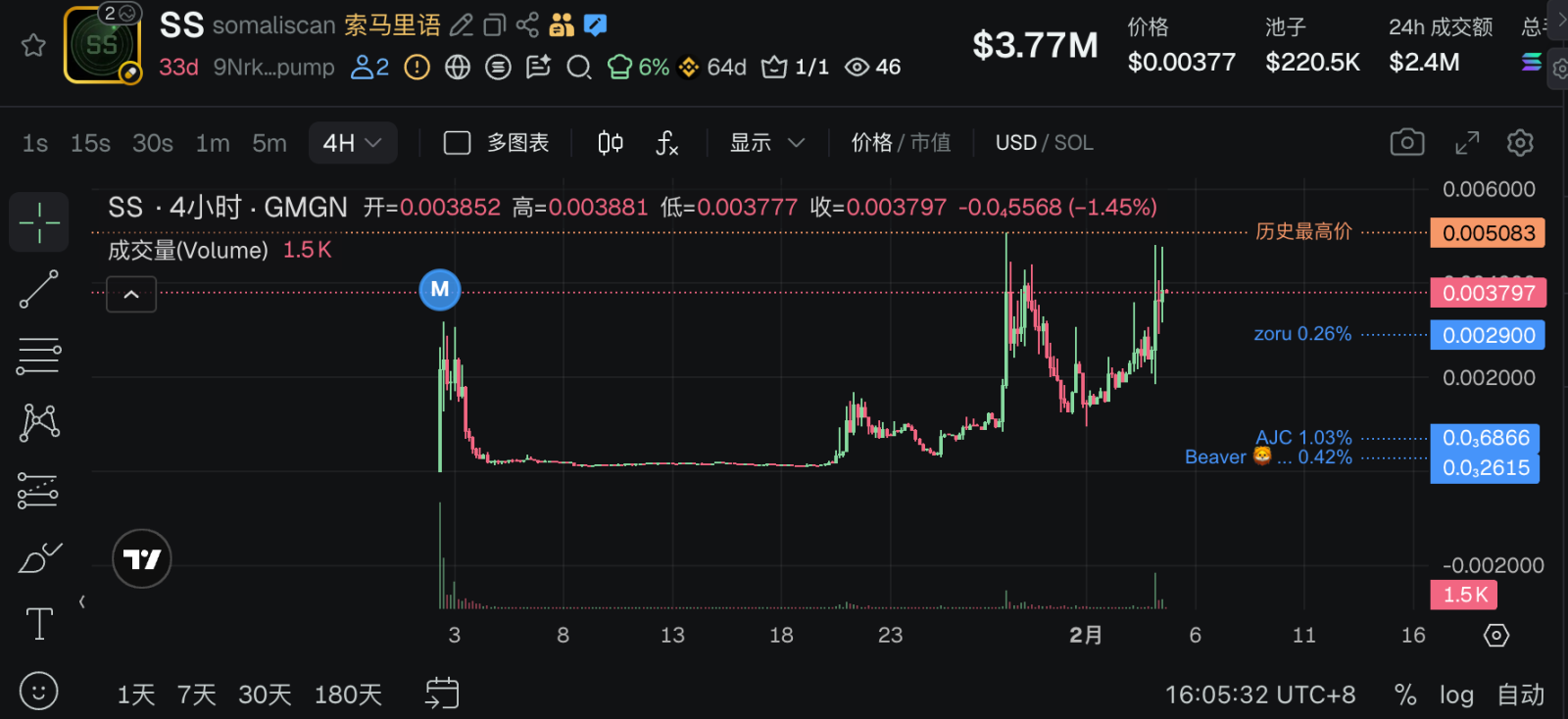
On January 25, Beaver stated that the competition prize money would be entirely used to purchase SS, with 10% of the total SS supply reserved for hackathons, 20% locked, and Beaver keeping only 4.5% for themselves.

It's certain that Beaver is not a "crypto insider." The market cap of less than $4 million also indicates that this meme token has little热度. Those who spend real money to buy SS are likely supporters of Beaver and SomaliScan. It's worth noting that the SomaliScan website also has a donation channel supporting Bitcoin, Ethereum, SOL, and XMR donations. If you enjoy stirring up trouble, you can support this "champion of democracy" who dares to expose U.S. government scandals.

Common Topics Among Netizens: Politics, Money, and Emotions

The Chinese internet has three enduringly popular topics: political trends, economic situations/how to make money, and personal emotions.

The top three articles in X's U.S.-only competition恰好 correspond to these points:

  • First Place: "Deloitte, a $74 Billion Cancer Metastasized Across America," exposing U.S. government corruption;

  • Second Place: "A Detailed Explanation of President Trump's Tariff Strategy: A Step-by-Step Guide on How to Operate," analyzing the patterns of Trump's tariff policies to derive an investment strategy应对变化;

  • Third Place (Official Favorite): "The Complete Guide: How to Achieve Extreme Focus," another piece of self-improvement鸡汤 from Daniel Koe.

High-readership Chinese articles on X also revolve around these topics.
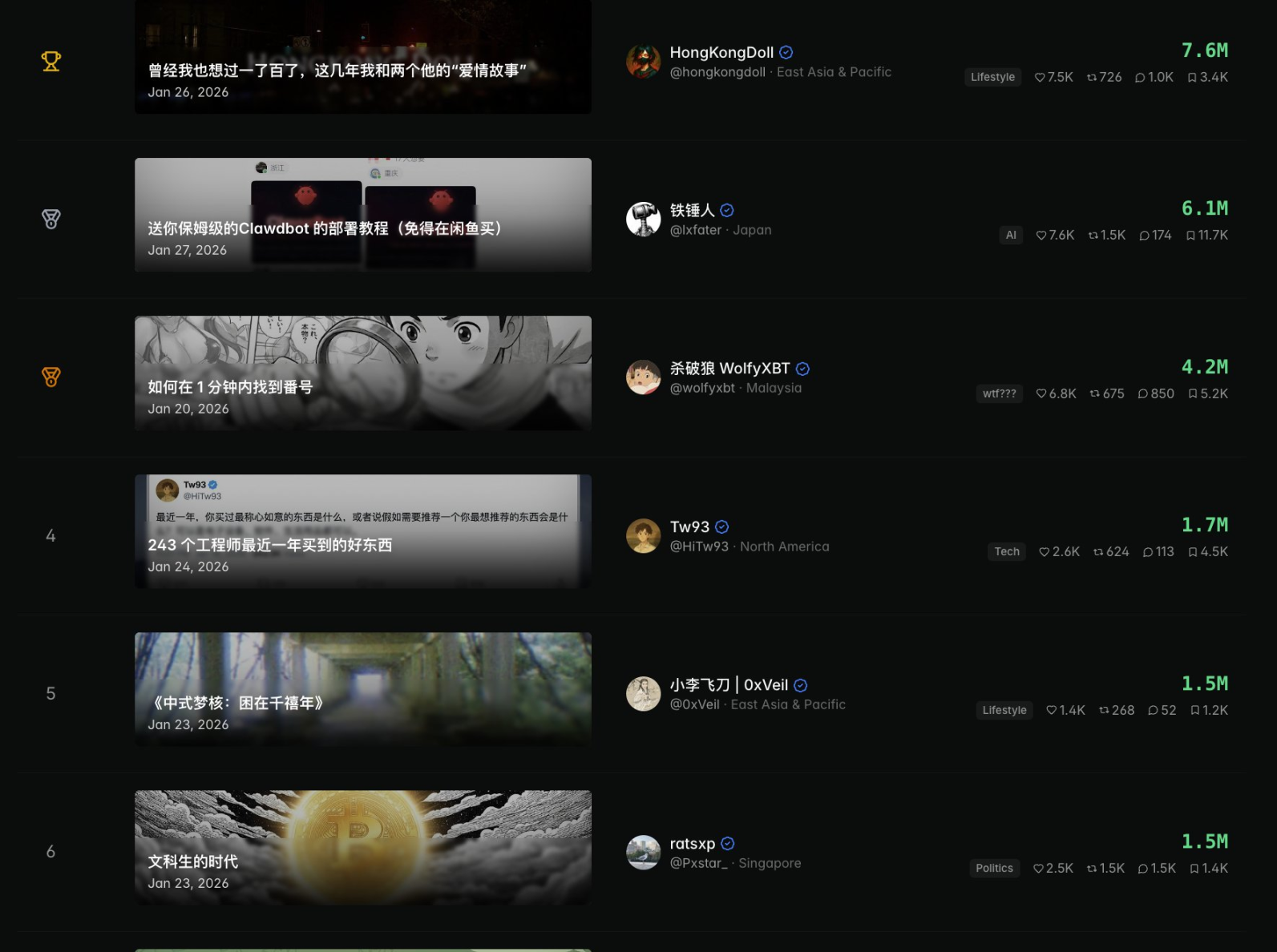
If you read these articles carefully, you'll find that they aren't particularly flowery in language but mostly present facts and reasoning, satisfying readers' emotional or practical needs. For creators, the conclusion is very simple: At least on the X platform, to gain more exposure, you either tell a new story unknown to others, whether about yourself or social issues, or provide a detailed "operational guide"—be it on how to make money, how to adjust your mindset, or even, as shown in the image above, how to find video codes.


Twitter:https://twitter.com/BitpushNewsCN

BitPush TG Discussion Group:https://t.me/BitPushCommunity

BitPush TG Subscription: https://t.me/bitpush

Original article link:https://www.bitpush.news/articles/7608637

Пов'язані питання

QWho won the $1 million creator competition on X and what was the topic of their article?

AThe winner was a creator named Beaver, whose article titled 'Deloitte, a $74 billion cancer metastasized across America' exposed government corruption involving Deloitte and U.S. government contracts.

QHow much did Deloitte receive in federal and state contracts over 20 years, and what was the estimated loss caused by their systems?

ADeloitte received $40 billion in contracts over20 years, and their systems caused an estimated $34 billion in losses.

QWhat is SomaliScan, and how is it related to Beaver's work?

ASomaliScan is a website created by Beaver that compiles and analyzes public data on government budgets, spending, federal grants, labor, and political donations, which he used to investigate and expose the corruption between Deloitte and the government.

QWhat meme token did Beaver launch, and how did its performance compare to his competition winnings?

ABeaver launched the meme token SS (SomaliScan token). Its market performance was relatively poor with less than $4 million in market cap, making the $1 million prize from the competition a rare case where writing an article was more profitable than trading the meme coin.

QWhat were the top three topics of the highest-read articles in X's creator competition, and how do they relate to popular topics in Chinese internet culture?

AThe top three topics were:1) government corruption (winning article),2) investment strategies based on political policies (second place), and3) self-improvement and focus (third place). These align with the perennial popular topics in Chinese internet culture: politics, money/economics, and personal emotions/self-help.

Пов'язані матеріали

A Clod of Chinese Soil Chokes Two Japanese Giants

"Chinese Soil Chokes Japanese Giants" The production of a key electronic specialty gas, tungsten hexafluoride (WF6), vital for manufacturing AI chips, was halted by two leading Japanese producers—Kanto Denka and Central Glass. Their shutdown was not due to a technological failure but a sudden, critical shortage of a raw material they had long taken for granted: ultra-high-purity (6N-grade) tungsten powder, which is almost entirely sourced from China. Following a quiet Chinese export announcement in January 2026, tungsten powder shipments to Japan dropped to zero for months. Despite frantic efforts, Japanese companies found no viable alternative; imported powder was three times more expensive and lacked the required purity. Their existing stockpiles were exhausted by mid-2026. WF6 is essential for depositing tungsten into the microscopic contact holes of High Bandwidth Memory (HBM) chips, which are crucial for advanced processors like those from Nvidia. While Japanese firms had mastered producing ultra-pure WF6 gas, their entire supply chain relied on China's 6N tungsten powder—a dependency now revealed as a fatal vulnerability. China's dominance in this "soil" results from decades of painstaking R&D by companies like Xiamen Tungsten and China Tungsten & Hightech. They overcame immense technical hurdles, such as separating chemically similar molybdenum from tungsten, to achieve mass production of the world's purest tungsten powder. With their primary suppliers gone, Kanto Denka and Central Glass announced a permanent halt to WF6 production starting July 1, 2026. This immediately created a supply crisis for major semiconductor manufacturers like Samsung and SK Hynix, forcing them to urgently seek and certify new Chinese suppliers for WF6 itself. The reversal marks a dramatic shift: China has moved from exporting low-value raw materials to controlling the high-purity foundation of a critical global tech supply chain, upending a long-established industrial hierarchy.

marsbit27 хв тому

A Clod of Chinese Soil Chokes Two Japanese Giants

marsbit27 хв тому

Without Tencent, What's Left for Suiyuan?

The article centers on the crucial question posed in the title: what is Seyond Technology really worth if its dominant customer, Tencent, were to stop purchasing its AI chips? As the last of China's "Four AI Chip Dragons" to secure approval for a public listing, Seyond's IPO filing reveals a profound and controversial dependency. In 2025, 74.9% to over 80% of its revenue came from Tencent. The piece argues that this extreme customer concentration is not merely a vulnerability but a strategic outcome of China's AI industry evolution. It contrasts Seyond's path with its peers (Moore Thread, Biren Technology, and MetaX), noting that while others raced to market with ambitious stories, Seyond focused first on securing and delivering for a major client. Its explosive revenue growth—with Q1 2026 up 1474.85% year-on-year—is driven by concentrated orders from Tencent, which itself faces massive, escalating AI compute demands for products like its Yuanbao and Hunyuan models. The relationship is framed as a deliberate, symbiotic cultivation of a supply chain. As both a major shareholder (20.26%) and primary client, Tencent is actively fostering Seyond to build a controllable, stable alternative to NVIDIA, similar to how global tech giants historically nurtured key suppliers. The high switching costs—involving software stacks and deployed systems—create a deep "ecological moat" for Seyond within Tencent's ecosystem. The analysis positions the AI chip landscape in three tiers: NVIDIA as the global leader, Huawei's Ascend as the state-backed player, and commercial firms like Seyond competing for market orders. Seyond is increasingly seen as "Tencent's compute foundation," with its product roadmap closely aligned with the tech giant's needs. The conclusion is that the industry's metric for success is shifting from fundraising and technical specs to real orders, delivery capability, and ecosystem binding. Seyond's value, therefore, lies not just in its chips but in holding a massive, multi-year procurement order from China's largest internet company—a tangible asset arguably more telling than any technical whitepaper in the current climate. The core insight is that for domestic chips, the ultimate challenge isn't just catching up technologically with NVIDIA, but earning the trust, scenarios, and recurring orders from a major anchor client.

marsbit1 год тому

Without Tencent, What's Left for Suiyuan?

marsbit1 год тому

War Trade Unwinding | TradeXYZ Weekend Observations

Weekend markets saw a clear return of risk appetite. Major indices rose broadly, with significant gains in tech and precious metals, while energy sectors fell sharply on the "end of war" narrative. On June 14, oil prices initially rose on reports Iran had not yet finalized a memorandum of understanding. Later, YNET reported Trump might immediately lift the maritime blockade on Iran and the Strait of Hormuz. At 21:30, Trump confirmed on Truth Terminal that a deal with Iran was done, authorizing an immediate end to the US blockade and toll-free opening of the Strait. Iran's deputy foreign minister simultaneously announced an immediate and permanent halt to military actions on multiple fronts. Oil prices had already fallen to weekend boundaries, pre-pricing the news. The S&P 500 subsequently touched 7530. Markets will likely remain in a waiting period until the formal peace deal signing on June 19. At the moment of the deal announcement, gold jumped from ~4,221 to a high of 4,337, and silver from ~67.85 to 70.83, before stabilizing at higher levels. Individual stocks and ETFs like NBIS, RKLB, and LITE performed strongly. NBIS, added to the Nasdaq index, saw a target price increase due to strong AI cloud growth. RKLB, also added to the index, benefited from positive SpaceX valuation sentiment. LITE received a $1,130 target from JPMorgan. SPCX rose quickly after Musk tweeted SpaceX could potentially reach ~$1 trillion in revenue by 2030. In summary, the market shock from the multi-month war is beginning to dissipate. Israel's actions remain the key variable before the June 19 signing. Upcoming events like Fed Chair Warsh's debut and BoJ rate hike expectations will also significantly impact markets this week.

marsbit2 год тому

War Trade Unwinding | TradeXYZ Weekend Observations

marsbit2 год тому

Торгівля

Спот
Ф'ючерси
活动图片





