Exposing $74 Billion Government Corruption, He 'Incidentally' Earned Millions on X Platform

比推Опубліковано о 2026-02-04Востаннє оновлено о 2026-02-04

Анотація

An anonymous X user known as Beaver won a $1 million creator competition on the platform by publishing an investigative article exposing a massive corruption scandal involving the consulting firm Deloitte and the U.S. government. The article, titled "Deloitte, a $74 Billion Cancer Metastasized Across America," revealed that Deloitte had received $40 billion in government contracts over two decades but caused approximately $34 billion in losses due to systemic failures, fraud, and deeply entrenched conflicts of interest, including frequent employee exchanges between the firm and government agencies. Beaver, who operates a data transparency website called SomaliScan, used public records to document the misuse of public funds. Although not primarily involved in cryptocurrency, Beaver had previously launched a memecoin called SS, which saw a temporary price surge following the article’s viral success—garnering 45 million views. The author pledged to use the prize money to purchase SS. The top three articles in the competition aligned with perennial popular themes: political exposure (winner), financial strategy (runner-up), and self-improvement advice (third place). The outcome underscores that high-impact content on X often revolves around uncovering hidden truths, offering practical guidance, or resonating with broad public sentiment.

Written by: Eric, Foresight News

Original Title: The Creator Who Took $1 Million from X Once Launched a Memecoin


At 00:00 Beijing time on February 4, 2025, X announced the results of its $1 million creator competition launched two weeks ago. The event was open only to U.S. participants, who were required to write an original article of at least 1,000 words. The article with the highest number of reads on the "Home Timeline" of X's paid users would win the exclusive million-dollar prize.

Given the precedent of "How to Completely Change Your Life in One Day" with 170 million views, many speculated that the winning article would likely be a similar "inspirational piece." However, the result was both unexpected and yet made sense.

Writing Articles Is More Profitable Than Trading Cryptocurrency

The creator who became a millionaire with a single article goes by the X username Beaver. His article, "Deloitte, a $74 Billion Cancer Metastasized Across America," garnered 45 million views.
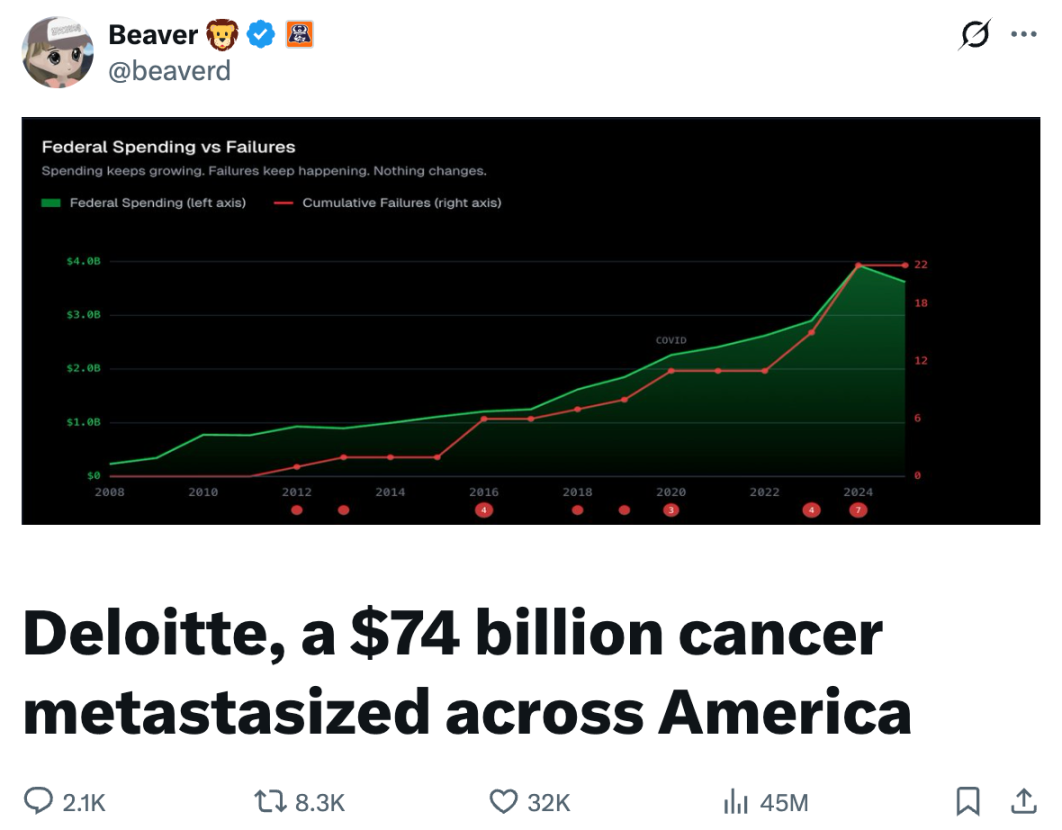
The winning article is an in-depth investigative report exposing a U.S. government scandal. The author, through analyzing public documents such as federal contracts, state contracts, recorded defaults, lawsuits, and audits, uncovered a history of "collusion between officials and businesses" involving tens of billions of dollars: Over the past 20 years, Deloitte has secured a total of $40 billion in contracts from federal and state governments. However, the various systems it developed, including unemployment benefit application systems, either suffered from vulnerabilities that led to billions in fraudulent claims or were abandoned after budgets were multiplied without results.

In summary, the government spent $40 billion on systems that ultimately caused $34 billion in losses. Even more alarming, there is frequent employee movement between Deloitte and the U.S. government, allowing Deloitte to infiltrate every aspect of the government, "like cancer cells spreading through the bloodstream," continuously siphoning taxpayers' money with no clear source or way to eradicate it.

Looking through Beaver's account, you'll find that its main theme is "concern for the country and its people," with topics almost always related to government, politics, and public welfare. Additionally, Beaver launched a website called SomaliScan, which compiles public data on government budgets, expenditures, federal grants, labor statistics, and includes information on political donations and other politically related data. The corrupt relationship between Deloitte and the government was uncovered by analyzing this data.
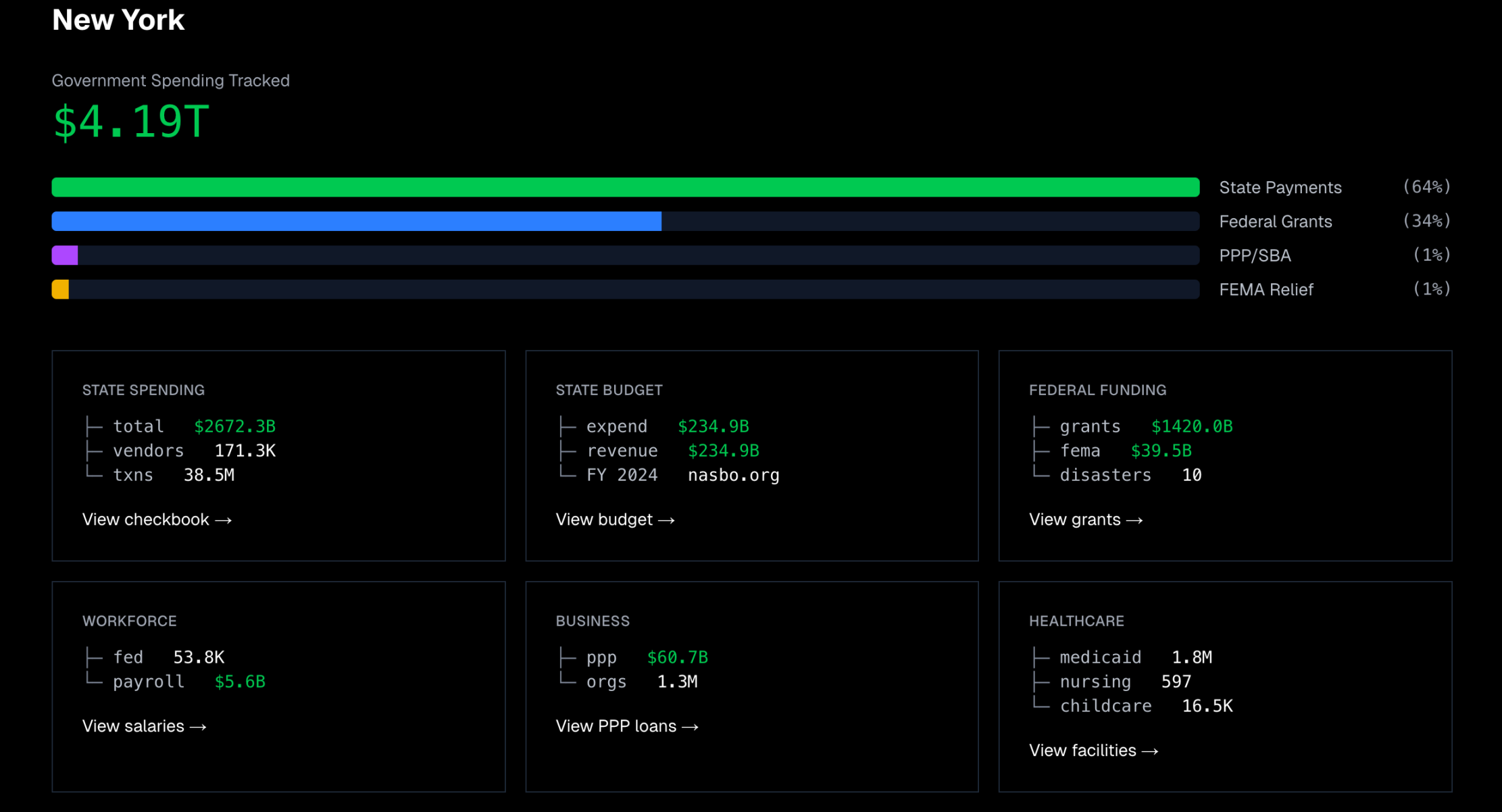
On February 3, Beaver also organized the massive "Epstein Files" released to the public into complex relationship diagrams on the website.
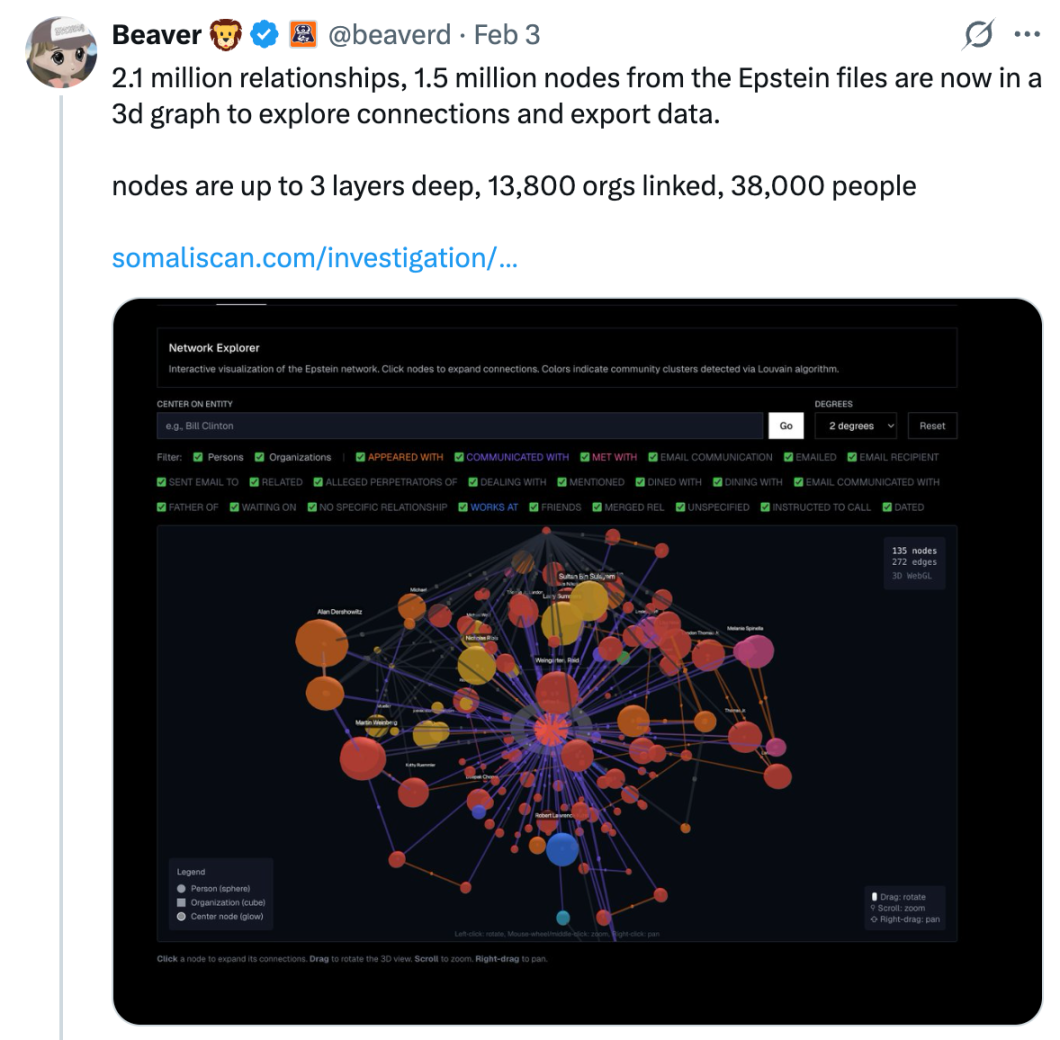
Interestingly, this political commentator launched a meme token called SS (9NrkmoqwF1rBjsfKZvn7ngCy6zqvb8A6A5RfTvR2pump) for the website on January 2 of this year. The token performed poorly initially but surged to a阶段性 high on January 28 after Beaver's article gained tens of millions of views, and spiked again when the winner was announced today. Compared to SS's dismal performance and the $1 million prize, this might be a rare case where "writing articles is more profitable than trading cryptocurrency."
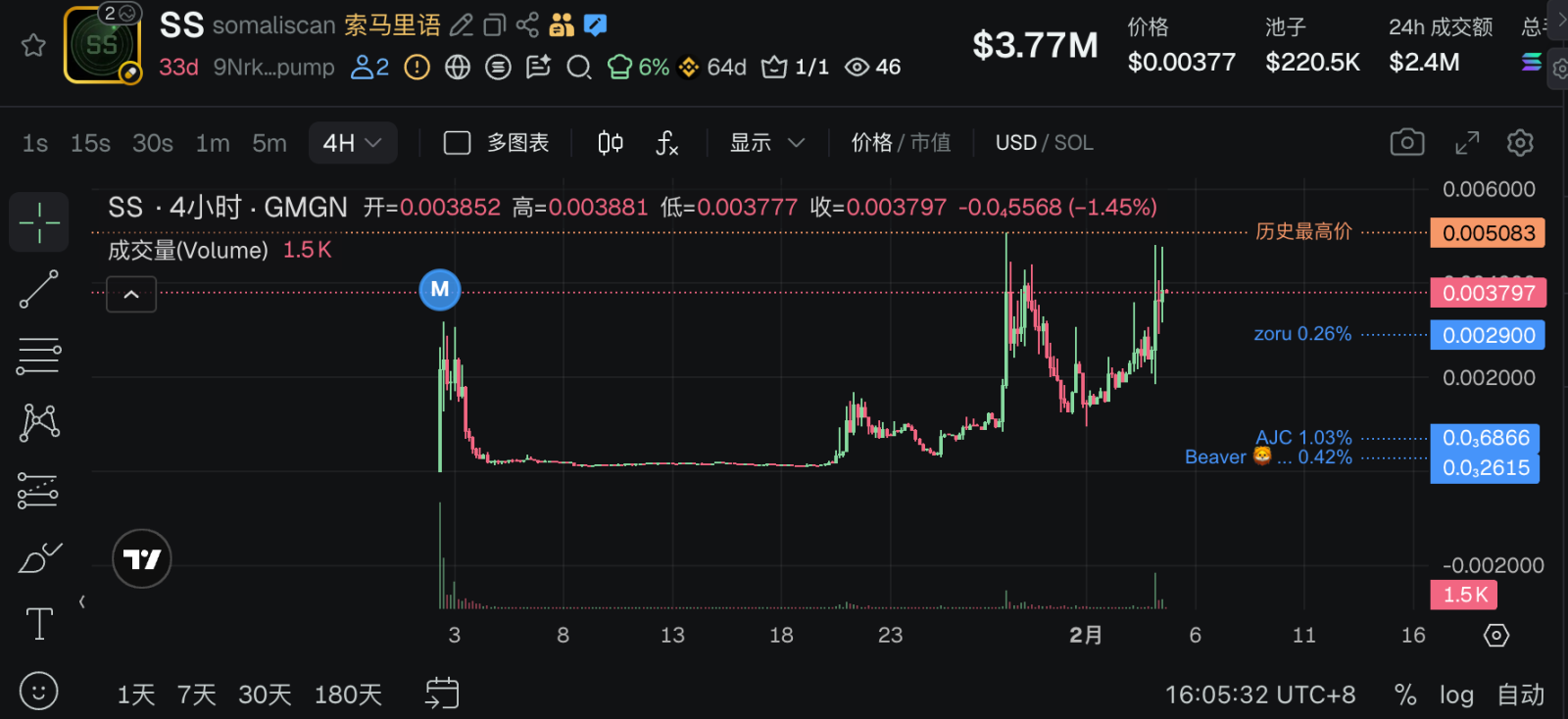
On January 25, Beaver stated that the competition prize money would be entirely used to purchase SS, with 10% of the total SS supply reserved for hackathons, 20% locked, and Beaver keeping only 4.5% for themselves.

It's certain that Beaver is not a "crypto insider." The market cap of less than $4 million also indicates that this meme token has little热度. Those who spend real money to buy SS are likely supporters of Beaver and SomaliScan. It's worth noting that the SomaliScan website also has a donation channel supporting Bitcoin, Ethereum, SOL, and XMR donations. If you enjoy stirring up trouble, you can support this "champion of democracy" who dares to expose U.S. government scandals.

Common Topics Among Netizens: Politics, Money, and Emotions

The Chinese internet has three enduringly popular topics: political trends, economic situations/how to make money, and personal emotions.

The top three articles in X's U.S.-only competition恰好 correspond to these points:

  • First Place: "Deloitte, a $74 Billion Cancer Metastasized Across America," exposing U.S. government corruption;

  • Second Place: "A Detailed Explanation of President Trump's Tariff Strategy: A Step-by-Step Guide on How to Operate," analyzing the patterns of Trump's tariff policies to derive an investment strategy应对变化;

  • Third Place (Official Favorite): "The Complete Guide: How to Achieve Extreme Focus," another piece of self-improvement鸡汤 from Daniel Koe.

High-readership Chinese articles on X also revolve around these topics.
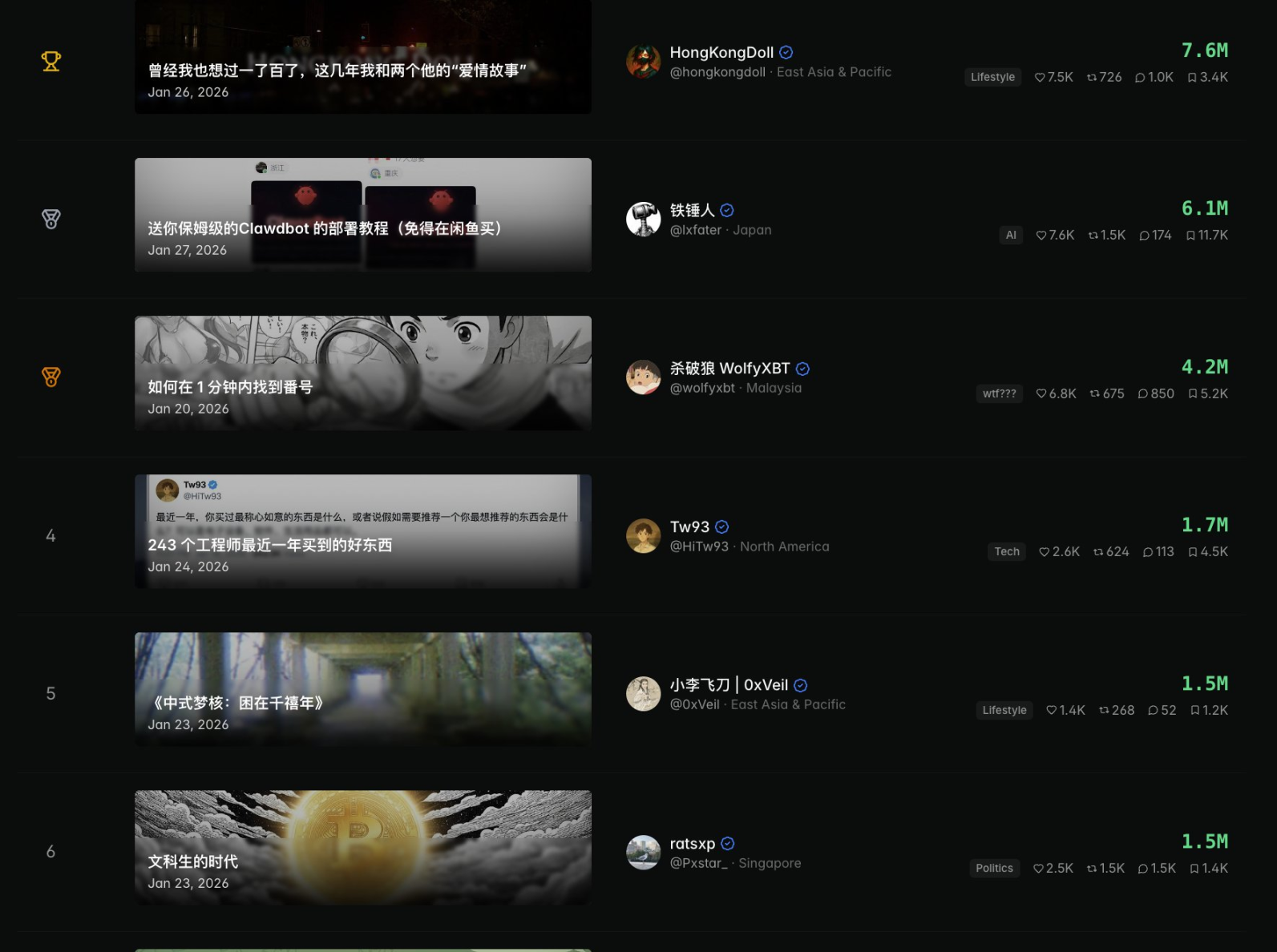
If you read these articles carefully, you'll find that they aren't particularly flowery in language but mostly present facts and reasoning, satisfying readers' emotional or practical needs. For creators, the conclusion is very simple: At least on the X platform, to gain more exposure, you either tell a new story unknown to others, whether about yourself or social issues, or provide a detailed "operational guide"—be it on how to make money, how to adjust your mindset, or even, as shown in the image above, how to find video codes.


Twitter:https://twitter.com/BitpushNewsCN

BitPush TG Discussion Group:https://t.me/BitPushCommunity

BitPush TG Subscription: https://t.me/bitpush

Original article link:https://www.bitpush.news/articles/7608637

Пов'язані питання

QWho won the $1 million creator competition on X and what was the topic of their article?

AThe winner was a creator named Beaver, whose article titled 'Deloitte, a $74 billion cancer metastasized across America' exposed government corruption involving Deloitte and U.S. government contracts.

QHow much did Deloitte receive in federal and state contracts over 20 years, and what was the estimated loss caused by their systems?

ADeloitte received $40 billion in contracts over20 years, and their systems caused an estimated $34 billion in losses.

QWhat is SomaliScan, and how is it related to Beaver's work?

ASomaliScan is a website created by Beaver that compiles and analyzes public data on government budgets, spending, federal grants, labor, and political donations, which he used to investigate and expose the corruption between Deloitte and the government.

QWhat meme token did Beaver launch, and how did its performance compare to his competition winnings?

ABeaver launched the meme token SS (SomaliScan token). Its market performance was relatively poor with less than $4 million in market cap, making the $1 million prize from the competition a rare case where writing an article was more profitable than trading the meme coin.

QWhat were the top three topics of the highest-read articles in X's creator competition, and how do they relate to popular topics in Chinese internet culture?

AThe top three topics were:1) government corruption (winning article),2) investment strategies based on political policies (second place), and3) self-improvement and focus (third place). These align with the perennial popular topics in Chinese internet culture: politics, money/economics, and personal emotions/self-help.

Пов'язані матеріали

Fu Peng's First Public Speech in 2026: What Exactly Are Crypto Assets? Why Did I Join the Crypto Asset Industry?

Fu Peng, a renowned macroeconomist and now Chief Economist at New火 Group, delivered his first public speech of 2026 at the Hong Kong Web3 Festival. He explained his perspective on crypto assets and why he joined the industry, framing it within the context of macroeconomic trends and financial evolution. Fu emphasized that crypto assets are transitioning from an early, belief-driven phase to a mature, institutionally integrated asset class. He drew parallels to the 1970s-80s, when technological advances (like computing) revolutionized traditional finance, leading to the rise of FICC (Fixed Income, Currencies, and Commodities). Similarly, current advancements in AI, data, and blockchain are reshaping finance, with crypto assets becoming part of a new "FICC + C" (C for Crypto) framework. He noted that institutional capital, including traditional hedge funds, avoided early crypto due to its speculative nature but are now engaging as regulatory clarity emerges (e.g., stablecoin laws, CFTC classifying crypto as a commodity). Fu predicted that 2025-2026 marks a turning point where crypto becomes a standardized, financially viable asset for diversified portfolios, akin to commodities or derivatives in traditional finance. Fu defined Bitcoin not as "digital gold" in a simplistic sense but as a value-preserving, financially tradable asset. He highlighted that crypto's future lies in regulated, institutional adoption, moving away from retail-dominated trading. His entry into crypto signals this maturation, where traditional finance integrates crypto into mainstream asset management.

marsbit52 хв тому

Fu Peng's First Public Speech in 2026: What Exactly Are Crypto Assets? Why Did I Join the Crypto Asset Industry?

marsbit52 хв тому

Justin Sun Sues Trump Family: What $75 Million Bought Was Only a Blacklist

Justin Sun, founder of Tron, has filed a lawsuit in federal court against World Liberty Financial (WLF), alleging he was made the "primary target of a fraudulent scheme" after investing $75 million. Sun claims the investment secured him an advisor title and WLFI tokens, which were later frozen by WLF, causing "hundreds of millions in losses." The dispute began in late 2024 when Sun's investment helped revive WLF's struggling token sale, which ultimately raised $550 million. Shortly after, the SEC dropped its lawsuit against Sun following Donald Trump's inauguration. However, relations soured when Sun refused WLF's demands for additional funding. In August 2025, WLF added a "blacklist" function to its smart contract, allowing it to unilaterally freeze tokens. Sun's holdings, worth approximately $107 million, were frozen, and he was threatened with token destruction. The lawsuit highlights WLF's structure, which directs 75% of token sale profits to the Trump family, who had earned $1 billion by December 2025. WLF's CEO is Zach Witkoff, son of U.S. Middle East envoy Steve Witkoff. The project faces scrutiny for opaque operations, including a controversial loan arrangement on the Dolomite platform, co-founded by a WLF advisor. Despite Sun's history with the SEC, the case underscores centralization risks within DeFi, as WLF controls governance and holds powers to freeze assets arbitrarily. Sun's tokens remain frozen as legal proceedings begin.

marsbit1 год тому

Justin Sun Sues Trump Family: What $75 Million Bought Was Only a Blacklist

marsbit1 год тому

$500 to Buy OpenAI Stock: Silicon Valley's Most Respectable Liquidity Invitation

Silicon Valley's largest venture capital platform, AngelList, has launched a new fund called USVC, allowing U.S. retail investors to buy into high-profile AI companies like OpenAI, Anthropic, and xAI with a minimum investment of $500—no accredited investor status required. Promoted by AngelList co-founder Naval Ravikant, the fund is framed as an opportunity for ordinary people to access high-growth private tech investments traditionally reserved for VCs. However, critics argue it functions more like an exit vehicle for early insiders. USVC acquires shares not through primary rounds but largely via secondary transactions—purchasing stakes from early investors, VC funds, and employees looking to cash out at peak valuations. With companies like xAI heavily weighted in the portfolio, the fund effectively channels retail money into providing liquidity for insiders who entered at much lower valuations. The fund’s structure raises concerns: shares are illiquid, with no secondary market, and buybacks are limited and discretionary. The actual annual fee reaches 3.61%, far above the advertised 1% management fee. This model parallels the "low float, high fully diluted valuation" strategy seen in crypto, where early investors profit by selling to latecomers at inflated prices. The timing—alongside similar moves by platforms like Robinhood—suggests that Silicon Valley’s sudden interest in retail inclusion may be less about democratizing access and more about securing exits for insiders.

marsbit1 год тому

$500 to Buy OpenAI Stock: Silicon Valley's Most Respectable Liquidity Invitation

marsbit1 год тому

Торгівля

Спот
Ф'ючерси
活动图片