Even Satoshi Nakamoto Would Kowtow to the God of Wealth

深潮Опубліковано о 2025-12-25Востаннє оновлено о 2025-12-25

Анотація

On the fifth day of the Lunar New Year, the author visits a temple in Hangzhou and observes a surprising number of cryptocurrency insiders—KOLs, community builders, and tech elites—praying for wealth, abandoning algorithmic consensus for incense and devotion. The piece notes the rising influence of metaphysics in crypto circles, where traditional analysis is increasingly supplanted by astrology, face-reading, and feng shui. A trader’s astrological prediction warns of Bitcoin’s “darkest hour” in 2026, while a VC partner admits that assessing founders’ facial traits is now part of due diligence. Anecdotes illustrate this trend: a listed company CEO’s devotion to feng shui reportedly led to massive Bitcoin gains, while a frog-avatar KOL ignored his advisor’s warning and lost everything trading futures. The author frames this not as mere superstition but as a psychological response to extreme volatility. Just as maritime cultures turned to deities like Mazu for safety in uncertain seas, crypto participants seek spiritual anchors amid market chaos. When tweets from figures like Musk or Trump can swing prices 50% in a day, belief systems—whether in code or cosmology—become a necessary comfort. The question isn’t whether the God of Wealth understands blockchain, but whether faith helps traders sleep at night.

Author: Xiaobing, Deep Tide TechFlow

Every year on the fifth day of the Lunar New Year, Xiaobing wakes up early to visit the Number One Temple of Wealth at Beigao Peak in Hangzhou.

I thought I would be jostling with aunties and uncles, but when I arrived, the scene was filled with familiar faces amidst the swirling incense smoke.

To the left was a well-known爆料KOL, to the right someone involved in community schemes, and a few tech elites who usually preach "decentralization" were devoutly kowtowing with loud thuds. In that moment, algorithmic consensus and Federal Reserve moves were no match for the three sticks of incense in their hands.

Over the past two years, mysticism has become the "mainstream study" in the crypto world. If you’re still looking at K-line charts, you’re a classical rookie; the real OGs are now reading birth charts.

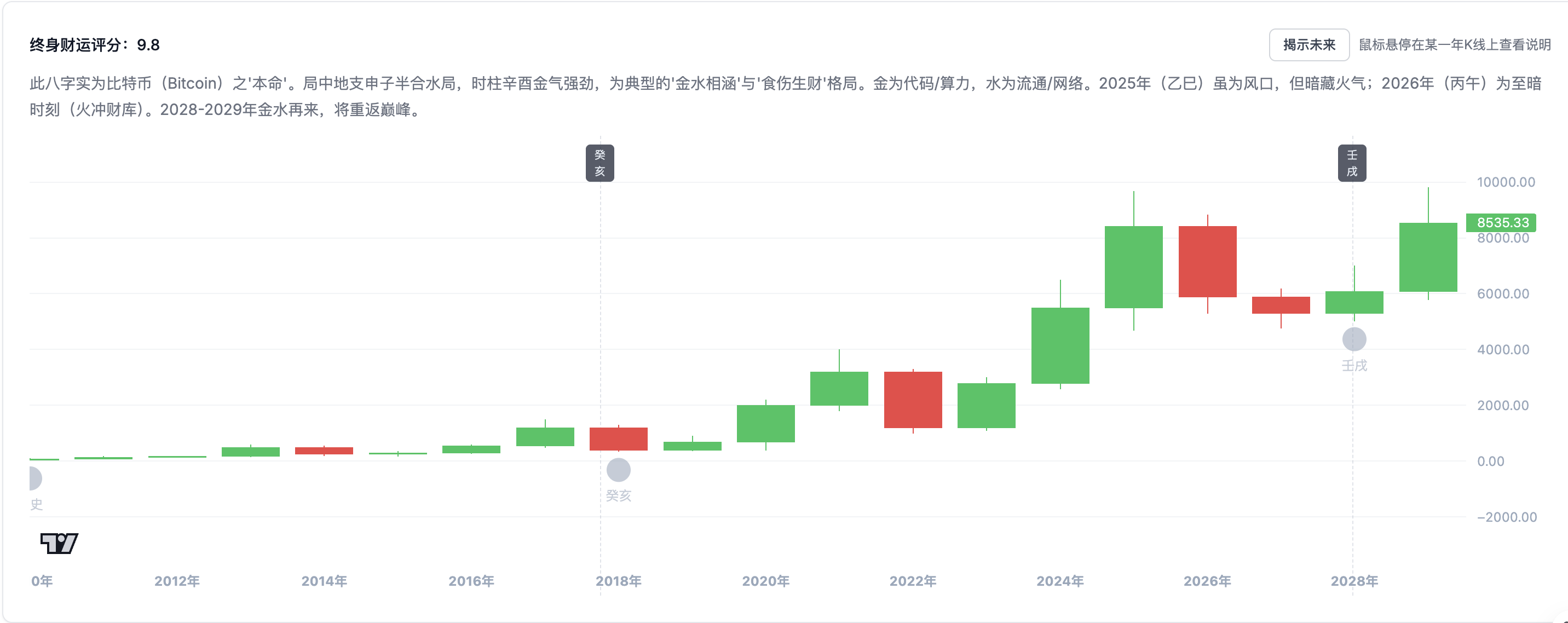
A crypto trader familiar with various macro indicators eventually turned to mysticism, recently calculating Bitcoin’s八字 (Bazi). The result was alarming: Fire clashes with the wealth vault, making 2026 (Bingwu Year) Bitcoin’s darkest hour. I quickly checked my wallet—good thing there were no coins in it anyway.
Remember when Alen, a crypto VC at y2z Ventures, bluntly stated that one of their fund’s core competitive edges was "reading面相" (face reading)? Due diligence (DD) used to involve code audits and business models, but now it’s different. First, check if the founder has a "wealth-draining face," then see if the project’s name clashes with风水 (Feng Shui).

On a recent trip to Shenzhen, I noticed that traders and KOLs’ standard setup isn’t data terminals—they all have a "Feng Shui consultant" backing them.

Don’t laugh; this actually works in the crypto world. Xiaobing knows a listed company boss in Hong Kong who is a devout believer in Feng Shui, donating real money to temples—possibly more than the company’s R&D budget.

And the result? Call it Feng Shui bringing noble help, but starting in 2023, he began buying Bitcoin, made hundreds of millions from hoarding, and later caught the wave of the DAT (Crypto Treasury Reserve) narrative, doubling the company’s stock price... Although everyone knows this is "survivorship bias," you can’t argue with the fact that he really made a fortune.

There are counterexamples too. A frog-avatar爆料KOL also had a Feng Shui consultant who advised him not to trade recently, but he couldn’t resist playing with contracts and ended up getting liquidated.

This isn’t entirely superstition.

Our traditional land-based civilization emphasizes farming—sow one seed in spring, reap ten thousand in autumn—focusing on certainty. But what does maritime civilization face? Storms and unknown waters.

Why do people in the southeastern coastal areas worship Mazu? Not out of ignorance, but because on the vast, unpredictable ocean, besides experience and technology, you need something else.

The crypto world is essentially a modern version of the "Age of Exploration." It faces deep, unfathomable waters and sudden storms. Humans are like this: the greater the randomness and volatility, the more we seek supernatural spiritual anchors.

When K-line charts fail, and a single tweet from Musk, Trump, or CZ can sway the market, Feng Shui becomes the last psychological defense. This isn’t ignorance; it’s an instinctive stress response to massive wealth fluctuations.

After all, when your assets can swing 50% in a day, you have to believe in something to sleep at night. As for whether the God of Wealth understands blockchain—does it really matter?


Пов'язані питання

QWhat is the main theme of the article regarding the crypto community's behavior?

AThe article highlights that mysticism and fortune-seeking practices, like worshipping the God of Wealth and using feng shui, have become prevalent in the crypto community as a psychological anchor amidst extreme market volatility and uncertainty.

QHow does the article describe the crypto space in comparison to historical contexts?

AIt compares the crypto space to the 'Age of Exploration' or maritime civilizations, where people face vast unknowns and storms, leading them to seek supernatural beliefs for stability and mental comfort.

QWhat example does the article give to show the effectiveness of feng shui in crypto success?

AIt mentions a Hong Kong-listed company boss who devoutly donated to temples and followed feng shui, leading to massive profits from Bitcoin investments and a surge in his company's stock price during the DAT narrative wave.

QWhat counterexample is provided about ignoring mystical advice in the crypto world?

AA frog-avatar KOL ignored his feng shui advisor's warning to avoid trading, engaged in contracts, and ended up getting liquidated.

QWhy does the article suggest crypto traders turn to mysticism instead of traditional analysis?

ABecause extreme market randomness, influenced by factors like tweets from figures such as Musk or Trump, makes traditional analysis like K-line charts less reliable, leading traders to seek psychological comfort through superstition.

Пов'язані матеріали

What Happens to Ethereum Developer Tools After the Grants Run Out?

On February 27th, the Ethereum Foundation (EF) announced Project Odin, a structured sustainability support program designed for a select group of strategic, previously grant-funded teams. Unlike a standard grant, Odin offers a long-term advisory mechanism focused on helping these teams establish credible, sustainable paths within a two-year framework, thereby reducing long-term dependence on single funding sources. The program addresses a critical post-grant challenge: how essential public goods, especially major developer tools, can achieve financial sustainability beyond initial funding. While grants from EF and programs like Gitcoin or RetroPGF remain vital for startups and research, they often fall short for mature, widely-used infrastructure. Tools like compilers, languages, and network stacks are deeply embedded but struggle with monetization, trapped between being too foundational to lose and too public to generate natural revenue. Project Odin provides teams with a dedicated Strategic Advisor to guide them through a three-phase process: 1) analyzing current funding and realistic options, 2) validating potential paths with stakeholders, and 3) executing plans, which may include crafting support contracts, service agreements, or other recurring revenue models. The first pilot participant is Vyper, a critical smart contract language for the EVM, highlighting the need for sustainable models for core infrastructure. The initiative reframes the public goods conversation from "who should be funded" to "how do already-proven teams avoid perpetual funding crises?" It encourages ecosystem participants—protocols and projects that depend on these tools—to view sustainable support not just as charity, but as essential risk management for their own operational supply chains.

marsbit21 хв тому

What Happens to Ethereum Developer Tools After the Grants Run Out?

marsbit21 хв тому

MARA Reports Q1 Revenue Below Expectations, Net Loss of $1.3 Billion, Stock Plunges After Hours

Bitcoin mining firm MARA Holdings reported disappointing Q1 2024 results, causing its stock to erase all daily gains and fall 3.44% in after-hours trading. Revenue dropped 18% year-over-year to $174.6 million, missing Wall Street estimates of $192.7 million. The company posted a net loss of $1.3 billion, a significant increase from a $533.4 million loss a year ago, primarily driven by unrealized losses on its holdings of 38,689 Bitcoin, which depreciated in value during the quarter. MARA also sold over 15,100 BTC in late March to repurchase debt at a discount. The broader mining environment remains challenging due to a 35% decline in Bitcoin's price from its all-time high and a nearly 30% increase in mining difficulty over the past year. MARA's market cap ranking among U.S. miners has slipped to seventh. Critically, the company announced a strategic pivot away from Bitcoin mining expansion. It stated it has no plans to purchase new mining equipment and is fully transitioning toward AI data centers. Its strategy involves retrofitting existing mining sites for AI and high-performance computing (HPC) and leveraging its recent $1.5 billion acquisition of Long Ridge Energy & Power, a gas-fired power plant and data center. This infrastructure could eventually support 600 MW of AI compute capacity, allowing MARA to redeploy up to 90% of its non-custodial mining power for AI and IT workloads.

marsbit22 хв тому

MARA Reports Q1 Revenue Below Expectations, Net Loss of $1.3 Billion, Stock Plunges After Hours

marsbit22 хв тому

The AI Investment Landscape Is Being Reshaped: Beyond the 'Magnificent Seven', What Opportunities Lie in the Semiconductor Supply Chain?

AI Investment Map is Reshaping: Opportunities Beyond the 'Magnificent Seven' Since ChatGPT ignited the AI wave, investment initially focused on the "Magnificent Seven" tech giants dominating cloud infrastructure. However, the rise of DeepSeek and debates on AI capital expenditure effectiveness are shifting this dynamic. Investors now recognize opportunities deeper in the supply chain—the companies providing the essential "picks and shovels." Early concerns about an AI investment "arms race" and potential low returns were partly alleviated by strong Q1 earnings from cloud providers, validating robust compute demand. This has highlighted a more certain investment thesis: regardless of which AI applications ultimately win, massive capital expenditure will first fuel demand for semiconductors and related components. This "pick-and-shovel" logic has driven semiconductor ETFs to record highs. Key beneficiaries include: * **Memory Chipmakers (e.g., SK Hynix, Samsung, Micron)**: High Bandwidth Memory (HBM) is a critical bottleneck for AI training. * **Photonics Companies**: Crucial for high-speed data transfer within AI data centers. * **The Broader "AI-11" Semiconductor Ecosystem**: This encompasses foundries & lithography (TSMC, ASML), logic & custom chips (AMD, Broadcom, Intel, Marvell), and enterprise storage (SanDisk, Western Digital). Every dollar of AI infrastructure spending flows through this chain. While the "Magnificent Seven" remain dominant in market size, their earnings growth premium over the rest of the S&P 500 ("S&P 493") is narrowing. Market attention and marginal investment are shifting towards the expanding semiconductor supply chain. The investment narrative is evolving from "betting on the ultimate AI winner" to "investing in the certainty of the infrastructure build-out." Understanding this shift from the demand side to the supply side is key to identifying future AI investment opportunities.

marsbit51 хв тому

The AI Investment Landscape Is Being Reshaped: Beyond the 'Magnificent Seven', What Opportunities Lie in the Semiconductor Supply Chain?

marsbit51 хв тому

Торгівля

Спот
Ф'ючерси
活动图片




