ETHZilla liquidates $74.5M in Ether to redeem convertible debt

cointelegraphОпубліковано о 2025-12-22Востаннє оновлено о 2025-12-22

Анотація

Cryptocurrency treasury firm ETHZilla liquidated 24,291 Ether (worth $74.5 million) to redeem outstanding convertible debt, according to a filing with the SEC. The sale leaves the company with approximately 69,800 ETH remaining on its balance sheet. ETHZilla recently rebranded from a biotech firm and pivoted to an Ether-focused investment strategy. The move reflects a broader trend of digital asset companies repositioning amid a crypto market downturn, with other firms like FG Nexus and Sequans Communications also selling portions of their crypto holdings to manage debt and strengthen their financial positions.

Crypto treasury company ETHZilla said in a filing with US regulators that it sold part of its Ether holdings to repay outstanding convertible notes amid a broader market downturn.

The company disclosed in a filing with the Securities and Exchange Commission the sale of 24,291 Ether (ETH) for $74.5 million at an average price of $3,068.69 per token, leaving about 69,800 ETH on its balance sheet as of Friday.

The company said it expects to use all or a significant portion of the proceeds to redeem its outstanding senior secured convertible notes.

ETHZilla rebranded from 180 Life Sciences Corp on July 29, pivoting away from biotechnology to an Ether-focused investment strategy. Until then, the former clinical-stage biotech had seen its shares fall more than 99.9% since going public in 2020.

The news comes after ETHZilla announced two acquisitions in December, taking a 20% fully diluted stake in automotive-finance AI startup Karus and a 15% stake in digital housing lender Zippy.

The former biotech company’s stock closed the trading session declining 8.7% on Monday and is down more than 65% year-to-date, according to Google Finance data.
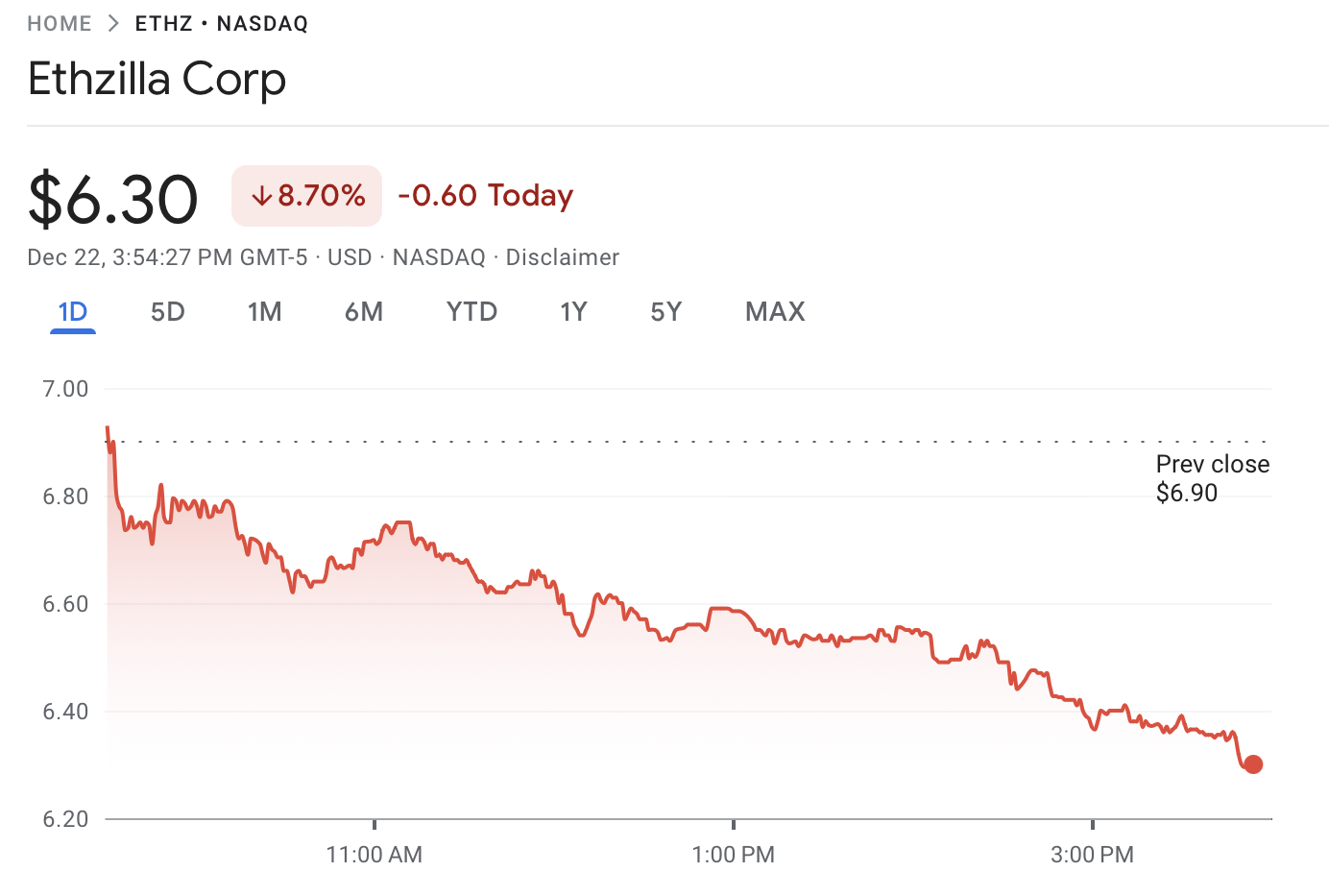
Source: Google Finance

Related: Metaplanet clears issuance of dividend-paying shares for overseas institutions

Digital asset treasuries reposition as prices drop

In September, Cointelegraph reported that publicly traded companies have sharply increased their Bitcoin (BTC) exposure this year. Data from BitcoinTreasuries.NET shows that more than 190 listed companies now hold Bitcoin on their balance sheets, with combined holdings exceeding 5% of Bitcoin’s circulating supply in September.

Ether has gauged similar demand from investors. According to CoinGecko data, 27 public companies collectively hold about 6 million ETH, also representing about 5% of the token's circulating supply.
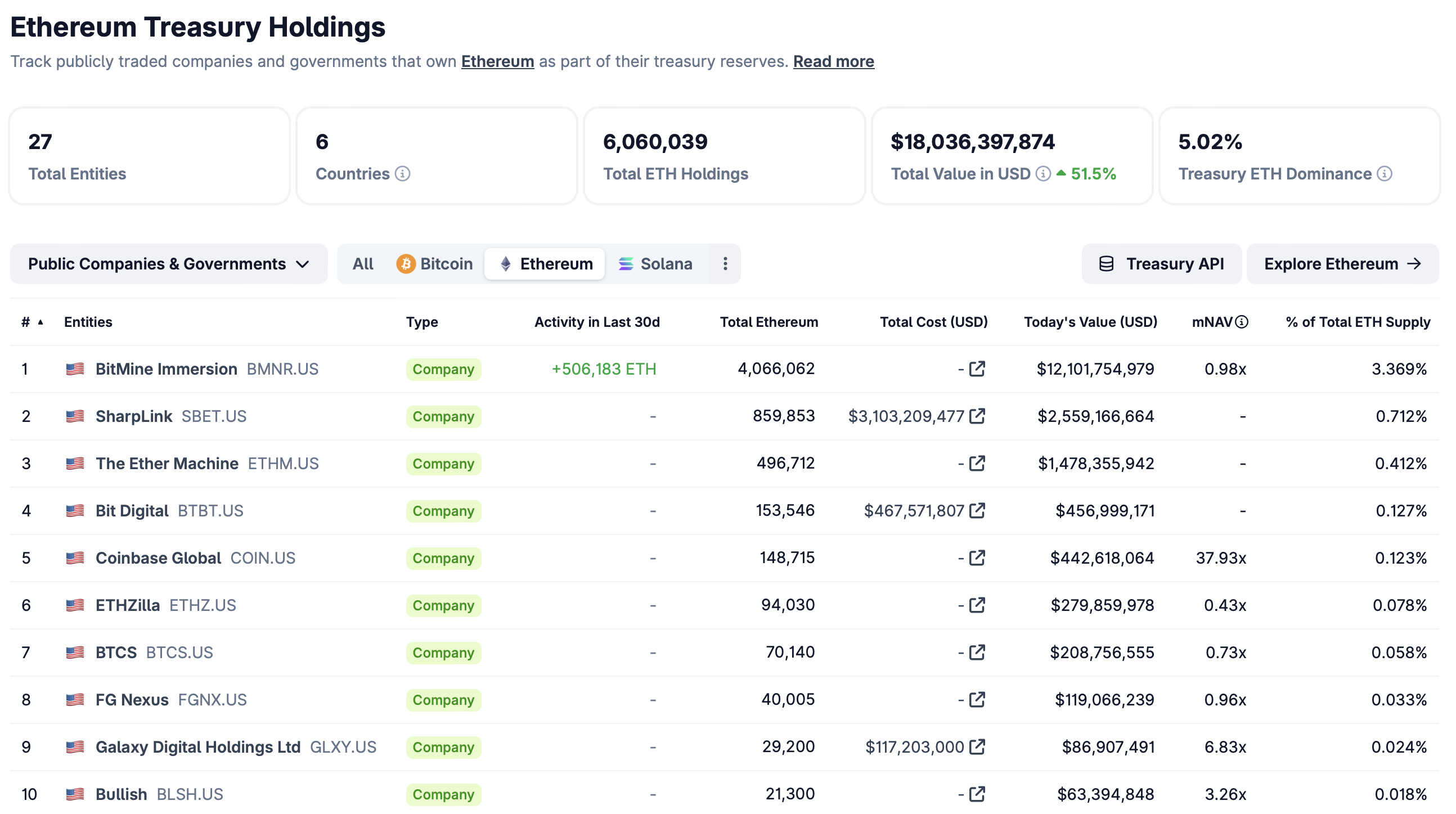
Ether Treasury Holdings. Source: CoinGecko

With Bitcoin retreating from its Oct. 6 record high of $126,000 and weakness spreading across altcoins including Ether, some digital-asset treasury companies are selling assets to strengthen their balance sheets.

In late October, Ether treasury company FG Nexus began selling its coins to fund a share repurchase program, liquidating 10,922 ETH alongside a separate debt draw to accelerate buybacks. The proceeds were used to support the repurchase of approximately 3.4 million shares at an average price of about $3.45 per share.

In November, Sequans Communications said it redeemed 50% of its outstanding convertible debt using proceeds from the sale of 970 Bitcoin. The transaction reduced total debt to $94.5 million and cut the company’s Bitcoin holdings to 2,264 BTC, down from 3,234 BTC.

On Friday, Strategy, the first public company to adopt a Bitcoin treasury strategy, said it sold 4.535 million shares of Class A stock between Dec. 15 and Dec. 21, raising $747.8 million to its cash reserves as it navigates the crypto downturn.

Magazine: Big questions: Would Bitcoin survive a 10-year power outage?

Трендові криптовалюти

Пов'язані питання

QWhy did ETHZilla liquidate $74.5 million worth of Ether?

AETHZilla sold part of its Ether holdings to repay outstanding convertible notes amid a broader market downturn.

QHow much Ether did ETHZilla still hold on its balance sheet after the sale?

AETHZilla held about 69,800 Ether on its balance sheet as of Friday after the sale.

QWhat was ETHZilla's previous name and business focus before its rebranding?

AETHZilla was previously named 180 Life Sciences Corp and was a clinical-stage biotech company before rebranding to focus on an Ether-focused investment strategy.

QWhat recent acquisitions did ETHZilla announce in December?

AIn December, ETHZilla announced acquiring a 20% fully diluted stake in automotive-finance AI startup Karus and a 15% stake in digital housing lender Zippy.

QHow has the stock performance of the former biotech company been year-to-date?

AThe former biotech company's stock is down more than 65% year-to-date, according to Google Finance data.

Пов'язані матеріали

U.S. Tech Momentum Stocks Post Largest Single-Day Gain Ever, But Is the Plunge Over?

US tech momentum stocks staged a sharp rebound on Tuesday (July 21st). Morgan Stanley's TMT Momentum Factor surged over 12%, marking its largest single-day gain on record, exceeding even peaks from the 2000 dot-com bubble. Key momentum indices from Goldman Sachs also posted their strongest daily performances in years. The rally was led by semiconductors, with the Philadelphia Semiconductor Index jumping 4.6%. This rebound followed three consecutive down days and a cumulative 33% plunge in momentum stocks, one of the steepest drawdowns since the dot-com era. Analysts attribute the surge largely to a short squeeze. Heavy selling had pushed high-beta momentum stocks into deeply oversold territory, forcing many short sellers, particularly in Asia, to cover their positions, creating a self-reinforcing buying spiral. However, the rebound's internals appear weak. Trading volume was notably low, and advancing stocks still lagged decliners on the S&P 500, indicating a narrow, concentrated rally rather than broad market participation. Diverging views emerge on the outlook. BTIG warns the bounce has hit key resistance and recommends selling into strength, citing extreme volatility and historical parallels to past market tops. Conversely, Goldman Sachs and UBS believe the momentum unwind is nearing its end, suggesting it may be time to gradually add exposure, as positioning has been significantly reduced. They caution, however, that high volatility warrants a measured approach, potentially using defined-risk strategies. The upcoming earnings season, particularly reports from major tech firms like Alphabet, is seen as a critical test for the rally's sustainability. Simultaneously, bond markets flashed a warning, with yields rising partly due to spiking oil prices. Analysts note that if long-term Treasury yields break decisively higher, it could pose a significant headwind for equities, especially growth stocks.

marsbit7 хв тому

U.S. Tech Momentum Stocks Post Largest Single-Day Gain Ever, But Is the Plunge Over?

marsbit7 хв тому

U.S. Tech Momentum Stocks Record Largest Single-Day Gain Ever, but Has the Rout Ended?

U.S. tech momentum stocks staged a dramatic rebound on Tuesday, July 21st. Key momentum indices like the Morgan Stanley TMT Momentum Factor and Goldman Sachs' High Beta Momentum Long Index posted historic or near-historic single-day gains, fueled largely by semiconductor stocks. This sharp rally followed a severe three-day sell-off that saw momentum stocks plunge 33%, marking one of the steepest pullbacks since the dot-com bubble. Analysts attribute the bounce primarily to a short squeeze, as forced covering from over-leveraged traders, particularly in Asia, created a buying spiral. However, the rally's health is questioned due to weak market breadth—overall trading volume was low, and decliners outnumbered advancers in the S&P 500 despite the index's gain—suggesting a narrow, concentrated surge rather than broad recovery. Opinions on the sustainability diverge. BTIG strategists warn the rebound has hit key resistance levels, citing extreme volatility and historic stock dispersion as signs of an ongoing broader correction, and recommend selling into strength. Conversely, Goldman Sachs and UBS view the aggressive momentum unwinding as nearing its end, noting reduced positioning and a lack of new fundamental catalysts. They suggest the sell-off presents a selective opportunity to add exposure, albeit cautiously and gradually using defined-risk strategies. The immediate trajectory hinges on the ongoing earnings season, with market focus on Alphabet's capital expenditure guidance for AI investment clarity. Meanwhile, bond markets present a risk, with rising Treasury yields—potentially heading toward 5.5%—and widening credit spreads for mega-cap tech companies posing a threat to equity valuations. The combination of technical factors, earnings results, and macro conditions leaves the durability of the rebound in doubt.

链捕手10 хв тому

U.S. Tech Momentum Stocks Record Largest Single-Day Gain Ever, but Has the Rout Ended?

链捕手10 хв тому

Long-Divided Must Unite, Long-United Must Divide: When L1 Becomes Its Own Rollup, What Is Ethereum's Endgame?

"The Inevitable Cycle: When L1 Becomes Its Own Rollup – What is Ethereum's Endgame?" For years, the Ethereum community grappled with concerns that L2s were fragmenting the ecosystem and eroding L1's value. While L2s provided cheaper execution, they also splintered liquidity and the unified user experience of a single chain. This has prompted a fundamental reassessment of the relationship between L1 and L2. Ethereum's roadmap is evolving. The "Scale" initiative merges L1 and L2 expansion into a holistic framework. L1 itself is advancing with higher gas limits, statelessness, and zkEVM verification, no longer content to be just a low-throughput settlement layer. Consequently, the primary value proposition of L2s is shifting from merely providing cheap blockspace to offering L1 cannot easily provide: application-specific optimizations, privacy features, and flexible governance models. L2s are becoming a spectrum of execution environments with varying degrees of security inheritance from Ethereum. A critical challenge in this multi-chain future is interoperability. The vision is to make Ethereum "feel like one chain again." This relies on advancements in native account abstraction (like EIP-7702) and intent-based architectures (Open Intents Framework), where users declare desired outcomes, and solvers handle the complex cross-chain execution. Furthermore, shortening Ethereum's finality time from minutes to seconds is crucial, as it underpins trust between chains for bridges, stablecoins, and cross-chain applications. Perhaps the most provocative idea is that Ethereum L1 itself could become a form of "its own Rollup." As zkEVM and proof systems mature, high-performance nodes could execute transactions and generate validity proofs. Regular validators would then verify these proofs instead of re-executing all transactions. This blurs the traditional L1/L2 hierarchy, making "Rollup" more of a general execution-verification architecture. Native Rollup aims to integrate L2 validation more directly into the Ethereum protocol, allowing L2s to inherit L1's security more fully and move away from reliance on security councils. In the end, L2s are not destined to replace L1 or be made obsolete by it. The likely future is a unified system where diverse execution environments—each optimized for specific use cases like DeFi, gaming, or privacy—coexist. They will share a common foundation of security, liquidity, and verifiable state, seamlessly connected to restore a cohesive user experience. The next phase for Ethereum is not just about scaling through separation, but about intelligently reintegrating what was separated back into a coherent whole.

链捕手26 хв тому

Long-Divided Must Unite, Long-United Must Divide: When L1 Becomes Its Own Rollup, What Is Ethereum's Endgame?

链捕手26 хв тому

Agent Race Ends, Super Workbench Takes Over

The era of fragmented AI agents is ending. Over the past month, China's tech giants—Tencent, Alibaba, and ByteDance—have simultaneously shifted strategy: instead of launching new, standalone AI agents, they are consolidating their various agent projects into unified "super workbenches." Tencent integrated its QClaw teams into WorkBuddy, a strategic product hailed as a potential third flagship after QQ and WeChat. Alibaba is merging its QoderWork, Wukong, and MuleRun agents into a new "Qianwen Office" platform under DingTalk's leadership. ByteDance rebranded its TRAE SOLO coding agent to TRAE Work, signaling a broader focus on workflow collaboration. This convergence marks a pivotal industry consensus. The initial exploration phase, where companies rapidly built numerous overlapping agents for different scenarios, proved costly and inefficient. With open-source tools eroding technical barriers, competition has shifted from agent creation to resource consolidation and cost control. Historically, platform wars are won not by creating more products, but by simplifying them—as seen with browsers unifying web access and super-apps consolidating services. Now, the "super workbench" aims to become the unified AI entry point for work. This reflects a deeper market realization: the primary audience for AI is no longer just programmers (a market in the tens of millions) but all knowledge workers (a market of billions). The real opportunity lies in augmenting everyday tasks—managing emails, documents, data, and meetings—across the entire workday. The core battleground is becoming control over the primary AI entry point that employees use daily. Tencent's WorkBuddy leverages WeChat and Tencent Docs; Alibaba's Qianwen Office taps into DingTalk's organizational data; ByteDance's TRAE Work integrates with Feishu's workflows. Whoever owns this "super workbench" gains strategic control over orchestrating enterprise data and APIs. This shift is redefining enterprise software. Traditional SaaS applications, valued for their user interfaces, will recede into the background. Their core functionalities will be exposed as standardized "Skills" or APIs for the super workbench's agents to invoke. Software value will shift from selling user seats to charging based on API calls and outcomes delivered. The evolution of agents is moving through clear stages: first as novel standalone products, then as consolidated primary work entry points, and finally as pervasive, invisible capabilities embedded into the digital fabric. The recent moves by major tech firms signal the transition from the first stage into the second, accelerating toward the third. In the end, the most successful agent technology may become invisible—like electricity or the HTTP protocol—a fundamental, unnamed infrastructure powering work itself.

marsbit53 хв тому

Agent Race Ends, Super Workbench Takes Over

marsbit53 хв тому

Торгівля

Спот

Популярні статті

Що таке DOGE M

Doge Matrix ($doge m): Нова порода криптовалюти, що керується спільнотою Вступ У постійно змінюваному ландшафті криптовалюти нові проекти постійно з'являються, кожен з яких прагне привернути увагу інвесторів та ентузіастів. Одним з останніх учасників цього домену є Doge Matrix, представлений тикером $doge m. Цей проект привернув увагу завдяки своїм корінням у популярній культурі мемів навколо Dogecoin, закріплюючи своє місце в просторі web3. Ця стаття має на меті надати всебічний аналіз Doge Matrix, охоплюючи його огляд, творця, інвесторів, функціональність, хронологію та помітні аспекти. Що таке Doge Matrix ($doge m)? Doge Matrix — це проект криптовалюти, що керується спільнотою, який, здається, будує на широкій привабливості Dogecoin, цифрової валюти, відомої своїм маскотом Shiba Inu та мем-походженням. Хоча загальні цілі Doge Matrix не є детально визначеними, він характеризується зобов'язанням залучати участь та підтримку спільноти. На відміну від традиційних криптовалют, які часто підкреслюють корисність або внутрішню цінність через підлягаючі технології, Doge Matrix позиціонує себе в просторі, що охоплює культурне явище криптовалют, особливо приваблюючи тих, хто резонує з етикою активів на основі мемів. Спираючись на сильні сторони спільноти Dogecoin, Doge Matrix працює як частина більш широкої екосистеми, запрошуючи участь та залучення користувачів, які поділяють інтерес до криптовалюти та цифрового простору. Хто є творцем Doge Matrix ($doge m)? Особистість творця Doge Matrix залишається невідомою. Ця відсутність прозорості не є рідкісним явищем у сфері криптовалют, де деякі проекти запускаються без розкриття ідентичностей своїх засновників. Відсутність інформації про засновницьку команду може викликати питання серед потенційних інвесторів щодо відповідальності та напрямку проекту. Хто є інвесторами Doge Matrix ($doge m)? На даний момент немає публічно доступної інформації про інвесторів або інвестиційні фонди, які підтримують Doge Matrix. Проект, здається, покладається переважно на підтримку спільноти, а не на інституційні інвестиції. Ця модель узгоджується з природою ініціативи, що керується спільнотою, сприяючи середовищу, де напрям проекту формується його учасниками, а не диктується вибраними фінансовими спонсорами. Як працює Doge Matrix ($doge m)? Специфіка операційних механізмів Doge Matrix є дещо розмитою, відображаючи ширшу тенденцію проектів у просторі мем-коінів, де інноваційні функціональності не завжди чітко сформульовані. Проте Doge Matrix, здається, розроблений для того, щоб використовувати існуючу екосистему криптовалют, заохочуючи участь користувачів, одночасно використовуючи знайомі культурні посилання, пов'язані з Dogecoin. Його потенційно унікальні характеристики походять від взаємодій у спільноті, а не від технологічних досягнень, підкреслюючи спільний досвід та співпрацю серед власників токенів. Хоча точні інновації не були чітко окреслені, проект, здається, створює простір, де члени спільноти можуть взаємодіяти, ділитися ідеями та просувати потенціал проекту вперед. Хронологія Doge Matrix ($doge m) Розглядаючи хронологію проекту, можна виявити помітні події, які визначили його шлях до цього часу: 25 листопада 2024: Doge Matrix досяг свого історичного максимуму, що стало значною віхою в його ранній історії. 1 січня 2025: Навпаки, Doge Matrix досяг свого історичного мінімуму, ілюструючи волатильність, яка часто асоціюється з криптовалютами, особливо на ранніх етапах життєвого циклу проекту. Триває: Проект продовжує активно торгуватися та підтримуватися своєю спільнотою, хоча конкретні майбутні віхи або цілі ще не були розкриті. Ключові моменти про Doge Matrix ($doge m) Орієнтація на спільноту У центрі Doge Matrix лежить зобов'язання до залучення спільноти. Проект процвітає на основі співпраці та спільних цілей серед своїх учасників, підкреслюючи важливість колективних зусиль. На відміну від централізованих проектів, які часто мають визначену структуру керівництва, Doge Matrix наразі демонструє більш гнучкий підхід до управління, де голос кожного члена спільноти має значення. Волатильність Ринок криптовалют відомий своєю волатильністю, і Doge Matrix не є винятком. Його історія цін відображає значні коливання між високими та низькими значеннями, що є типовим для багатьох нових криптовалют, але підкреслює ризики, пов'язані з інвестиціями в нові токени. Відсутність детальної інформації Однією з найпомітніших рис Doge Matrix є брак детальної інформації щодо його технологічних основ та операційних механізмів. Ця невизначеність вимагає від потенційних інвесторів провести ретельну перевірку перед залученням до проекту. Висновок Підсумовуючи, Doge Matrix ($doge m) ілюструє нову хвилю проектів криптовалюти, які сильно покладаються на залучення спільноти та культурну значущість. Хоча йому бракує певних специфікацій — таких як чітке керівництво, визначені цілі та детальна функціональність — проект зміг викликати інтерес у криптоспільноті, використовуючи вже встановлену привабливість культури мемів. Як і з будь-якими інвестиціями в сфері криптовалют, розуміння вроджених ризиків і проведення всебічного дослідження є важливими для потенційних учасників. Doge Matrix слугує нагадуванням про динамічну, іноді непередбачувану природу криптоіндустрії, що відзначається постійною еволюцією та ентузіазмом щодо ініціатив, що керуються спільнотою.

504 переглядів усьогоОпубліковано 2025.02.03Оновлено 2025.02.03

Що таке DOGE M

Що таке $M

Розуміння Mantis ($M): Нова ера в кросчейн-інтероперабельності У постійно змінюваному ландшафті Web3 та криптовалют нові проекти прагнуть запропонувати інноваційні рішення, спрямовані на покращення користувацького досвіду та розширення функціональних можливостей у рамках децентралізованої фінансової екосистеми. Один з таких проектів, що привертає увагу, - це Mantis ($M), піонерський протокол, заснований на принципах кросчейн-інтероперабельності та угод на основі намірів. Ця стаття розглядає основні аспекти Mantis, включаючи його основну функціональність, творців, інвестиційну підтримку, інноваційні особливості та ключові етапи. Що таке Mantis ($M)? Mantis описується як протокол врегулювання намірів у кількох доменах, який спрощує кросчейн-взаємодії, дозволяючи користувачам безперешкодно виконувати складні фінансові транзакції на різних блокчейн-платформах. Протокол працює через три основні шари: Вираження намірів: Користувачі можуть формулювати свої цілі транзакцій, використовуючи природну мову, що забезпечується DISE LLM, передовою мовною моделлю штучного інтелекту. Наприклад, користувач може висловити бажання обміняти Ethereum (ETH) на Solana (SOL) з певною допустимою похибкою в 1%. Виконання: Цей шар використовує мережу розв'язувачів, які змагаються за виконання намірів користувачів. Транзакції виконуються за допомогою механізмів, таких як Coincidence of Wants (CoWs) та Order Flow Auctions (OFAs), які забезпечують оптимальне задоволення запитів користувачів. Врегулювання: Використовуючи протокол міжблокчейн-комунікації (IBC), Mantis дозволяє атомарні кросчейн-транзакції, що дозволяє користувачам працювати на різних підтримуваних ланцюгах, включаючи Ethereum, Solana та Cosmos. Mantis розроблений для впровадження рідної генерації доходу для бездіяльних активів, використовуючи криптографічні докази для підтримки цілісності транзакцій протягом усього процесу. Творці та команда розробників Mantis був задуманий Composable Foundation, дослідницькою організацією, відомою своїм акцентом на рішеннях для блокчейн-інтероперабельності. Ця організація співпрацює з відомими академічними установами, такими як Гарвардський університет та Університет Лісабона, сприяючи широким дослідженням та розробкам, які формують архітектуру та функціональність Mantis. Зобов'язання Composable Foundation сприяти інноваціям у сфері блокчейн-технологій позиціонує Mantis як надійне рішення для зростаючого попиту на інтероперабельність між кількома блокчейн-мережами. Інвестори та підтримка Хоча конкретні деталі про окремих інвесторів не були публічно розкриті, Mantis користується значною підтримкою від різних суб'єктів, включаючи: Гранти екосистеми від ланцюгів, що підтримують IBC, які підтримують зростання протоколу та інтеграцію в децентралізовані фінансові екосистеми. Стратегічні партнерства з постачальниками інфраструктури, які покращують мережеві можливості Mantis та стратегії впровадження. Фінансування через казну Composable Foundation, що забезпечує стабільну фінансову підтримку для поточних розробок та операційних витрат. Ці спільні зусилля відображають консенсус серед зацікавлених сторін щодо важливості покращення кросчейн-функціональності та потенційної корисності інфраструктурних інновацій Mantis. Ключові інновації Mantis вирізняється кількома піонерськими інноваціями, які покращують його функціональність та корисність: Незалежні від ланцюга наміри: Користувачі можуть ініціювати транзакції з будь-якого підтримуваного ланцюга, при цьому врегулюючи їх на іншому. Ця гнучкість надає користувачам більше можливостей, стимулюючи взаємодію між різними платформами. Інтерфейс на базі штучного інтелекту: Інтеграція DISE LLM дозволяє користувачам виконувати складні DeFi-операції, використовуючи природну мову, що спрощує взаємодію та робить технологію блокчейн доступною для ширшої аудиторії. Захоплення MEV у кросдоменному середовищі: Mantis створює внутрішній ринок для максимального екстракційного значення (MEV) через конкуренцію серед розв'язувачів. Цей інноваційний підхід дозволяє досягати більшої ефективності та екстракції вартості в складних транзакціях. Модульний шар врегулювання: Протокол підтримує різні методи верифікації, включаючи нульові знання та оптимістичні роллапи, забезпечуючи універсальну структуру, яка може адаптуватися до нових блокчейн-технологій. Історична хронологія Розвиток Mantis відзначений кількома критичними етапами, які окреслюють його траєкторію та зростання: | Рік | Етап | |————|————————————————————————-| | 2022 | Початкова розробка концепції в дослідницькому підрозділі Composable Foundation. | | Q3 2024 | Запуск тестової мережі з можливостями мосту між Solana та Ethereum. | | Q1 2025 | Очікувана подія генерації токенів (TGE) разом із запуском основної мережі. | | Q2 2025 | Очікувана інтеграція DISE LLM та розширення кросчейн-можливостей. | | 2025 H2 | Запланована підтримка понад 15 ланцюгів через подальші оновлення IBC. | Ця хронологія окреслює еволюцію Mantis, від концептуальних обговорень до активної реалізації та майбутніх етапів зростання. Стратегія зростання екосистеми Стратегія Mantis щодо зростання екосистеми включає кілька ініціатив, спрямованих на заохочення участі користувачів та залучення розробників: Система кредитів: Користувачі можуть заробляти кредити протоколу, надаючи ліквідність та беручи участь у реферальних програмах. Ці кредити можна буде обміняти на винагороди в майбутньому, сприяючи формуванню сильної спільноти користувачів. Модульний набір для розробки програмного забезпечення (SDK): Цей набір інструментів надає розробникам можливість створювати додатки на основі моделей, що керуються намірами, використовуючи інфраструктуру Mantis, тим самим сприяючи інноваціям у його екосистемі. Модель управління: У міру розвитку протоколу, власники токенів $M отримають можливість брати участь в управлінні протоколом, що дозволить їм голосувати за запропоновані оновлення та зміни, підвищуючи залученість спільноти та децентралізацію. Mantis представляє собою значний прогрес у сфері кросчейн-архітектури. Завдяки безперешкодній інтеграції передових алгоритмів штучного інтелекту з надійною структурою врегулювання, Mantis прагне вирішити проблеми фрагментації в багатоланцюгових екосистемах. Його інноваційний підхід ставить на перше місце покращення користувацького досвіду, дотримуючись основоположних принципів децентралізації та безпеки, встановлюючи новий стандарт для майбутньої інтероперабельності блокчейн-технологій. Оскільки Mantis продовжує свій шлях зростання та реалізації, він обіцяє стати проектом, за яким варто уважно стежити в конкурентному середовищі Web3 та децентралізованих фінансів. Зосереджуючись на подоланні кордонів та підвищенні залученості користувачів, Mantis готовий стати невід'ємною частиною майбутніх розробок у сфері криптовалют.

71 переглядів усьогоОпубліковано 2025.03.18Оновлено 2025.03.18

Що таке $M

Як купити M

Ласкаво просимо до HTX.com! Ми зробили покупку MemeCore (M) простою та зручною. Дотримуйтесь нашої покрокової інструкції, щоб розпочати свою криптовалютну подорож.Крок 1: Створіть обліковий запис на HTXВикористовуйте свою електронну пошту або номер телефону, щоб зареєструвати обліковий запис на HTX безплатно. Пройдіть безпроблемну реєстрацію й отримайте доступ до всіх функцій.ЗареєструватисьКрок 2: Перейдіть до розділу Купити крипту і виберіть спосіб оплатиКредитна/дебетова картка: використовуйте вашу картку Visa або Mastercard, щоб миттєво купити MemeCore (M).Баланс: використовуйте кошти з балансу вашого рахунку HTX для безперешкодної торгівлі.Треті особи: ми додали популярні способи оплати, такі як Google Pay та Apple Pay, щоб підвищити зручність.P2P: Торгуйте безпосередньо з іншими користувачами на HTX.Позабіржова торгівля (OTC): ми пропонуємо індивідуальні послуги та конкурентні обмінні курси для трейдерів.Крок 3: Зберігайте свої MemeCore (M)Після придбання MemeCore (M) збережіть його у своєму обліковому записі на HTX. Крім того, ви можете відправити його в інше місце за допомогою блокчейн-переказу або використовувати його для торгівлі іншими криптовалютами.Крок 4: Торгівля MemeCore (M)Легко торгуйте MemeCore (M) на спотовому ринку HTX. Просто увійдіть до свого облікового запису, виберіть торгову пару, укладайте угоди та спостерігайте за ними в режимі реального часу. Ми пропонуємо зручний досвід як для початківців, так і для досвідчених трейдерів.

540 переглядів усьогоОпубліковано 2025.07.02Оновлено 2026.06.02

Як купити M

Обговорення

Ласкаво просимо до спільноти HTX. Тут ви можете бути в курсі останніх подій розвитку платформи та отримати доступ до професійної ринкової інформації. Нижче представлені думки користувачів щодо ціни M (M).

活动图片














