Ethereum's Year of Interoperability: A Deep Dive into EIL, a Grand Experiment in Entrusting 'Trust' to Game Theory?

marsbitОпубліковано о 2026-01-12Востаннє оновлено о 2026-01-12

Анотація

Ethereum is entering a major phase of mass adoption in 2026, driven by the development of the Ethereum Interoperability Layer (EIL). EIL is not a new blockchain but a set of standards and protocols designed to connect Ethereum’s Layer 2 (L2) networks seamlessly. It aims to standardize state proofs and message passing between L2s, enabling native interoperability without altering their core security models. Currently, L2s operate as isolated environments with separate signatures, assets, and user experiences. EIL, combined with Account Abstraction (ERC-4337) and a trust-minimized messaging layer (XLP), allows users to perform cross-chain transactions with a single signature, abstracting away complexities like gas fees and repeated authorizations. Unlike traditional bridges or intent-based solutions, EIL avoids introducing new trust assumptions like solvers. Instead, it relies on XLP providers to facilitate instant transactions, with Ethereum L1 serving as a fallback enforcement layer via slashing mechanisms in case of malfeasance. However, EIL faces challenges in balancing efficiency and security. Its model shifts trust from technical verification to economic incentives and penalties, raising questions about sustainability under market volatility, scalability in multi-chain environments, and the economic feasibility of liquidity provision. Despite these open questions, EIL represents a significant experiment in expanding Ethereum’s interoperability while preserving its core...

2026 is destined to be a pivotal year for Ethereum's Mass Adoption.

With the finalization of multiple underlying upgrades in 2025 and the establishment and advancement of the Interop roadmap, the Ethereum ecosystem is gradually entering the "Great Era of Interoperability." Against this backdrop, EIL (Ethereum Interoperability Layer) is stepping into the spotlight from behind the scenes (Further reading: "Ethereum's Interop Roadmap: Unlocking the 'Last Mile' of Mass Adoption").

If early technical discussions were still at the "proof-of-concept" stage, EIL has undoubtedly now entered the deep waters of standard implementation and engineering. This has sparked a series of major community debates. For instance, when pursuing a Web2-smooth cross-chain experience, are we quietly altering the long-held trust boundaries of Ethereum?

Objectively speaking, when any technological vision moves towards engineering implementation, trade-offs between efficiency and security are inevitable. This article also attempts to move beyond technical slogans and, by examining the specific design details of EIL, deconstruct its real trade-offs between efficiency, standards, and security assumptions.

I. What Exactly is EIL 'Sewing' Together?

First, we need to clarify the essence of EIL once again—it is not a new chain, nor a new consensus layer, but rather a set of interoperability communication frameworks and standard protocol collections.

In short, the core logic of EIL lies in standardizing the "state proofs" and "message passing" of different L2s without rewriting Ethereum's underlying security model, enabling different L2s to possess composability and interaction capabilities akin to a single chain without changing their own security assumptions (Further reading: "The End of Ethereum Islands: How EIL Reconstructs Fragmented L2s into a 'Supercomputer'?").

As is well known, in the current Ethereum ecosystem, each L2 is an isolated island. For example, your account (EOA) on Optimism and your account on Arbitrum, while having the same address, have completely isolated states:

  • Signature Isolation: Your signature on Chain A cannot be directly verified by Chain B;
  • Asset Isolation: Your assets on Chain A are also invisible to Chain B;
  • Interaction Barriers: Cross-chain operations require repeated authorizations, gas swaps, waiting for settlement, etc.;

EIL, combining the capabilities of "Account Abstraction (ERC-4337)" and a "trust-minimized message layer," constructs a unified execution environment at the account layer + message layer, attempting to eliminate these artificial divisions:

The author previously gave an intuitive example: cross-chain interactions used to be like traveling abroad—you needed to exchange currency (cross-chain assets), obtain a visa (re-authorize), and follow local traffic rules (purchase target chain Gas). Entering the EIL era, cross-chain interactions are more like using a Visa card globally:

No matter which country you are in, just swipe your card once (sign), and the underlying banking network (EIL) automatically handles exchange rates, settlement, and verification—you don't perceive the existence of national borders.

Compared to traditional cross-chain bridges, Relayers, and Intent/Solver models, the advantages of this design are also intuitive—the Native route is the safest, most transparent, but slow and experience-fragmented; the Intent route offers the best experience but introduces Solver trust and game theory; EIL attempts to push the experience closer to Intent without introducing a Solver, but requires deep integration with wallets and protocol layers.
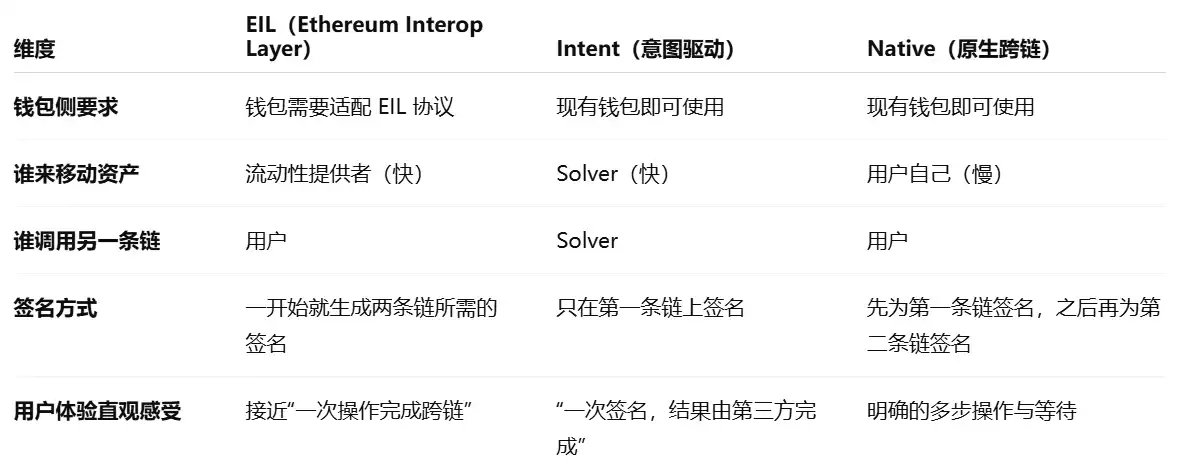
Source: Based on @MarcinM02, self-generated image

The EIL proposal put forward by the Ethereum Foundation's Account Abstraction team paints such a future: users only need to sign once to complete a cross-chain transaction, without relying on centralized relays or adding new trust assumptions, and can initiate transactions directly from their wallet for seamless settlement across different L2s.

II. EIL's Engineering Path: Account Abstraction + Trust-Minimized Message Layer

Of course, this also raises a more practical question: whether the implementation details and ecosystem adaptation of EIL can achieve "theory equals practice" remains an open proposition.

We can break down EIL's engineering implementation path. As mentioned above, it does not attempt to introduce a new inter-chain consensus but is built upon two existing building blocks: ERC-4337 Account Abstraction (AA) + a trust-minimized cross-chain message and liquidity mechanism.

First is Account Abstraction based on ERC-4337. It decouples the account and the private key, allowing a user account to become a smart contract account with customizable validation logic and cross-chain execution logic, no longer limited to the traditional EOA key-pair model.

The significance of this for EIL is that cross-chain operations do not need to rely on external executors (Solvers) to act on your behalf. Instead, they can be expressed at the account layer as a standardized User Operation object (UserOp), constructed and managed uniformly by the wallet.

These functions were previously impossible with EOA itself and required complex external contract wrappers. Account Abstraction based on ERC-4337 allows user accounts to evolve from a rigid "key pair" into programmable code. More bluntly, users only need one signature (UserOp) to express cross-chain intent (Further reading: "From EOA to Account Abstraction: Will Web3's Next Leap Happen in the 'Account System'?"):

Account contracts can embed more complex validation/execution rules; one signature can trigger a series of cross-chain instructions. Combined with mechanisms like Paymaster, it can even achieve Gas abstraction—for example, paying for target chain fees using source chain assets, eliminating the awkwardness of having to buy a few dollars of native Gas tokens before crossing chains.

This is why the EIL narrative is often tied to wallet experience, as what it truly aims to change is the entry point through which users interact with the multi-chain world.

The second is the trust-minimized message passing mechanism—XLP (Cross-chain Liquidity Provider), which solves the efficiency problem of cross-chain message passing.

Because traditional cross-chain interactions rely on relays or centralized bridges, EIL introduces XLP. On this basis, an ideal path that is theoretically efficient and sacrifices as little security as possible can be built:

  • The user submits a cross-chain transaction on the source chain;
  • XLP observes this intent in the mempool and advances funds/Gas on the target chain, providing a "Payment Voucher";
  • The user utilizes the voucher to complete self-execution on the target chain;

The actual user experience is near-instantaneous settlement, without waiting for the slow settlement of the official bridge.

However, you might spot a problem: what if the XLP takes the money but doesn't deliver? The ingenious design of EIL lies in the fact that if an XLP defaults, the user can submit proof on Ethereum L1 to trigger permissionless slashing of its staked assets.

The official bridge is only used for settlement and recourse in case of bad debt. This means the system runs extremely fast under normal conditions; in extreme cases, security is still backed by Ethereum L1.
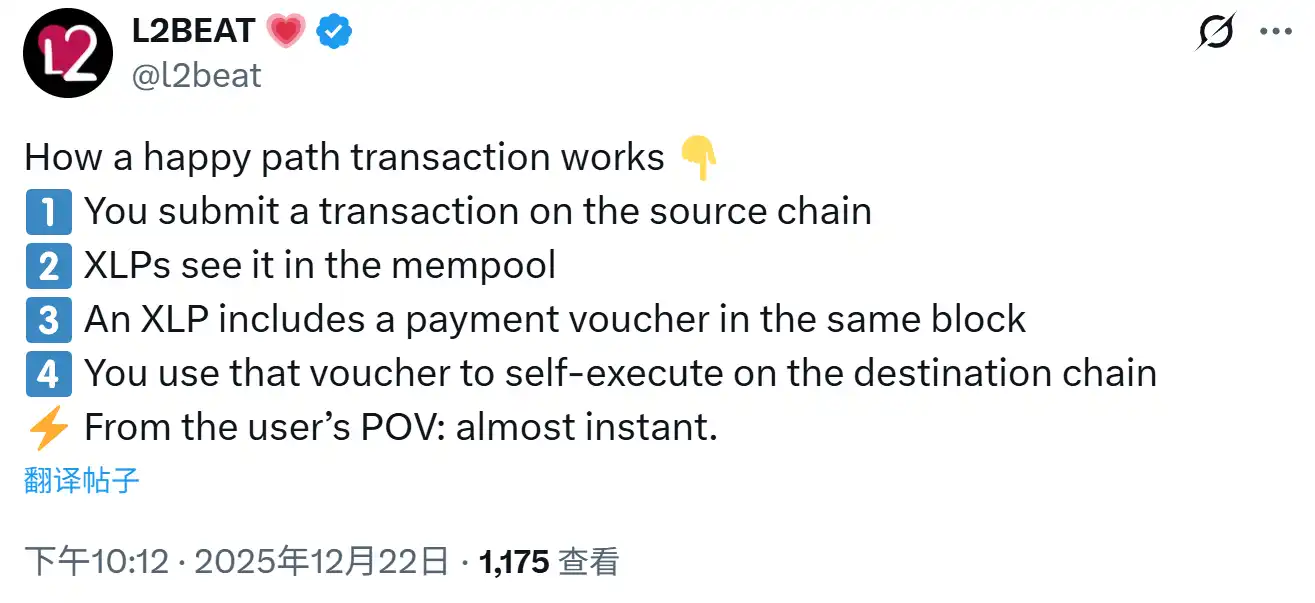
This structure means moving the slow and expensive security mechanism out of the default path, instead concentrating the trust pressure on failure handling.

Of course, this is also one of the sources of controversy: when security relies more on the "executability of the failure path" and the "effectiveness of economic penalties," is EIL truly adding no new trust assumptions? Or is it merely shifting trust from explicit relays to a more hidden, more engineered set of conditions?

This leads to the more critical discussion below—while it looks elegant in theory, what potential centralization and economic frictions might it face in the real-world ecosystem, and why does the community remain cautious about it?

III. Between Vision and Engineering: Is EIL Truly 'Minimizing Trust'?

By now, EIL's ambition is clear. Its design strives to avoid explicit relay trust and attempts to converge cross-chain interactions into one signature and one user operation at the wallet layer.

The problem is—trust doesn't just disappear; it merely migrates.

This is why platforms like L2BEAT, which have long focused on L2 risk boundaries, remain particularly cautious about the engineering implementation of EIL. After all, once an interoperability layer becomes the universal default path, any hidden assumptions, incentive failures, or governance single points of failure could amplify into systemic risks.

Specifically, EIL's efficiency comes from two points: first, AA packages actions into one signature; second, XLP's advance payment allows users to bypass waiting. The former is more straightforward, an efficiency gain from embedded AA. But the latter's advance payment means that some security no longer comes from immediately verifiable finality, but from "economic guarantees that can be pursued and penalized."

This undoubtedly pushes the risk exposure towards several more engineering-oriented questions:

  • Under real market fluctuations, how are the XLP's default probability, capital cost, and risk hedging priced?
  • Is "slashing" timely and executable enough to cover losses in extreme scenarios?
  • When amounts become larger and paths more complex (multi-hop/multi-chain), do failure scenarios become exponentially more difficult?

Ultimately, the trust foundation here is no longer mathematical proof but the validator's staked collateral. If the cost of attack is lower than the potential profit, the system still faces rollback risks.

Furthermore, objectively speaking, EIL attempts to solve liquidity fragmentation through technical means, but liquidity itself is market behavior. If significant cost and trust disparities still exist between chains, a mere communication standard (EIL) cannot make liquidity truly flow. After all, a pure communication protocol standard cannot solve the economic essence of "liquidity unwillingness to flow."

Extending this thought further, without accompanying economic incentive design, EIL might face the dilemma of having standardized pipelines but lacking executors because it's unprofitable.

However, overall, EIL is one of the most important infrastructure concepts proposed by the Ethereum community to address fragmented L2 experiences. It attempts to simplify UX while maintaining Ethereum's core values (self-custody, censorship resistance, disintermediation), which is commendable in itself (Further reading: "Seeing Through the Noise of Ethereum 'Degeneration': Why is 'Ethereum Values' the Widest Moat?").

For ordinary users, there's no need to hastily praise or否定 EIL, but rather to understand its trade-offs and boundary assumptions in protocol design.

After all, for the current Ethereum, EIL is not a simple upgrade to existing cross-chain pain points, but a technical and value attempt that deeply integrates experience, economy, and security trust boundaries. It has the potential to push Ethereum towards truly seamless interoperability, but it might also expose new boundary effects and necessary compromises during implementation.

In Conclusion

In 2026, EIL is not a plug-and-play ultimate answer, but more like a systematic test of trust boundaries, engineering feasibility, and the limits of user experience.

If it succeeds, Ethereum's L2 world will truly look like one chain; if it is less successful, it will undoubtedly leave clear lessons for the next generation of interoperability design.

Before 2026, everything is still an experiment.

And this, perhaps, is Ethereum's most real and most respectable aspect.

Трендові криптовалюти

Пов'язані питання

QWhat is the core purpose of the Ethereum Interoperability Layer (EIL)?

AThe core purpose of the Ethereum Interoperability Layer (EIL) is to serve as a set of interoperability communication frameworks and standard protocol collections. It aims to standardize 'state proofs' and 'message passing' for different Layer 2 solutions (L2s) without altering Ethereum's underlying security model, enabling seamless composability and interaction between L2s as if they were a single chain.

QHow does EIL combine Account Abstraction (ERC-4337) and trust-minimized messaging to improve cross-chain experiences?

AEIL combines Account Abstraction (ERC-4337), which decouples accounts from private keys and allows user accounts to become programmable smart contract accounts, with a trust-minimized cross-chain messaging and liquidity mechanism (XLP). This enables users to express cross-chain intent with a single signature (UserOp), while XLP providers prepay funds/Gas on the target chain for near-instant transactions, backed by economic penalties for malfeasance enforceable via Ethereum L1.

QWhat are the potential risks or trust assumptions introduced by EIL's engineering design?

AEIL's design shifts some security from immediate verifiable finality to economic guarantees reliant on penalties. Risks include the pricing of XLP违约 probability and capital costs, the timeliness and executability of slashing mechanisms in extreme cases, and potential systemic risks if incentives fail or governance becomes centralized. Trust is not eliminated but transferred to more engineered economic and failure-handling processes.

QHow does EIL differ from traditional cross-chain bridges or Intent/Solver models in terms of security and user experience?

ATraditional cross-chain bridges (native routes) are secure and transparent but slow with fragmented user experiences. Intent/Solver models offer the best user experience but introduce solver trust and博弈. EIL attempts to approach Intent-like usability without solvers by deeply integrating wallet and protocol standards, relying on Account Abstraction and trust-minimized messaging, though it requires significant ecosystem adaptation and introduces new economic trust assumptions.

QWhy is the Ethereum community cautious about EIL's implementation despite its promising vision?

AThe Ethereum community remains cautious because EIL's efficiency gains depend on economic incentives and penalty mechanisms that are untested at scale. Concerns include the feasibility of timely slashing, market-driven risks for XLP providers, liquidity fragmentation economic issues not solved by mere communication standards, and the potential for new centralization points or failure scenarios in complex multi-chain transactions, which could amplify systemic risks if not properly engineered.

Пов'язані матеріали

From Gold to Bitcoin: Fixed Supply + Institutional Frenzy, Might It Repeat the 'Explosive' Price Trend?

"From Gold to Bitcoin: Fixed Supply and Institutional Frenzy May Lead to 'Explosive' Price Rally Analysts suggest Bitcoin's price action could mirror gold's over the past two decades, following the launch of spot Bitcoin ETFs. Gold ETFs, introduced in 2004, drove gold's price surge to a current market cap near $28 trillion. Both gold and Bitcoin are non-yielding stores of value, with prices driven purely by investor sentiment rather than cash flows or credit. Gold ETFs experienced dramatic cycles: explosive growth, painful drawdowns, and slow recoveries, with each cycle reaching higher peaks. Bitcoin ETFs, approved in early 2024, saw rapid institutional adoption but are now facing similar volatility. Recent warnings highlight the risk of significant ETF outflows disrupting the current rebound. BlackRock's IBIT, a leading Bitcoin ETF, has sold nearly 100,000 BTC to meet redemptions while still holding over 733,000. The core parallel is fixed supply: when demand surges, prices explode, but demand is often volatile and wave-like, not steady. Institutional interest, through ETFs and corporate adoption, remains a key support pillar, helping to cushion sell-offs. If Bitcoin captures even a fraction of gold's role as a store of value, its upside potential is immense, though the path will be marked by high volatility. For investors, focusing on long-term trends and managing risk is crucial as this 'price explosion' narrative unfolds."

Foresight News31 хв тому

From Gold to Bitcoin: Fixed Supply + Institutional Frenzy, Might It Repeat the 'Explosive' Price Trend?

Foresight News31 хв тому

Why Is AI Agent Shopping Hard to Popularize?

The article argues that the popular narrative of "AI agent shopping" – equipping AI with a wallet to autonomously handle purchases – is fundamentally flawed and oversimplifies the complexity of shopping. It deconstructs shopping into two core actions: **information retrieval** (standardized, easily automated) and **value judgment** (deeply subjective and human-centric). The narrative mistakenly assumes AI can fully handle both. Value judgment itself has two layers: **evaluation** (assessing options against criteria) and **demand definition** (setting the criteria, weights, and values). The latter is inherently human and dynamic, as preferences are not fixed but constructed during the decision-making process ("constructive preferences"). The real dividing line for automation is not product standardization, but whether the **act of choosing** itself holds experiential value. For mundane purchases (e.g., printer paper), full AI delegation works. For experiential goods (e.g., wine, furniture), the joy of selection is core to consumption, so AI should act as an assistant that narrows options, leaving the final choice to humans. The "AI wallet" concept confuses three separate elements: decision-making, execution, and fund custody. Current payment industry solutions (e.g., from Stripe, Mastercard, Google, Visa) show that limited, scoped payment authorization tokens are sufficient for most consumer scenarios, not full fund custody. The true use case for autonomous AI wallets is in **B2B procurement** and **machine-to-machine (M2M) settlements** for standardized, high-frequency, low-value transactions. The real bottlenecks for AI shopping are not payment technology, but **1) the lack of trusted data sources** (e.g., fake reviews, counterfeit goods) and **2) the impossibility of automating human demand definition**. The conclusion is that the focus should be on safely automating the assessment and filtering process while reserving for humans the rights to define their criteria and enjoy the final act of choice. For experiential goods, the platform's competitive advantage shifts to providing a superior selection experience.

Foresight News1 год тому

Why Is AI Agent Shopping Hard to Popularize?

Foresight News1 год тому

After Nine Months of Shorting, a Full Turn to Long: Renowned Trader Opens Bitcoin Positions Around 64K, Crypto Market Long-Short Divergence Intensifies

After nine months of being short, prominent crypto trader Doctor Profit has closed all his bearish positions and started buying Bitcoin near $64,000, signaling a complete bullish reversal. He argues that structural market changes—such as impending U.S. regulation (CLARITY Act) and institutional adoption via securities tokenization—are rewriting the traditional four-year cycle script, potentially bringing the market bottom forward from the widely expected September/October timeframe. This view finds some technical support from on-chain analyst gumsays, who notes a bullish divergence on Bitcoin's weekly chart has persisted for 147 days, nearing the 161-day duration seen before the 2022 cycle low. However, cycle researcher Jake Pahor presents a counter-argument based on historical data. Analyzing patterns since 2014, he identifies three common features of past bear market bottoms: a ~12-month duration from peak to trough, a sustained period of extreme fear (with a proprietary risk score below 20), and the price falling below Bitcoin's realized price (~$53,000 currently). The current cycle, only nine months from its October 2025 peak, meets none of these conditions. The debate highlights a market torn between "front-running" a potential early bottom driven by new fundamentals and waiting for confirmation through traditional on-chain and sentiment metrics. While Doctor Profit opts for aggressive buying, Pahor maintains a disciplined, tiered accumulation strategy, continuing weekly buys at current risk levels but reserving larger orders for if more extreme fear emerges.

marsbit1 год тому

After Nine Months of Shorting, a Full Turn to Long: Renowned Trader Opens Bitcoin Positions Around 64K, Crypto Market Long-Short Divergence Intensifies

marsbit1 год тому

Торгівля

Спот

Популярні статті

Що таке ETH 2.0

ETH 2.0: Нова ера для Ethereum Вступ ETH 2.0, широко відомий як Ethereum 2.0, є величезним оновленням для блокчейну Ethereum. Ця трансформація не є лише косметичною зміною; вона має на меті фундаментально покращити масштабованість, безпеку та сталий розвиток мережі. З переходом від енергомісткого механізму консенсусу Proof of Work (PoW) до більш ефективного Proof of Stake (PoS), ETH 2.0 обіцяє трансформаційний підхід до екосистеми блокчейнів. Що таке ETH 2.0? ETH 2.0 — це збірка особливих, взаємопов’язаних оновлень, спрямованих на оптимізацію можливостей та продуктивності Ethereum. Це перетворення розроблене для вирішення критичних викликів, з якими стикалося існуюче механізм Ethereum, зокрема щодо швидкості транзакцій та заторів у мережі. Мета ETH 2.0 Основні цілі ETH 2.0 зосереджені на покращенні трьох ключових аспектів: Масштабованість: Мета — значно підвищити кількість транзакцій, які мережа може обробити за секунду; ETH 2.0 прагне вийти за межі поточного обмеження приблизно в 15 транзакцій на секунду, потенційно досягнувши тисяч. Безпека: Підвищені заходи безпеки є невід’ємною частиною ETH 2.0, зокрема через покращену стійкість до кібератак і збереження децентралізованої етики Ethereum. Сталий розвиток: Новий механізм PoS розроблений не тільки для підвищення ефективності, але й для різкого зменшення споживання енергії, що узгоджує операційну структуру Ethereum з екологічними міркуваннями. Хто є творцем ETH 2.0? Створення ETH 2.0 можна віднести до Ethereum Foundation. Ця неприбуткова організація, яка відіграє важливу роль у підтримці розвитку Ethereum, очолюється відомим співавтором Віталіком Бутеріним. Його бачення більш масштабованого та стійкого Ethereum стало рушійною силою цього оновлення, залучаючи внески зі всього світу від розробників і ентузіастів, які прагнуть покращити протокол. Хто є інвесторами ETH 2.0? Хоча подробиці про інвесторів ETH 2.0 не були оприлюднені, відомо, що Ethereum Foundation отримує підтримку від різних організацій та осіб у сфері блокчейну та технологій. Ці партнери включають венчурні капітальні компанії, технологічні компанії та філантропічні організації, які мають спільний інтерес у підтримці розвитку децентралізованих технологій та інфраструктури блокчейну. Як працює ETH 2.0? ETH 2.0 відзначається введенням низки ключових функцій, які відрізняють його від попередника. Proof of Stake (PoS) Перехід до механізму консенсусу PoS є одним із знакових змін ETH 2.0. На відміну від PoW, який покладається на енергомісткий видобуток для перевірки транзакцій, PoS дозволяє користувачам підтверджувати транзакції та створювати нові блоки відповідно до кількості ETH, яку вони ставлять у мережі. Це призводить до підвищення енергоефективності, зменшуючи споживання приблизно на 99,95%, завдяки чому Ethereum 2.0 стає значно більш екологічною альтернативою. Шардові ланцюги Шардові ланцюги є ще одним ключовим нововведенням ETH 2.0. Ці менші ланцюги працюють паралельно з основним ланцюгом Ethereum, що дозволяє обробляти кілька транзакцій одночасно. Це підходи покращує загальну ємність мережі, усуваючи проблеми масштабованості, які переслідували Ethereum. Beacon Chain У центрі ETH 2.0 знаходиться Beacon Chain, яка координує мережу і управляє протоколом PoS. Вона виконує роль організатора: контролює валідаторів, забезпечує з’єднання шард з мережею і моніторить загальний стан екосистеми блокчейнів. Хронологія ETH 2.0 Шлях ETH 2.0 характеризується кількома ключовими етапами, які відображають еволюцію цього значного оновлення: Грудень 2020: Запуск Beacon Chain ознаменував введення PoS, проклавши шлях до міграції на ETH 2.0. Вересень 2022: Завершення "Злиття" є знаковим моментом, коли мережа Ethereum успішно перейшла з PoW на PoS, відкриваючи нову еру для Ethereum. 2023: Очікуване розгортання шардових ланцюгів має на меті подальше покращення масштабованості мережі Ethereum, закріплюючи ETH 2.0 як надійну платформу для децентралізованих додатків і послуг. Ключові особливості та переваги Покращена масштабованість Однією з найзначніших переваг ETH 2.0 є його покращена масштабованість. Поєднання PoS та шардових ланцюгів дозволяє мережі розширити свою ємність, що дозволяє їй обробляти набагато більший обсяг транзакцій в порівнянні з класичною системою. Енергоефективність Запровадження PoS є величезним кроком до енергоефективності в технології блокчейн. Значно зменшуючи споживання енергії, ETH 2.0 не тільки знижує операційні витрати, але також ближче узгоджується з глобальними цілями сталого розвитку. Підвищена безпека Оновлені механізми ETH 2.0 сприяють підвищенню безпеки по всій мережі. Впровадження PoS, поряд з інноваційними контрольними заходами, встановленими через шардові ланцюги та Beacon Chain, забезпечує вищий рівень захисту від потенційних загроз. Зниження витрат для користувачів З покращенням масштабованості вплив на витрати на транзакції також стане очевидним. Збільшена ємність і зменшені затори, як очікується, призведуть до зниження зборів для користувачів, що зробить Ethereum більш доступним для повсякденних транзакцій. Висновок ETH 2.0 є значною еволюцією в екосистемі блокчейну Ethereum. Оскільки він вирішує важливі питання, такі як масштабованість, споживання енергії, ефективність транзакцій і загальна безпека, важливість цього оновлення не можна недооцінювати. Перехід до Proof of Stake, введення шардових ланцюгів і фундаментальна робота Beacon Chain свідчать про майбутнє, в якому Ethereum може задовольнити зростаючі вимоги децентралізованого ринку. В індустрії, що рухається вперед завдяки інноваціям та прогресу, ETH 2.0 є підтвердженням можливостей технології блокчейн у прокладенні шляху до більш сталого та ефективного цифрового економіки.

199 переглядів усьогоОпубліковано 2024.04.04Оновлено 2024.12.03

Що таке ETH 2.0

Що таке ETH 3.0

ETH3.0 та $eth 3.0: Глибоке дослідження майбутнього Ethereum Вступ У швидко змінюваному світі криптовалют та технології блокчейн, ETH3.0, часто позначуваний як $eth 3.0, став темою значного інтересу та спекуляцій. Цей термін охоплює два основні концепти, які потребують уточнення: Ethereum 3.0: Це потенційне майбутнє оновлення, яке має на меті покращення можливостей існуючого блокчейну Ethereum, зокрема, фокусуючись на поліпшенні масштабованості та продуктивності. ETH3.0 Мем Токен: Цей окремий криптовалютний проект прагне використовувати блокчейн Ethereum для створення екосистеми, орієнтованої на меми, сприяючи залученню до криптовалютної громади. Розуміння цих аспектів ETH3.0 є важливим не лише для криптоентузіастів, але й для тих, хто спостерігає за широкими технологічними тенденціями у цифровому просторі. Що таке ETH3.0? Ethereum 3.0 Ethereum 3.0 пропонується як оновлення вже існуючої мережі Ethereum, яка стала основою багатьох децентралізованих додатків (dApps) та смарт-контрактів з моменту свого виникнення. Передбачувані удосконалення зосереджені в основному на масштабованості — інтегруючи передові технології, такі як шардінг та нульові знання (zk-докази). Ці технологічні нововведення націлені на забезпечення безпрецедентної кількості транзакцій на секунду (TPS), потенційно досягаючи мільйонів, тим самим вирішуючи одну з найзначніших обмежень, з якими стикається сучасна технологія блокчейн. Покращення є не лише технічним, а й стратегічним; воно спрямоване на підготовку мережі Ethereum до широкого прийняття та корисності в майбутньому, позначеному збільшеним попитом на децентралізовані рішення. ETH3.0 Мем Токен На відміну від Ethereum 3.0, ETH3.0 Мем Токен пропонує легшу та грайливішу домену, поєднуючи культуру інтернет-мемів із динамікою криптовалют. Цей проект дозволяє користувачам купувати, продавати та обмінювати меми на блокчейні Ethereum, надаючи платформу, яка сприяє залученню громади через креативність та спільні інтереси. ETH3.0 Мем Токен має на меті продемонструвати, як технологія блокчейн може перетинатися з цифровою культурою, створюючи випадки використання, які є водночас розважальними та фінансово життєздатними. Хто є творцем ETH3.0? Ethereum 3.0 Ініціатива щодо Ethereum 3.0 переважно підтримується консорціумом розробників та дослідників у межах громади Ethereum, зокрема, до складу якого входить Джастін Дрейк. Відомий своїми думками та внеском у розвиток Ethereum, Дрейк є помітною особистістю в обговореннях щодо переходу Ethereum на новий рівень консенсусу, який називається «Beam Chain». Цей колабораційний підхід до розробки свідчить про те, що Ethereum 3.0 не є продуктом єдиного творця, а скоріше втіленням колективної винахідливості, спрямованої на просування технології блокчейн. ETH3.0 Мем Токен Деталі про творця ETH3.0 Мем Токена наразі не відстежуються. Природа мем-токенів часто призводить до більш децентралізованої та громартової структури, що може пояснити відсутність специфічної атрибуції. Це узгоджується з етикою ширшої крипто-спільноти, де інновації часто виникають з колективних, а не індивідуальних зусиль. Хто є інвесторами ETH3.0? Ethereum 3.0 Підтримка Ethereum 3.0 переважно надходить від Фонду Ethereum поряд з ентузіастичною спільнотою розробників та інвесторів. Це базове співробітництво надає значний градус легітимності та підвищує ймовірність успішної реалізації, оскільки воно використовує довіру та авторитет, накопичені за роки роботи мережі. У швидко змінюваному кліматі криптовалют підтримка громади займає важливу роль у розвитку та прийнятті, позиціонуючи Ethereum 3.0 як серйозного конкурента для майбутніх блокчейн-інновацій. ETH3.0 Мем Токен Хоча наразі доступні джерела не надають явної інформації щодо інвестиційних фондів або організацій, що підтримують ETH3.0 Мем Токен, це свідчить про типову модель фінансування для мем-токенів, яка часто спирається на підтримку знизу та залучення громади. Інвестори в такі проекти зазвичай складаються з осіб, які мотивовані потенціалом інновацій, що керуються спільнотою, та духом співпраці, притаманним крипто-спільноті. Як працює ETH3.0? Ethereum 3.0 Відмінні риси Ethereum 3.0 полягають у його запропонованій реалізації технології шардінгу та zk-proof. Шардінг — це метод розподілу блокчейну на менші, керовані частини чи «шарди», які можуть обробляти транзакції одночасно, а не послідовно. Це децентралізоване оброблення допомагає запобігти заторам та забезпечити оперативність мережі навіть під великим навантаженням. Технологія нульових доказів (zk-proof) надає ще один рівень складності, дозволяючи валідацію транзакцій без розкриття підпорядкованих даних. Цей аспект не лише підвищує конфіденційність, а й збільшує загальну ефективність мережі. Також обговорюється включення нульової Ефірної віртуальної машини (zkEVM) в це оновлення, що ще більше підвищить можливості та корисність мережі. ETH3.0 Мем Токен ETH3.0 Мем Токен виділяється завдяки використанню популярності культури мемів. Він створює ринок, на якому користувачі можуть брати участь у торгівлі мемами не лише для розваги, але й для потенційного економічного вигоди. Інтегруючи функції, такі як стейкінг, забезпечення ліквідності та механізми управління, проект сприяє створенню середовища, яке заохочує взаємодію та участь громади. Пропонуючи унікальне поєднання розваг та економічних можливостей, ETH3.0 Мем Токен прагне залучити різну аудиторію, яка охоплює від криптоентузіастів до casual-консумерів мемів. Хронологія ETH3.0 Ethereum 3.0 11 листопада 2024: Джастін Дрейк натякає на майбутнє оновлення ETH 3.0, яке зосереджене на поліпшеннях масштабованості. Це оголошення означає початок формальних обговорень щодо майбутньої архітектури Ethereum. 12 листопада 2024: Очікується, що запропоновану пропозицію для Ethereum 3.0 буде представлено на Devcon у Бангкоку, що готує ґрунт для більш широкого зворотного зв'язку від громади та потенційних наступних кроків у розвитку. ETH3.0 Мем Токен 21 березня 2024: ETH3.0 Мем Токен офіційно потрапляє у список на CoinMarketCap, що означає його дебют у публічному крипто-просторі та підвищує видимість для його меморієнтованої екосистеми. Ключові моменти На завершення, Ethereum 3.0 представляє значну еволюцію в межах мережі Ethereum, зосереджуючись на подоланні обмежень щодо масштабованості та продуктивності через передові технології. Його запропоновані оновлення відображають проактивний підхід до майбутніх вимог і корисності. Натомість ETH3.0 Мем Токен втілює суть культури, керованої громадою, у сфері криптовалют, використовуючи культуру мемів для створення привабливих платформ, які заохочують творчість і участь користувачів. Розуміння окремих цілей і функцій ETH3.0 та $eth 3.0 є надзвичайно важливим для кожного, хто цікавиться поточними подіями в крипто-просторі. З обома ініціативами, які прокладають унікальні шляхи, вони разом підкреслюють динамічну та багатогранну природу інновацій у блокчейн-технологіях.

190 переглядів усьогоОпубліковано 2024.04.04Оновлено 2024.12.03

Що таке ETH 3.0

Як купити ETH

Ласкаво просимо до HTX.com! Ми зробили покупку Ethereum (ETH) простою та зручною. Дотримуйтесь нашої покрокової інструкції, щоб розпочати свою криптовалютну подорож.Крок 1: Створіть обліковий запис на HTXВикористовуйте свою електронну пошту або номер телефону, щоб зареєструвати обліковий запис на HTX безплатно. Пройдіть безпроблемну реєстрацію й отримайте доступ до всіх функцій.ЗареєструватисьКрок 2: Перейдіть до розділу Купити крипту і виберіть спосіб оплатиКредитна/дебетова картка: використовуйте вашу картку Visa або Mastercard, щоб миттєво купити Ethereum (ETH).Баланс: використовуйте кошти з балансу вашого рахунку HTX для безперешкодної торгівлі.Треті особи: ми додали популярні способи оплати, такі як Google Pay та Apple Pay, щоб підвищити зручність.P2P: Торгуйте безпосередньо з іншими користувачами на HTX.Позабіржова торгівля (OTC): ми пропонуємо індивідуальні послуги та конкурентні обмінні курси для трейдерів.Крок 3: Зберігайте свої Ethereum (ETH)Після придбання Ethereum (ETH) збережіть його у своєму обліковому записі на HTX. Крім того, ви можете відправити його в інше місце за допомогою блокчейн-переказу або використовувати його для торгівлі іншими криптовалютами.Крок 4: Торгівля Ethereum (ETH)Легко торгуйте Ethereum (ETH) на спотовому ринку HTX. Просто увійдіть до свого облікового запису, виберіть торгову пару, укладайте угоди та спостерігайте за ними в режимі реального часу. Ми пропонуємо зручний досвід як для початківців, так і для досвідчених трейдерів.

3.3k переглядів усьогоОпубліковано 2024.12.10Оновлено 2026.06.02

Як купити ETH

Обговорення

Ласкаво просимо до спільноти HTX. Тут ви можете бути в курсі останніх подій розвитку платформи та отримати доступ до професійної ринкової інформації. Нижче представлені думки користувачів щодо ціни ETH (ETH).

活动图片