Ethereum's Quantum Security and Privacy: Why Developers Are Reassessing Priorities

cryptonews.ruОпубліковано о 2026-08-30Востаннє оновлено о 2026-08-30

Анотація

The article discusses a major shift in Ethereum's development priorities, focusing on quantum resistance, privacy, and scalability. The new roadmap, updated to 2029, elevates post-quantum cryptography as a critical near-term goal, aiming to prepare the network for future quantum computing threats before they become practical. Privacy is also being integrated at the base protocol level (Private L1), moving beyond an add-on feature, using mechanisms like keyed nonces and zero-knowledge proofs to obscure user activity. Scalability efforts will leverage technologies like STARK proofs and zkVM, while the protocol architecture is being simplified under the "Lean Ethereum" concept. This strategic pivot coincides with significant personnel changes within the Ethereum Foundation and is influenced by external tech trends like AI and the growing market demand for privacy-focused cryptocurrencies. The article concludes that while these updates present long-term technical promise, market volatility and implementation complexities remain considerations for investors.

Ethereum's quantum security has become one of the main focuses of the new roadmap: the team behind the second-largest cryptocurrency by market cap is strengthening its focus on post-quantum cryptography, privacy, and scaling, while some previous technical priorities are taking a backseat. This is not about a one-time upgrade but a shift in priorities: developers are choosing schemes designed to prepare the network for future risks, although a practical quantum threat to $ETH is currently seen as a task for the coming years, not a current widespread hack.

Ethereum is needed as an open blockchain infrastructure for digital finance and applications: the network can verify transactions, run programmable rules, and build services on top of the base layer. Its strengths compared to more rigid networks are update flexibility, a developed ecosystem, support for scaling solutions, and a quick transition towards privacy and new cryptographic schemes.

How Vitalik Buterin Described the New Vision for Ethereum

On August 10, Vitalik Buterin explained that he compared Ethereum's previous development plans with the current Strawmap, calculated until 2029. As a result, the priorities have changed noticeably: quantum attack resistance, base-layer privacy, and a simpler protocol architecture are now at the center of attention. According to his logic, quantum computing can no longer be left out of basic planning: if signatures and keys ever become a weak point, protection will need to be rebuilt in advance, not during a crisis.

The main roadmap, prepared in 2023, was synchronized with the new Strawmap. Buterin compares the modernization approach to the Ship of Theseus: if every part of a ship is gradually replaced, does it remain the same ship? The logic for Ethereum is similar. Developers want to update key system elements without a sharp break from the current network—essentially rebuilding the blockchain while it's in motion.

Such changes are planned to be carried out through a series of hard forks within the Lean Ethereum concept. Its meaning is to simplify the infrastructure, leave fewer complex components, and rely on a limited set of reliable cryptographic primitives. For a network where every transaction must be verifiable and secure, such compactness becomes not just a matter of convenience but a security factor.

What Changed in the Strawmap

Fresh edits to the Strawmap appeared in August. The map still contains upcoming upgrades, including Ethereum Improvement Proposals, as well as the Glamsterdam upgrade in 2026 and the Hegota upgrade in 2027. A separate block is dedicated to long-term priorities—security, scaling, and privacy.

Compared to the 2023 roadmap, the new version changes the balance of forces. Buterin highlights several key shifts.

  • Quantum resistance has risen higher on the priority list.
  • Some EVM improvements have become less important.
  • Some previous technical solutions are being replaced by more modern designs.
  • Ideas not present in the early plan have been added to the Strawmap, primarily due to rapid progress in artificial intelligence and post-quantum cryptography.

These changes show that the team is responding not only to the network's internal problems. External technological trends also influence the plans: the development of AI, growing interest in zero-knowledge proofs, and the anticipation of an era where quantum computers become a practical threat to old protection schemes.

Privacy Moves to the Base Protocol Level

One of the most noticeable shifts is related to privacy. It is now considered not as an additional feature on top of the network but as a requirement for the base level—Private L1. The idea is to make it harder to link network actions to a specific user and allow data verification without revealing unnecessary information.

To this end, keyed nonces and recent roots are being discussed. These mechanisms should help hide connections between operations and participants. Part of the task of protecting sensitive information may also be addressed by FOCIL—a mechanism that fights censorship and forcibly includes transactions in the ledger.

Additionally, developers are considering lean privacy pools and wormholes. The latter idea is related to zero-knowledge proofs and proposal EIP-7503. In such a model, a user can prove the correctness of an action without revealing all details. For a blockchain, this is an important balance: the network remains verifiable, but publicity no longer means complete transparency of every step.

Post-Quantum Cryptography Becomes an Urgent Task

2029 is increasingly mentioned as a possible deadline by which significant digital infrastructure must transition to quantum-resistant solutions.

Specialists from Microsoft, Google, and Cloudflare consider 2029 an important milestone for preparing significant digital infrastructure for quantum risks.

US authorities, in turn, plan to transition federal service cryptography to new standards by 2030.

Simply put, post-quantum cryptography is a set of protection methods designed to withstand attacks not only from ordinary computers but also from future quantum computers. For Ethereum, this means gradually replacing vulnerable elements: primarily signature schemes, proof aggregation methods, and account protection mechanisms.

Ethereum is moving in the same direction. Among the options are replacing some current mechanisms with hash-based signatures like leanXMSS, implementing leanSPHINCS, and aggregation via zkzk-frames. Nicolas Kocinie from the Ethereum Foundation believes that individual solutions for account protection can be implemented without a hard fork.

The problem is particularly important because modern electronic signatures in many systems are built on algorithms that could be weakened by a quantum computer in the future. For cryptocurrencies, this is not an abstract threat: if a vulnerability in computer security affects signatures or keys, user funds will be at risk.

Currently, the main risk does not appear as an instant opportunity to steal $ETH, but as a future scenario: a sufficiently powerful quantum computer could attempt to recover private keys from public data or weaken the signatures that underpin the right to control funds. Therefore, addresses, keys, and wallets that can be transferred to new schemes before such a threat becomes practical are important.

In this context, ECDSA, hash functions, and new signature schemes are discussed. Ethereum's cryptography must be ready for a world where quantum mechanics stops being just a laboratory topic and becomes a practical basis for computation. If an ordinary computer takes too long to solve such tasks, a specialized quantum machine could potentially change the rules of the game.

How Users Can Reduce Future Quantum Risks

For an ordinary $ETH holder, the main task now is not to panic but to monitor network and wallet updates. While developers are preparing quantum-resistant schemes, a reasonable set of actions looks like this.

  • Store seed phrases and private keys offline and do not enter them into third-party services.
  • Use wallets that quickly support Ethereum updates and new account protection standards.
  • After the appearance of recommended quantum-resistant schemes, transfer funds to new addresses or accounts if such a step is suggested by wallet or protocol developers.
  • Do not keep large amounts in old wallets that have not been updated for a long time and may not support new signature mechanisms.

Scaling Through STARK and More Rigid Constructions

Scaling is associated with new state types and recursive STARK proofs. Buterin calls STARK proofs and AI-accelerated formal verification methods full-fledged building blocks upon which Ethereum's future can be designed.

STARK proofs and formal verification, enhanced by artificial intelligence, are becoming some of the reliable components for Ethereum's technical development.

Instead of trying to scale all network activity equally, developers want to use more specialized mechanisms with clear limitations. This approach should help better withstand periods of high load and allocate resources more accurately. For a data transmission protocol in a distributed network, this is fundamental: the clearer the rules, the easier the verification and the lower the risk of unexpected failures.

Blobs, Native Rollups, and the Role of Artificial Intelligence

The new Strawmap includes elements that in 2023 either did not yet exist in their current form or were not seriously considered. Among them are blobs, gas futures, native rollups, and more noticeable integration of artificial intelligence.

Some previous ideas, on the contrary, have become outdated. For example, Verkle trees no longer look like the main direction, and developers plan to gradually transition from them to polynomial binary trees. This is another example of how the roadmap changes along with the technological environment.

Buterin separately talks about zkVM. This concept suggests that the protocol will give users access to a system of commands different from the EVM. Among the main candidates are leanISA and RISC-V. According to Buterin's estimate, such systems are simpler, more modern, and more efficient than the EVM.

Why the Reassessment of Plans Coincided with Personnel Changes

The new priority setting emerged after a series of departures from the Ethereum Foundation. Since 2025, developers and managers have left the organization. Among them:

  • Peter Szilagyi.
  • Tomasz Stanczak.
  • Raul Kripalani.
  • Josh Stark.
  • Tim Beiko.
  • Barnabe Monnot.
  • Julian Ma.
  • Carl Beekhuizen.

Other specialists have also left.

Not all commented on their decisions. Peter Szilagyi, for example, hinted at Vitalik Buterin's too strong influence on the direction of the ecosystem. Buterin himself previously stated that the role of the Ethereum Foundation has been reassessed: it is now more of a "Special Node" with a specific purpose, not the central command hub of the entire network.

Therefore, the roadmap update can be seen not only as a technical process. It is happening against the backdrop of personnel changes, a reassessment of the balance of influence, and a search for a new coordination model within the ecosystem.

Privacy Became a Market Signal

The interest in privacy is not growing in a vacuum. Over the past year, attention to anonymous coins has sharply increased in the cryptocurrency market.

The price picture for this period looks like this:

  • Zcash: around $40 in summer 2025 and $796 now, a roughly 20x increase.
  • Monero: $150 in summer 2025, $443 now, and a rise above $570 in January 2026.
  • Ethereum: over $4,700 in August 2025 and around $2,460 now.

Against this backdrop, the focus on privacy can be explained not only by technical reasons but also by market expectations. Users increasingly want cryptocurrencies to combine blockchain transparency with personal data protection.

At the same time, technologies based on zero-knowledge proofs are useful not only for privacy. They help scale the network and simplify the verification of complex operations. According to Buterin, SNARKs in 2023 were not yet mature enough to be included in the roadmap. By 2026, the situation had changed, so the new paradigm began to look more realistic.

Should You Buy $ETH Now?

The situation around $ETH is ambiguous: the technical roadmap has become clearer regarding privacy, scaling, and quantum resistance, but the price after August 2025 is noticeably lower than previous levels, and there have been personnel changes within the Ethereum Foundation.

  • Arguments in favor of buying could include long-term updates, work with zero-knowledge proofs, a course towards Private L1, and preparation for post-quantum cryptography.
  • Arguments against buying or for caution include volatility, the complexity of hard forks, dependence on development timelines, and the risk that the market has already priced in some of the expectations.
  • A neutral approach is to buy $ETH only with a clear horizon in mind, limit its share in the portfolio, and not use money whose loss would be critical.

Quantum Threat to Bitcoin and the Marketing Effect

Quantum computing could become a problem not only for Ethereum. Bitcoin is also often discussed in this context. Deloitte believes that over 4 million $BTC on early addresses, including about 1 million $BTC from the Patoshi mining period, could be at risk. These coins are potentially associated with Satoshi Nakamoto.

Ledger's CTO, Charles Guillemet, admits that Bitcoin might go through a series of hard forks in the future. The reason is simple: it will be difficult for users to agree on a single modernization method. Ethereum compared to it looks more flexible, although this flexibility is achieved at the cost of constantly refining goals and the noticeable role of key figures like Vitalik Buterin.

There is also a more pragmatic explanation for what is happening. The updated roadmap can work as a signal for investors. After personnel changes and a prolonged price decline, the asset needs to show clear future directions: privacy, scaling, quantum resistance, and more modern cryptography.

What This Means for Ethereum's Future

Ethereum's current course cannot be called entirely new. Many ideas have been discussed for a long time, but now they have received a different order and a clearer place in the development plan. The main shift is that quantum security, privacy, and provable scalability are becoming not peripheral improvements but part of the core of the future architecture.

Developers are adjusting the roadmap to the technological reality: AI is developing faster, zero-knowledge proofs are becoming more practical, and post-quantum cryptography is ceasing to be a distant future topic. For a network that aims to be the basic infrastructure for digital finance, such a reassessment looks not like a sharp turn but an attempt to prepare in advance for the next stage of the industry's development.

end-content
Трендові криптовалюти

Пов'язані питання

QAccording to the article, what are the three main new priorities for Ethereum's development roadmap as highlighted by Vitalik Buterin?

AThe three main new priorities are quantum resistance (post-quantum cryptography), base-layer privacy (Private L1), and a simpler protocol architecture.

QWhy has post-quantum cryptography become an urgent task for Ethereum, according to the text?

APost-quantum cryptography has become urgent because significant digital infrastructure is targeting 2029 as a deadline to prepare for quantum risks, with U.S. authorities aiming to transition federal cryptography by 2030. The threat is future-focused: a sufficiently powerful quantum computer could potentially recover private keys from public data or weaken the digital signatures that secure funds.

QWhat is the concept of 'Private L1' mentioned in the article, and how does it differ from previous approaches to privacy on Ethereum?

A'Private L1' refers to treating privacy as a requirement for the base-layer protocol itself, rather than as an additional feature built on top of the network. The goal is to make it harder to link network actions to specific users and to enable data verification without revealing unnecessary information, moving privacy from a peripheral add-on to a core architectural principle.

QThe article mentions that the updated roadmap coincides with personnel changes at the Ethereum Foundation. What reason did one departing developer, Peter Szilágyi, hint at for his departure?

APeter Szilágyi hinted that his departure was due to what he perceived as Vitalik Buterin's excessive influence on the direction of the ecosystem.

QWhat are two specific technical mechanisms or concepts mentioned for improving Ethereum's scalability in the new Strawmap?

ATwo specific concepts for improving scalability mentioned are the use of recursive STARK proofs and the exploration of 'native rollups.'

Пов'язані матеріали

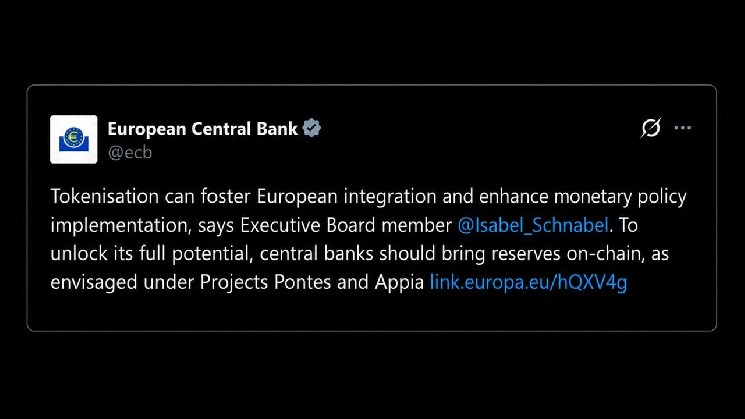
ECB's Schnabel says central bank money 'should move to blockchain'

ECB Executive Board member Isabel Schnabel stated that central bank money "must move onto the blockchain." She argued that stablecoins lack the independent ability to scale liquidity during financial stress—a gap only a central bank can fill. Her proposed solution involves tokenization, which she says can make transactions faster, safer, and more programmable, but only if the safest asset (central bank money) is on the same "rails" as other tokenized assets. This marks a notable shift for the Eurosystem, which had previously viewed Distributed Ledger Technology (DLT) mainly as a tool for regulating stablecoins and crypto, not as infrastructure to adopt directly. The first step is Project Pontes, launching in September. It will initially synchronize the ECB’s existing TARGET services with private DLT platforms. Eventually, it aims to enable settlement finality on a Eurosystem-managed DLT platform with smart contract functionality and 24/7 operation. The long-term strategy is Project Appia, tasked with developing the architecture, standards, and legal framework for a genuine European tokenized asset market by 2028. Trials have already processed around €1.6 billion, and since March 2026, the ECB accepts DLT-based assets as collateral. While not directly impacting Bitcoin's price, these developments signal that a major G7 central bank is preparing to settle transactions on-chain, lending legitimacy to the underlying infrastructure of crypto markets. The ECB's move to avoid "disintermediation" by private tokenization shows that debates in central bank boardrooms are now aligning with discussions long followed in the crypto space.

cryptonews.ru43 хв тому

ECB's Schnabel says central bank money 'should move to blockchain'

cryptonews.ru43 хв тому

Ripple Labs Warns of a New Challenge for Blockchains

Ripple Labs is preparing the XRP Ledger for quantum threats but now emphasizes a broader challenge: ensuring financial infrastructure can adapt simultaneously to quantum computing and artificial intelligence. Senior Director of Engineering Ayo Akinyele states the goal is not merely anticipating a "Q-Day" but building infrastructure capable of preemptively adopting new security mechanisms without network disruption. The shift to post-quantum cryptography involves more than swapping algorithms; it requires flexible infrastructure, improved key management, and clear upgrade paths. Financial systems were not designed with quantum computers in mind, necessitating a rethink of transaction, identity, asset, and data protection. This is underscored by significant investments, such as the $2 billion U.S.-IBM quantum factory initiative and a 2030 U.S. government mandate for post-quantum cryptography adoption. AI introduces distinct risks by driving automation and autonomous economic activity, increasing demand for an always-on, internet-oriented payment infrastructure. AI agents could soon conduct transactions independently, creating new security requirements. Ripple Labs advocates for proactive, orderly preparation rather than a crisis-driven transition, having outlined a four-phase strategy aiming for a full XRP Ledger transition by 2028, now expanded to address both quantum and AI-driven challenges.

cryptonews.ru44 хв тому

Ripple Labs Warns of a New Challenge for Blockchains

cryptonews.ru44 хв тому

Торгівля

Спот

Популярні статті

Що таке ETH 2.0

ETH 2.0: Нова ера для Ethereum Вступ ETH 2.0, широко відомий як Ethereum 2.0, є величезним оновленням для блокчейну Ethereum. Ця трансформація не є лише косметичною зміною; вона має на меті фундаментально покращити масштабованість, безпеку та сталий розвиток мережі. З переходом від енергомісткого механізму консенсусу Proof of Work (PoW) до більш ефективного Proof of Stake (PoS), ETH 2.0 обіцяє трансформаційний підхід до екосистеми блокчейнів. Що таке ETH 2.0? ETH 2.0 — це збірка особливих, взаємопов’язаних оновлень, спрямованих на оптимізацію можливостей та продуктивності Ethereum. Це перетворення розроблене для вирішення критичних викликів, з якими стикалося існуюче механізм Ethereum, зокрема щодо швидкості транзакцій та заторів у мережі. Мета ETH 2.0 Основні цілі ETH 2.0 зосереджені на покращенні трьох ключових аспектів: Масштабованість: Мета — значно підвищити кількість транзакцій, які мережа може обробити за секунду; ETH 2.0 прагне вийти за межі поточного обмеження приблизно в 15 транзакцій на секунду, потенційно досягнувши тисяч. Безпека: Підвищені заходи безпеки є невід’ємною частиною ETH 2.0, зокрема через покращену стійкість до кібератак і збереження децентралізованої етики Ethereum. Сталий розвиток: Новий механізм PoS розроблений не тільки для підвищення ефективності, але й для різкого зменшення споживання енергії, що узгоджує операційну структуру Ethereum з екологічними міркуваннями. Хто є творцем ETH 2.0? Створення ETH 2.0 можна віднести до Ethereum Foundation. Ця неприбуткова організація, яка відіграє важливу роль у підтримці розвитку Ethereum, очолюється відомим співавтором Віталіком Бутеріним. Його бачення більш масштабованого та стійкого Ethereum стало рушійною силою цього оновлення, залучаючи внески зі всього світу від розробників і ентузіастів, які прагнуть покращити протокол. Хто є інвесторами ETH 2.0? Хоча подробиці про інвесторів ETH 2.0 не були оприлюднені, відомо, що Ethereum Foundation отримує підтримку від різних організацій та осіб у сфері блокчейну та технологій. Ці партнери включають венчурні капітальні компанії, технологічні компанії та філантропічні організації, які мають спільний інтерес у підтримці розвитку децентралізованих технологій та інфраструктури блокчейну. Як працює ETH 2.0? ETH 2.0 відзначається введенням низки ключових функцій, які відрізняють його від попередника. Proof of Stake (PoS) Перехід до механізму консенсусу PoS є одним із знакових змін ETH 2.0. На відміну від PoW, який покладається на енергомісткий видобуток для перевірки транзакцій, PoS дозволяє користувачам підтверджувати транзакції та створювати нові блоки відповідно до кількості ETH, яку вони ставлять у мережі. Це призводить до підвищення енергоефективності, зменшуючи споживання приблизно на 99,95%, завдяки чому Ethereum 2.0 стає значно більш екологічною альтернативою. Шардові ланцюги Шардові ланцюги є ще одним ключовим нововведенням ETH 2.0. Ці менші ланцюги працюють паралельно з основним ланцюгом Ethereum, що дозволяє обробляти кілька транзакцій одночасно. Це підходи покращує загальну ємність мережі, усуваючи проблеми масштабованості, які переслідували Ethereum. Beacon Chain У центрі ETH 2.0 знаходиться Beacon Chain, яка координує мережу і управляє протоколом PoS. Вона виконує роль організатора: контролює валідаторів, забезпечує з’єднання шард з мережею і моніторить загальний стан екосистеми блокчейнів. Хронологія ETH 2.0 Шлях ETH 2.0 характеризується кількома ключовими етапами, які відображають еволюцію цього значного оновлення: Грудень 2020: Запуск Beacon Chain ознаменував введення PoS, проклавши шлях до міграції на ETH 2.0. Вересень 2022: Завершення "Злиття" є знаковим моментом, коли мережа Ethereum успішно перейшла з PoW на PoS, відкриваючи нову еру для Ethereum. 2023: Очікуване розгортання шардових ланцюгів має на меті подальше покращення масштабованості мережі Ethereum, закріплюючи ETH 2.0 як надійну платформу для децентралізованих додатків і послуг. Ключові особливості та переваги Покращена масштабованість Однією з найзначніших переваг ETH 2.0 є його покращена масштабованість. Поєднання PoS та шардових ланцюгів дозволяє мережі розширити свою ємність, що дозволяє їй обробляти набагато більший обсяг транзакцій в порівнянні з класичною системою. Енергоефективність Запровадження PoS є величезним кроком до енергоефективності в технології блокчейн. Значно зменшуючи споживання енергії, ETH 2.0 не тільки знижує операційні витрати, але також ближче узгоджується з глобальними цілями сталого розвитку. Підвищена безпека Оновлені механізми ETH 2.0 сприяють підвищенню безпеки по всій мережі. Впровадження PoS, поряд з інноваційними контрольними заходами, встановленими через шардові ланцюги та Beacon Chain, забезпечує вищий рівень захисту від потенційних загроз. Зниження витрат для користувачів З покращенням масштабованості вплив на витрати на транзакції також стане очевидним. Збільшена ємність і зменшені затори, як очікується, призведуть до зниження зборів для користувачів, що зробить Ethereum більш доступним для повсякденних транзакцій. Висновок ETH 2.0 є значною еволюцією в екосистемі блокчейну Ethereum. Оскільки він вирішує важливі питання, такі як масштабованість, споживання енергії, ефективність транзакцій і загальна безпека, важливість цього оновлення не можна недооцінювати. Перехід до Proof of Stake, введення шардових ланцюгів і фундаментальна робота Beacon Chain свідчать про майбутнє, в якому Ethereum може задовольнити зростаючі вимоги децентралізованого ринку. В індустрії, що рухається вперед завдяки інноваціям та прогресу, ETH 2.0 є підтвердженням можливостей технології блокчейн у прокладенні шляху до більш сталого та ефективного цифрового економіки.

360 переглядів усьогоОпубліковано 2024.04.04Оновлено 2024.12.03

Що таке ETH 2.0

Що таке ETH 3.0

ETH3.0 та $eth 3.0: Глибоке дослідження майбутнього Ethereum Вступ У швидко змінюваному світі криптовалют та технології блокчейн, ETH3.0, часто позначуваний як $eth 3.0, став темою значного інтересу та спекуляцій. Цей термін охоплює два основні концепти, які потребують уточнення: Ethereum 3.0: Це потенційне майбутнє оновлення, яке має на меті покращення можливостей існуючого блокчейну Ethereum, зокрема, фокусуючись на поліпшенні масштабованості та продуктивності. ETH3.0 Мем Токен: Цей окремий криптовалютний проект прагне використовувати блокчейн Ethereum для створення екосистеми, орієнтованої на меми, сприяючи залученню до криптовалютної громади. Розуміння цих аспектів ETH3.0 є важливим не лише для криптоентузіастів, але й для тих, хто спостерігає за широкими технологічними тенденціями у цифровому просторі. Що таке ETH3.0? Ethereum 3.0 Ethereum 3.0 пропонується як оновлення вже існуючої мережі Ethereum, яка стала основою багатьох децентралізованих додатків (dApps) та смарт-контрактів з моменту свого виникнення. Передбачувані удосконалення зосереджені в основному на масштабованості — інтегруючи передові технології, такі як шардінг та нульові знання (zk-докази). Ці технологічні нововведення націлені на забезпечення безпрецедентної кількості транзакцій на секунду (TPS), потенційно досягаючи мільйонів, тим самим вирішуючи одну з найзначніших обмежень, з якими стикається сучасна технологія блокчейн. Покращення є не лише технічним, а й стратегічним; воно спрямоване на підготовку мережі Ethereum до широкого прийняття та корисності в майбутньому, позначеному збільшеним попитом на децентралізовані рішення. ETH3.0 Мем Токен На відміну від Ethereum 3.0, ETH3.0 Мем Токен пропонує легшу та грайливішу домену, поєднуючи культуру інтернет-мемів із динамікою криптовалют. Цей проект дозволяє користувачам купувати, продавати та обмінювати меми на блокчейні Ethereum, надаючи платформу, яка сприяє залученню громади через креативність та спільні інтереси. ETH3.0 Мем Токен має на меті продемонструвати, як технологія блокчейн може перетинатися з цифровою культурою, створюючи випадки використання, які є водночас розважальними та фінансово життєздатними. Хто є творцем ETH3.0? Ethereum 3.0 Ініціатива щодо Ethereum 3.0 переважно підтримується консорціумом розробників та дослідників у межах громади Ethereum, зокрема, до складу якого входить Джастін Дрейк. Відомий своїми думками та внеском у розвиток Ethereum, Дрейк є помітною особистістю в обговореннях щодо переходу Ethereum на новий рівень консенсусу, який називається «Beam Chain». Цей колабораційний підхід до розробки свідчить про те, що Ethereum 3.0 не є продуктом єдиного творця, а скоріше втіленням колективної винахідливості, спрямованої на просування технології блокчейн. ETH3.0 Мем Токен Деталі про творця ETH3.0 Мем Токена наразі не відстежуються. Природа мем-токенів часто призводить до більш децентралізованої та громартової структури, що може пояснити відсутність специфічної атрибуції. Це узгоджується з етикою ширшої крипто-спільноти, де інновації часто виникають з колективних, а не індивідуальних зусиль. Хто є інвесторами ETH3.0? Ethereum 3.0 Підтримка Ethereum 3.0 переважно надходить від Фонду Ethereum поряд з ентузіастичною спільнотою розробників та інвесторів. Це базове співробітництво надає значний градус легітимності та підвищує ймовірність успішної реалізації, оскільки воно використовує довіру та авторитет, накопичені за роки роботи мережі. У швидко змінюваному кліматі криптовалют підтримка громади займає важливу роль у розвитку та прийнятті, позиціонуючи Ethereum 3.0 як серйозного конкурента для майбутніх блокчейн-інновацій. ETH3.0 Мем Токен Хоча наразі доступні джерела не надають явної інформації щодо інвестиційних фондів або організацій, що підтримують ETH3.0 Мем Токен, це свідчить про типову модель фінансування для мем-токенів, яка часто спирається на підтримку знизу та залучення громади. Інвестори в такі проекти зазвичай складаються з осіб, які мотивовані потенціалом інновацій, що керуються спільнотою, та духом співпраці, притаманним крипто-спільноті. Як працює ETH3.0? Ethereum 3.0 Відмінні риси Ethereum 3.0 полягають у його запропонованій реалізації технології шардінгу та zk-proof. Шардінг — це метод розподілу блокчейну на менші, керовані частини чи «шарди», які можуть обробляти транзакції одночасно, а не послідовно. Це децентралізоване оброблення допомагає запобігти заторам та забезпечити оперативність мережі навіть під великим навантаженням. Технологія нульових доказів (zk-proof) надає ще один рівень складності, дозволяючи валідацію транзакцій без розкриття підпорядкованих даних. Цей аспект не лише підвищує конфіденційність, а й збільшує загальну ефективність мережі. Також обговорюється включення нульової Ефірної віртуальної машини (zkEVM) в це оновлення, що ще більше підвищить можливості та корисність мережі. ETH3.0 Мем Токен ETH3.0 Мем Токен виділяється завдяки використанню популярності культури мемів. Він створює ринок, на якому користувачі можуть брати участь у торгівлі мемами не лише для розваги, але й для потенційного економічного вигоди. Інтегруючи функції, такі як стейкінг, забезпечення ліквідності та механізми управління, проект сприяє створенню середовища, яке заохочує взаємодію та участь громади. Пропонуючи унікальне поєднання розваг та економічних можливостей, ETH3.0 Мем Токен прагне залучити різну аудиторію, яка охоплює від криптоентузіастів до casual-консумерів мемів. Хронологія ETH3.0 Ethereum 3.0 11 листопада 2024: Джастін Дрейк натякає на майбутнє оновлення ETH 3.0, яке зосереджене на поліпшеннях масштабованості. Це оголошення означає початок формальних обговорень щодо майбутньої архітектури Ethereum. 12 листопада 2024: Очікується, що запропоновану пропозицію для Ethereum 3.0 буде представлено на Devcon у Бангкоку, що готує ґрунт для більш широкого зворотного зв'язку від громади та потенційних наступних кроків у розвитку. ETH3.0 Мем Токен 21 березня 2024: ETH3.0 Мем Токен офіційно потрапляє у список на CoinMarketCap, що означає його дебют у публічному крипто-просторі та підвищує видимість для його меморієнтованої екосистеми. Ключові моменти На завершення, Ethereum 3.0 представляє значну еволюцію в межах мережі Ethereum, зосереджуючись на подоланні обмежень щодо масштабованості та продуктивності через передові технології. Його запропоновані оновлення відображають проактивний підхід до майбутніх вимог і корисності. Натомість ETH3.0 Мем Токен втілює суть культури, керованої громадою, у сфері криптовалют, використовуючи культуру мемів для створення привабливих платформ, які заохочують творчість і участь користувачів. Розуміння окремих цілей і функцій ETH3.0 та $eth 3.0 є надзвичайно важливим для кожного, хто цікавиться поточними подіями в крипто-просторі. З обома ініціативами, які прокладають унікальні шляхи, вони разом підкреслюють динамічну та багатогранну природу інновацій у блокчейн-технологіях.

369 переглядів усьогоОпубліковано 2024.04.04Оновлено 2024.12.03

Що таке ETH 3.0

Як купити ETH

Ласкаво просимо до HTX.com! Ми зробили покупку Ethereum (ETH) простою та зручною. Дотримуйтесь нашої покрокової інструкції, щоб розпочати свою криптовалютну подорож.Крок 1: Створіть обліковий запис на HTXВикористовуйте свою електронну пошту або номер телефону, щоб зареєструвати обліковий запис на HTX безплатно. Пройдіть безпроблемну реєстрацію й отримайте доступ до всіх функцій.ЗареєструватисьКрок 2: Перейдіть до розділу Купити крипту і виберіть спосіб оплатиКредитна/дебетова картка: використовуйте вашу картку Visa або Mastercard, щоб миттєво купити Ethereum (ETH).Баланс: використовуйте кошти з балансу вашого рахунку HTX для безперешкодної торгівлі.Треті особи: ми додали популярні способи оплати, такі як Google Pay та Apple Pay, щоб підвищити зручність.P2P: Торгуйте безпосередньо з іншими користувачами на HTX.Позабіржова торгівля (OTC): ми пропонуємо індивідуальні послуги та конкурентні обмінні курси для трейдерів.Крок 3: Зберігайте свої Ethereum (ETH)Після придбання Ethereum (ETH) збережіть його у своєму обліковому записі на HTX. Крім того, ви можете відправити його в інше місце за допомогою блокчейн-переказу або використовувати його для торгівлі іншими криптовалютами.Крок 4: Торгівля Ethereum (ETH)Легко торгуйте Ethereum (ETH) на спотовому ринку HTX. Просто увійдіть до свого облікового запису, виберіть торгову пару, укладайте угоди та спостерігайте за ними в режимі реального часу. Ми пропонуємо зручний досвід як для початківців, так і для досвідчених трейдерів.

3.8k переглядів усьогоОпубліковано 2024.12.10Оновлено 2026.06.02

Як купити ETH

Обговорення

Ласкаво просимо до спільноти HTX. Тут ви можете бути в курсі останніх подій розвитку платформи та отримати доступ до професійної ринкової інформації. Нижче представлені думки користувачів щодо ціни ETH (ETH).

活动图片