Ethereum's Narrative Is Being Rewritten: When L1 zkEVM Becomes the Endgame, When Will the Next Revolution Arrive?

marsbitОпубліковано о 2026-03-07Востаннє оновлено о 2026-03-07

Анотація

Ethereum's narrative is undergoing a significant rewrite, shifting from a programmable ledger (2015-2020) to an L2-centric settlement layer (2021-2023), and now toward becoming a verifiable computer with L1 zkEVM as its endgame (2024 onward). The newly proposed Strawmap roadmap outlines an ambitious technical direction, targeting faster L1 confirmation, "Gigagas"-level throughput (10,000 TPS), quantum resistance, and native privacy. This transformation is driven by eight core technical workstreams: formalizing EVM specifications, replacing Keccak with ZK-friendly hashes, transitioning to Verkle Trees, enabling stateless clients, standardizing ZK proof systems, decoupling execution and consensus layers, implementing recursive proof aggregation, and ensuring developer toolchain compatibility. L1 zkEVM aims to integrate zero-knowledge proofs directly into Ethereum’s consensus layer, fundamentally upgrading its trust model. While full implementation may take until 2028-2029, this shift repositions Ethereum as the verifiable trust root for the entire Web3 ecosystem—enhancing scalability without compromising decentralization. The move also redefines the role of L2s, evolving them from scaling solutions to specialized execution environments. Ethereum’s structured, multi-year effort reflects its unique capacity for coordinated innovation and may ultimately establish it as a global settlement layer—fast, secure, and private.

From a purely experiential perspective, since 2025, the update frequency of the Ethereum core developer community has been unusually intense.

From the Fusaka upgrade to Glamsterdam, and then to long-term planning around issues like kEVM, quantum-resistant cryptography systems, and Gas Limit over the next three years, Ethereum has densely released multiple roadmap documents covering three to five years within just a few months.

This pace itself is a signal.

If you carefully read the latest roadmap, you will find a clearer and more radical direction emerging: Ethereum is transforming itself into a verifiable computer, and the end point of this path is L1 zkEVM.

I. The Three Shifts in Ethereum's Narrative Focus

On February 26, Ethereum Foundation researcher Justin Drake posted on a social platform stating that the Ethereum Foundation had proposed a roadmap draft named Strawmap, outlining the upgrade direction for the Ethereum L1 protocol in the coming years.

This roadmap proposes five core goals: a faster L1 (second-level finality), a "Gigagas" L1 achieving 10,000 TPS through zkEVM, high-throughput L2 based on Data Availability Sampling (DAS), a quantum-resistant cryptography system, and native private transaction functionality; the roadmap also plans for seven protocol forks by 2029, averaging about one every six months.
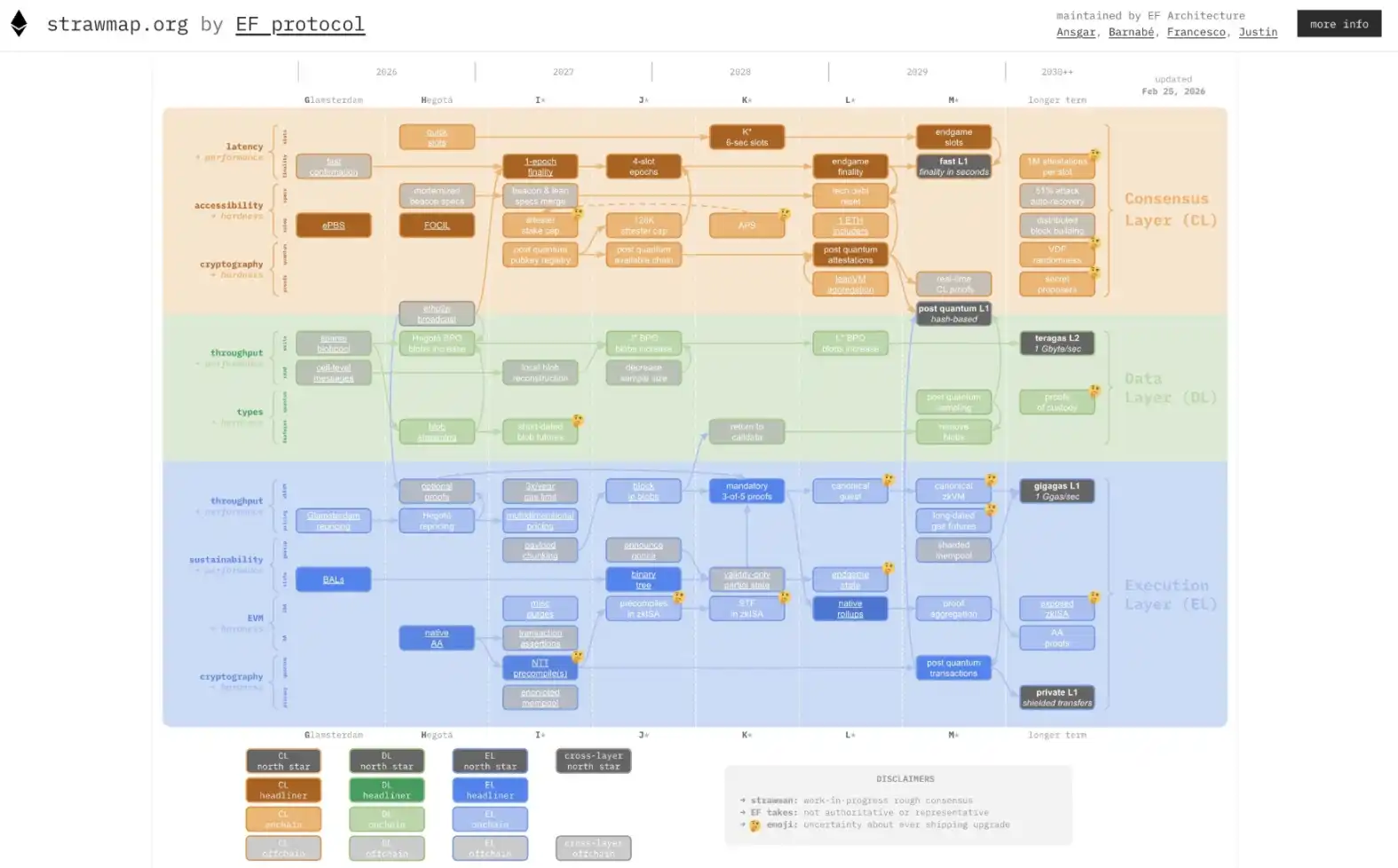
It can be said that over the past decade, Ethereum's development has always been accompanied by the continuous evolution of its narrative and technical路线.

The first stage (2015–2020) was the programmable ledger.

This was the initial core narrative of Ethereum, namely "Turing-complete smart contracts." At that time, Ethereum's biggest advantage was that it could do more things compared to Bitcoin, such as DeFi, NFTs, and DAOs, all products of this narrative. A large number of decentralized financial protocols began operating on-chain, from lending and DEXs to stablecoins. Ethereum gradually became the main settlement network for the crypto economy.

The second stage (2021–2023) saw the narrative taken over by L2.

As Gas fees on the Ethereum mainnet soared, making transaction costs unaffordable for ordinary users, Rollups began to take the lead in scaling. Ethereum also gradually repositioned itself as a settlement layer, aiming to be the foundational base providing security for L2s.

Simply put, this involved migrating most of the execution layer's computation to L2, scaling through Rollups, while L1 was only responsible for data availability and final settlement. During this period, The Merge and EIP-4844 served this narrative, aiming to make L2s cheaper and safer to use Ethereum's trust.

The third stage (2024–2025) focused on narrative introspection and reflection.

As is well known, the prosperity of L2 brought an unexpected problem: Ethereum L1 itself became less important. Users began operating more on Arbitrum, Base, Optimism, etc., rarely interacting directly with L1. The price performance of ETH also reflected this anxiety.

This led the community to debate: if L2s capture all the users and activity, where is the value capture for L1? It wasn't until the internal turbulence within Ethereum in 2025 and the series of roadmaps laid out in 2026 that this logic began to evolve profoundly.

In fact,梳理 (sorting out) the core technical directions since 2025, Verkle Trees, Stateless Clients, EVM Formal Verification, native ZK support, etc., have repeatedly appeared. These technical directions all point to the same thing: making Ethereum L1 itself verifiable. It is important to note that this is not just about allowing L2 proofs to be verified on L1, but about enabling every step of L1's state transition to be compressed and verified via zero-knowledge proofs.

This is the ambition of L1 zkEVM. Different from L2 zkEVM, L1 zkEVM (in-protocol zkEVM) means integrating zero-knowledge proof technology directly into the Ethereum consensus layer.

It is not a replica of L2 zkEVMs (like zkSync, Starknet, Scroll), but rather transforming Ethereum's execution layer itself into a ZK-friendly system. So, if L2 zkEVM is about building a ZK world on top of Ethereum, then L1 zkEVM is about turning Ethereum itself into that ZK world.

Once this goal is achieved, Ethereum's narrative will upgrade from being L2's settlement layer to the "root trust for verifiable computation."

This will be a qualitative change, not the quantitative change of the past few years.

II. What is the True L1 zkEVM?

It's worth reiterating a common point: in the traditional model, validators need to "re-execute" every transaction to verify a block, whereas in the zkEVM model, validators only need to verify a ZK Proof. This allows Ethereum to increase the Gas Limit to 100 million or even higher without increasing the burden on nodes (Further reading: 'The Dawn of the ZK Route: Is the Roadmap for Ethereum's Endgame Accelerating?').

However, transforming Ethereum L1 into a zkEVM is by no means a matter of a single breakthrough; it requires simultaneous progress in eight directions, each being a multi-year engineering effort.

Workstream 1: EVM Formalization

The prerequisite for any ZK proof is that the object being proven has a precise mathematical definition. However, today's EVM behavior is defined by client implementations (Geth, Nethermind, etc.), not by a strict formal specification. The behavior of different clients might be inconsistent in edge cases, making it extremely difficult to write ZK circuits for the EVM—after all, you can't write proofs for an ambiguously defined system.

Therefore, the goal of this workstream is to write every EVM instruction, every state transition rule, into a machine-verifiable formal specification. This is the foundation of the entire L1 zkEVM project. Without it, everything that follows is building on sand.

Workstream 2: ZK-Friendly Hash Function Replacement

Ethereum currently uses Keccak-256 extensively as its hash function. Keccak is extremely unfriendly to ZK circuits, with huge computational overhead, significantly increasing proof generation time and cost.

The core task of this workstream is to gradually replace the use of Keccak inside Ethereum with ZK-friendly hash functions (like Poseidon, Blake series), especially on the state tree and Merkle proof paths. This is a change that affects everything, as the hash function permeates every corner of the Ethereum protocol.

Workstream 3: Verkle Tree Replacing Merkle Patricia Tree

This is one of the most anticipated changes in the 2025–2027 roadmap. Ethereum currently uses the Merkle Patricia Tree (MPT) to store the global state. Verkle Trees replace hash linkages with vector commitments, which can compress witness size by tens of times.

For L1 zkEVM, this means the amount of data needed to prove each block is drastically reduced, and proof generation speed is significantly improved. It also means the introduction of Verkle Trees is a key infrastructure prerequisite for the feasibility of L1 zkEVM.

Workstream 4: Stateless Clients

Stateless clients refer to nodes that, when verifying blocks, do not need to locally store the complete Ethereum state database; they only need the witness data附带 (attached) with the block itself to complete verification.

This workstream is deeply bound with Verkle Trees because stateless clients are only practically feasible if the witness is small enough. Thus, the significance of stateless clients for L1 zkEVM is twofold: on one hand, it greatly reduces the hardware threshold for running nodes, aiding decentralization; on the other hand, it provides a clear input boundary for ZK proofs, allowing the prover to only need to process the data contained in the witness, not the entire world state.

Workstream 5: ZK Proof System Standardization and Integration

L1 zkEVM needs a mature ZK proof system to generate proofs for block execution. However, the current technical landscape in the ZK field is highly fragmented, with no公认 (consensus) optimal solution. The goal of this workstream is to define a standardized proof interface at the Ethereum protocol layer, allowing different proof systems to接入 (access/be integrated) through competition, rather than designating a specific one.

This maintains technological openness while also leaving room for the continuous evolution of proof systems. The Ethereum Foundation's PSE (Privacy and Scaling Explorations) team has substantial preliminary积累 (accumulation) in this direction.

Workstream 6: Decoupling Execution Layer and Consensus Layer (Engine API Evolution)

Currently, Ethereum's Execution Layer (EL) and Consensus Layer (CL) communicate via the Engine API. Under the L1 zkEVM architecture, every state transition of the execution layer requires generating a ZK proof, and the generation time for this proof may far exceed a block's出块间隔 (block time).

The core problem this workstream needs to solve is how to decouple execution and proof generation without breaking the consensus mechanism—execution can be completed quickly first, proof generation can be滞后异步 (generated asynchronously later), and then validators can complete final confirmation at an appropriate time. This involves a deep改造 (overhaul) of the block finality model.

Workstream 7: Recursive Proofs and Proof Aggregation

The cost of generating a ZK proof for a single block is high, but if proofs for multiple blocks can be recursively aggregated into one proof, the verification cost can be significantly reduced. Progress in this workstream will directly determine how低成本 (low-cost) L1 zkEVM can operate.

Workstream 8: Developer Toolchain and EVM Compatibility Guarantee

All underlying technical transformations must ultimately be transparent to smart contract developers on Ethereum. The existing hundreds of thousands of contracts cannot fail due to the introduction of zkEVM. Developers' toolchains cannot be forced to rewrite.

This workstream is the most easily underestimated but often the most time-consuming. Historically, every EVM upgrade required extensive backward compatibility testing and toolchain adaptation work. The scale of changes for L1 zkEVM is far greater than previous upgrades, so the workload for toolchains and compatibility will be an order of magnitude higher.

III. Why is Now the Right Time to Understand This?

The release of Strawmap coincides with a time when the market has doubts about ETH's price performance. From this perspective, the most important value of this roadmap lies in redefining Ethereum as "infrastructure."

For builders, represented by developers, Strawmap provides directional certainty. For users, these technical upgrades will ultimately translate into perceptible experiences: transactions finalized within seconds, assets seamlessly flowing between L1 and L2, privacy protection becoming a built-in feature rather than a plugin.

Objectively speaking, L1 zkEVM is not a product that will be launched in the near future; its complete implementation may take until 2028-2029 or even later.

But at least it redefines Ethereum's value proposition. If L1 zkEVM succeeds, Ethereum will no longer be just the settlement layer for L2, but the verifiable trust root for the entire Web3 world, allowing any on-chain state to ultimately be traced back mathematically to Ethereum's ZK proof chain. This is decisive (决定性) for Ethereum's long-term value capture.

Secondly, it also affects the long-term positioning of L2. After all, when L1 itself possesses ZK capabilities, the role of L2 will change—evolving from "secure scaling solutions" to "specialized execution environments." Which L2s can find their place in this new landscape will be the most值得观察 (worth observing) ecological evolution in the coming years.

Most importantly, the author feels it is also an excellent window to observe Ethereum's developer culture—the ability to simultaneously advance eight interdependent technical workstreams, each being a multi-year engineering effort, while maintaining a decentralized coordination method, is itself Ethereum's unique capability as a protocol.

Understanding this helps to more accurately assess Ethereum's true position in various competitive narratives.

Overall, from the "Rollup-centric" approach of 2020 to the Strawmap of 2026, the evolution of Ethereum's narrative reflects a clear trajectory: scaling cannot rely solely on L2; L1 and L2 must co-evolve.

Therefore, the eight workstreams of L1 zkEVM are the technical mapping of this cognitive shift. They collectively point to one goal: enabling the Ethereum mainnet to achieve an order-of-magnitude performance improvement without sacrificing decentralization. This is not a negation of the L2 route, but its perfection and supplement.

In the next three years, this "Ship of Theseus" will undergo seven forks and replace countless "planks." When it arrives at the next stop in 2029, we may see a truly "global settlement layer"—fast, secure, private, and as open as ever.

Let's wait and see together.

Пов'язані питання

QWhat is the ultimate goal of Ethereum's latest roadmap, Strawmap, as described in the article?

AThe ultimate goal is to transform Ethereum into a verifiable computer, with L1 zkEVM as the endgame. This involves making Ethereum L1 itself a ZK-friendly system, turning it into the root of verifiable trust for the entire Web3 world, rather than just a settlement layer for L2s.

QWhat are the three major shifts in Ethereum's narrative focus from 2015 to the present?

A1. 2015-2020: Programmable Ledbger - Focus on Turing-complete smart contracts enabling DeFi, NFTs, and DAOs. 2. 2021-2023: L2 Narrative - Ethereum repositioned as a settlement layer for L2 Rollups to scale. 3. 2024-2025: Introspection and Inward Focus - A shift towards making L1 itself verifiable with zkEVM to address value capture concerns.

QWhat is the key difference between an L2 zkEVM and the proposed L1 zkEVM?

AAn L2 zkEVM (like zkSync or Starknet) builds a ZK world on top of Ethereum. In contrast, L1 zkEVM (in-protocol zkEVM) integrates zero-knowledge proof technology directly into Ethereum's consensus layer, transforming Ethereum itself into that ZK world.

QName at least three of the eight key workstreams required to implement L1 zkEVM.

AThree of the eight workstreams are: 1. EVM Formalization: Creating a precise mathematical definition of the EVM. 2. ZK-Friendly Hash Function Replacement: Substituting Keccak-256 with ZK-friendly alternatives like Poseidon. 3. Verkle Tree Replacement: Replacing the Merkle Patricia Tree with Verkle Trees to compress witness data.

QHow does the article suggest the role of L2s will change if L1 zkEVM is successfully implemented?

AThe role of L2s will evolve from being security and scaling solutions to becoming specialized execution environments. Their long-term positioning will shift as L1 itself takes on the core role of providing verifiable trust.

Пов'язані матеріали

US Government Suddenly Halts Anthropic's Strongest Model, "Quasi-IPO Stock Price" Plunges 3.7% Overnight

U.S. Government Halts Anthropic's Top AI Models, 'Pre-IPO' Price Drops 3.7% On June 12, the U.S. government ordered Anthropic to shut down access to its two most powerful AI models, Claude Fable 5 and Claude Mythos 5, citing national security concerns. The directive, issued by the Department of Commerce, required Anthropic to block access for all foreign nationals, leading the company to disable the models globally for all users. Anthropic strongly opposed the move, arguing the government's basis was a "narrow jailbreak vulnerability" and warning that applying such a standard industry-wide would effectively halt all frontier model deployments. The news impacted Anthropic's implied valuation in speculative markets. The Anthropic perpetual contract on Hyperliquid fell approximately 3.7% to around $1,627, down from highs above $1,800 following the models' release. Unauthorized tokenized products linked to Anthropic on Solana also saw significant declines. The models, launched just days earlier on June 9, represented a major capability leap for Anthropic. Fable 5 was its first public release of a "Mythos"-tier model above its flagship Claude Opus. The shutdown creates an ironic situation for Anthropic, a company founded on "AI safety" principles, and adds uncertainty to its ongoing IPO preparations. The company is actively engaging with regulators to resolve what it calls a "misunderstanding" and restore service.

marsbit16 хв тому

US Government Suddenly Halts Anthropic's Strongest Model, "Quasi-IPO Stock Price" Plunges 3.7% Overnight

marsbit16 хв тому

SpaceX IPO Creates Trillion-Dollar Billionaire: Musk's Wealth Equals Half of Crypto Market

SpaceX's record-breaking IPO has propelled Elon Musk to become the first modern billionaire with a personal net worth exceeding $1 trillion, reaching $1.11 trillion according to Bloomberg. This staggering wealth surpasses the total market capitalization of all cryptocurrencies excluding Bitcoin and equals roughly half of the entire crypto market's value. The milestone highlights extreme wealth concentration and the significant devaluation of the altcoin market, whose total cap has nearly halved since late 2025 as capital flows into large tech stocks. SpaceX's Nasdaq debut saw its valuation hit $2.2 trillion, with shares soaring from a $135 offer price to close at $161. Its first-day trading volume of $85 billion set a new global IPO record. Musk owns 42% of the company. Despite his wealth dwarfing the altcoin sector, Musk maintains deep ties to digital assets. He personally holds Bitcoin, Ethereum, and Dogecoin, while his companies, SpaceX and Tesla, collectively hold over 30,000 Bitcoin, ranking among the top corporate BTC holders globally. His acquisition and integration of financial data tools into X (formerly Twitter) further connect his ecosystem to the markets. Ultimately, Musk's trillion-dollar status underscores the immense wealth controlled by tech founders, though this fortune remains largely tied to volatile stock prices rather than liquid assets.

Foresight News24 хв тому

SpaceX IPO Creates Trillion-Dollar Billionaire: Musk's Wealth Equals Half of Crypto Market

Foresight News24 хв тому

Hardcore First Look | Ocean Embodied Intelligence Company 'Shihang Intelligence' Secures Record-Breaking 1 Billion in Funding, Zhu Xiaohu, Temasek Place Bets

Breaking News | Ocean Embodied Intelligence company "Shihang Intelligent" secures a record-breaking 1 billion RMB (approximately 10 billion yuan) in Series A financing, with investment from Zhu Xiaohu and Temasek. Author: Qiu Xiaofen | Editor: Yuan Silai Ocean Embodied Intelligence company "Shihang Intelligent" has completed its Series A funding round, raising over 1 billion RMB. This marks the largest single funding round in the global marine robotics field to date. Investors include upstream momentum funds from chip companies "Moore Thread" and "Kunlunxin," Singapore's state-owned investment platform Vertex Growth, and listed company Dyneo, among others. Existing investors like GSR Ventures (whose founder Zhu Xiaohu has invested for the fifth time), Vertex Ventures China, Hua Ying Capital, and Long Capital also significantly increased their investments. Founder and CEO Chen Xiaobo, a 1989-born alumnus of Harbin Engineering University, is a long-time expert in underwater robotics. He received the National Defense Science and Technology Progress Award at age 28 (the youngest recipient) and led the development of China's first commercial underwater cleaning robot. The funds will be used for core technology R&D, global market expansion, and building the industry chain ecosystem to scale the application of marine robots in complex underwater scenarios. The ocean is considered one of the most challenging environments for robotics due to low light, high turbidity, complex currents, limited communication, high pressure, and corrosion. "Shihang Intelligent" focuses on developing core underlying technologies for marine robots, covering six key systems: power, control, sensing, navigation, sealing, and deployment. Its robots are capable of operating at depths from 0 to 10,000 meters with full degrees of freedom, performing complex maneuvers, autonomous navigation, and multi-robot collaboration. Applications include ship cleaning, underwater security, offshore wind power, marine ranching, and seabed inspection. The company's order value for the first half of 2026 alone has exceeded 1 billion RMB. Its "Orca Robot" is used by major shipping companies and has performed maintenance on over a thousand large vessels. In April of this year, the company launched its ocean embodied large model "Cangqiong CEORION." Unlike traditional remote-controlled or pre-programmed robots, this model integrates environmental perception, task understanding, and action generation into a single end-to-end architecture. Trained on millions of hours of commercial operation data and simulation data, it covers 12 major underwater operation scenarios. In simulations, it achieved over 90% task success rate and over 70% zero-shot adaptation capability to unseen environments. A built-in physics reasoning module reduces collision risk by 80%, enabling autonomous operation even with weak or no communication. Recently, "Shihang Intelligent" was selected as a core technology partner for Singapore's Maritime and Port Authority national hull inspection and cleaning program. These advancements indicate marine robotics is moving from pilot projects to scaled applications, with real-world operations generating valuable data to continuously improve robot capabilities. CEO Chen Xiaobo stated the company will continue investing in core marine robotics technology, the embodied intelligence model, and global application scenarios to expand into more high-risk, high-difficulty, and high-value underwater operations.

marsbit50 хв тому

Hardcore First Look | Ocean Embodied Intelligence Company 'Shihang Intelligence' Secures Record-Breaking 1 Billion in Funding, Zhu Xiaohu, Temasek Place Bets

marsbit50 хв тому

Three Months, 35 Billion Yuan: Investors Rush to Grab the OpenAI of the Physical World

Investors flock to a physical AI startup as the race for the "OpenAI of the physical world" heats up. Ji Jia Shi Jie (GigaWorld), a company dedicated to developing Artificial General Intelligence (AGI) for the physical world, has raised 3.5 billion RMB (approximately $490 million) in just three months, according to a report from investment media outlet Touzijie. The latest B2 funding round of 1 billion RMB attracted a wide range of top-tier investors, including sovereign wealth funds, industrial capital, and financial institutions. This brings the total funding for the young company, now valued over 10 billion RMB, to 3.5 billion RMB across three recent rounds. The company is led by Huang Guan, a post-90s Tsinghua University PhD with extensive experience in AI, autonomous driving, and entrepreneurship. Its core innovation is a "dual-pyramid" system comprising a five-layer data pyramid (from internet videos to real-world robot data) and a three-layer algorithm pyramid focused on world simulation, action alignment, and reinforcement learning. This system underpins its key models: the "World Action Model" (e.g., GigaBrain series for robot control) and the "World Generation Model" (e.g., GigaWorld series for simulating and understanding the physical world). Its models have reportedly achieved top rankings in global robotics benchmarks. Ji Jia Shi Jie argues that while current digital AGI excels in information processing, the next frontier is physical AGI—systems that can understand and interact with the real world. The company believes the field is approaching its "GPT-3 moment," a key inflection point in capability scaling. To achieve this, the company is pursuing a dual-market strategy. For the consumer (C) market, it launched the "SeeLight" brand and its S1 general-purpose humanoid robot, which has secured initial orders for deployment in real homes. For the business (B) market, it focuses on industrial automation with its Maker series robots, having signed agreements for large-scale deployment in factories, and its DriveDreamer world model for autonomous driving, which is already in use with over 30 automakers and tech companies. The report concludes that by bridging the gap between digital intelligence and physical action, Ji Jia Shi Jie aims to unlock a new wave of productivity, ultimately bringing physical AGI into everyday life.

marsbit1 год тому

Three Months, 35 Billion Yuan: Investors Rush to Grab the OpenAI of the Physical World

marsbit1 год тому

What's the Connection Between Pinduoduo's Huang Zheng and Blockchain?

This text explores the unexpected connection between Pinduoduo founder Colin Huang and blockchain, as suggested in his article *Turning Capitalism Upside Down*. Huang argues Pinduoduo's core business is about managing "uncertainty." He posits that wealth flows to the rich because they absorb life's uncertainties (e.g., illness, job loss) that devastate the poor, who pay a premium for certainty through insurance or stable prices. Pinduoduo's model attempts a "reverse insurance": by aggregating consumer demand via group-buying and flash sales, it creates a large, predictable order for manufacturers. This certainty allows factories to remove risk premiums, passing savings back as lower prices, thus partially reversing the wealth flow. The key obstacle, Huang notes, is that an individual's buying intent is an unreliable promise. He then asks if blockchain is the natural solution for this "reverse insurance." The text elaborates that blockchain, through smart contracts with binding deposits, could transform casual intent into a costly-to-break, enforceable commitment. This replaces interpersonal trust with coded rules, making promises credible, pricable, and resistant to fraud. Finally, the author draws a parallel to Bitcoin, framing two paths to creating certainty: the "Pinduoduo path" of aggregating decentralized will into scale, and the "Bitcoin path" of locking rules into immutable code. Both sacrifice something—personal freedom or system flexibility—to manufacture trust and predictability.

链捕手2 год тому

What's the Connection Between Pinduoduo's Huang Zheng and Blockchain?

链捕手2 год тому

Торгівля

Спот
Ф'ючерси

Популярні статті

Що таке $S$

Розуміння SPERO: Комплексний огляд Вступ до SPERO Оскільки ландшафт інновацій продовжує еволюціонувати, виникнення технологій web3 та криптовалютних проектів відіграє ключову роль у формуванні цифрового майбутнього. Один з проектів, який привернув увагу в цій динамічній сфері, — це SPERO, позначений як SPERO,$$s$. Ця стаття має на меті зібрати та представити детальну інформацію про SPERO, щоб допомогти ентузіастам та інвесторам зрозуміти його основи, цілі та інновації в рамках web3 та крипто-сектору. Що таке SPERO,$$s$? SPERO,$$s$ — це унікальний проект у криптопросторі, який прагне використати принципи децентралізації та технології блокчейн для створення екосистеми, що сприяє залученню, корисності та фінансовій інклюзії. Проект розроблений для полегшення взаємодії між користувачами новими способами, надаючи їм інноваційні фінансові рішення та послуги. У своїй основі SPERO,$$s$ прагне надати можливості індивідам, забезпечуючи інструменти та платформи, які покращують користувацький досвід у криптовалютному просторі. Це включає в себе можливість більш гнучких методів транзакцій, сприяння ініціативам, що підтримуються спільнотою, та створення шляхів для фінансових можливостей через децентралізовані додатки (dApps). Основна концепція SPERO,$$s$ обертається навколо інклюзивності, прагнучи зменшити розриви в традиційній фінансовій системі, використовуючи переваги технології блокчейн. Хто є творцем SPERO,$$s$? Особистість творця SPERO,$$s$ залишається дещо невідомою, оскільки є обмежені публічно доступні ресурси, що надають детальну інформацію про його засновників. Ця відсутність прозорості може бути наслідком зобов'язання проекту до децентралізації — етики, яку багато проектів web3 поділяють, ставлячи колективні внески вище за індивідуальне визнання. Зосереджуючи обговорення навколо спільноти та її колективних цілей, SPERO,$$s$ втілює суть наділення без виділення конкретних осіб. Таким чином, розуміння етики та місії SPERO є більш важливим, ніж ідентифікація єдиного творця. Хто є інвесторами SPERO,$$s$? SPERO,$$s$ підтримується різноманітними інвесторами, починаючи від венчурних капіталістів до ангельських інвесторів, які прагнуть сприяти інноваціям у крипто-секторі. Зосередження цих інвесторів зазвичай узгоджується з місією SPERO — пріоритет надається проектам, які обіцяють технологічний прогрес у суспільстві, фінансову інклюзію та децентралізоване управління. Ці інвесторські фонди зазвичай зацікавлені в проектах, які не лише пропонують інноваційні продукти, але й позитивно впливають на спільноту блокчейн та її екосистеми. Підтримка з боку цих інвесторів підкріплює SPERO,$$s$ як значного конкурента в швидко змінюваній сфері крипто-проектів. Як працює SPERO,$$s$? SPERO,$$s$ використовує багатогранну структуру, яка відрізняє його від традиційних криптовалютних проектів. Ось деякі ключові особливості, які підкреслюють його унікальність та інноваційність: Децентралізоване управління: SPERO,$$s$ інтегрує моделі децентралізованого управління, надаючи користувачам можливість активно брати участь у процесах прийняття рішень щодо майбутнього проекту. Цей підхід сприяє відчуттю власності та відповідальності серед членів спільноти. Корисність токена: SPERO,$$s$ використовує свій власний криптовалютний токен, розроблений для виконання різних функцій в екосистемі. Ці токени дозволяють здійснювати транзакції, отримувати винагороди та полегшувати послуги, що пропонуються на платформі, підвищуючи загальну залученість та корисність. Шарова архітектура: Технічна архітектура SPERO,$$s$ підтримує модульність та масштабованість, що дозволяє безперешкодно інтегрувати додаткові функції та додатки в міру розвитку проекту. Ця адаптивність є надзвичайно важливою для збереження актуальності в постійно змінюваному крипто-ландшафті. Залучення спільноти: Проект підкреслює ініціативи, що підтримуються спільнотою, використовуючи механізми, які стимулюють співпрацю та зворотний зв'язок. Підтримуючи сильну спільноту, SPERO,$$s$ може краще задовольняти потреби користувачів та адаптуватися до ринкових тенденцій. Фокус на інклюзію: Пропонуючи низькі комісії за транзакції та зручні інтерфейси, SPERO,$$s$ прагне залучити різноманітну базу користувачів, включаючи осіб, які раніше не брали участі в крипто-просторі. Це зобов'язання до інклюзії узгоджується з його загальною місією наділення через доступність. Хронологія SPERO,$$s$ Розуміння історії проекту надає важливі уявлення про його розвиток та етапи. Нижче наведено пропоновану хронологію, що відображає значні події в еволюції SPERO,$$s$: Етап концептуалізації та ідеації: Початкові ідеї, що стали основою SPERO,$$s$, були сформовані, тісно пов'язані з принципами децентралізації та фокусом на спільноті в індустрії блокчейн. Запуск білого паперу проекту: Після концептуального етапу був випущений комплексний білий папір, що детально описує бачення, цілі та технологічну інфраструктуру SPERO,$$s$, щоб залучити інтерес та зворотний зв'язок від спільноти. Створення спільноти та ранні залучення: Активні зусилля були спрямовані на створення спільноти ранніх прихильників та потенційних інвесторів, що полегшило обговорення цілей проекту та отримання підтримки. Подія генерації токенів: SPERO,$$s$ провів подію генерації токенів (TGE) для розподілу своїх рідних токенів серед ранніх прихильників та встановлення початкової ліквідності в екосистемі. Запуск початкового dApp: Перший децентралізований додаток (dApp), пов'язаний з SPERO,$$s$, став доступним, дозволяючи користувачам взаємодіяти з основними функціями платформи. Постійний розвиток та партнерства: Безперервні оновлення та вдосконалення пропозицій проекту, включаючи стратегічні партнерства з іншими учасниками блокчейн-простору, сформували SPERO,$$s$ у конкурентоспроможного та еволюціонуючого гравця на крипто-ринку. Висновок SPERO,$$s$ є свідченням потенціалу web3 та криптовалют для революціонізації фінансових систем та наділення індивідів. Завдяки зобов'язанню до децентралізованого управління, залучення спільноти та інноваційно спроектованих функцій, він прокладає шлях до більш інклюзивного фінансового ландшафту. Як і з будь-якими інвестиціями в швидко змінюваному крипто-просторі, потенційним інвесторам та користувачам рекомендується ретельно досліджувати та обдумано взаємодіяти з поточними подіями в SPERO,$$s$. Проект демонструє інноваційний дух крипто-індустрії, запрошуючи до подальшого дослідження його численних можливостей. Хоча подорож SPERO,$$s$ ще триває, його основні принципи можуть справді вплинути на майбутнє того, як ми взаємодіємо з технологією, фінансами та один з одним у взаємопов'язаних цифрових екосистемах.

73 переглядів усьогоОпубліковано 2024.12.17Оновлено 2024.12.17

Що таке $S$

Що таке AGENT S

Агент S: Майбутнє автономної взаємодії в Web3 Вступ У постійно змінюваному ландшафті Web3 та криптовалюти інновації постійно переосмислюють, як люди взаємодіють з цифровими платформами. Один з таких новаторських проектів, Агент S, обіцяє революціонізувати взаємодію людини з комп'ютером через свою відкриту агентну структуру. Прокладаючи шлях для автономних взаємодій, Агент S прагне спростити складні завдання, пропонуючи трансформаційні застосування в штучному інтелекті (ШІ). Це детальне дослідження заглиблюється в складності проекту, його унікальні особливості та наслідки для сфери криптовалюти. Що таке Агент S? Агент S є революційною відкритою агентною структурою, спеціально розробленою для вирішення трьох основних викликів в автоматизації комп'ютерних завдань: Набуття специфічних знань у галузі: Структура інтелектуально навчається з різних зовнішніх джерел знань та внутрішнього досвіду. Цей подвійний підхід дозволяє їй створити багатий репозиторій специфічних знань у галузі, покращуючи її продуктивність у виконанні завдань. Планування на довгих горизонтах завдань: Агент S використовує планування з підкріпленням досвіду, стратегічний підхід, який полегшує ефективний розподіл та виконання складних завдань. Ця функція значно підвищує її здатність ефективно та результативно управляти кількома підзавданнями. Обробка динамічних, неоднорідних інтерфейсів: Проект представляє Інтерфейс Агент-Комп'ютер (ACI), інноваційне рішення, яке покращує взаємодію між агентами та користувачами. Використовуючи багатомодальні великі мовні моделі (MLLMs), Агент S може безперешкодно орієнтуватися та маніпулювати різноманітними графічними інтерфейсами користувача. Завдяки цим новаторським функціям Агент S надає надійну структуру, яка вирішує складнощі, пов'язані з автоматизацією людської взаємодії з машинами, прокладаючи шлях для численних застосувань у ШІ та за його межами. Хто є творцем Агент S? Хоча концепція Агент S є фундаментально новаторською, конкретна інформація про його творця залишається невідомою. Творець наразі невідомий, що підкреслює або початкову стадію проекту, або стратегічний вибір зберегти засновників у таємниці. Незважаючи на анонімність, акцент залишається на можливостях та потенціалі структури. Хто є інвесторами Агент S? Оскільки Агент S є відносно новим у криптографічній екосистемі, детальна інформація про його інвесторів та фінансових спонсорів не задокументована. Відсутність публічно доступних відомостей про інвестиційні фонди або організації, що підтримують проект, викликає питання щодо його фінансової структури та дорожньої карти розвитку. Розуміння підтримки є критично важливим для оцінки стійкості проекту та потенційного впливу на ринок. Як працює Агент S? В основі Агент S лежить передова технологія, яка дозволяє йому ефективно функціонувати в різних умовах. Його операційна модель побудована навколо кількох ключових функцій: Взаємодія з комп'ютером, подібна до людської: Структура пропонує розширене планування ШІ, прагнучи зробити взаємодії з комп'ютерами більш інтуїтивними. Імітуючи людську поведінку при виконанні завдань, вона обіцяє підвищити досвід користувачів. Наративна пам'ять: Використовується для використання високорівневого досвіду, Агент S використовує наративну пам'ять для відстеження історій завдань, тим самим покращуючи свої процеси прийняття рішень. Епізодична пам'ять: Ця функція надає користувачам покрокові інструкції, дозволяючи структурі пропонувати контекстуальну підтримку в міру виконання завдань. Підтримка OpenACI: Завдяки можливості працювати локально, Агент S дозволяє користувачам зберігати контроль над своїми взаємодіями та робочими процесами, узгоджуючи з децентралізованою етикою Web3. Легка інтеграція з зовнішніми API: Його універсальність і сумісність з різними платформами ШІ забезпечують те, що Агент S може безперешкодно вписатися в існуючі технологічні екосистеми, роблячи його привабливим вибором для розробників та організацій. Ці функціональні можливості колективно сприяють унікальному положенню Агент S у крипто-просторі, оскільки він автоматизує складні, багатоступеневі завдання з мінімальним втручанням людини. У міру розвитку проекту його потенційні застосування в Web3 можуть переосмислити, як відбуваються цифрові взаємодії. Хронологія Агент S Розробка та етапи Агент S можуть бути узагальнені в хронології, яка підкреслює його значні події: 27 вересня 2024 року: Концепція Агент S була представлена в комплексній науковій статті під назвою “Відкрита агентна структура, яка використовує комп'ютери як людина”, що демонструє основи проекту. 10 жовтня 2024 року: Наукова стаття була опублікована на arXiv, пропонуючи детальне дослідження структури та її оцінки продуктивності на основі бенчмарку OSWorld. 12 жовтня 2024 року: Було випущено відеопрезентацію, що надає візуальне уявлення про можливості та особливості Агент S, ще більше залучаючи потенційних користувачів та інвесторів. Ці маркери в хронології не лише ілюструють прогрес Агент S, але й вказують на його прихильність до прозорості та залучення громади. Ключові моменти про Агент S У міру розвитку структури Агент S кілька ключових характеристик виділяються, підкреслюючи її новаторський характер та потенціал: Інноваційна структура: Розроблена для забезпечення інтуїтивного використання комп'ютерів, подібного до людської взаємодії, Агент S пропонує новий підхід до автоматизації завдань. Автономна взаємодія: Здатність автономно взаємодіяти з комп'ютерами через GUI означає стрибок до більш інтелектуальних та ефективних обчислювальних рішень. Автоматизація складних завдань: Завдяки своїй надійній методології він може автоматизувати складні, багатоступеневі завдання, роблячи процеси швидшими та менш схильними до помилок. Безперервне вдосконалення: Механізми навчання дозволяють Агенту S покращуватися на основі минулого досвіду, постійно підвищуючи свою продуктивність та ефективність. Універсальність: Його адаптивність до різних операційних середовищ, таких як OSWorld та WindowsAgentArena, забезпечує його здатність служити широкому спектру застосувань. Оскільки Агент S займає своє місце в ландшафті Web3 та криптовалюти, його потенціал покращити можливості взаємодії та автоматизувати процеси означає значний прогрес у технологіях ШІ. Завдяки своїй інноваційній структурі Агент S є прикладом майбутнього цифрових взаємодій, обіцяючи більш безперешкодний та ефективний досвід для користувачів у різних галузях. Висновок Агент S представляє собою сміливий крок вперед у поєднанні ШІ та Web3, з можливістю переосмислити, як ми взаємодіємо з технологією. Хоча проект все ще на ранніх стадіях, можливості для його застосування є величезними та переконливими. Завдяки своїй комплексній структурі, що вирішує критичні виклики, Агент S прагне вивести автономні взаємодії на передній план цифрового досвіду. У міру того, як ми заглиблюємося в сфери криптовалюти та децентралізації, проекти, подібні до Агент S, безсумнівно, відіграватимуть ключову роль у формуванні майбутнього технологій та співпраці людини з комп'ютером.

698 переглядів усьогоОпубліковано 2025.01.14Оновлено 2025.01.14

Що таке AGENT S

Як купити S

Ласкаво просимо до HTX.com! Ми зробили покупку Sonic (S) простою та зручною. Дотримуйтесь нашої покрокової інструкції, щоб розпочати свою криптовалютну подорож.Крок 1: Створіть обліковий запис на HTXВикористовуйте свою електронну пошту або номер телефону, щоб зареєструвати обліковий запис на HTX безплатно. Пройдіть безпроблемну реєстрацію й отримайте доступ до всіх функцій.ЗареєструватисьКрок 2: Перейдіть до розділу Купити крипту і виберіть спосіб оплатиКредитна/дебетова картка: використовуйте вашу картку Visa або Mastercard, щоб миттєво купити Sonic (S).Баланс: використовуйте кошти з балансу вашого рахунку HTX для безперешкодної торгівлі.Треті особи: ми додали популярні способи оплати, такі як Google Pay та Apple Pay, щоб підвищити зручність.P2P: Торгуйте безпосередньо з іншими користувачами на HTX.Позабіржова торгівля (OTC): ми пропонуємо індивідуальні послуги та конкурентні обмінні курси для трейдерів.Крок 3: Зберігайте свої Sonic (S)Після придбання Sonic (S) збережіть його у своєму обліковому записі на HTX. Крім того, ви можете відправити його в інше місце за допомогою блокчейн-переказу або використовувати його для торгівлі іншими криптовалютами.Крок 4: Торгівля Sonic (S)Легко торгуйте Sonic (S) на спотовому ринку HTX. Просто увійдіть до свого облікового запису, виберіть торгову пару, укладайте угоди та спостерігайте за ними в режимі реального часу. Ми пропонуємо зручний досвід як для початківців, так і для досвідчених трейдерів.

1.5k переглядів усьогоОпубліковано 2025.01.15Оновлено 2026.06.02

Як купити S

Обговорення

Ласкаво просимо до спільноти HTX. Тут ви можете бути в курсі останніх подій розвитку платформи та отримати доступ до професійної ринкової інформації. Нижче представлені думки користувачів щодо ціни S (S).

活动图片














