Ethereum's Ballmer Moment: As Everyone Is Bearish, the Circulating Supply Is Disappearing

marsbitОпубліковано о 2026-06-04Востаннє оновлено о 2026-06-04

Анотація

"Ethereum's Ballmer Moment: Circulation Shrinks Amid Bearish Sentiment" Amid widespread bearish sentiment, with prominent figures like Bankless founder David Hoffman selling ETH and young developers flocking to Solana, some argue Ethereum is entering its "Ballmer era"—akin to Microsoft's perceived stagnation under Steve Ballmer. While surface-level criticisms about slow protocol development, cautious leadership, and competitive pressure are valid, underlying fundamentals tell a different story. Approximately 30% of ETH is staked, major holders like BitMine are accumulating, and spot ETFs continue to absorb supply. Regulatory clarity, including the SEC/CFTC's March ruling on staking rewards and the potential passage of the CLARITY Act, is transforming crypto from a regulatory threat into a legitimized framework. This institutionalization, alongside a shrinking circulating supply (with net issuance around 0.23% annually), creates significant buy-side pressure independent of fee-based value capture. The broader crypto total addressable market is expanding through regulated stablecoins, tokenized assets, and institutional adoption. While public chains face competition from permissioned alternatives, the winning model appears to be permissioned assets settling on public chains like Ethereum and Solana. The author advocates a non-maximalist, barbell strategy: holding ETH for its institutional role and supply squeeze, SOL for consumer/throughput trends, BTC as a macro hedge, and...

Author: Ben Lakoff

Translation: Deep Tide TechFlow

Deep Tide Guide: When Bankless founder sold all ETH and 19-year-old developers flocked to Solana, the bearish narrative for Ethereum became consensus. However, Ben Lakoff, a partner at BanklessVC, believes this is a repeat of Microsoft's "Ballmer Era"—superficially the narrative is bearish, but underlying fundamentals are steadily growing. A 30% staking rate, ETF accumulation, and clearer regulations are compressing the circulating supply. While crypto regulation is shifting from an existential threat to a legal framework, it's precisely the time to get in.

Welcome to the May trading flow summary.

This month's thesis section is a bit longer, so I've put it upfront. All financing rounds, fund raises, and hackathon results are placed afterward.

Ethereum's Ballmer Era

Last month, David Hoffman sold all his ETH at $2,070 and wrote a thoughtful article explaining why. It spread all over X (Twitter).

David subsequently joined the Chopping Block podcast, and I really enjoyed that conversation. Tarun said Ethereum is "ossifying" because no 19-year-olds want to build there. Max Resnick called the Ethereum Foundation "risk-averse." The bullish Haseeb gave the entire bearish sentiment a name: this is Ethereum's Ballmer Era. That phrase resonated with me.

This framework is too good to let go.

Yes, I'm bullish on "crypto," I'm bullish on BTC, I'm bullish on ETH... I'm bullish on the trend. But pretending the bearish thesis is weak is just self-deception, so I want to elaborate further on my position. These are my views, not necessarily representing BanklessVC's views, and certainly not investment advice.

The Bearish Thesis Has a Name, and It's Not Wrong

The substance is real. In fact, we've dropped another 10% since that article was published.

David's argument: ETH as money was always a long-term bet, and the rollup-centric roadmap makes it even longer. Ethereum is a "giver, not a taker"... it's designed to distribute block space at cost. L2s capture 98% margins on blob revenue. The gas limit is gradually increasing to 100M+. The BPO fork aggressively expands blob supply. The $30B to $163B stablecoin surge creates value for Circle and Tether, not ETH. Meanwhile, SOL, NEAR, BNB, and TRX have repriced as fee-driven comparables. He's mechanically correct. The protocol is designed for abundant block space, the exact opposite of the fee-driven value capture you want.

Tarun's "ossification" view is the cultural version of the same thing. Talent follows founder energy, and that energy is now on Solana, Monad, Hyperliquid, and whatever comes next (maybe not Ethereum, not crypto). Resnick's "risk-averse EF" is the institutional version. The foundation is devoutly focused on protecting network integrity at a moment when it needs to stay competitive.

Haseeb is right. A "Ballmer Era." Slow product cadence. Botched transitions. Sharper competitors with killer instinct. Loud critics who are right on the points.

What Microsoft Actually Did During the Ballmer Era

Ballmer ran Microsoft from 2000 to 2014. The joke: wasted 14 years. Missed mobile, missed search, missed social, shipped Vista, threw a few chairs.

That's the joke I remember, but what does the joke miss? MSFT stock went sideways for over a decade, while the enterprise franchise compounded relentlessly underneath. Dividends did most of the work. Office and Windows licenses printed money the entire "Microsoft is dead" narrative period. Then Satya took over, and MSFT went 10x.

The lesson (at least in the Microsoft version) is that deeply embedded, enterprise-loved, time-tested infrastructure tends to keep compounding through its own bearish narrative. The bearish narrative is often correct on the surface. Just not enough to short.

Ethereum is still the largest credibly neutral public chain for tokenized assets. BUIDL launched there. ~66% of USDC supply is there. The deepest DeFi liquidity is there.

But the lead is shrinking fast. BUIDL isn't just on Ethereum (~40%), down from ~85% a year ago. USDC exists on 34 chains. Western Union chose Solana over Ethereum for USDPT. The institutional default is shifting from singular "Ethereum" to plural "public chains."

Still bullish for the incumbent. Just not a monopoly anymore. Whether 19-year-olds want to build there is a real long-term concern. But it's not what decides the next two years.

Beneath the Noise: The Circulating Supply Is Collapsing

This is the part most bearish takes miss.

~30% of ETH is staked. Treasury corps hold another 6%+ and growing. BitMine alone holds 4.47% of the supply and is publicly targeting 5%. Spot ETFs keep absorbing more. The SEC/CFTC March 17 ruling classifying staking rewards as non-securities unlocked the entire staking ETF pipeline. Five other issuers (Fidelity, Franklin, Invesco, 21Shares, VanEck) have staking amendments pending Q2 decisions.

Every ETH staked through an ETF is ETH that cannot be sold on price impulse. Net issuance is ~0.23% annualized. The float is shrinking faster than that, and on most days these intake sides are bidding. The math doesn't care if ETH is boring.

So David is right, ETH won't reprice from fee burn. The roadmap chose abundance. But ETH can reprice from float compression, staking yield demand, and institutional Schelling point premium without winning the fee war. At least near-term.

Crypto's TAM Keeps Rising

Zooming out a bit from ETH. The real story of the last 12 months is crypto regulation shifting from an existential threat to a legal framework.

The GENIUS Act is now law. Payment stablecoins have a federal regime. The CLARITY Act passed the House in July, passed the Senate Banking Committee on May 14, and structurally looks likely to pass before midterms. Stablecoin circulating supply is over $2.8T and compounding. Tokenized treasuries are scaling. Spot ETFs exist for a growing list of assets.

This isn't the crypto-dies phase. This is the crypto-becomes-a-regulated-trillion-dollar-slice-of-the-financial-system phase where boring institutions are mandated to plug in.

In prior bears, we genuinely worried whether this ecosystem would exist in the future. But, with some caveats, and they matter.

First: Crypto winning vs. decentralized crypto winning are not the same thing. The truly scary bear case isn't David's fee math. It's "blockchain winning" eventually looking like Canton, JPM Onyx, DTCC's permissioned ledgers and a few Avalanche subnets, with the public crypto asset complex capturing basically none of the real value.

That world exists (and is concerning), but I'd bet on the public chain side for a few reasons. Pure permissioned chains as the institutional answer have been pitched for a decade and keep losing adoption (maybe this time is different?). The architecture actually winning is permissioned assets on public chain rails: BUIDL, BENJI, Ondo's USDY. Tokens execute KYC and transfer restrictions; settlement runs on Ethereum, Solana, and other public infrastructure. The empirical record of KYC pools coexisting with open public pools (Aave Arc, Compound Treasury) is that they fail.

That's still bullish for public chains, including ETH, as settlement layers. But it's weaker than full DeFi composability. Permissioned assets cannot freely compose with open pools, but the gated-access version is the mode winning.

Second: The question is no longer whether crypto adoption happens. It's which crypto captures it. The honest answer is, not all goes to ETH, but the institutionalized, regulated, "needs credibly neutral" giant chunk almost certainly. Because the alternative is asking tier-1 banks to settle tokenized assets on chains run like startups... unlikely.

This is where the Ballmer framework underrates the bull case. It only works if the underlying market keeps growing. Crypto's underlying market is growing fast in the most regulator-blessed, institutionalized way.

Barbell Strategy: Bullish on the Trend, Not Extremism

The bear thesis I take seriously isn't the fee analysis. It's leadership and competition. EF might indeed need its Satya moment. The killer instinct vacuum is real. Solana, Monad, and Hyperliquid aren't slowing down. ETH/BTC and ETH/SOL could go sideways or lower for a while before turning.

The way to position around this is simple: stop being an extremist.

Hold ETH for the time-tested/institutionalized/float compression trade. Hold SOL for the consumer/throughput/distribution trade. Hold BTC for macro hedge. Hold a small basket of next-gen L1s and application-layer winners where the cultural energy is actually flowing.

I know. ETH is a $250B asset, impacted by macro trends, and your capital allocation always involves trade-offs. I'm not an extremist, but I'm still bullish on ETH. Summarizing why:

The float is shrinking faster than issuance.

Q2 staking ETF approvals are a live, dated catalyst.

CLARITY Act passage broadly unleashes institutional crypto. Clearer rules let regulated capital deploy at scale across the asset class. ETH's moat is incumbent network effects plus credible neutrality, making it the default public chain settlement layer for tokenized assets, even as the lead shrinks.

The bear thesis is so loud it's now consensus. The historical hit rate of consensus bear at $2K after a 60% drawdown is low.

The optionality value of a "Satya moment" isn't priced in. If EF gets reorged, or a more aggressive entity emerges to lead protocol development, that's pure upside no bear model includes.

I see this trade as "David is partially right and ETH still works." Microsoft worked under Ballmer. Crypto adoption is winning. The assets you most want to own are the ones most deeply embedded in the part of crypto the US government just spent two years writing rules for.

Zoom out on what regulators are actually saying. The SEC and CFTC are telling you they want to rebuild finance on-chain. Bring dollars on-chain. In that world, how is this not insanely bullish? Maybe if you're a cypherpunk, this isn't the world you envisioned... gated assets, KYC rails, everything requiring permission. But for public chains as settlement infrastructure? Unquestionably bullish.

That's the crux of where we are in the cycle. AI is the center of attention, full stop. It's hot, parabolic, and as an early-stage investor, that's exactly the problem. You want to deploy capital where it's not hot. When a sector is this overheated, it's hard to put capital to work anywhere but the earliest pre-seed stage without paying a premium.

Crypto, right now, is not hot. The bear thesis is consensus. The energy is elsewhere. That's the setup you want, not the one you run from.

On a long enough timeline, everything becomes AI, everything becomes blockchain. One of these is priced like it already happened. The other just got a two-year head start written into law, and everyone is looking the other way.

Buckle up. Now turning to the rest of crypto/web3 financings :)

Top 10 Crypto Financing Rounds

Kalshi | Series F | Prediction Markets | $1B | 2026-05-07

Led by Coatue, with participation from Sequoia, a16z, IVP, Paradigm, Morgan Stanley, and ARK Invest. This $1B round values Kalshi at $22B, double the $11B valuation just five months prior. Annualized trading volume tripled in six months to $178B, with institutional volume up 800%. Kalshi is CFTC-regulated and not crypto-native, so call it the asterisk on this list, but it now has >90% of US prediction market activity, and prediction markets are one of the cleanest on-ramp stories crypto has right now.

Dunamu (Upbit) | Strategic Investment | Centralized Exchange | $408M | 2026-05-28

Three Samsung-affiliated companies (Samsung Securities, Samsung SDS, Samsung Card) agreed to purchase ~4% of Dunamu, operator of South Korea's largest crypto exchange Upbit, for ~$408M (612.8B KRW). Each buyer mentioned positioning for KRW-pegged stablecoins, tokenized securities, and on-chain settlement ahead of Korea's Digital Asset Basic Act. This is part of a May sprint transferring ~14% of Dunamu to Korean giants like Hana and Hanwha. Closing June 19.

Circle (Arc) | Token Presale | Infrastructure/Stablecoins | $222M | 2026-05-11

Circle raised $222M (FDV $3B) for Arc, its institutional L1 for stablecoin settlement and tokenized assets. a16z crypto put in $75M, with participation from BlackRock, Apollo, ICE, Standard Chartered Ventures, SBI, Janus Henderson, General Catalyst, Marshall Wace, ARK, Haun, and Bullish. This is the clearest "TradFi is picking rails" signal of 2026. A regulated stablecoin issuer is building its own chain, with the largest asset manager on the cap table.

Ripple (Ripple Prime) | Debt Financing | Infrastructure/Prime Brokerage | $200M | 2026-05-11

Ripple secured $200M in debt financing from a fund managed by Neuberger Specialty Finance to expand lending capacity for its multi-asset prime brokerage, Ripple Prime. Existing institutional loans serve as collateral. Ripple Prime revenue is up 3x YoY since Ripple acquired the platform in 2025. Traditional finance credit backing crypto prime brokerage loan books.

Elliptic | Series D | Compliance/AI x Crypto | $120M | 2026-05-12

Led by One Peak in this $120M round (valuation $670M), with participation from Nasdaq Ventures, Deutsche Bank, and British Business Bank. This is the largest pure equity VC round of the month. Elliptic is building agentic AML/compliance tooling. Reading with post-April lens: this is the ops/compliance layer DeFi keeps being reminded it needs, now with TradFi capital behind it.

Fun | Series A | Payments/Consumer | $72M | 2026-05-01

Co-led by Multicoin Capital and SignalFire, with participation from Infinity Ventures, Pharsalus Capital, and Justin Mateen. Fun is a crypto/fiat on-ramp powering financial platforms like Polymarket. Largest consumer/payments VC round of the month, a clean bet on the prediction market and consumer crypto heatwave track.

Fasset | Series B | Stablecoins/Payments | $51M | 2026-05-14

Led by SBI Group in this $51M raise, with Investcorp and Arz Portföy participating. Fasset is a stablecoin-powered neobank for emerging markets, with ~$32B annualized transaction volume. Real proof-of-concept for the stablecoin-as-payments thesis, and in the places that matter most: the corners of the world where dollar rails are genuinely life-changing.

Variational | Series A | DeFi/Derivatives/RWA | $50M | 2026-05-20

Led by Dragonfly, with participation from Bain Capital Crypto and Coinbase Ventures. Variational operates an RFQ-style platform for on-chain perpetuals on real-world assets: oil, gold, silver, copper. The team's call is that RWA perps could surpass BTC and ETH perps within a year. Most thesis-heavy small trade of the month.

OpenTrade | Strategic/Growth | Stablecoins/RWA | $17M | 2026-05-06

Mercury Fund and Notion Capital backed OpenTrade's $17M raise to scale its yield infrastructure for stablecoins backed by real-world assets. Another data point for the month's dominant theme: the interest-bearing stablecoin track with underlying RWA collateral.

Cycles | Seed | Infrastructure/Clearing | $6.4M | 2026-05-21

Led by Blockchange Ventures, with participation from Coinbase Ventures, Compound VC, and Primitive Ventures. Small in size, but this is exactly the kind of institutional-grade plumbing that must exist before the "next $10T inflow" story comes true.

Click here to view all financing rounds for May
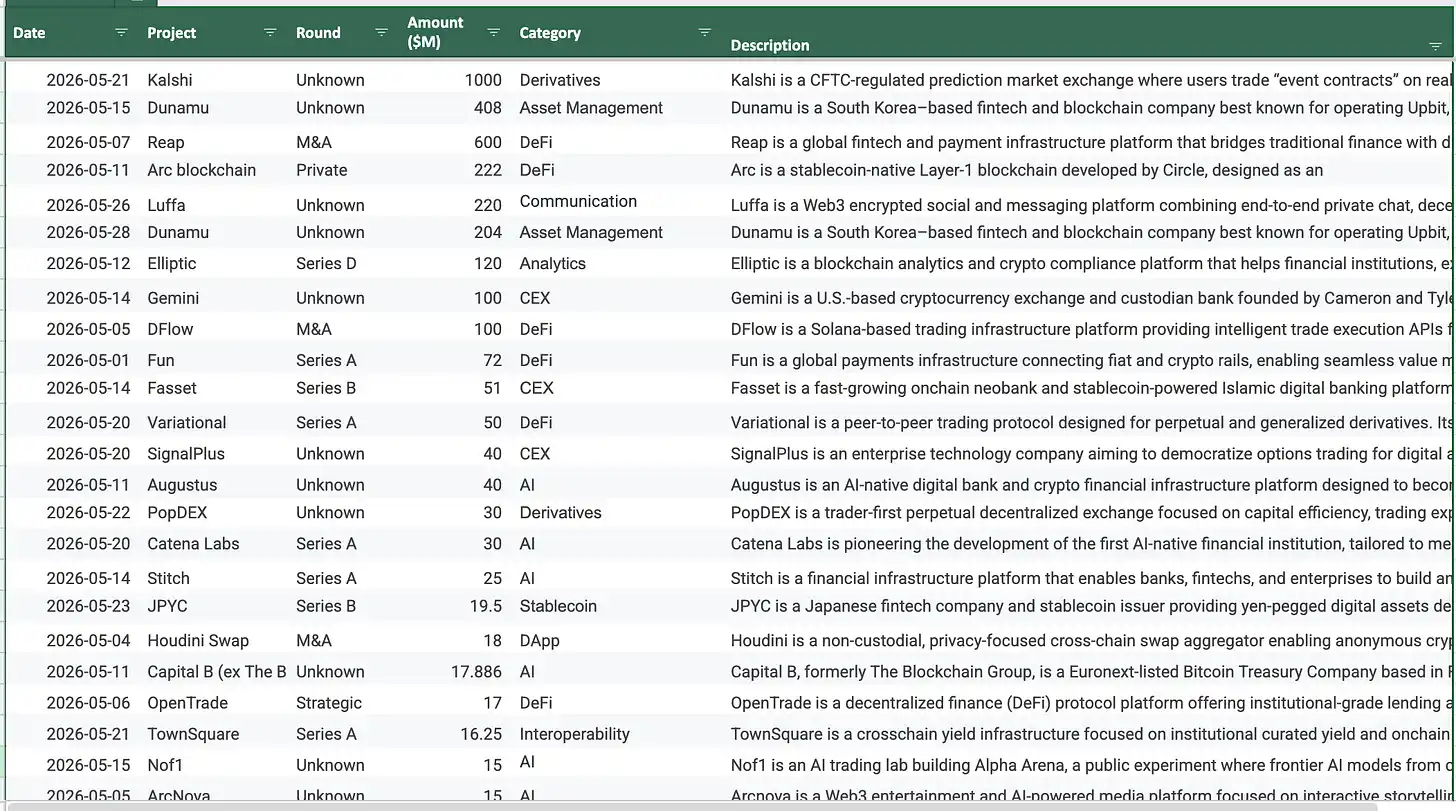
May Crypto VC Fund Raise Announcements

A quieter month for new fund announcements after a busy April, but two big moves...

Haun Ventures | Fund II $1B | May 2026

Katie Haun's firm raised $1B across an early-stage fund and a later-stage companion fund, pushing AUM above $2B. Top three priority themes: next-gen financial infrastructure, asset tokenization and new markets, and the "agent economy" where AI systems transact on behalf of humans. Capital will be deployed over the next 2-3 years.

a16z crypto | Crypto Fund V $2.2B | May 2026

The fund we flagged in March as targeting ~$2B closed officially at $2.2B. All stages, 10-year investment horizon, focused on real-world utility: stablecoins, payments, financial services, perps, lending, prediction markets, asset tokenization. a16z's framing is that crypto fundamentals are "at all-time highs."

Reminder, if you're interested in learning more about Bankless Ventures Fund II, please fill out this form and we'll be in touch!

ETHGlobal New York 2026 | June 12-14, 2026

NYC, in-person. Preceded by ETHConf NYC (June 8-10) and Pragma NYC.

Base Onchain Summer Hackathon | ~June 2026 (Date TBD)

Virtual. Base's flagship on-chain hackathon; last one attracted 7,500+ builders, sponsors included Stripe, Shopify, Farcaster, and Zora. (2026 dates not confirmed yet, please verify on Devfolio.)

ETHGlobal Lisbon 2026 | July 24-26, 2026

Lisbon, Portugal, in-person. Pragma Lisbon July 25.

Solana Frontier Hackathon | Apr 6 - May 11, 2026

Virtual. Crypto's largest startup competition, ~2,857 submissions over five weeks. Prizes: $30K grand champion, $10K each for 20 standout teams, plus $2.5M in venture funding and accelerator admission from Colosseum. Winners not announced by month-end; judging in progress, watch blog.colosseum.com early to mid-June.

ETHPrague 2026 | May 8-10, 2026

Prague, Czech Republic (City Hall). Fifth edition; conference plus hackathon, focused on Ethereum's "solarpunk" future.

Solana Mobile Hackathon | April 2026

Virtual. Concluded, 400+ app submissions from builders in 66 countries.

Solana Frontier Demo Day | June 2026 (Date TBD)

Virtual. Final demos for Frontier hackathon teams, expected after winners announcement.

ETHGlobal New York Showcase Day | June 14, 2026

NYC. Project judging and showcases on final day of hackathon.

ETHPrague 2026 Closing Showcase | May 10, 2026

Prague. Demos and judging on final day of ETHPrague hackathon.

Accelerator Applications Open

Solana Incubator (Cohort 5) | Apps Open / Early Deadline ~June 5

NYC. 3-month program starting Sept 2026; rolling review, preference for early applicants. Looking for 4-6 teams (existing Solana teams, web3 teams considering Solana, or web2 teams adding web3).

Alliance DAO (ALL18) | Apps Open / Rolling Review

Virtual + in-person retreats. ALL18 starts Sept 7, 2026; interview decisions ~2 weeks post-application. ~5% acceptance rate; median graduate raise $3.5M at $25M valuation.

a16z Crypto Startup Accelerator (CSX) | Apps Open (Please verify next cohort)

In-person, 9-week program, hosted twice annually in different cities. $500K for 7% equity; ~3% acceptance rate.

Outlier Ventures Base Camp | Rolling Applications

Virtual + in-person. 12-week accelerator, accepting early applications for 2026 DeAI, DeFi, RWA, and DePIN tracks.

Techstars Web3 | Apps Open

Virtual + in-person. Reportedly open for 2026 applications.

That's a wrap for May!

Thanks everyone, and good luck!

Ben Lakoff, CFA

https://twitter.com/benlakoff

Пов'язані питання

QWhat does the author mean by 'Ethereum's Ballmer moment'?

AThe author uses the term 'Ethereum's Ballmer moment' to draw a parallel between Microsoft's period under CEO Steve Ballmer (2000-2014) and Ethereum's current state. During Ballmer's tenure, Microsoft stock was seen as stagnant and the company was criticized for missing key trends (like mobile and search), while its core enterprise business (like Office and Windows) continued to grow steadily underneath the surface negative narrative. Similarly, despite current bearish narratives about Ethereum (e.g., slow product pace, competition, lack of young developer interest), the author argues its core fundamentals—like institutional adoption, staking, and regulatory clarity—are strengthening beneath the noise, setting the stage for potential future growth.

QWhat are the main bearish arguments against Ethereum mentioned in the article?

AThe main bearish arguments cited in the article are: 1) Ethereum's roadmap prioritizes abundant, low-cost block space over high fee capture, which limits its value accrual as a fee-driven asset. 2) Cultural 'ossification' and a lack of 'killer instinct,' with younger developers and entrepreneurial energy flowing to chains like Solana, Monad, and Hyperliquid instead. 3) The Ethereum Foundation is seen as overly cautious and risk-averse, focused on protecting network integrity rather than aggressively competing. 4) Ethereum's lead in areas like tokenized assets and stablecoins is narrowing as alternatives gain adoption.

QAccording to the author, why is Ethereum's circulating supply shrinking despite the bearish narrative?

AThe author argues that Ethereum's circulating supply is shrinking due to several factors: 1) Approximately 30% of ETH is staked and locked. 2) Treasury corporations (like BitMine) hold over 6% and are accumulating more. 3) Spot ETFs are continuously absorbing supply. 4) The SEC/CFTC ruling in March classified staking rewards as non-securities, paving the way for staking ETFs, which would lock up even more ETH (as staked ETH via ETFs cannot be sold on price impulses). With a net annual issuance of only ~0.23%, the buying pressure from these sources is causing the circulating supply to contract faster than new ETH is issued.

QHow has the regulatory landscape for crypto changed in the last 12 months, according to the article?

AThe article states that over the past 12 months, crypto regulation has shifted from being an 'existential threat' to a 'statutory framework.' Key developments include: the GENIUS Act becoming law, creating a federal regime for payment stablecoins; the CLARITY Act passing the House and advancing in the Senate; stablecoin circulation surpassing $2.8 trillion and growing; tokenized Treasury products scaling; and spot ETFs being approved for more assets. This transition signifies crypto is becoming a regulated, trillion-dollar slice of the financial system, inviting institutional capital that was previously hesitant.

QWhat is the author's recommended investment strategy regarding major crypto assets?

AThe author recommends a 'barbell strategy' of not being a maximalist for any single asset. Specifically: 1) Hold ETH for the 'timeless/institutional/circulating supply crunch' trade. 2) Hold SOL for the 'consumer/throughput/distribution' trade. 3) Hold BTC as a macro hedge. 4) Hold a small basket of next-generation L1s and application-layer winners where the cultural and entrepreneurial energy is actually flowing. This diversified approach allows investors to capture growth across different thematic trends within the expanding crypto ecosystem.

Пов'язані матеріали

What Are Some Good Paths for Chinese Web3 Entrepreneurship? (Part 5)

This article explores pathways for Chinese Web3 teams to pivot toward AI, building on a previous discussion. It focuses on two specific team profiles: **Security & Risk Control Teams:** These teams, skilled in smart contract auditing, wallet security, and on-chain monitoring, can transition to providing **Agent behavior auditing and AI security governance**. As AI Agents automate tasks, access data, and trigger payments, enterprises will need solutions to monitor permissions, audit logs, control data access, and prevent anomalies—creating a strong B2B demand. **Application & Community-Focused Teams:** Instead of completely rebranding as AI companies, these teams should use AI to **enhance their existing products**. For example, research platforms can use AI to summarize information and identify signals; community tools can automate user support and analysis; and educational products can create personalized learning paths. The key is integrating AI to solve existing user pain points, like information overload or high operational costs. The article also advises against certain AI directions for Chinese Web3 teams, such as building general-purpose large language models (too resource-intensive), creating overly broad Agent platforms (hard to monetize), developing AI traders/automated yield products (high regulatory and risk sensitivity), or simply adding superficial AI features without genuine value. The core conclusion: Successful migration depends not on chasing AI hype, but on **identifying how a team's existing Web3 capabilities—be it in data, payments, security, or user operations—can address real needs in new AI application scenarios.**

marsbit13 хв тому

What Are Some Good Paths for Chinese Web3 Entrepreneurship? (Part 5)

marsbit13 хв тому

Торгівля

Спот
Ф'ючерси

Популярні статті

Що таке $S$

Розуміння SPERO: Комплексний огляд Вступ до SPERO Оскільки ландшафт інновацій продовжує еволюціонувати, виникнення технологій web3 та криптовалютних проектів відіграє ключову роль у формуванні цифрового майбутнього. Один з проектів, який привернув увагу в цій динамічній сфері, — це SPERO, позначений як SPERO,$$s$. Ця стаття має на меті зібрати та представити детальну інформацію про SPERO, щоб допомогти ентузіастам та інвесторам зрозуміти його основи, цілі та інновації в рамках web3 та крипто-сектору. Що таке SPERO,$$s$? SPERO,$$s$ — це унікальний проект у криптопросторі, який прагне використати принципи децентралізації та технології блокчейн для створення екосистеми, що сприяє залученню, корисності та фінансовій інклюзії. Проект розроблений для полегшення взаємодії між користувачами новими способами, надаючи їм інноваційні фінансові рішення та послуги. У своїй основі SPERO,$$s$ прагне надати можливості індивідам, забезпечуючи інструменти та платформи, які покращують користувацький досвід у криптовалютному просторі. Це включає в себе можливість більш гнучких методів транзакцій, сприяння ініціативам, що підтримуються спільнотою, та створення шляхів для фінансових можливостей через децентралізовані додатки (dApps). Основна концепція SPERO,$$s$ обертається навколо інклюзивності, прагнучи зменшити розриви в традиційній фінансовій системі, використовуючи переваги технології блокчейн. Хто є творцем SPERO,$$s$? Особистість творця SPERO,$$s$ залишається дещо невідомою, оскільки є обмежені публічно доступні ресурси, що надають детальну інформацію про його засновників. Ця відсутність прозорості може бути наслідком зобов'язання проекту до децентралізації — етики, яку багато проектів web3 поділяють, ставлячи колективні внески вище за індивідуальне визнання. Зосереджуючи обговорення навколо спільноти та її колективних цілей, SPERO,$$s$ втілює суть наділення без виділення конкретних осіб. Таким чином, розуміння етики та місії SPERO є більш важливим, ніж ідентифікація єдиного творця. Хто є інвесторами SPERO,$$s$? SPERO,$$s$ підтримується різноманітними інвесторами, починаючи від венчурних капіталістів до ангельських інвесторів, які прагнуть сприяти інноваціям у крипто-секторі. Зосередження цих інвесторів зазвичай узгоджується з місією SPERO — пріоритет надається проектам, які обіцяють технологічний прогрес у суспільстві, фінансову інклюзію та децентралізоване управління. Ці інвесторські фонди зазвичай зацікавлені в проектах, які не лише пропонують інноваційні продукти, але й позитивно впливають на спільноту блокчейн та її екосистеми. Підтримка з боку цих інвесторів підкріплює SPERO,$$s$ як значного конкурента в швидко змінюваній сфері крипто-проектів. Як працює SPERO,$$s$? SPERO,$$s$ використовує багатогранну структуру, яка відрізняє його від традиційних криптовалютних проектів. Ось деякі ключові особливості, які підкреслюють його унікальність та інноваційність: Децентралізоване управління: SPERO,$$s$ інтегрує моделі децентралізованого управління, надаючи користувачам можливість активно брати участь у процесах прийняття рішень щодо майбутнього проекту. Цей підхід сприяє відчуттю власності та відповідальності серед членів спільноти. Корисність токена: SPERO,$$s$ використовує свій власний криптовалютний токен, розроблений для виконання різних функцій в екосистемі. Ці токени дозволяють здійснювати транзакції, отримувати винагороди та полегшувати послуги, що пропонуються на платформі, підвищуючи загальну залученість та корисність. Шарова архітектура: Технічна архітектура SPERO,$$s$ підтримує модульність та масштабованість, що дозволяє безперешкодно інтегрувати додаткові функції та додатки в міру розвитку проекту. Ця адаптивність є надзвичайно важливою для збереження актуальності в постійно змінюваному крипто-ландшафті. Залучення спільноти: Проект підкреслює ініціативи, що підтримуються спільнотою, використовуючи механізми, які стимулюють співпрацю та зворотний зв'язок. Підтримуючи сильну спільноту, SPERO,$$s$ може краще задовольняти потреби користувачів та адаптуватися до ринкових тенденцій. Фокус на інклюзію: Пропонуючи низькі комісії за транзакції та зручні інтерфейси, SPERO,$$s$ прагне залучити різноманітну базу користувачів, включаючи осіб, які раніше не брали участі в крипто-просторі. Це зобов'язання до інклюзії узгоджується з його загальною місією наділення через доступність. Хронологія SPERO,$$s$ Розуміння історії проекту надає важливі уявлення про його розвиток та етапи. Нижче наведено пропоновану хронологію, що відображає значні події в еволюції SPERO,$$s$: Етап концептуалізації та ідеації: Початкові ідеї, що стали основою SPERO,$$s$, були сформовані, тісно пов'язані з принципами децентралізації та фокусом на спільноті в індустрії блокчейн. Запуск білого паперу проекту: Після концептуального етапу був випущений комплексний білий папір, що детально описує бачення, цілі та технологічну інфраструктуру SPERO,$$s$, щоб залучити інтерес та зворотний зв'язок від спільноти. Створення спільноти та ранні залучення: Активні зусилля були спрямовані на створення спільноти ранніх прихильників та потенційних інвесторів, що полегшило обговорення цілей проекту та отримання підтримки. Подія генерації токенів: SPERO,$$s$ провів подію генерації токенів (TGE) для розподілу своїх рідних токенів серед ранніх прихильників та встановлення початкової ліквідності в екосистемі. Запуск початкового dApp: Перший децентралізований додаток (dApp), пов'язаний з SPERO,$$s$, став доступним, дозволяючи користувачам взаємодіяти з основними функціями платформи. Постійний розвиток та партнерства: Безперервні оновлення та вдосконалення пропозицій проекту, включаючи стратегічні партнерства з іншими учасниками блокчейн-простору, сформували SPERO,$$s$ у конкурентоспроможного та еволюціонуючого гравця на крипто-ринку. Висновок SPERO,$$s$ є свідченням потенціалу web3 та криптовалют для революціонізації фінансових систем та наділення індивідів. Завдяки зобов'язанню до децентралізованого управління, залучення спільноти та інноваційно спроектованих функцій, він прокладає шлях до більш інклюзивного фінансового ландшафту. Як і з будь-якими інвестиціями в швидко змінюваному крипто-просторі, потенційним інвесторам та користувачам рекомендується ретельно досліджувати та обдумано взаємодіяти з поточними подіями в SPERO,$$s$. Проект демонструє інноваційний дух крипто-індустрії, запрошуючи до подальшого дослідження його численних можливостей. Хоча подорож SPERO,$$s$ ще триває, його основні принципи можуть справді вплинути на майбутнє того, як ми взаємодіємо з технологією, фінансами та один з одним у взаємопов'язаних цифрових екосистемах.

73 переглядів усьогоОпубліковано 2024.12.17Оновлено 2024.12.17

Що таке $S$

Що таке AGENT S

Агент S: Майбутнє автономної взаємодії в Web3 Вступ У постійно змінюваному ландшафті Web3 та криптовалюти інновації постійно переосмислюють, як люди взаємодіють з цифровими платформами. Один з таких новаторських проектів, Агент S, обіцяє революціонізувати взаємодію людини з комп'ютером через свою відкриту агентну структуру. Прокладаючи шлях для автономних взаємодій, Агент S прагне спростити складні завдання, пропонуючи трансформаційні застосування в штучному інтелекті (ШІ). Це детальне дослідження заглиблюється в складності проекту, його унікальні особливості та наслідки для сфери криптовалюти. Що таке Агент S? Агент S є революційною відкритою агентною структурою, спеціально розробленою для вирішення трьох основних викликів в автоматизації комп'ютерних завдань: Набуття специфічних знань у галузі: Структура інтелектуально навчається з різних зовнішніх джерел знань та внутрішнього досвіду. Цей подвійний підхід дозволяє їй створити багатий репозиторій специфічних знань у галузі, покращуючи її продуктивність у виконанні завдань. Планування на довгих горизонтах завдань: Агент S використовує планування з підкріпленням досвіду, стратегічний підхід, який полегшує ефективний розподіл та виконання складних завдань. Ця функція значно підвищує її здатність ефективно та результативно управляти кількома підзавданнями. Обробка динамічних, неоднорідних інтерфейсів: Проект представляє Інтерфейс Агент-Комп'ютер (ACI), інноваційне рішення, яке покращує взаємодію між агентами та користувачами. Використовуючи багатомодальні великі мовні моделі (MLLMs), Агент S може безперешкодно орієнтуватися та маніпулювати різноманітними графічними інтерфейсами користувача. Завдяки цим новаторським функціям Агент S надає надійну структуру, яка вирішує складнощі, пов'язані з автоматизацією людської взаємодії з машинами, прокладаючи шлях для численних застосувань у ШІ та за його межами. Хто є творцем Агент S? Хоча концепція Агент S є фундаментально новаторською, конкретна інформація про його творця залишається невідомою. Творець наразі невідомий, що підкреслює або початкову стадію проекту, або стратегічний вибір зберегти засновників у таємниці. Незважаючи на анонімність, акцент залишається на можливостях та потенціалі структури. Хто є інвесторами Агент S? Оскільки Агент S є відносно новим у криптографічній екосистемі, детальна інформація про його інвесторів та фінансових спонсорів не задокументована. Відсутність публічно доступних відомостей про інвестиційні фонди або організації, що підтримують проект, викликає питання щодо його фінансової структури та дорожньої карти розвитку. Розуміння підтримки є критично важливим для оцінки стійкості проекту та потенційного впливу на ринок. Як працює Агент S? В основі Агент S лежить передова технологія, яка дозволяє йому ефективно функціонувати в різних умовах. Його операційна модель побудована навколо кількох ключових функцій: Взаємодія з комп'ютером, подібна до людської: Структура пропонує розширене планування ШІ, прагнучи зробити взаємодії з комп'ютерами більш інтуїтивними. Імітуючи людську поведінку при виконанні завдань, вона обіцяє підвищити досвід користувачів. Наративна пам'ять: Використовується для використання високорівневого досвіду, Агент S використовує наративну пам'ять для відстеження історій завдань, тим самим покращуючи свої процеси прийняття рішень. Епізодична пам'ять: Ця функція надає користувачам покрокові інструкції, дозволяючи структурі пропонувати контекстуальну підтримку в міру виконання завдань. Підтримка OpenACI: Завдяки можливості працювати локально, Агент S дозволяє користувачам зберігати контроль над своїми взаємодіями та робочими процесами, узгоджуючи з децентралізованою етикою Web3. Легка інтеграція з зовнішніми API: Його універсальність і сумісність з різними платформами ШІ забезпечують те, що Агент S може безперешкодно вписатися в існуючі технологічні екосистеми, роблячи його привабливим вибором для розробників та організацій. Ці функціональні можливості колективно сприяють унікальному положенню Агент S у крипто-просторі, оскільки він автоматизує складні, багатоступеневі завдання з мінімальним втручанням людини. У міру розвитку проекту його потенційні застосування в Web3 можуть переосмислити, як відбуваються цифрові взаємодії. Хронологія Агент S Розробка та етапи Агент S можуть бути узагальнені в хронології, яка підкреслює його значні події: 27 вересня 2024 року: Концепція Агент S була представлена в комплексній науковій статті під назвою “Відкрита агентна структура, яка використовує комп'ютери як людина”, що демонструє основи проекту. 10 жовтня 2024 року: Наукова стаття була опублікована на arXiv, пропонуючи детальне дослідження структури та її оцінки продуктивності на основі бенчмарку OSWorld. 12 жовтня 2024 року: Було випущено відеопрезентацію, що надає візуальне уявлення про можливості та особливості Агент S, ще більше залучаючи потенційних користувачів та інвесторів. Ці маркери в хронології не лише ілюструють прогрес Агент S, але й вказують на його прихильність до прозорості та залучення громади. Ключові моменти про Агент S У міру розвитку структури Агент S кілька ключових характеристик виділяються, підкреслюючи її новаторський характер та потенціал: Інноваційна структура: Розроблена для забезпечення інтуїтивного використання комп'ютерів, подібного до людської взаємодії, Агент S пропонує новий підхід до автоматизації завдань. Автономна взаємодія: Здатність автономно взаємодіяти з комп'ютерами через GUI означає стрибок до більш інтелектуальних та ефективних обчислювальних рішень. Автоматизація складних завдань: Завдяки своїй надійній методології він може автоматизувати складні, багатоступеневі завдання, роблячи процеси швидшими та менш схильними до помилок. Безперервне вдосконалення: Механізми навчання дозволяють Агенту S покращуватися на основі минулого досвіду, постійно підвищуючи свою продуктивність та ефективність. Універсальність: Його адаптивність до різних операційних середовищ, таких як OSWorld та WindowsAgentArena, забезпечує його здатність служити широкому спектру застосувань. Оскільки Агент S займає своє місце в ландшафті Web3 та криптовалюти, його потенціал покращити можливості взаємодії та автоматизувати процеси означає значний прогрес у технологіях ШІ. Завдяки своїй інноваційній структурі Агент S є прикладом майбутнього цифрових взаємодій, обіцяючи більш безперешкодний та ефективний досвід для користувачів у різних галузях. Висновок Агент S представляє собою сміливий крок вперед у поєднанні ШІ та Web3, з можливістю переосмислити, як ми взаємодіємо з технологією. Хоча проект все ще на ранніх стадіях, можливості для його застосування є величезними та переконливими. Завдяки своїй комплексній структурі, що вирішує критичні виклики, Агент S прагне вивести автономні взаємодії на передній план цифрового досвіду. У міру того, як ми заглиблюємося в сфери криптовалюти та децентралізації, проекти, подібні до Агент S, безсумнівно, відіграватимуть ключову роль у формуванні майбутнього технологій та співпраці людини з комп'ютером.

673 переглядів усьогоОпубліковано 2025.01.14Оновлено 2025.01.14

Що таке AGENT S

Як купити S

Ласкаво просимо до HTX.com! Ми зробили покупку Sonic (S) простою та зручною. Дотримуйтесь нашої покрокової інструкції, щоб розпочати свою криптовалютну подорож.Крок 1: Створіть обліковий запис на HTXВикористовуйте свою електронну пошту або номер телефону, щоб зареєструвати обліковий запис на HTX безплатно. Пройдіть безпроблемну реєстрацію й отримайте доступ до всіх функцій.ЗареєструватисьКрок 2: Перейдіть до розділу Купити крипту і виберіть спосіб оплатиКредитна/дебетова картка: використовуйте вашу картку Visa або Mastercard, щоб миттєво купити Sonic (S).Баланс: використовуйте кошти з балансу вашого рахунку HTX для безперешкодної торгівлі.Треті особи: ми додали популярні способи оплати, такі як Google Pay та Apple Pay, щоб підвищити зручність.P2P: Торгуйте безпосередньо з іншими користувачами на HTX.Позабіржова торгівля (OTC): ми пропонуємо індивідуальні послуги та конкурентні обмінні курси для трейдерів.Крок 3: Зберігайте свої Sonic (S)Після придбання Sonic (S) збережіть його у своєму обліковому записі на HTX. Крім того, ви можете відправити його в інше місце за допомогою блокчейн-переказу або використовувати його для торгівлі іншими криптовалютами.Крок 4: Торгівля Sonic (S)Легко торгуйте Sonic (S) на спотовому ринку HTX. Просто увійдіть до свого облікового запису, виберіть торгову пару, укладайте угоди та спостерігайте за ними в режимі реального часу. Ми пропонуємо зручний досвід як для початківців, так і для досвідчених трейдерів.

1.5k переглядів усьогоОпубліковано 2025.01.15Оновлено 2026.06.02

Як купити S

Обговорення

Ласкаво просимо до спільноти HTX. Тут ви можете бути в курсі останніх подій розвитку платформи та отримати доступ до професійної ринкової інформації. Нижче представлені думки користувачів щодо ціни S (S).

活动图片