ETH Price Holds Near $3,000 as ETF Outflows Offset Market Gains

TheNewsCryptoОпубліковано о 2026-01-28Востаннє оновлено о 2026-01-28

Анотація

Ethereum (ETH) is trading near $3,004, showing modest gains while remaining range-bound between key support and resistance levels. Despite a 24-hour trading volume of $26.56 billion, ETH faces subdued medium-term momentum, trading below key moving averages. Institutional flows show a net outflow of $63.53 million from Ethereum ETFs, with BlackRock’s fund contributing significantly. While some products saw minor inflows, they weren’t enough to offset outflows, though cumulative net inflows since launch stand at $12.36 billion. Technical indicators like RSI and MACD suggest balanced buying and selling pressure, with near-term movement likely confined between $2,900 support and $3,150–$3,200 resistance.

Ethereum (ETH) is trading near $3,004, showing a modest gain over the past day as price action remains around the $3,000 level. Over the last 24 hours, ETH moved between an intraday low of $2,916.22 and a high of $3,040.72, while its market capitalization stands at $362.66 billion and trading volume is around $26.56 billion. This reflects ongoing interest in the asset even as broader market dynamics evolve.

Meanwhile, institutional flows into Ethereum’s exchange-traded products remain a key focus. According to the latest data SoSoValue, the total net flow for January 27 showed a net outflow of about $63.53 million, with BlackRock’s ETHA fund accounting for the largest portion of that outflow.
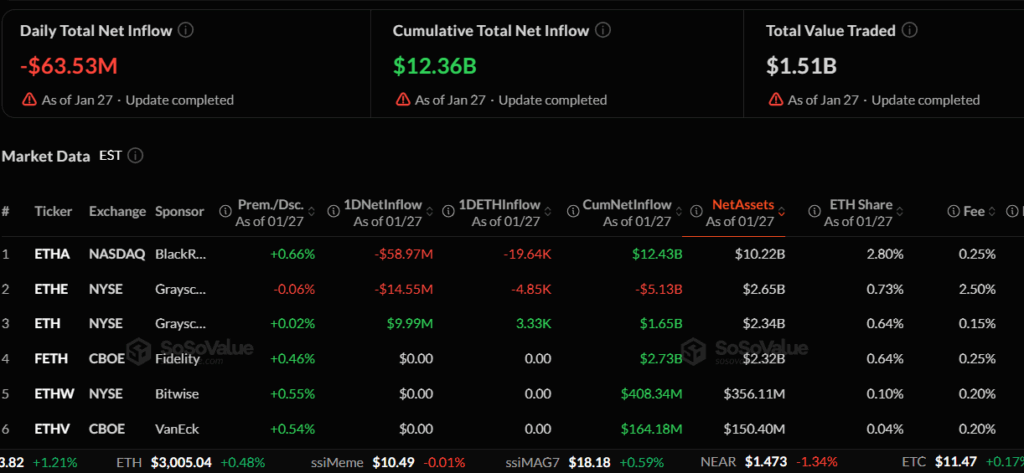
At the same time, some other products, such as the Grayscale Ethereum Mini Trust ETF, recorded smaller net inflows, but they were not large enough to offset the overall outflow figure. The cumulative total net inflow into Ethereum spot ETFs now stands near $12.36 billion since these products launched.

Ethereum Trades Near $3,000 as Price Action Remains Range-Bound

On the weekly chart, Ethereum is still trading below its 9-week moving average (near $3,050) and below the 21-week moving average (around $3,515). This suggests that medium-term trend momentum remains subdued. Weekly price action has seen lower highs after peaks near $3,800, indicating that sellers have been active at higher levels and the broader structure has not yet turned decisively upward. The lack of a fresh bullish crossover keeps upside momentum restrained for now.

The RSI (14) on the weekly timeframe sits around 44–45, below neutral levels. This highlights a lack of strong momentum in either direction, with buying and selling pressures broadly balanced. Meanwhile, the MACD indicator remains below its signal line with the histogram in negative territory, pointing to continued range-bound conditions rather than a firm trend reversal.

Zooming in, The Bull Bear Power Trend (BBPT) shows reduced bearish pressure, but bullish strength is still limited. This aligns with the current sideways movement.

Looking at short-term price action, daily charts show ETH consolidating above $2,900, with buyers defending dips and sellers stepping in near resistance levels. From a longer-term perspective, Ethereum remains above several key support bands but below major resistance zones formed earlier in the year, reflecting a period of correction and consolidation following earlier gains.

In the near term, support is seen near $2,900, while resistance is located around $3,150–$3,200. Until price clears these levels with conviction, ETH’s movement is likely to remain range-bound, shaped by both technical levels and broader market flows.


TagsAltcoinCrypto MarketETHETHEREUM

Пов'язані питання

QWhat is the current trading price of Ethereum (ETH) and what is its market capitalization?

AEthereum (ETH) is trading near $3,004, and its market capitalization stands at $362.66 billion.

QWhat was the total net flow for Ethereum exchange-traded products on January 27, and which fund had the largest outflow?

AThe total net flow for January 27 showed a net outflow of about $63.53 million, with BlackRock's ETHA fund accounting for the largest portion of that outflow.

QWhat do the weekly RSI and MACD indicators suggest about Ethereum's current market momentum?

AThe weekly RSI (14) sits around 44–45, below neutral levels, indicating a lack of strong momentum in either direction. The MACD remains below its signal line with the histogram in negative territory, pointing to continued range-bound conditions rather than a firm trend reversal.

QWhat are the key near-term support and resistance levels for Ethereum's price?

AIn the near term, support is seen at $2,900, while resistance is located around $3,150–$3,200.

QWhat is the cumulative total net inflow into Ethereum spot ETFs since their launch?

AThe cumulative total net inflow into Ethereum spot ETFs now stands near $12.36 billion since these products launched.

Пов'язані матеріали

In Jinjiang, Fujian, a Storage Super Unicorn Lies Quiet

In Fujian's Jinjiang, a city known for sportswear, lies a quiet semiconductor giant: Fujian Jinhua Integrated Circuit Co. (JHICC). Once a promising domestic DRAM manufacturer alongside Yangtze Memory and ChangXin Memory Technologies (CXMT), its journey was derailed in 2018 when the U.S. placed it on an Entity List and filed criminal charges for alleged trade secret theft. This halted production for years. A turning point came in February 2024 when a U.S. federal court found JHICC not guilty. However, it had lost crucial time. While CXMT soared to become a top-valued A-share company in 2024, JHICC, with an estimated valuation of 80 billion RMB, was just restarting. Its current output is primarily customized DDR4 chips, not the advanced DDR5/HBM demanded for AI, but it still benefits from the broader memory chip upcycle. JHICC's story is tied to Chen Zhengkun, a veteran engineer who left Micron to lead the venture. Founded in 2016 with state-backed funding, JHICC partnered with Taiwan's UMC to develop DRAM technology. Rapid progress was cut short by the U.S. actions, which Micron initiated, partly due to its heavy reliance on the Chinese market. Post-sanctions, Chen's team worked to rebuild the production line with reduced reliance on U.S. technology. According to its records, JHICC achieved small-scale production and revenue growth under immense pressure. It now focuses on the stable "niche" DRAM market (e.g., TVs, routers) with a monthly capacity of ~40,000 wafers, aiming for 60,000 by 2026. It holds over 1,000 patents but remains on the Entity List. For Jinjiang, investing in JHICC was a bold industrial leap. The local government provided unwavering financial and logistical support during the crisis, helping the company survive. JHICC has become the anchor for a growing local semiconductor cluster. Though its scale lags behind domestic peers, JHICC's persistence symbolizes a hard-won foothold in a global market long dominated by Samsung, SK Hynix, and Micron. Having missed one boom, it seeks a place in the new AI-driven memory supercycle.

marsbit2 год тому

In Jinjiang, Fujian, a Storage Super Unicorn Lies Quiet

marsbit2 год тому

Торгівля

Спот
活动图片




