ETH Down to $1.8K – Will It Keep Crashing and Will LiquidChain Explode in 2026?

bitcoinistОпубліковано о 2026-02-06Востаннє оновлено о 2026-02-06

Анотація

Ethereum's price has declined to around $1,800, sparking concerns of a further crash. However, the article argues this is more likely a bear trap and a consolidation phase rather than a true capitulation event. Technical analysis suggests a descending wedge pattern on the weekly chart, which historically breaks upward 68% of the time. A weekly close above $1,850 could signal a trend reversal, potentially targeting $2,500 by late 2026. The bearish narrative is countered by on-chain data showing institutional accumulation via ETFs, indicating smart money is accumulating at these levels. Concurrently, the article highlights LiquidChain ($LIQUID) as a high-beta investment opportunity poised to benefit from Ethereum's potential recovery. Positioned as a "Cross-Chain Liquidity Layer," LiquidChain aims to solve liquidity fragmentation between ecosystems like Ethereum, Bitcoin, and Solana. Its ongoing presale has raised over $529K, and it is presented as a leveraged bet on the future of multi-chain interoperability. The piece concludes that while a drop to $1,500 is possible, it would likely be a brief liquidity grab, making the current ETH price a potential generational entry point.

Trusted Editorial content, reviewed by leading industry experts and seasoned editors. Ad Disclosure

Quick Facts:

  • ➡️ Ethereum’s crash to a sub-$1,800 zone is a low-probability bear scenario; support at $1,800 is historically robust.
  • ➡️ A weekly close above $1,850 would confirm a trend reversal, targeting $2,500 by late 2026.
  • ➡️ LiquidChain solves critical liquidity fragmentation issues, offering a high-beta opportunity for investors betting on a cross-chain future.
  • ➡️ Institutional accumulation via ETFs suggests the current price action is a consolidation phase, not a distribution event.

Ethereum is currently stuck in one of its trickiest market structures since the 2022 lows.

While Bitcoin flirts with all-time highs and Solana captures the ‘retail casino’ narrative, ETH has languished in a choppy range between $1,800 and $1,900.

This stagnation has emboldened bears to call for a capitulation event down to $1,200, a level unseen since the FTX collapse. But focusing solely on price action while ignoring on-chain accumulation? That’s a classic retail trap.

The bearish thesis relies on a ‘death by a thousand cuts’ scenario: Layer 2s cannibalizing mainnet revenue, underwhelming ETF inflows, and regulatory hostility.

Yet, this pessimism ignores the massive institutional bid slowly building below $1,800. The charts aren’t signaling a crash; they’re showing high-time-frame consolidation before a violent expansion.

Smart money (who rarely buy tops) views the $1,850–$1,900 zone as a generational entry, with models pointing toward a $2,500 reclamation by mid-2026.

Why does this matter? Because volatility in the base layer often triggers explosive repricing in associated infrastructure plays. While conservative capital waits for Ethereum to confirm a trend reversal, risk-tolerant traders are already front-running the recovery.

They’re positioning in high-beta infrastructure protocols. This rotation is driving serious interest toward LiquidChain ($LIQUID), a Layer 3 solution designed to fix the liquidity fragmentation currently plaguing the ecosystem.

Check out the LiquidChain presale.

Technical Outlook: Why the Crash Narrative May Be a Bear Trap

Calls for Ethereum to revisit $1,800 are possible, sure, but structurally unlikely without a macro-black swan event.

Technically, ETH is compressing within a descending wedge pattern on the weekly timeframe. Historically? That structure breaks to the upside 68% of the time. The critical level to watch is the 50-week moving average, hovering near $1,900. A weekly close above that invalidates the bearish thesis entirely.

Fundamentally, the ‘$ETH is dying’ narrative misses the forest for the trees. While L2s have reduced mainnet burn, the upcoming Pectra upgrade (expected early 2025) should optimize the execution layer significantly.

Plus, ETH ETF flows are finally stabilizing after a tepid start.

Institutional allocators don’t buy tops; they buy peak fear. The current RSI divergence on the 3-day chart suggests seller exhaustion is near.

If the market pushes ETH down toward $1,500, expect a ‘V-shaped’ recovery as limit orders from major funds absorb the liquidity.

The Outlook:

  • Bull Case: ETH reclaims $2,000 on high volume, triggering a short squeeze to $2,500 by Q3 2026.
  • Base Case: Continued consolidation between $1,900 and $2,250 through year-end, flushing out leverage before the next leg up.
  • Bear Case (Invalidation): A weekly close below $1,700 opens the door to the dreaded $1,500 wick. However, this would likely be a ‘max pain’ liquidity grab rather than a sustained trend.

(The data points to a market that’s overly hedged to the downside, creating a powder keg for a bullish reversal.)

$LIQUID is available here.

LiquidChain Targets High Beta Upside as Smart Money Rotates

As Ethereum prepares for its next expansion phase, the biggest gains in the 2026 cycle will likely come from infrastructure layers solving ETH’s interoperability bottleneck. That’s where LiquidChain ($LIQUID) comes in. While Ethereum settles value, it remains fragmented from other liquidity hubs like Bitcoin and Solana.

LiquidChain acts as the “Cross-Chain Liquidity Layer,” a Layer 3 infrastructure fusing these ecosystems into a single execution environment.

Investors hunting for asymmetric upside are tracking LiquidChain because it tackles the “user friction” problem hampering mass adoption.

Instead of complex bridging and wrapped assets, LiquidChain offers a unified liquidity layer where developers deploy once to access users across chains. The project is moving fast, with the official presale already raising $529K.
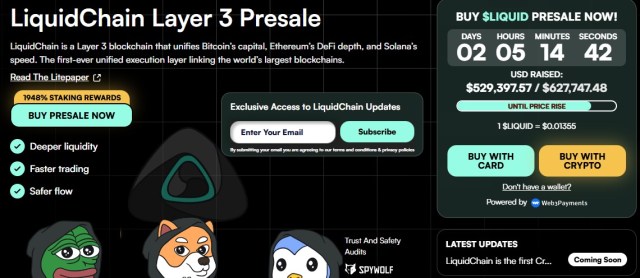
Don’t miss out on the ongoing presale, join the LiquidChain token sale here.

Currently priced at $0.01355, the LiquidChain token represents a high-risk, high-reward bet on the future of chain abstraction. If the ‘multichain’ thesis holds true for 2026, protocols effectively merging BTC and ETH liquidity will command a premium. Of course, early-stage infrastructure is inherently volatile.

Risks include technical execution delays and intense competition in the L3 sector. But for those betting on an ETH resurgence, LiquidChain offers a leveraged play on the ecosystem’s growth, without the diminishing returns of a mature large-cap asset.

Disclaimer: This article is for informational purposes only and does not constitute financial advice. Cryptocurrencies, especially presales and new L3 protocols, are highly volatile and carry significant risk. Always conduct your own independent research before investing.

Editorial Process for bitcoinist is centered on delivering thoroughly researched, accurate, and unbiased content. We uphold strict sourcing standards, and each page undergoes diligent review by our team of top technology experts and seasoned editors. This process ensures the integrity, relevance, and value of our content for our readers.

patrubogdan

Follow

Full Profile

Related Posts

Bitcoin’s Crash Triggered IBIT’s Biggest Trading Day, as $HYPER Keeps Pumping

Winklevoss‑Backed Gemini Cuts Up To 25% Of Staff, Exits UK, EU, And Australia

New Virginia Bill Allows the State to Invest in Bitcoin, Signaling Institutional Shift for Bitcoin Hyper

Tether Pours $150M in Gold.com as $LIQUID’s Presale Turns Heads

XRP Retests $1.29 Support: Is $2 Still in Play or Will LiquidChain Capture the Momentum?

Bitcoin Teeters on Edge: Will $60K Hold or Is a V-Shape Recovery Imminent? $HYPER Keeps Pumping

Пов'язані питання

QWhat is the current technical outlook for Ethereum's price according to the article?

AThe article states that Ethereum is compressing within a descending wedge pattern on the weekly timeframe, which historically breaks to the upside 68% of the time. A weekly close above the 50-week moving average near $1,900 would invalidate the bearish thesis. The base case is continued consolidation, with a bull case targeting $2,500 by Q3 2026.

QWhat is LiquidChain ($LIQUID) and what problem does it aim to solve?

ALiquidChain is a Layer 3 infrastructure protocol designed to act as a 'Cross-Chain Liquidity Layer.' It aims to solve the problem of liquidity fragmentation by fusing ecosystems like Ethereum, Bitcoin, and Solana into a single execution environment, eliminating the need for complex bridging and wrapped assets.

QWhat are the key risks mentioned for investing in a project like LiquidChain?

AThe key risks mentioned are that early-stage infrastructure is inherently volatile and includes potential technical execution delays and intense competition in the Layer 3 (L3) sector.

QWhat does the article suggest is the 'institutional bid' building for Ethereum?

AThe article suggests that despite bearish sentiment, a massive institutional bid is slowly building below $1,800. It states that smart money views the $1,850–$1,900 zone as a generational entry point, with major funds expected to absorb liquidity if the price drops further, viewing the current stagnation as consolidation, not distribution.

QWhat is the significance of the Pectra upgrade for Ethereum mentioned in the article?

AThe upcoming Pectra upgrade, expected in early 2025, is cited as a fundamental factor that should significantly optimize Ethereum's execution layer, countering the narrative that reduced mainnet activity from Layer 2s is a long-term negative for ETH.

Пов'язані матеріали

In Jinjiang, Fujian, a Storage Super Unicorn Lies Quiet

In Fujian's Jinjiang, a city known for sportswear, lies a quiet semiconductor giant: Fujian Jinhua Integrated Circuit Co. (JHICC). Once a promising domestic DRAM manufacturer alongside Yangtze Memory and ChangXin Memory Technologies (CXMT), its journey was derailed in 2018 when the U.S. placed it on an Entity List and filed criminal charges for alleged trade secret theft. This halted production for years. A turning point came in February 2024 when a U.S. federal court found JHICC not guilty. However, it had lost crucial time. While CXMT soared to become a top-valued A-share company in 2024, JHICC, with an estimated valuation of 80 billion RMB, was just restarting. Its current output is primarily customized DDR4 chips, not the advanced DDR5/HBM demanded for AI, but it still benefits from the broader memory chip upcycle. JHICC's story is tied to Chen Zhengkun, a veteran engineer who left Micron to lead the venture. Founded in 2016 with state-backed funding, JHICC partnered with Taiwan's UMC to develop DRAM technology. Rapid progress was cut short by the U.S. actions, which Micron initiated, partly due to its heavy reliance on the Chinese market. Post-sanctions, Chen's team worked to rebuild the production line with reduced reliance on U.S. technology. According to its records, JHICC achieved small-scale production and revenue growth under immense pressure. It now focuses on the stable "niche" DRAM market (e.g., TVs, routers) with a monthly capacity of ~40,000 wafers, aiming for 60,000 by 2026. It holds over 1,000 patents but remains on the Entity List. For Jinjiang, investing in JHICC was a bold industrial leap. The local government provided unwavering financial and logistical support during the crisis, helping the company survive. JHICC has become the anchor for a growing local semiconductor cluster. Though its scale lags behind domestic peers, JHICC's persistence symbolizes a hard-won foothold in a global market long dominated by Samsung, SK Hynix, and Micron. Having missed one boom, it seeks a place in the new AI-driven memory supercycle.

marsbit43 хв тому

In Jinjiang, Fujian, a Storage Super Unicorn Lies Quiet

marsbit43 хв тому

Must-Watch Events Next Week|CLARITY Act Could Face Senate Vote; SpaceX, Circle to Report Earnings (8.3-8.9)

**Summary: Key Events and Developments to Watch (August 3-9)** The upcoming week is marked by significant financial disclosures, key legislative deadlines, and notable product updates. **Major Financial Events:** Several companies are scheduled to release their Q2 2026 earnings. American Bitcoin (ABTC) will report on August 3, followed by SpaceX and Hut 8 Mining Corp. on August 4, and Circle on August 5. Notably, a significant portion of SpaceX shares (up to 12% of total shares) will be unlocked on August 6 following their earnings release. **Key Legislative Deadline:** The U.S. Senate faces an August 7 deadline to secure 60 votes for the CLARITY Act, a bipartisan bill aiming to establish a federal regulatory framework for cryptocurrencies. The Senate may hold a full vote on the bill during the week. **Economic Data:** The U.S. July Non-Farm Payrolls report will be released on August 7, providing crucial labor market data. **Technology & Product Updates:** * **Shutdowns:** DeFi portfolio tracker Zapper and wallet app Ctrl Wallet will cease operations on August 3. * **Upgrades:** LayerZero will deprecate its v1 relayers on August 3. XRP Ledger's new version 3.3.0, featuring five new functions, is expected next week. * **AI:** Elon Musk announced that the advanced Grok 4.6 AI model is set for release around August 7. * **Bitcoin:** The BIP-110 forced signaling for a potential Bitcoin network change is scheduled to begin around August 8. **Other Notable Events:** Chinese robotics firm Unitree Tech has set its preliminary price inquiry for its IPO for August 5. South Korean exchange Upbit will delist AQT and AERGO tokens on August 3.

marsbit2 год тому

Must-Watch Events Next Week|CLARITY Act Could Face Senate Vote; SpaceX, Circle to Report Earnings (8.3-8.9)

marsbit2 год тому

Торгівля

Спот
活动图片





