ETH Breaks Below $1,900! Behind the 22% Plunge, Vitalik's 'Five-Year Austerity' Strategy

marsbitОпубліковано о 2026-02-24Востаннє оновлено о 2026-02-24

Анотація

Ethereum (ETH) has experienced a sharp decline, falling below $1,900 and dropping over 22% from recent highs. This downturn is driven by a combination of liquidity outflows and shifting market expectations. Key factors include significant net redemptions from U.S. spot Ethereum ETFs, large-scale selling by whale addresses (1.43 million ETH sold in two weeks), and substantial personal sales by co-founder Vitalik Buterin. In response, the Ethereum Foundation has announced a five-year "moderate austerity" strategy to ensure long-term financial sustainability and continued development of core technology. Buterin is personally funding certain public goods projects to reduce the Foundation’s financial burden. Despite price pressure, Ethereum’s network performance has improved, with TPS reaching a record high due to the Fusaka upgrade. However, centralization risks in block building remain. The upcoming Glamsterdam upgrade aims to address this with ePBS (enshrined Proposer-Builder Separation) to reduce dominance by a few large players and reshape MEV economics. Additionally, regulatory pressure is mounting with the EU’s MiCA regulation set to take effect in July 2026, increasing compliance costs and affecting DeFi and liquidity providers. Ethereum is currently in a phase of short-term volatility and structural adjustment, balancing capital outflows against long-term technical and governance improvements.

Author: Max.s

The current cryptocurrency market is undergoing a severe structural adjustment. According to the latest trading data (as shown on the chart, ETH/USDT has fallen to around $1,847.84, with a clear recent unilateral downward trend), Ethereum (ETH) is experiencing a deep correction driven by both capital flows and market expectations.
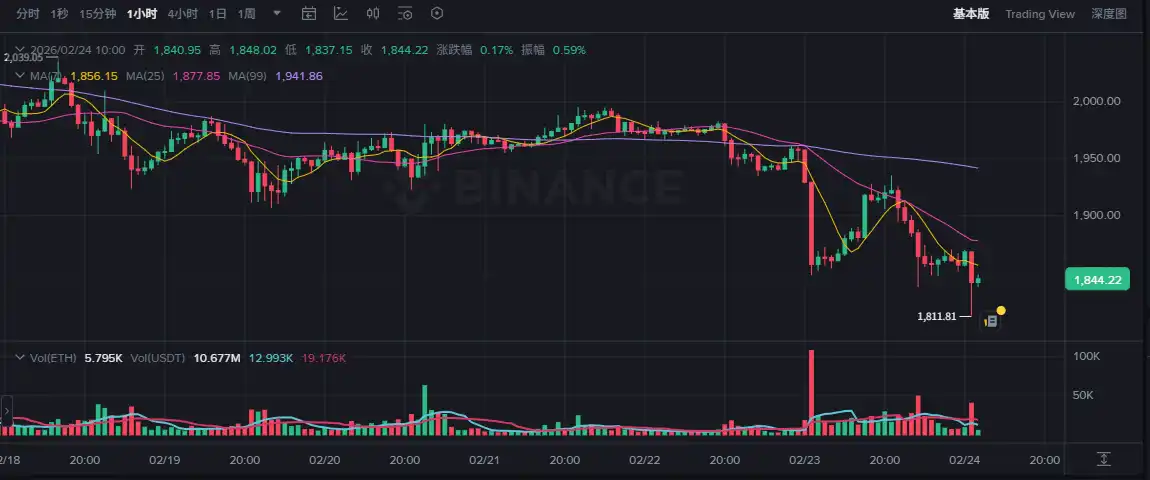
Looking back at the price movement in February 2026, ETH plummeted from above $2,360 to the $1,825 range in a short period, a drop of over 22.7%. Behind the surface of the price decline lies a comprehensive restructuring of the Ethereum network in terms of technical upgrades, organizational structure, and regulatory environment. For institutional investors and financial professionals, looking beyond short-term price fluctuations and understanding the transformation of Ethereum's underlying asset logic is the core issue at hand.

The most immediate pressure facing Ethereum currently comes from the continuous withdrawal of liquidity. This capital outflow is not a single event but a resonance of multiple sources of capital.

Net Redemptions in Spot ETFs: Risk aversion among institutional investors has significantly increased. For example, on January 29, 2026, U.S. spot Ethereum ETFs recorded a single-day net outflow of $155.7 million. Among them, Fidelity's FETH saw a net outflow of $59.2 million, BlackRock's ETHA had a net outflow of $54.9 million, and Grayscale's two funds also recorded outflows in the tens of millions of dollars. This indicates that traditional Wall Street capital is systematically reducing its exposure to Ethereum.

Concentrated Selling by Early Holders: On-chain data shows that whale accounts sold approximately 1.43 million ETH within just two weeks.

Founder's Sell-Off: This month, Ethereum co-founder Vitalik Buterin sold over 8,800 ETH, cashing out approximately $18.45 million. In traditional financial markets, intensive selling by core management is often seen as a major bearish signal, further exacerbating market panic.
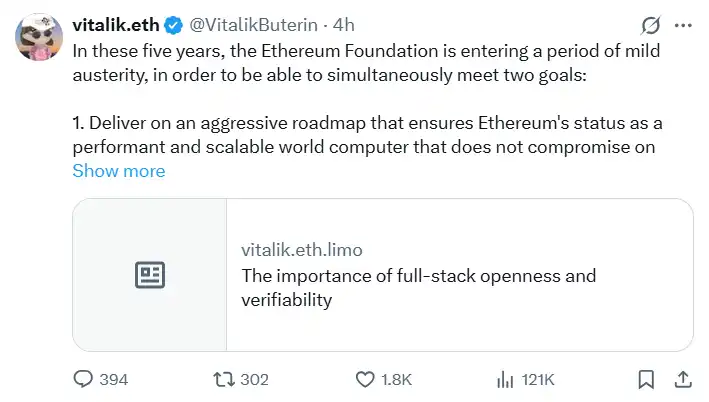
Facing the market's winter, the Ethereum Foundation (EF) has made a defensive shift in its financial strategy. Vitalik Buterin announced that the foundation will enter a five-year period of "moderate austerity."

From a corporate finance perspective, this is a classic cash flow management strategy. Its core objectives are twofold: first, to ensure the foundation can continue to fund the development of Ethereum's core underlying technology in the future, avoiding threats to its independence due to excessive resource consumption; second, to ensure that Ethereum's ambitious roadmap as a high-performance "world computer" is delivered on schedule.

To support this strategy, Vitalik himself proactively severed the funding dependence of some "special projects" on the foundation. He chose to extract 16,384 ETH and use decentralized staking yields to self-fund research and development for public goods such as open-source software, hardware, and privacy protection projects. This approach of internalizing peripheral R&D expenses and focusing on core business marks a move toward maturity and restraint in Ethereum's capital operations.

While the price is under pressure, Ethereum's technical fundamentals have shown remarkable resilience, even exhibiting a rare phenomenon of "price-volume divergence." Recently, the Ethereum network's TPS (transactions per second) reached a historic high of 75,862, far exceeding the previous peak of 58,786.
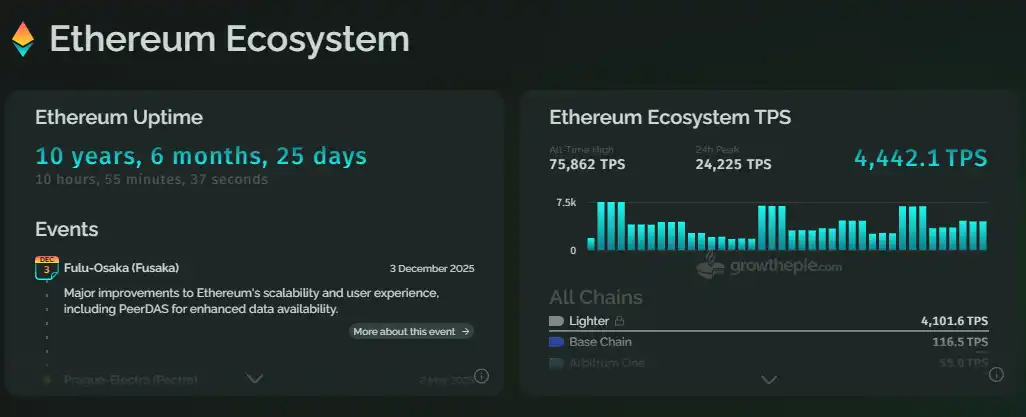
This is largely due to the Fusaka upgrade deployed last December. This upgrade introduced the PeerDAS mechanism, significantly expanding the data throughput of Layer 2 networks. However, with the explosion in data capacity, new systemic risks are emerging. Vitalik pointed out that because current block builders still need to download complete data, the network faces serious centralization risks.

To address this hidden danger, Ethereum plans to launch the Glamsterdam upgrade in 2026, which is essentially a bottom-up reform targeting internal oligopolies within the network.

ePBS Mechanism Reshapes Profit Distribution: The core of this upgrade is ePBS (in-protocol proposer-builder separation). It forcibly incorporates the block-building process into the protocol's底层, standardizing the bidding process and weakening the absolute dominance of the current few external builders over the market.

Preventing Rent-Seeking by Giants: For financial professionals, this means Ethereum is proactively intervening in its internal MEV (Maximal Extractable Value) market structure, breaking down the technical barriers of leading capital, and reconstructing the underlying logic of staking yields.

In addition to the internal structural pains, the Ethereum ecosystem also faces the impending regulatory hammer. The EU's MiCA (Markets in Crypto-Assets) regulation, set to take full effect on July 1, 2026, requires all crypto businesses operating within the EU to meet strict compliance standards.

The implementation of this regulation will directly impact the vast number of DeFi protocols, liquidity providers, and related derivative markets on the Ethereum chain that lack the backing of traditional corporate entities. The sharp rise in compliance costs and the early withdrawal of some non-compliant funds are the deep-seated macro reasons behind the recent sustained bleeding in the spot market.

Ethereum is in a period of divergence: on one side, there is the ruthless selling by short-term capital and the pre-pricing of strict regulations; on the other, there is the robust expansion of technical infrastructure and a self-driven revolution against internal monopolies. This is a typical "deleveraging" process, trading short-term pain for long-term systemic stability.


Пов'язані питання

QWhat is the main reason for the recent sharp decline in Ethereum's price, according to the article?

AThe main reason is a dual pressure from capital outflows and shifting expectations, including massive net redemptions from spot ETFs, concentrated selling by early large holders, and sell-offs by founders, all contributing to a 22.7% drop.

QWhat strategic shift did Vitalik Buterin announce for the Ethereum Foundation in response to market conditions?

AVitalik Buterin announced that the Ethereum Foundation will enter a five-year 'mild austerity' phase to ensure sustainable funding for core technology development and maintain independence while focusing on Ethereum's ambitious roadmap.

QHow did the recent Fusaka upgrade impact Ethereum's network performance?

AThe Fusaka upgrade, deployed last December, introduced the PeerDAS mechanism, which significantly increased data throughput for Layer 2 networks, pushing Ethereum's TPS to a new high of 75,862.

QWhat is the purpose of the upcoming Glamsterdam upgrade for Ethereum?

AThe Glamsterdam upgrade aims to address centralization risks by implementing ePBS (in-protocol proposer-builder separation) to reform the block building process, reduce dominance by a few external builders, and restructure the MEV market to prevent oligopoly.

QWhat regulatory challenge is the Ethereum ecosystem facing in 2026, as mentioned in the article?

AThe Ethereum ecosystem is facing the EU's MiCA (Markets in Crypto-Assets) regulation, set to take full effect on July 1, 2026, which imposes strict compliance standards on crypto firms operating in the EU, potentially impacting DeFi protocols and liquidity providers.

Пов'язані матеріали

Why Bitcoin Holds Above $64,000 After Fed's Hard Pause

**Bitcoin Stabilizes Near $64,000 Following Hawkish Fed Pause** The cryptocurrency market, led by Bitcoin, remained stable around $64,000 despite a volatile reaction to the latest U.S. Federal Reserve meeting. The Fed paused interest rates but signaled a hawkish stance, with three committee members voting for an increase—the highest dissent since 2016. This limits risk appetite but hasn't triggered panic selling. Key market highlights include Bitcoin ETFs seeing a net inflow of $32.1 million, breaking a streak of outflows, while Ethereum ETFs experienced outflows of $18.65 million. Liquidations affected about 90,000 traders. Technically, Bitcoin finds support around $63,000-$63,500, with major resistance near $66,000. While its price is about 49% below its all-time high, institutional demand via ETFs and the absence of mass capitulation support a potential recovery scenario in the second half of the year. Major altcoins showed mixed movements, with Solana attracting capital while Ethereum faced selling pressure despite strong on-chain metrics like a growing staking queue. Regulatory news took a pause as the U.S. Senate delayed the CLARITY Act vote until at least autumn. For the final trading day of July, U.S. inflation and consumer spending data will be crucial. Bitcoin's key levels to watch are $63,000 support and $66,000 resistance. Sustained ETF inflows and Bitcoin holding above $63,000 are seen as positive signs for a potential market recovery later in the year.

cryptonews.ru1 год тому

Why Bitcoin Holds Above $64,000 After Fed's Hard Pause

cryptonews.ru1 год тому

Participants in XRP Fraud Scheme That Stole $9 Million from 71 Investors Arrested

South Korean police have arrested three individuals accused of operating a fraudulent investment platform that stole approximately 3.4 million XRP (worth about $9 million) from 71 investors between October 16 and 23. The suspects promoted the site Fxrpntwork.com through blogs, online articles, and YouTube videos, promising guaranteed principal and monthly returns of 1.5% to 1.8%. Investors were instructed to transfer XRP from Korean exchanges to overseas platforms and then to wallets controlled by the group before the site was shut down. The scammers copied the branding of legitimate projects Flare Network and FXRP to appear credible. Authorities warn that such impersonation frauds, which use familiar branding and urgent promises of guaranteed profits, are a common red flag. Legitimate companies do not solicit cryptocurrency transfers through unsolicited promotions. Seoul police have issued an Interpol Red Notice for a fourth suspect abroad and are investigating others involved in creating and promoting the fraudulent website. While investigators froze 17.3 billion won in assets, approximately 10 billion won was moved during the probe, with wallet analysis revealing transfers totaling 27.3 billion won, suggesting there may be additional unidentified victims and accomplices. The case underscores the organized, cross-border nature of crypto investment fraud.

cryptonews.ru1 год тому

Participants in XRP Fraud Scheme That Stole $9 Million from 71 Investors Arrested

cryptonews.ru1 год тому

Торгівля

Спот
活动图片




