ETC Olympia Development Part 1: Implementing ECIP-1111 and ECIP-1112

金色财经Опубліковано о 2025-12-12Востаннє оновлено о 2025-12-12

Анотація

ETC Olympia Development Series Part 1: Implementing ECIP-1111 and ECIP-1112 This article introduces the first part of the Ethereum Classic Olympia development series, focusing on the implementation of ECIP-1111 and ECIP-1112. These two proposals are the only components within the broader Olympia framework that modify consensus behavior. ECIP-1111 modernizes the fee market by introducing an EIP-1559-style mechanism with a base fee and optional priority tip (miner tip). A key difference from Ethereum is that the base fee is not burned but is instead redirected to a treasury address defined by ECIP-1112. It also adds support for Type-2 transactions and the BASEFEE opcode (0x48), ensuring compatibility with modern EVM tooling and wallets. Crucially, it does not change miner rewards, monetary policy, or existing transaction types. ECIP-1112 defines an immutable, deterministic treasury smart contract that will receive the redirected base fees. This vault is designed to be receive-only upon activation, meaning it can accumulate value but cannot distribute funds until a separate, subsequent governance layer (defined in other ECIPs) is deployed and activated on the contract layer. The article emphasizes the modular architecture of Olympia. While the suite includes five ECIPs (1111-1115), only these two affect consensus. This separation ensures that the core protocol remains minimal and auditable, while future governance and funding mechanisms can evolve independently at the contra...

Ethereum Classic Core Developers - Olympia Development Series (Part 1)

Implementing ECIP-1111 and ECIP-1112: Base Fee Redirection and the Immutable Treasury

1. Introduction - From Concept to Code

This section provides an overview of the overall architecture of Olympia: its purpose, development history, and how ECIPs 1111-1115 fit into the modular, multi-layer upgrade path. This article will delve into the current engineering practices for two ECIPs, which together define the consensus boundaries of Olympia:

  • ECIP-1111 — EVM and Protocol Upgrades

  • ECIP-1112 — Immutable Treasury Contract

These two proposals are the only components in Olympia that modify consensus behavior. Other parts of the framework—governance (ECIP-1113), funding proposals (ECIP-1114), and the optional smoothing mechanism (ECIP-1115)—all operate at the contract layer and do not affect block validity or fork choice. On November 11, 2025, Ethereum Classic core developers initiated the implementation phase, preparing consensus logic and reference client infrastructure for a potential Mordor testnet deployment.

This article outlines:

  • What ECIP-1111 introduces

  • How ECIP-1112 defines the treasury target address

  • How these components work together

  • What is currently being prototyped in reference client development

This article only describes design proposals and implementation work and does not indicate that they will necessarily be activated or adopted in the future through the ECIP-1000 process. Before deploying the consensus layer changes of ECIP-1111 or ECIP-1112 to Mordor or the mainnet, ETC clients must first verify their stability and compatibility under baseline conditions.

2. ECIP-1111 — Modernizing the Fee Mechanism, Minimizing Network Disruption

ECIP-1111 integrates two widely adopted EVM improvements:

  • EIP-1559-style fee mechanism (Base Fee + optional tip) This mechanism introduces:

  • A dynamically adjusting base fee (BASEFEE),

  • An optional high-priority fee (tip) still paid directly to miners

  • And a more predictable fee market for modern tools.

2. Support for Type-2 (1559-style) transactions: This functionality has become standard for most wallets and infrastructure.

3. BASEFEE opcode (0x48): This exposes the current block's BASEFEE to contract logic (gas estimators, DEX routers, toolchains, etc.).

What changes for Ethereum Classic (ETC)?

Only one behavior differs from the Ethereum mainnet:

  • Ethereum Foundation (ETH): BASEFEE is burned.

  • Ethereum Classic (ETC): BASEFEE is redirected to the treasury defined by ECIP-1112. All other EIP-1559 semantics remain unchanged.

What remains the same?

  • Miner tips remain unchanged.

  • Block rewards remain unchanged.

  • Monetary policy (ECIP-1017) remains unchanged.

  • Traditional transaction types (Type-0 and Type-1) remain fully valid.

  • Existing contracts will not break; existing applications require no modifications.

  • No additional trust assumptions or permission mechanisms are introduced.

ECIP-1111 is additive, minimal, and strictly limited to modernizing the fee mechanism and enabling the BASEFEE redirection function.

3. ECIP-1112 — The Immutable Deterministic Treasury

ECIP-1112 defines the receiving address for the redirected base fees: a minimal, immutable smart contract deployed at a deterministic address. These definitions remain theoretical until client software demonstrates consistent behavior in a multi-client environment, a milestone requiring comprehensive testing to safely assess the Olympia components.

Core Features

  • Immutability: No upgrade key, no admin, no proxy pattern.

  • Deterministic address (e.g., via CREATE2): All clients agree on the same treasury destination.

  • Receive-only upon activation: The treasury can accumulate value but cannot release funds until subsequent governance is activated.

  • No internal governance logic: Purely a custody layer, not a decision-making layer.

Upon activation (testnet or mainnet):

  • The treasury can only receive funds.

  • No withdrawal mechanism is enabled until ECIP-1113 and ECIP-1114 are deployed, audited, and intentionally activated. This separation ensures predictability for consensus upgrades and makes them independent of the implementation of any governance scheme.

4. Clear Consensus Boundaries

Although Olympia comprises five ECIP proposals, only ECIP-1111 and ECIP-1112 change consensus behavior.

Consensus Boundary Summary

  • ECIP-1111 — Protocol layer. Introduces consensus changes: new base fee mechanism, Type-2 transactions, and the BASEFEE opcode.

  • ECIP-1112 — Protocol/Contract layer. Introduces consensus changes: defines the deterministic treasury receiving address for redirected base fees.

  • ECIP-1113 — Contract/Application layer. No consensus changes.
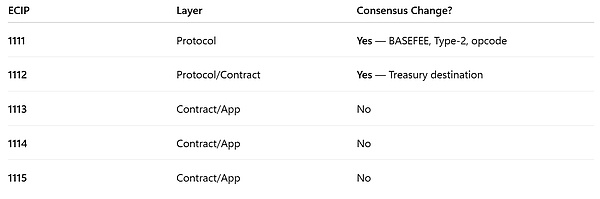
  • ECIP-1114 — Contract/Application layer. No consensus changes.

  • ECIP-1115 — Contract/Application layer. No consensus changes.

This modular structure ensures:

  • Consensus-critical logic remains lean and auditable,

  • Governance and funding mechanisms can evolve at the contract layer,

  • Improvements to ECIP-1113 to 1115 require no additional consensus changes.

If adopted, clients implementing ECIP-1111 and ECIP-1112 will maintain consensus compatibility, unaffected by subsequent governance layer deployments. Reference implementations can begin prototyping consensus logic during the draft stage, but these changes must undergo comprehensive testing (including baseline client validation such as the Gorgoroth verification described in Part II) before being merged into production clients.

5. Why Governance Activation is Delayed

If ECIP-1111 and ECIP-1112 are activated, base fees will begin flowing into the treasury—but treasury spending will remain disabled.

This phased deployment enables:

  • Independent testing of base fees

  • Comprehensive auditing of ECIP-1113 and ECIP-1114

  • Precise coordination among client implementers and infrastructure providers

  • Predictable behavior for node operators

If governance contracts are subsequently deployed and activated, the treasury will connect with authorized executors entirely at the contract layer (not the consensus layer).

6. Type-2 Transactions and Long-term EVM Interoperability

Type-2 transaction support is crucial for Ethereum Classic to maintain compatibility with:

  • Modern wallets

  • Exchanges and custody services

  • RPC infrastructure

  • Tooling frameworks (Hardhat, Foundry, etc.)

  • Block explorers

  • Cross-chain interoperability

Type-2 transactions do not alter user requirements or introduce permission mechanisms. Traditional transaction types will remain fully supported.

Type-2, as an incremental feature, ensures ETC maintains interoperability with the mainstream transaction format of the EVM ecosystem.

7. The Broader Context — Maintaining a Programmable Proof-of-Work Base Layer

Together, ECIP-1111 and ECIP-1112 constitute a foundational step for Ethereum Classic towards a sustainably funded, operational model for programmable proof-of-work—provided the community chooses to adopt these proposals.

These proposals achieve their goals without:

  • Modifying miner incentives

  • Introducing inflation

  • Changing monetary policy

  • Adding a governance layer to consensus

  • Altering Ethereum Classic's security assumptions

Their purpose is limited to:

  • Modernizing the fee market

  • Establishing a transparent protocol-level value accrual mechanism

If adopted, these changes will pave the way for the contract-layer governance and funding systems in subsequent Olympia proposals, without requiring new consensus rules.

8. Conclusion — Minimal, Secure, and Forward-Compatible

ECIP-1111 and ECIP-1112 define the consensus layer components proposed within the Olympia framework. They:

  • Add Type-2 and base fee mechanisms

  • Redirect the base fee to a deterministic treasury

  • Keep all existing user and miner behavior unchanged

  • Prepare ETC for future contract-layer components

These proposals do not introduce governance logic into the consensus mechanism, nor do they add trust assumptions on top of the existing EIP-1559/EIP-3198 semantics. Their aim is to preserve the conservatism of ETC's core protocol and EVM ecosystem compatibility, while enabling sustainable value flows at the contract layer.

9. ECIP Process Clarity

The Olympia ECIP specifications (1111–1115) are currently in the draft stage and under active discussion. Reference clients have initiated early implementation work on ECIP-1111 and ECIP-1112, which is fully consistent with the provisions of the ECIP-1000 draft stage. Reference implementations will only be considered for mainnet activation after testing on the Mordor testnet is completed. After testnet results are qualified, ECIP proposers may submit specification update proposals. Any decision to advance to "Accepted" status or schedule mainnet activation must undergo community review and the full ECIP-1000 evaluation process. This article outlines the design and implementation work being advanced during the draft stage.

10. What's Next in the Series

With the consensus design framework established, the next installment will focus on the client layer—the Fukuii alpha testing plan is about to launch, aiming to validate ETC client interoperability before Olympia integrations.

Disclaimer: The content of this article does not constitute any investment or financial advice. The content is reproduced from EthereumClassic and is for industry information reference only. If you have questions or copyright issues, please contact us for removal.

Пов'язані питання

QWhat are the two ECIPs that modify consensus behavior in the Olympia upgrade series?

AECIP-1111 (EVM and Protocol Upgrades) and ECIP-1112 (Immutable Vault Contract) are the two proposals that modify consensus behavior.

QHow does the handling of the BASEFEE differ between Ethereum (ETH) and Ethereum Classic (ETC) under ECIP-1111?

AOn Ethereum (ETH), the BASEFEE is burned. On Ethereum Classic (ETC), the BASEFEE is redirected to the treasury defined by ECIP-1112.

QWhat is the core purpose of the vault defined in ECIP-1112 at the time of its initial activation?

AAt activation, the vault is receive-only; it can accumulate value but has no mechanism to withdraw or release funds until governance proposals (ECIP-1113 and ECIP-1114) are deployed, audited, and intentionally activated.

QWhich components of the Olympia series operate purely at the contract/application layer without changing consensus rules?

AECIP-1113 (Governance), ECIP-1114 (Funding Proposals), and ECIP-1115 (Optional Smoothing Mechanism) operate at the contract/application layer and do not change consensus behavior.

QWhat is the stated goal of implementing Type-2 (EIP-1559-style) transactions on Ethereum Classic?

AThe goal is to ensure interoperability with the broader EVM ecosystem, including modern wallets, exchanges, RPC infrastructure, development frameworks, and block explorers, by supporting a mainstream transaction format.

Пов'язані матеріали

Bitwise: Crypto Becomes a Contrarian Investment, Three Logics to Understand the Current Market

**Summary** Matt Hougan, Bitwise's CIO, analyzes the current crypto market through three key lenses, arguing it has shifted from a momentum-driven to a contrarian investment. **1) Crypto Becomes a Contrarian Play:** The market is weak, with major assets like Bitcoin and Ethereum down significantly. Capital has moved to hot sectors like AI, leaving crypto as an "unloved" asset class. This transforms crypto investing from trend-following to a test of patience and fundamental analysis. Investors now favor projects with solid fundamentals (e.g., Hyperliquid) over speculative ones. **2) Regulatory Overhang:** The uncertain fate of the U.S. CLARITY Act, a major crypto regulatory framework, is a key headwind. With its passage in 2024 seen as far from guaranteed (estimates range from 30-55%), institutional capital remains on the sidelines, choosing less risky alternatives like AI stocks. The market needs clarity—whether the bill passes or fails—more than any specific outcome to move decisively. **3) Capital Rotates to New Fundamentals:** This cycle differs from past bear markets where money fled to Bitcoin. Now, capital seeks smaller assets with strong use cases. While major cryptos fell in May 2024, tokens like Hyperliquid (+72%), Zcash (+50%), and XLM (+44%) rallied on their specific fundamentals. This rotation confirms the new contrarian, fundamentals-driven logic and signals the bear market may be in its later stages. **Conclusion:** Short-term pressure persists due to regulatory uncertainty and competition from AI narratives. Investing in crypto now requires a contrarian mindset—acting against the crowd and focusing on fundamental value. Patience and targeting high-quality projects based on their merits are essential for capturing long-term gains.

marsbit15 хв тому

Bitwise: Crypto Becomes a Contrarian Investment, Three Logics to Understand the Current Market

marsbit15 хв тому

ChatGPT Might Be Disappearing Soon

OpenAI announced at its "Intelligence at Work" event that its coding assistant, Codex, will be fully integrated into the ChatGPT app within weeks. This move marks a strategic shift from a conversational AI (Chat) towards a unified "agentic" platform capable of execution. Codex, originally launched to compete with Anthropic's Claude Code, has grown rapidly to 5 million weekly active users, with 20% being non-developers like analysts and designers. Its enterprise revenue now constitutes 40% of OpenAI's total. The integration is the first step in creating a super-app combining ChatGPT (interface), Codex (execution engine), and the Atlas browser (web access). OpenAI also unveiled new Codex features: specialized Agent plugins for six professional roles, an "Annotations" tool for direct document editing, and a "Sites" function to turn work into shareable web apps. Internally, this reflects a power shift; the Codex team now leads core product strategy. While the ChatGPT brand remains for its vast user base, the platform's future is focused on autonomous agents that perform tasks, not just chat. The article notes that competition with Claude Code pushed OpenAI's development, with Codex competing on cost-effectiveness and accessibility rather than raw coding quality. It concludes that the essence of "ChatGPT" is evolving from a chatbot into an AI agent platform, with the name potentially becoming a legacy symbol of its original function.

marsbit25 хв тому

ChatGPT Might Be Disappearing Soon

marsbit25 хв тому

WWDC26 Ultimate Preview: The All-New Siri is the Main Course, iOS 27 is Another Year of Refinements

Apple has confirmed WWDC26 will begin on June 8, with the keynote at 10 AM PT (1 AM Beijing Time, June 9). This year's focus is expected to shift significantly from routine OS updates to Apple's progress in AI, particularly a major overhaul of Siri. Reports indicate the highlight will be a new Siri, reportedly powered by Google's Gemini technology. This upgraded assistant is expected to appear as a lightweight bubble from the Dynamic Island and be accessible via a unified "Search or Ask" system-wide entry point. It aims to deeply integrate with iOS 27, iPadOS 27, and macOS 27, accessing personal data like messages, photos, and documents, with a potential standalone Siri app also in development. For iOS 27, leaks suggest incremental improvements rather than major redesigns. Key updates may include a redesigned, more customizable Camera app, enhanced photo editing tools within the Photos app, and potential early system optimizations for a future foldable iPhone. The update is also rumored to prioritize bug fixes, stability, and performance optimization. iPadOS 27 is anticipated to focus on improving productivity features like window management, file systems, and external display support to better utilize the iPad's hardware. macOS 27 is seen as a core platform for Apple Intelligence, likely receiving an optimized Siri, new AI features, and continued refinement of the "Liquid Glass" design language. Notably, macOS 27 may finally drop support for Intel-based Macs. The overarching theme for WWDC26 is whether Apple can effectively integrate AI across its ecosystem. The success of the new Siri and Apple Intelligence will be judged on their ability to move beyond standalone features and become a cohesive, context-aware system layer that understands user workflows across iPhone, iPad, Mac, and other devices, while maintaining Apple's emphasis on privacy and stability. The conference represents Apple's critical attempt to catch up and redefine the AI assistant experience after a perceived slow start in the generative AI era.

marsbit51 хв тому

WWDC26 Ultimate Preview: The All-New Siri is the Main Course, iOS 27 is Another Year of Refinements

marsbit51 хв тому

Торгівля

Спот
Ф'ючерси

Популярні статті

Як купити ETC

Ласкаво просимо до HTX.com! Ми зробили покупку Ethereum Classic (ETC) простою та зручною. Дотримуйтесь нашої покрокової інструкції, щоб розпочати свою криптовалютну подорож.Крок 1: Створіть обліковий запис на HTXВикористовуйте свою електронну пошту або номер телефону, щоб зареєструвати обліковий запис на HTX безплатно. Пройдіть безпроблемну реєстрацію й отримайте доступ до всіх функцій.ЗареєструватисьКрок 2: Перейдіть до розділу Купити крипту і виберіть спосіб оплатиКредитна/дебетова картка: використовуйте вашу картку Visa або Mastercard, щоб миттєво купити Ethereum Classic (ETC).Баланс: використовуйте кошти з балансу вашого рахунку HTX для безперешкодної торгівлі.Треті особи: ми додали популярні способи оплати, такі як Google Pay та Apple Pay, щоб підвищити зручність.P2P: Торгуйте безпосередньо з іншими користувачами на HTX.Позабіржова торгівля (OTC): ми пропонуємо індивідуальні послуги та конкурентні обмінні курси для трейдерів.Крок 3: Зберігайте свої Ethereum Classic (ETC)Після придбання Ethereum Classic (ETC) збережіть його у своєму обліковому записі на HTX. Крім того, ви можете відправити його в інше місце за допомогою блокчейн-переказу або використовувати його для торгівлі іншими криптовалютами.Крок 4: Торгівля Ethereum Classic (ETC)Легко торгуйте Ethereum Classic (ETC) на спотовому ринку HTX. Просто увійдіть до свого облікового запису, виберіть торгову пару, укладайте угоди та спостерігайте за ними в режимі реального часу. Ми пропонуємо зручний досвід як для початківців, так і для досвідчених трейдерів.

120 переглядів усьогоОпубліковано 2024.12.10Оновлено 2026.06.02

Як купити ETC

Обговорення

Ласкаво просимо до спільноти HTX. Тут ви можете бути в курсі останніх подій розвитку платформи та отримати доступ до професійної ринкової інформації. Нижче представлені думки користувачів щодо ціни ETC (ETC).

活动图片